| No. |
Photo |
Description |
|
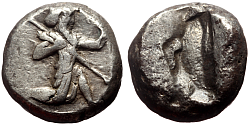 |
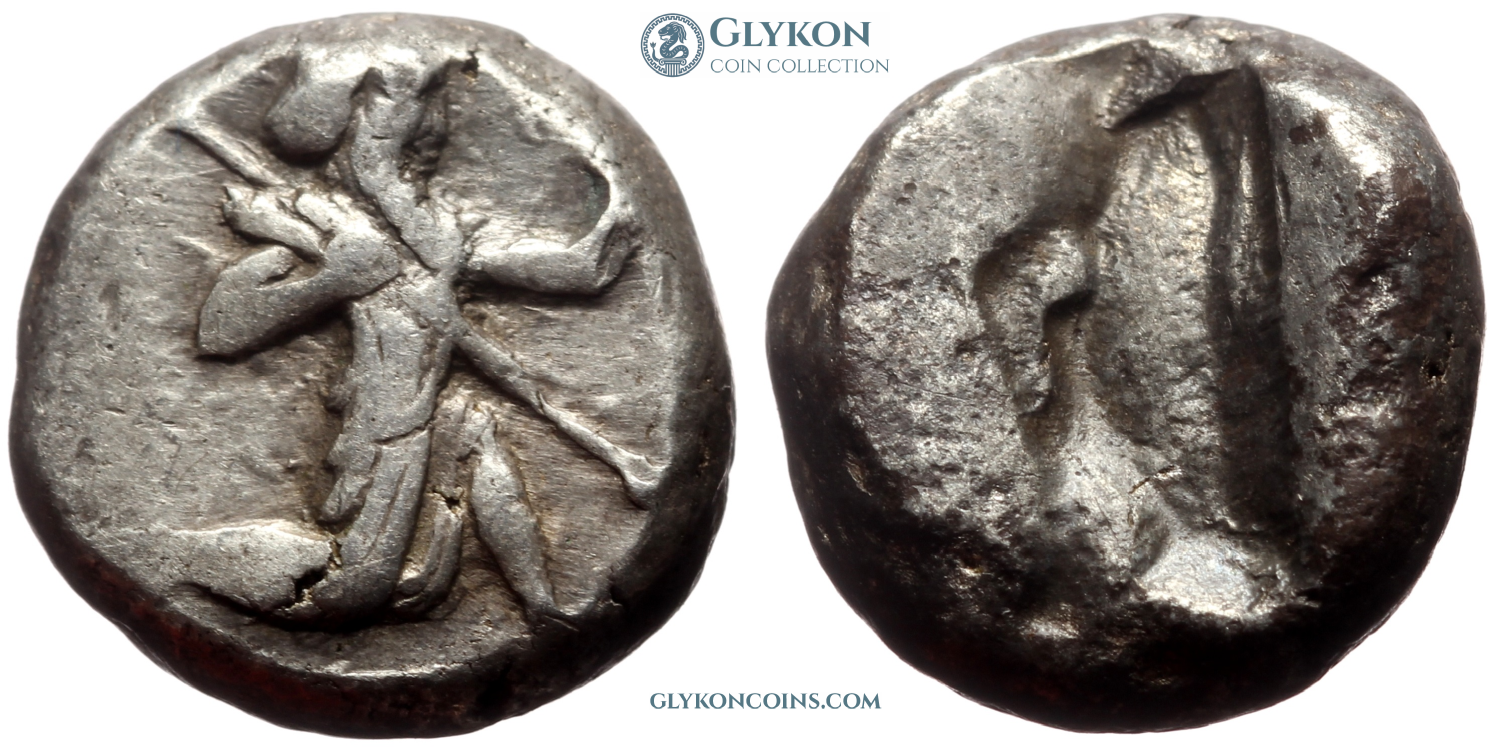
Achaemenid Empire (Persia)
Denomination: Siglos
Time: 420-375 BC, reign of Xerxes II to Artaxerxes II
Weight: 5.48 g
Diameter: approx. 14.4 mm
Reference: Type IIIb
Obverse: Bearded Great King kneeling to right, holding bow and spear.
Reverse: Irregular oblong incuse. |
|
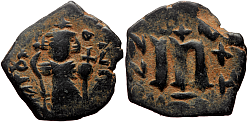 |
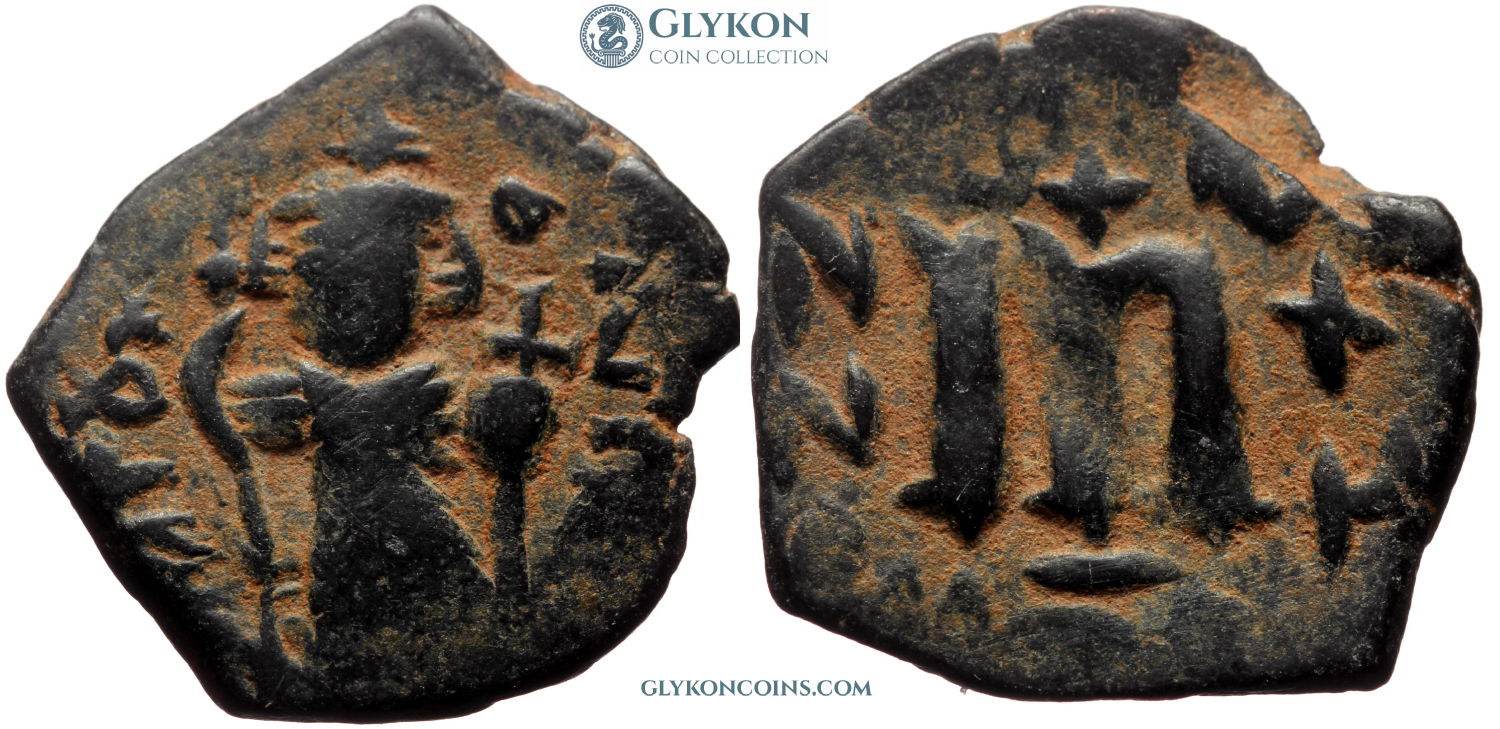
Rashidun/early Umayyad Caliphate
Denomination: pseudo-Byzantine fals (imitation of Byzantine follis)
Mint: undetermined in Syria (Hims?)
Time: 636-670s AD
Weight: 4.61 g
Diameter: approx. 22.2 mm
Reference: ---
Obverse: Facing figure of crowned emperor beardless or with short beard, wearing chlamys, holding long cross-topped scepter and globus cruciger. Legend: indeterminable early Arabic or corrupted Greek/Latin.
Reverse: Large M indicating denomination of 40 nummi flanked by NN and XX, cross above, other indiscernible signs.
Comment: Early Islamic conquests were an earth-shattering event on many different levels. It was this that led to the de facto end of antiquity and the ancient way of life, true beginning of the Middle Ages. And it also led to the birth of two completely new magnificent civilizations. Not only the Islamic one, but also the one that will be later called the Western civilization. Hitherto the Latin West was just an appendix to the Roman world centered in Constantinople, but the advances of Islamic armies isolated the West from its metropolis and forced it to fend on its own.
At first the conquerors weren't well accustomed to a monetary economy and largely kept the financial structures of the lands they took intact, including the metal system and the Christian (and, in Persia, Zoroastrian) iconography. Thus the "Arab-Byzantine" and "Arab-Sassanid" coinage was born - the earliest phase of Islamic coinage. This coin is a plain imitation of a Byzantine follis, imperial figure and cross intact, struck by rulers who saw no reason to change what already worked. Only in the 690s did Islamic coins stop being mere imitations and acquire their own templates, and only in the earliest 700s was a distinct, though still Byzantine-indebted, Islamic monetary system born. |
|
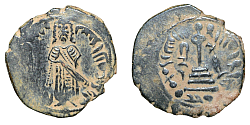 |
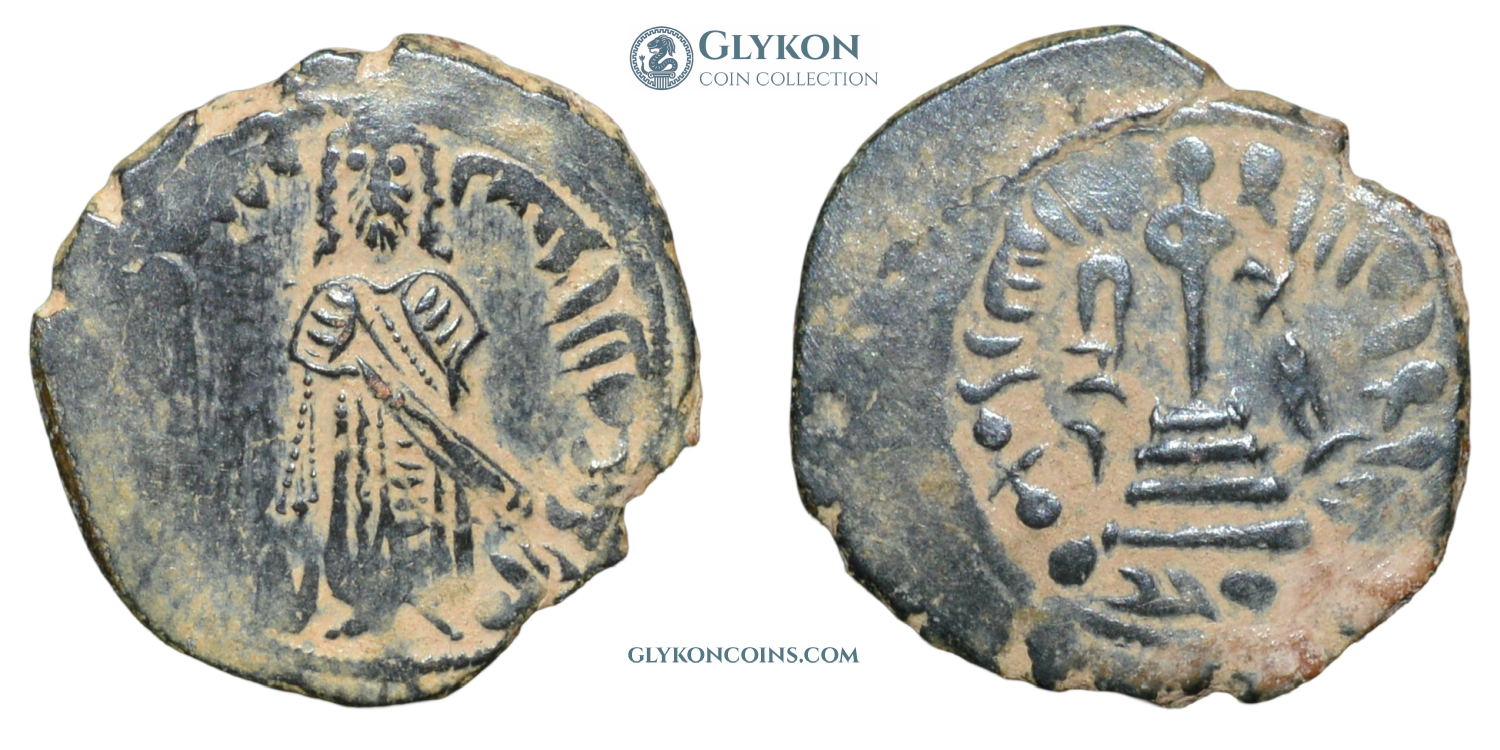
early Umayyad Caliphate, reign of Abd al-Malik ibn Marwan (685-705 AD)
Denomination: "standing Caliph" fals
Mint: Hims (former Emesa)
Time: approx. 691-697 AD
Weight: 3.33 g
Diameter: approx. 19.7 mm
Reference: Hims A-3539, Goodwin-171-179
Obverse: Facing standing, bearded figure of the Caliph in elaborate robes, holding a scabbarded sword. Legend: Arabic calligraphy.
لعبد الله عبد الملك أمير المؤمنين — li-ʿAbd Allāh ʿAbd al-Malik amīr al-muʾminīn — Belonging to the servant of God, Abd al-Malik, Commander of the Faithful.
Reverse: Modified cross potent on four steps, surrounded by Arabic calligraphy. Legend: Arabic calligraphy.
بسم الله لا اله الا الله وحده محمد رسول الله — bismillāh lā ilāha illā Allāh waḥdahu Muḥammad rasūl Allāh — "In the name of God; there is no god but God, He alone; Muhammad is the Messenger of God."
حمص — Ḥimṣ — Hims
Comment: Initially the Arab conquerors imitated the coinage already present on seized territories, copying mainly Byzantine and Persian patterns, both Christian and Zoroastrian. However, as the Islamic world started to mature and asserted self-confidence, the need for independent coinage became pressing. The immediate trigger was likely the Eastern Roman emperor Justinian II's brief experiment in putting Jesus' image on Byzantine coins, an act unprecedented in earlier history. Islam wasn't strongly aniconic yet, as evidenced by prodigious archaeological finds. However, it is apparent that in many parts of the Eastern Mediterranean this new Byzantine coinage caused a huge backlash. In Byzantium this, a generation later, resulted in the Iconoclast controversy. In Islam the trajectory was similar and even faster. But even here there was a transitional period in which a less strict aniconism was tried, and this coin is from that very period. For a time Caliph Abd al-Malik minted coins with a male figure, most likely himself; this coinage, struck in gold and copper, is nowadays referred to as "Standing Caliph." After a few years Abd al-Malik abandoned this design and started minting coins only with Arabic calligraphy, which became the basic pattern of Islamic coinage for centuries. Occasionally, though, human figures would continue to appear on Islamic coins into the 14th century if we include Turkic and other non-Arabic rulers. |
|
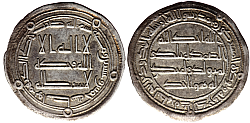 |
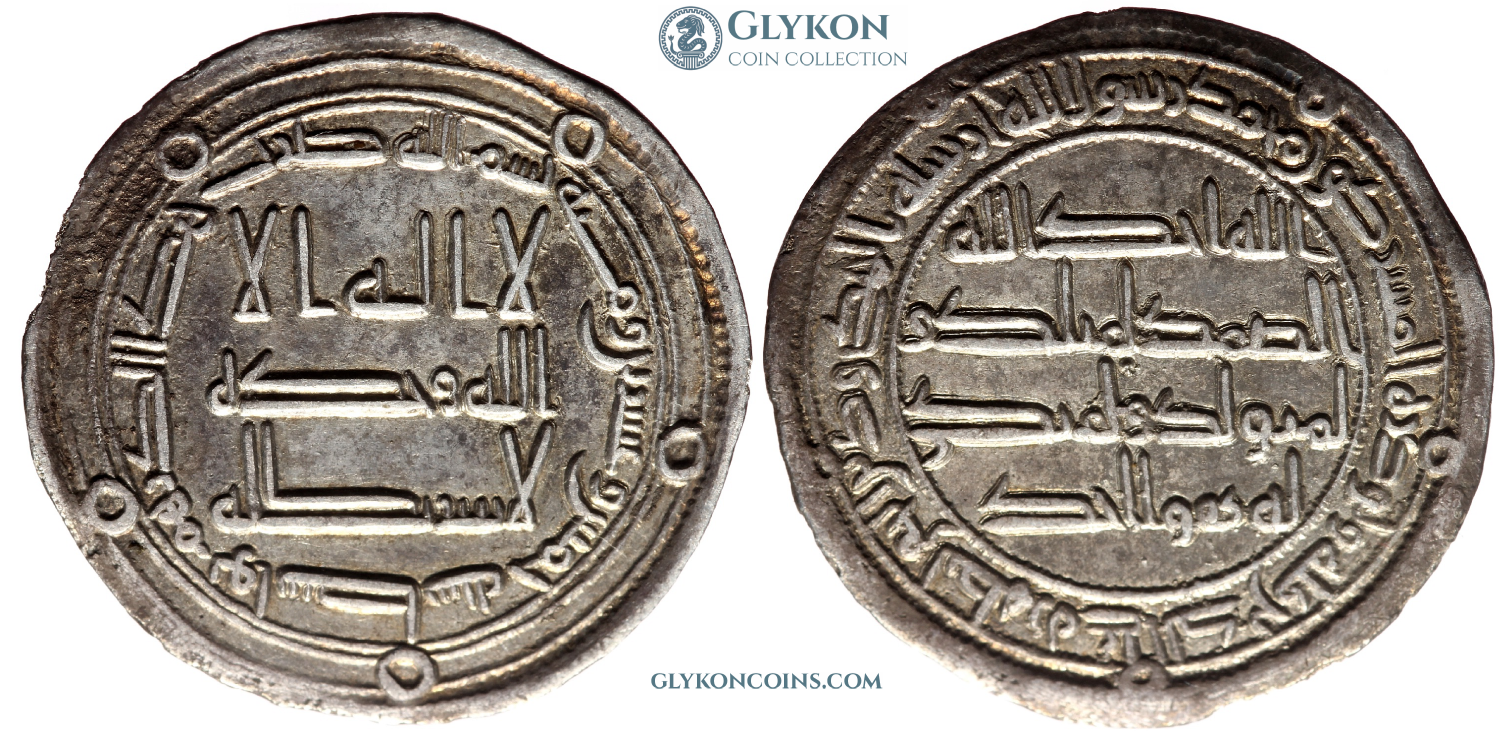
Umayyad Caliphate, reign of Hisham ibn Abd al-Malik (724-743 AD)
Denomination: dirham
Mint: Wasit
Time: 742-743 AD / 125 AH
Weight: 2.88 g
Diameter: approx. 24.6 mm
Reference: Album 137
Obverse: Arabic calligraphy.
In center (three lines) - the tawḥīd, Muslim confession of the faith:
لا إله إلا / الله وحده / لا شريك له — lā ilāha illā / Allāh waḥdahu / lā šarīka lahu — "There is no god but God alone; He has no partner."
On the margin:
بسم الله ضرب هذا الدرهم بواسط سنة خمس وعشرين ومائة — bism Allāh ḍuriba hādhā al-dirham bi-Wāsiṭ sanat khams wa-ʿishrīn wa-miʾa — "In the name of God, this dirham was struck at Wāsiṭ in the year five and twenty and one hundred (= AH 125)."
Reverse: Arabic calligraphy.
In center (four lines) - Sūrat al-Ikhlāṣ (Qur'an 112), the theological heart of the aniconic coinage:
الله أحد الله / الصمد لم يلد / ولم يولد ولم / يكن له كفوا أحد — Allāh aḥad, Allāh al-ṣamad, lam yalid wa-lam yūlad, wa-lam yakun lahu kufuwan aḥad — "God is One, God the eternal; He begat not, nor was begotten; and there is none like unto Him."
On the margin - the "mission" verse (part of Qur'an 9:33):
محمد رسول الله أرسله بالهدى ودين الحق ليظهره على الدين كله — Muḥammad rasūl Allāh arsalahu bi-l-hudā wa-dīn al-ḥaqq li-yuẓhirahu ʿalā al-dīn kullihi — "Muhammad is the Messenger of God, whom He sent with guidance and the religion of truth, that He might make it prevail over all religion."
Comment: First inkling of mature Islamic coinage. The Caliphate, thanks to its conquests and access to silver mines in what is now Afghanistan, was able to mint large quantities of silver coinage, based largely on the late Sasanian standard. This caused a mass inflow of silver into the Middle East, and also into the Mediterranean world. Perhaps because of this inflow, the Byzantine Empire was itself able to mint silver coins in quantity again, and so, after a while, did western Europe. |