Roman Republican coinage (to 30 BC)
| No. |
Photo |
Description |
|
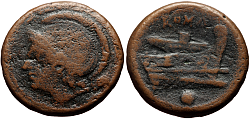 |
Roman Republic
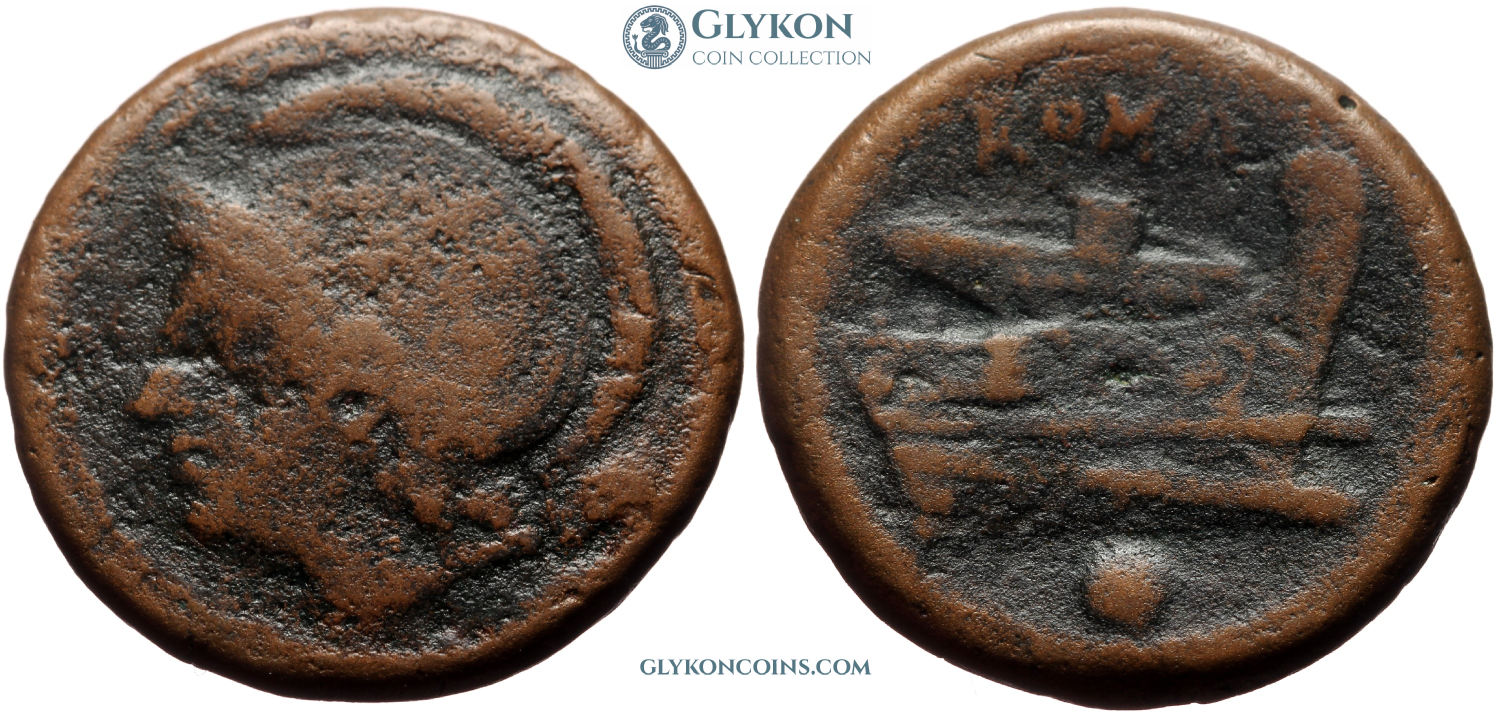
Denomination: Uncia
Time: 217-215 BC
Weight: 12.11 g
Diameter: approx. 24.7 mm
Reference: Crawford 38/6; Sydenham 86
Obverse: Helmeted head of Roma to left, pellet behind.
Reverse: Ship's prow to right, pellet below. Legend: ROMA. |
|
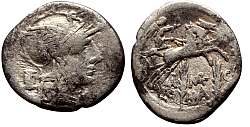 |
Roman Republic
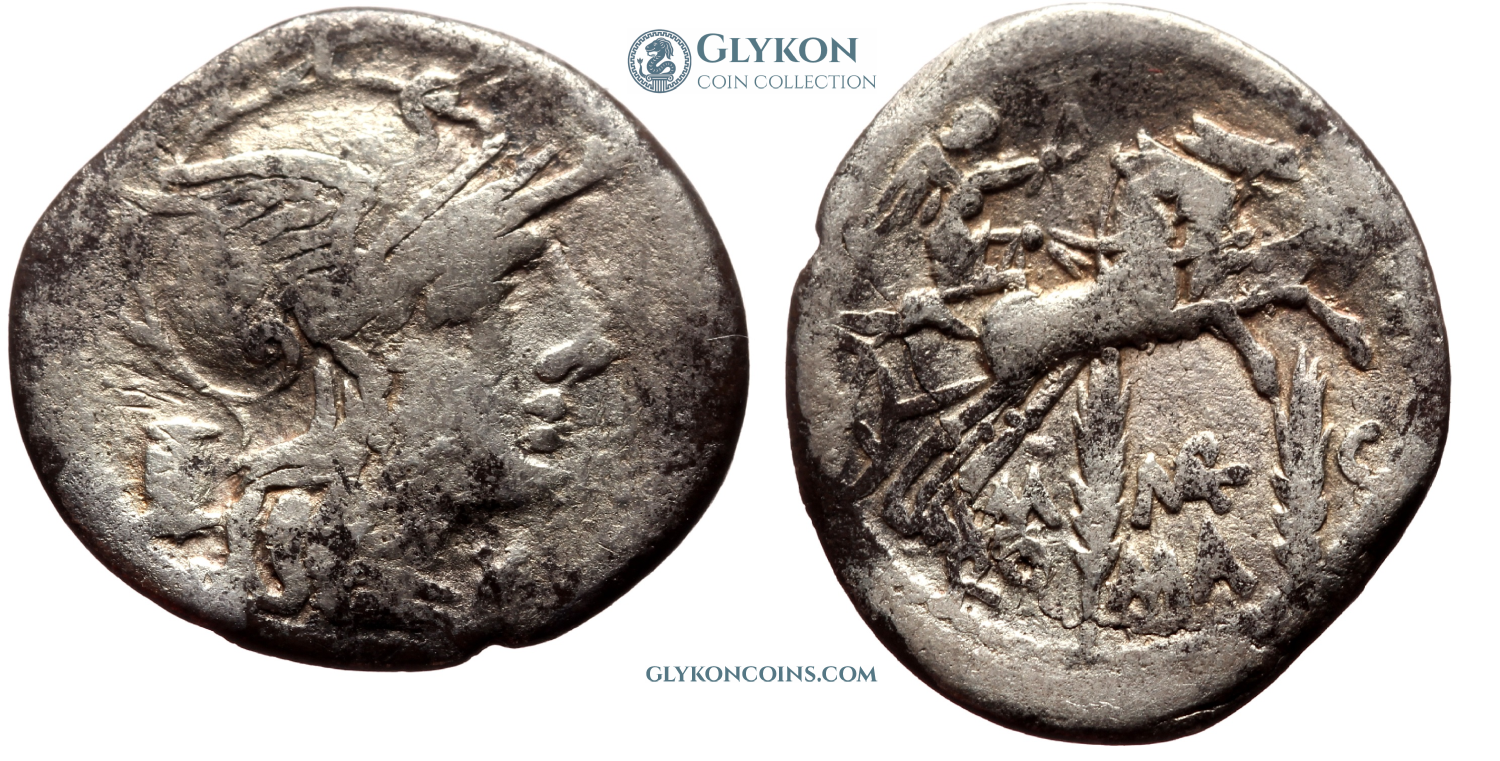
Denomination: Denarius
Time: 134 BC; moneyer M. Marcius Mn. f.
Weight: 3.77 g
Diameter: approx. 20.2 mm
Reference: Crawford 245/1; Sydenham 500
Obverse: Helmeted head of Roma to right, modius behind, star lower right.
Reverse: Victory driving racing biga to right, holding reins and whip. Legend: C MAR C - ROMA, divided by two grain ears.
Comment:
Initially, republican denarii adhered to a consistent pattern with only minor variations: the obverse typically featured the head of a deity, such as the goddess Roma, personifying Rome, while the reverse depicted either a deity in a chariot or divine armored horsemen (or horseman). Occasionally, small additions or modifications were introduced. However, as the political struggle between aristocratic factions intensified, the coins began to incorporate more intricate details, ultimately leading to the complete abandonment of the old design.
This might be a good place to briefly mention who decided what would be on coins during the Republic. This was done by officials called "tresviri monetales", anglicized as "moneyers". They were young aristocrats, usually at the beginning of their political career, elected by three for a period of one year. It was most often one of their first public functions, a step towards more responsible positions.
It was the moneyers who were responsible for choosing what was depicted on the coins and also supervised their minting. Due to the fact that there were three moneyers, there were usually three different styles of coinage in a given year. There were more types, because one moneyer could release more than one type. Of course, it was not these aristocrats who physically made the dies and minted the coins. This was handled by mint staff, likely at least partially composed of state slaves.
Over time, the position of moneyer was increasingly exposed politically. Coinage also acquired an increasingly partisan character. Thanks to this, we can learn a lot from coins about the political and everyday life of Rome during the late Republic.
From the moneyers and the central mint they managed, we must distinguish military mints. The latter multiplied during the imperatorial period, otherwise known as the period of civil wars. It was apparently a point of honor for each of the leaders tearing the Republic apart to have his own mint and to produce coins that assured the soldiers that it was their commander who was right and not his rivals.
|
|
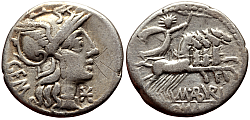 |
Roman Republic
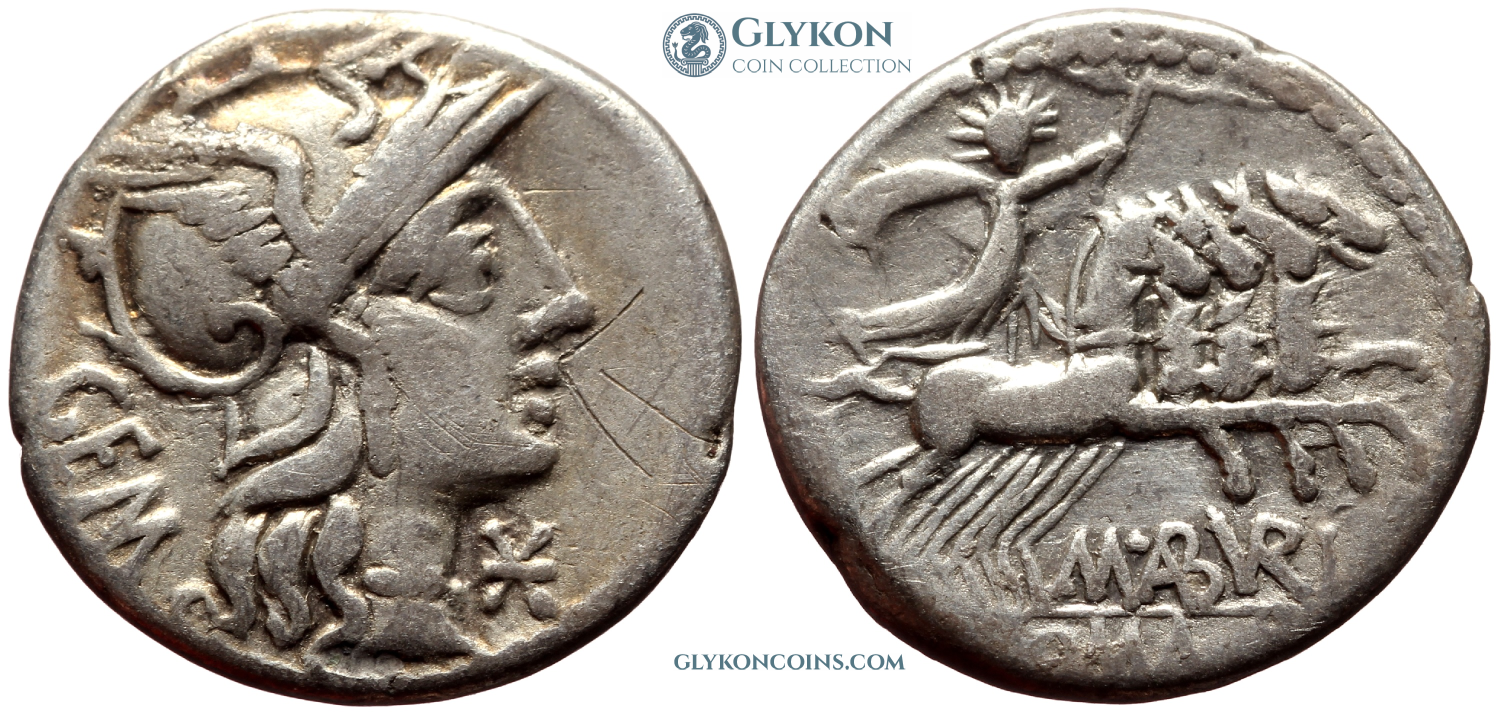
Denomination: Denarius
Time: 132 BC; moneyer M. Aburius M. f. Geminus
Weight: 3.74 g
Diameter: approx. 19.1 mm
Reference: Crawford 250/1; Sydenham 487
Obverse: Helmeted head of Roma to right, star lower right. Legend: GEM.
Reverse: Sol driving racing quadriga to right, holding reins and whip. Legend: M·ABVRI - ROMA. |
|
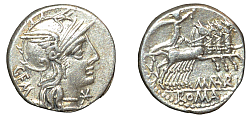 |
Roman Republic
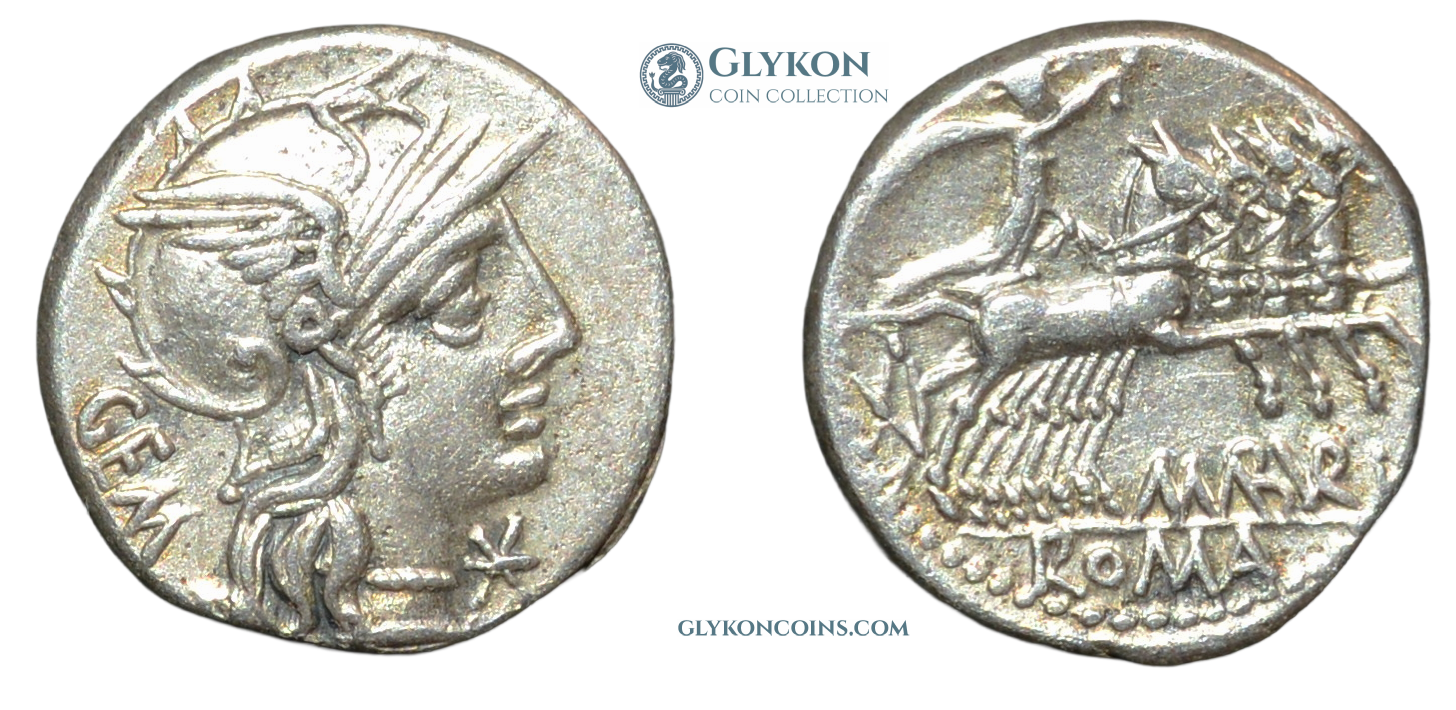
Denomination: Denarius
Time: 132 BC; moneyer M. Aburius M. f. Geminus
Weight: 3.89 g
Diameter: approx. 18.4 mm
Reference: Crawford 250/1; Sydenham 487
Obverse: Helmeted head of Roma to right, star lower right. Legend: GEM.
Reverse: Sol driving racing quadriga to right, holding reins and whip. Legend: M·ABVRI - ROMA.
Same type as above. |
|
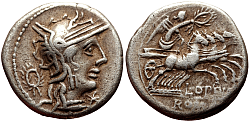 |
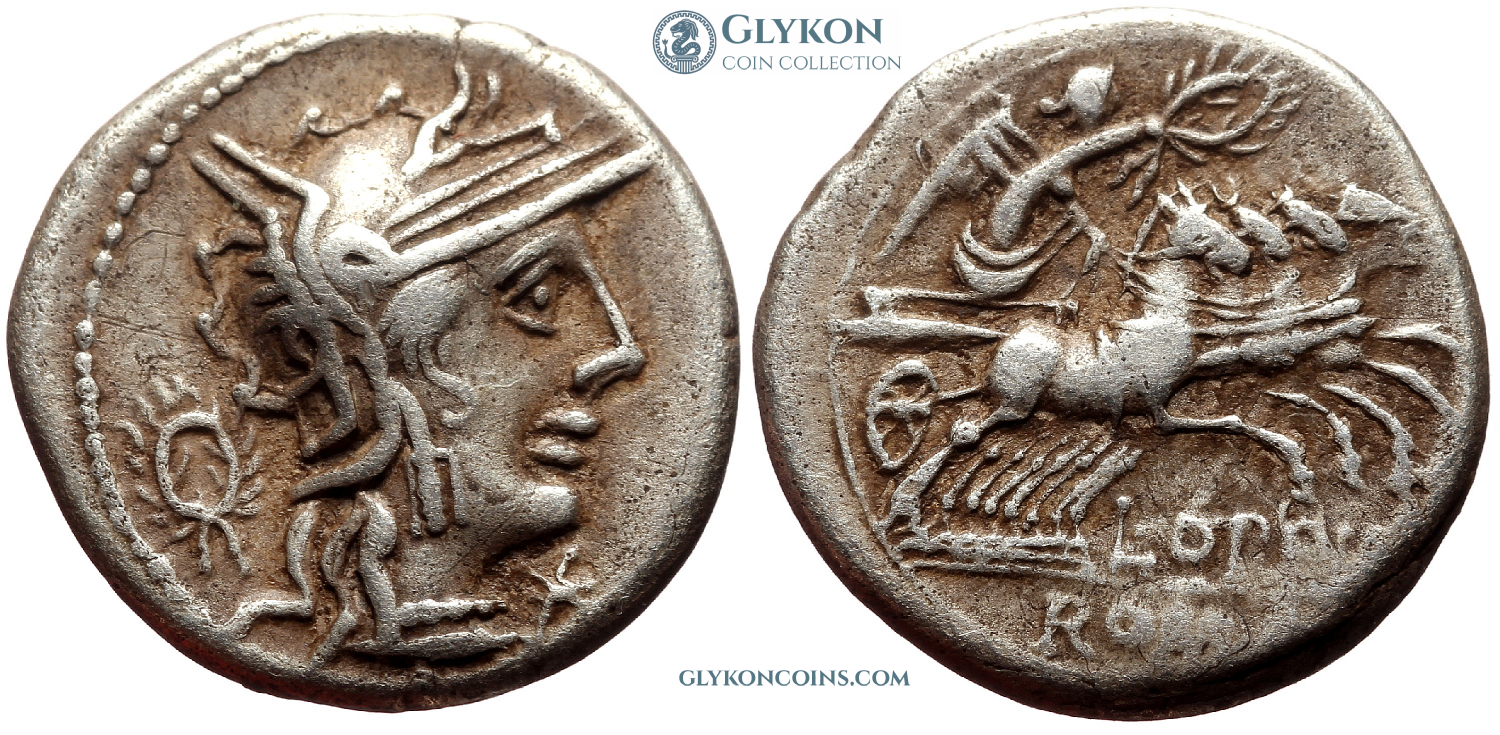
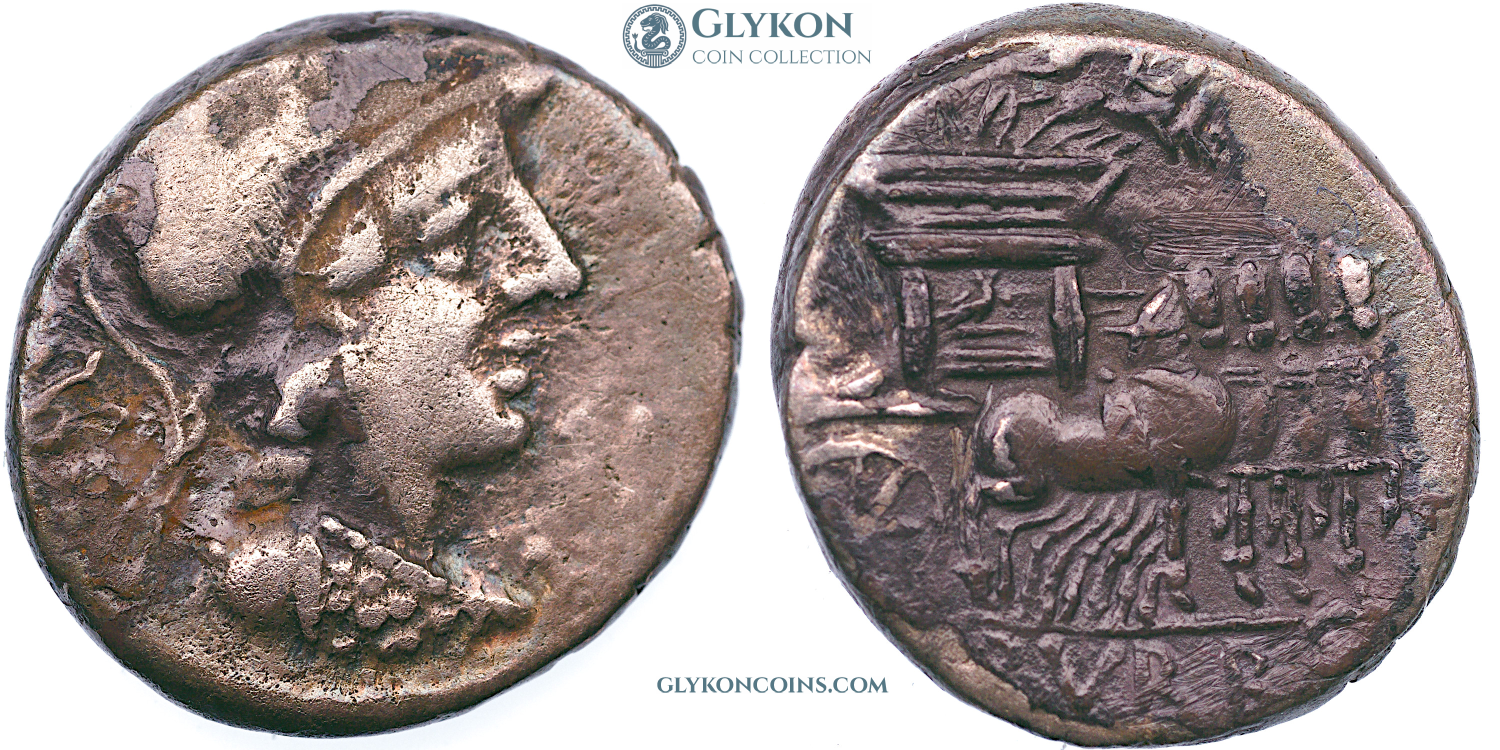
Roman Republic
Denomination: Denarius
Time: 131 BC; moneyer L. Opimius
Weight: 3.72 g
Diameter: approx. 17.3 mm
Reference: Crawford 253/1
Obverse: Helmeted head of Roma to right, wreath left, star lower right.
Reverse: Victory driving racing quadriga to right, holding reins and whip. Legend: L·OPEIMI - ROMA. |
|
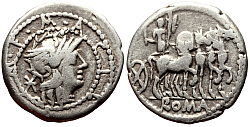 |
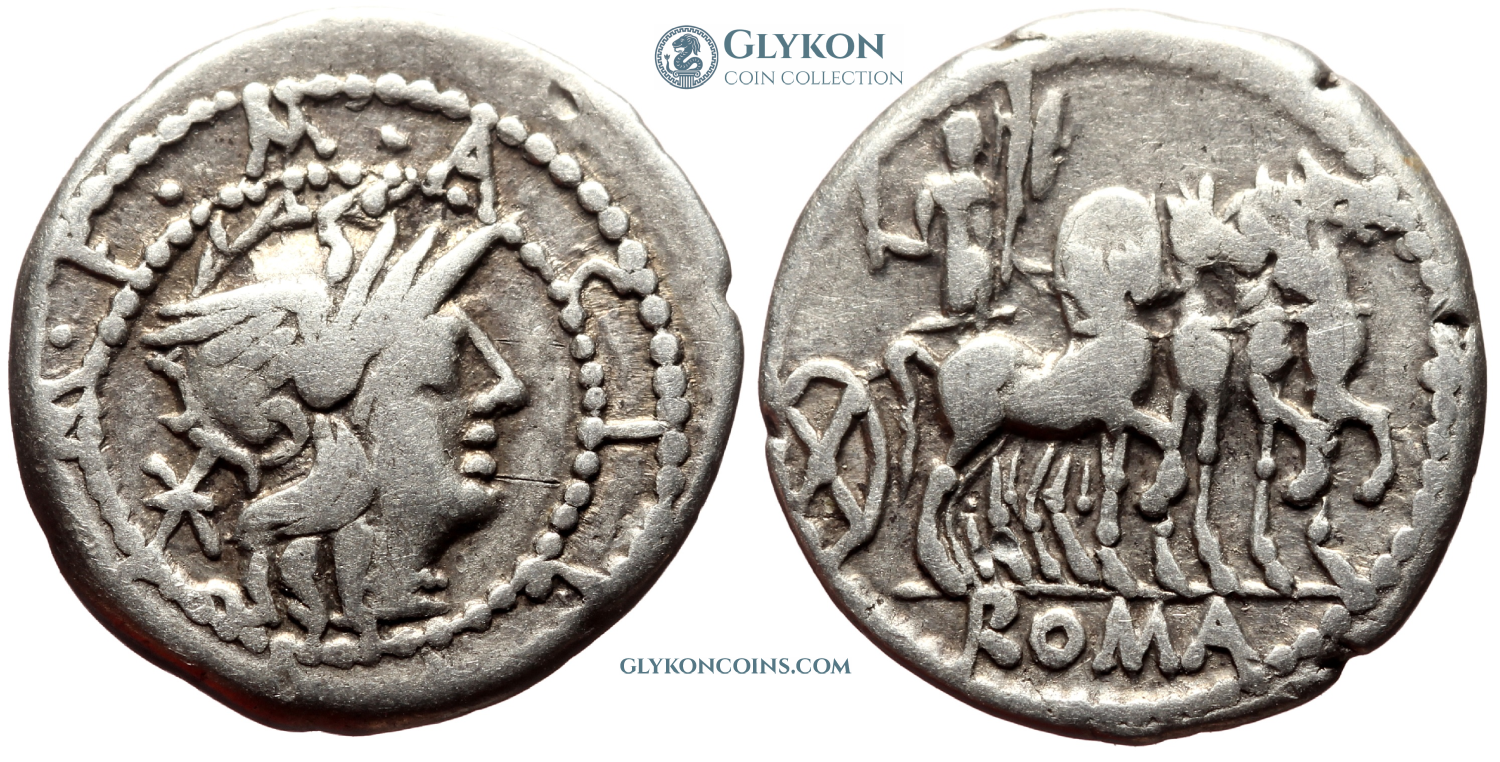
Roman Republic
Denomination: Denarius
Time: 130 BC; moneyer M. Acilius M.f.
Weight: 3.84 g
Diameter: approx. 18.4 mm
Reference: Crawford 255/1; Sydenham 511
Obverse: Helmeted head of Roma to right. Star or monogram behind. Legend: M·ACILIVS·M·F between two circles of dots.
Reverse: Hercules driving a quadriga to right, holding a tropheum and reins in one hand and club in another. Legend: ROMA in exergue. |
|
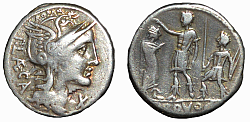 |
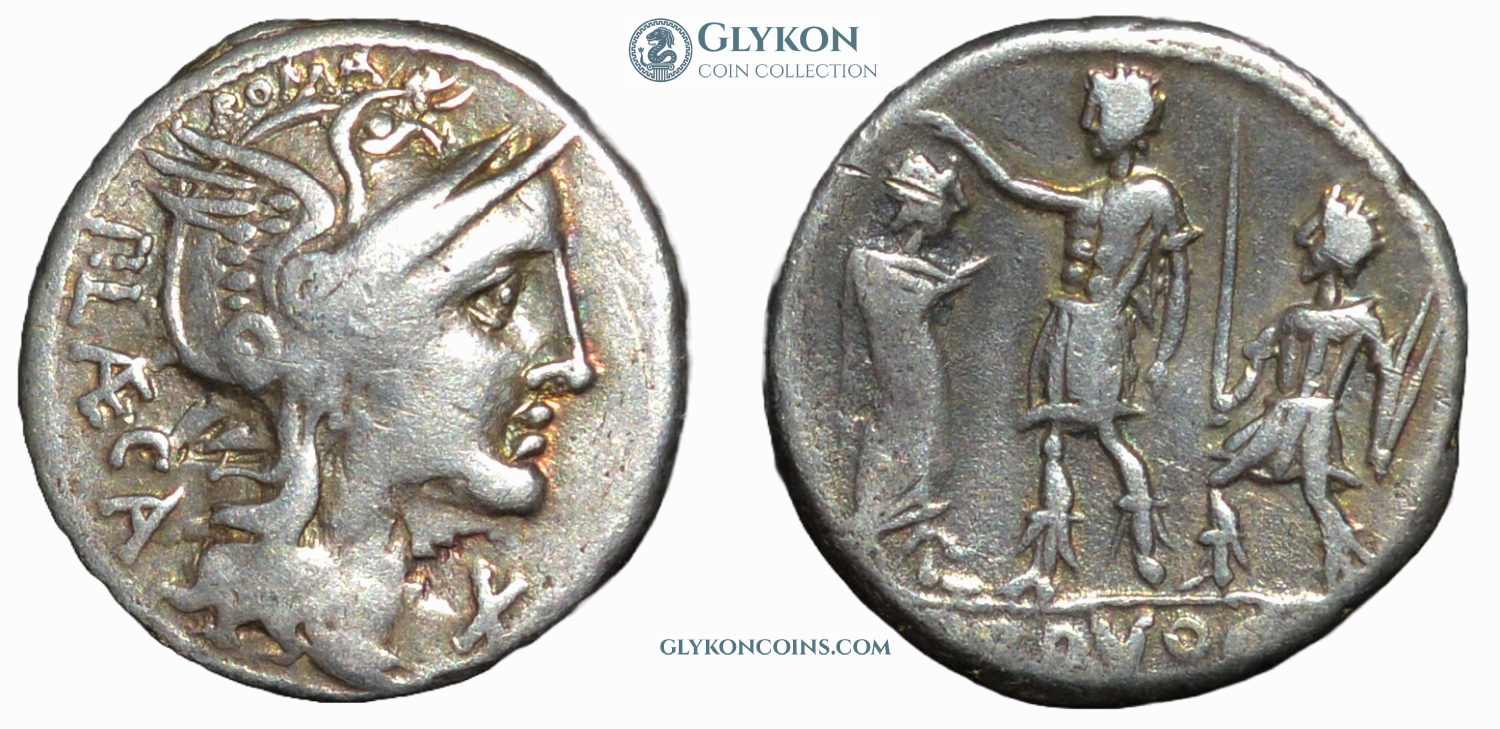
Roman Republic
Denomination: Denarius
Time: 110/109 BC; moneyer P. Porcius Laeca
Weight: 3.83 g
Diameter: approx. 18.5 mm
Reference: Crawford 301/1
Obverse: Helmeted head of Roma facing right. Legend: ROMA - P·LAECA - X.
Reverse: On the left a togate private citizen facing right reaching out to a magistrate in military attire who stands in the middle facing left and raising his hand. On the right a lictor facing left and holding two rods. Legend: PROVOCO.
Comment: Interesting issue celebrating provocatio - an institution of Roman law in which every citizen could invoke (provoco) an appeal to the people or tribune of the plebs against the action of a magistrate. Thus the coin celebrates the liberty of citizens against arbitrary government, the rule of law and the (mostly theoretical) equality before the law. |
|
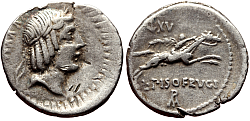 |
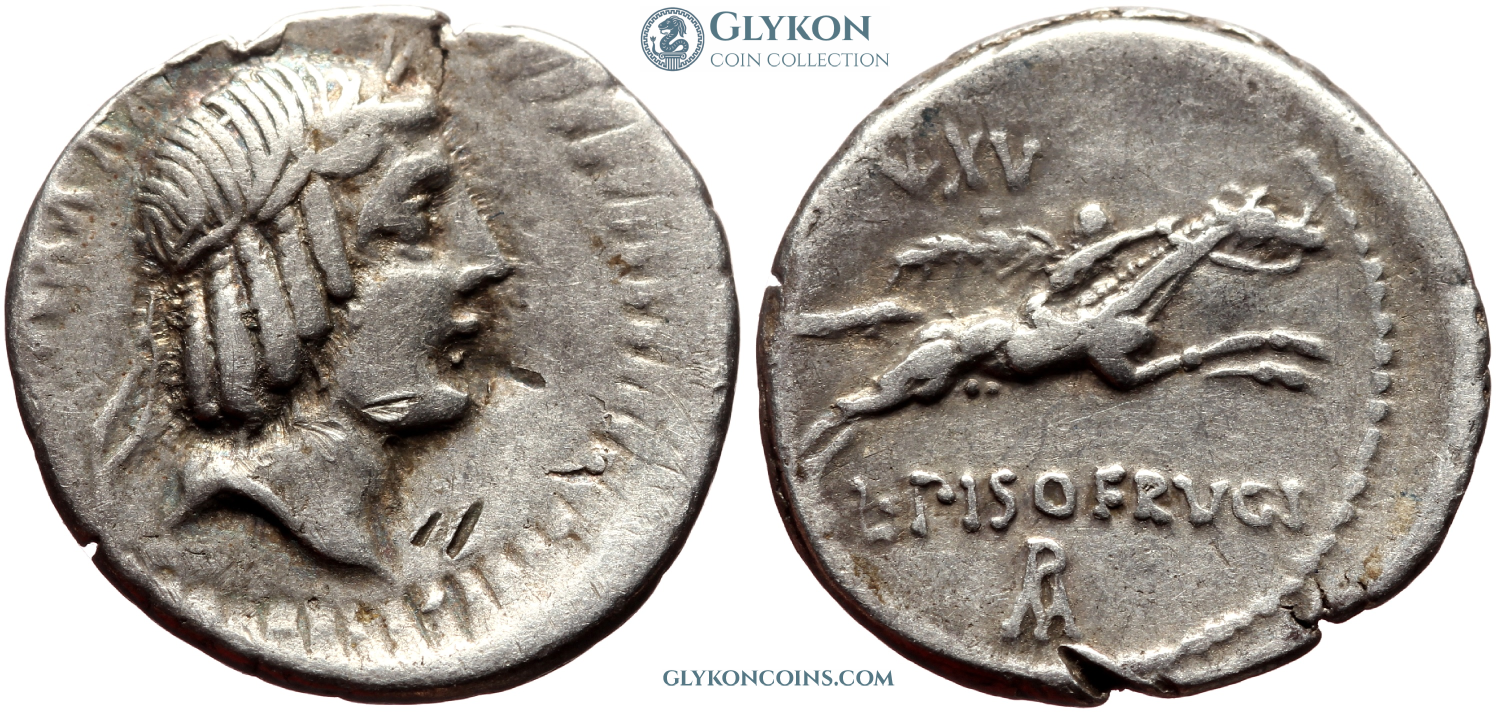
Roman Republic
Denomination: Denarius
Time: 90 BC; moneyer L. Calpurnius Piso Frugi
Weight: 3.80 g
Diameter: approx. 19.7 mm
Reference: Crawford 340/1
Obverse: Laureate head of Apollo to right. Banker's marks.
Reverse: Horseman galloping to right, holding palm branch. Legend: L·PISOFRVGI. Monograms above and below. |
|
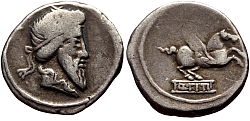 |
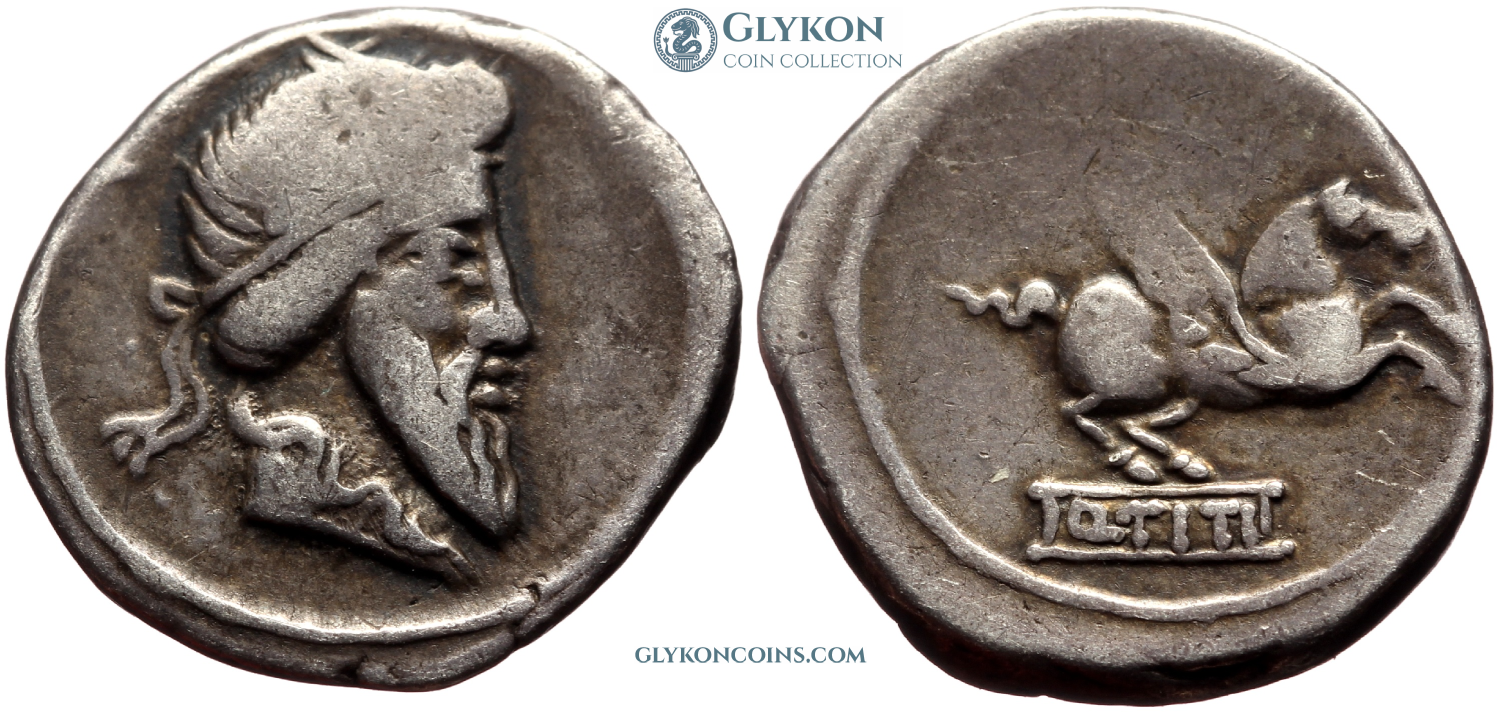
Roman Republic
Denomination: Denarius
Time: 90 BC; moneyer Q. Titius
Weight: 3.95 g
Diameter: approx. 18.9 mm
Reference: Crawford 341/1
Obverse: Bearded head of Titinus (fertility deity) to right, wearing winged diadem.
Reverse: Pegaus prancing to right. Legend: Q.TITI. |
|
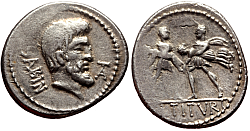 |
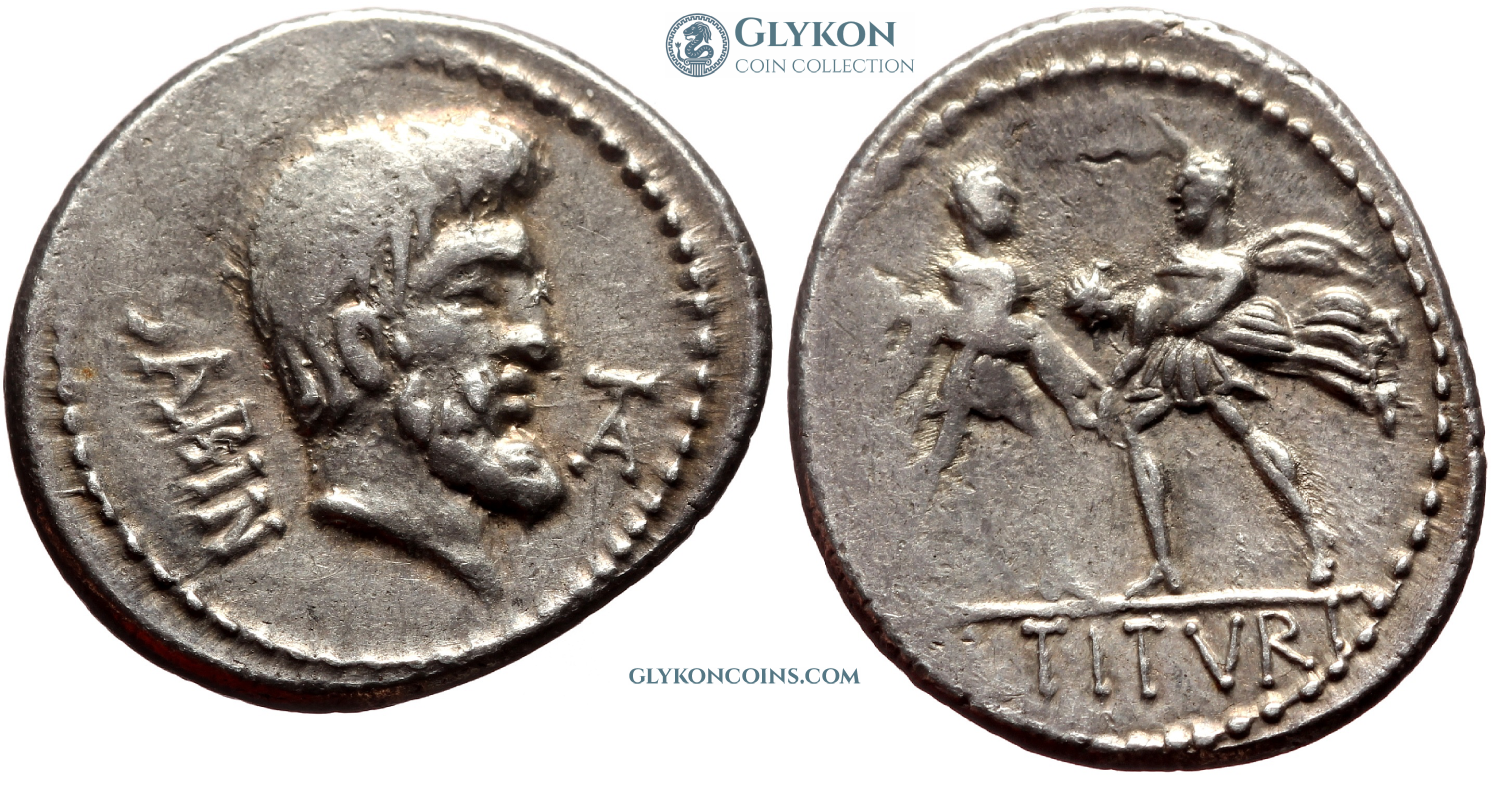
Roman Republic
Denomination: Denarius
Time: 89 BC; moneyer L. Titurius Sabinus
Weight: 3.88 g
Diameter: approx. 19.8 mm
Reference: Crawford 344/1a
Obverse: Bearded head of Tatius (mythical king of Sabines) to right. Monogram lower right. Legend: SABIN.
Reverse: Two archaically dressed Romans carrying off protesting Sabine women. Legend: L.TITVRI in exergue.
Comment: Minted during the Social War by a politician of Sabine descent. The reverse depicts the mythical abduction of Sabine women. It was likely intended to emphasize the Sabine descent of Romans and thus underline that the two were essentially one people. Quite a potent message at the time of war between the two. |
|
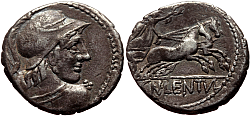 |
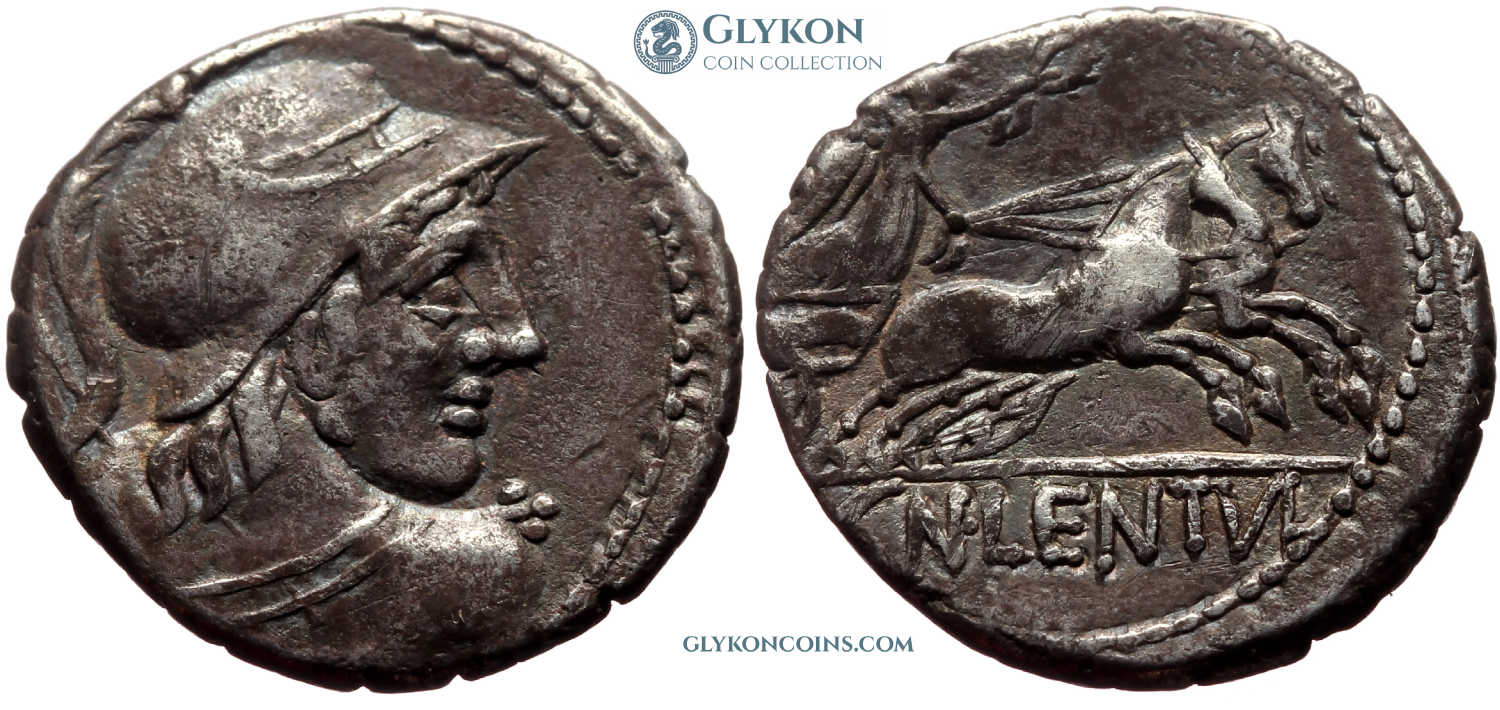
Roman Republic
Denomination: Denarius
Time: 88 BC; moneyer Gn. Cornelius Lentulus
Weight: 3.87 g
Diameter: approx. 18.4 mm
Reference: Crawford 345/1
Obverse: Bust of youthful Mars in plumeted Boeotian helmet to right.
Reverse: Victory driving racing biga to right, holding wreath. Legend: CN·LENTVL in exergue. |
|
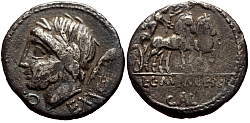 |
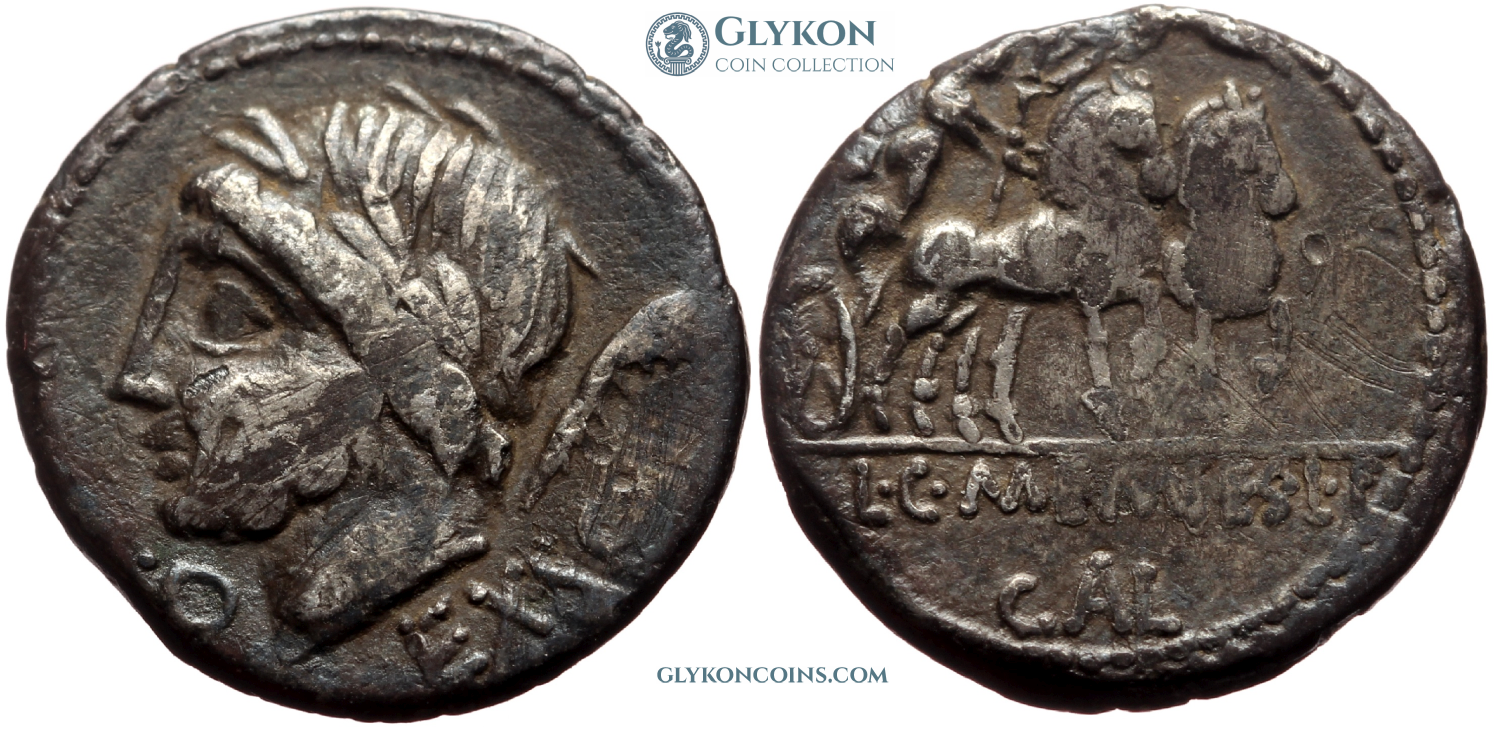
Roman Republic
Denomination: Denarius
Time: 87 BC; moneyer L. and C. Memmius L.f. Galeria
Weight: 3.48 g
Diameter: approx. 17.8 mm
Reference: Crawford 349/1
Obverse: Laureate and bearded head of Saturn to left, harpa (type of sickle and symbol of Saturn) behind. Legend: EX·SC, control mark under Saturn's chin.
Reverse: Venus driving prancing biga to right, holding scepter. Cupid holding wreath flying above. Legend: L·C·MEMIES·L·F - GAL in exergue. |
|
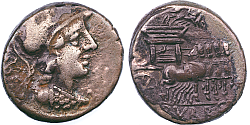 |
Roman Republic
Denomination: Denarius
Time: 87 BC; moneyer L. Rubrius Dossenus
Weight: 3.57 g
Diameter: approx. 16.5 mm
Reference: Crawford 348/3
Obverse: Helmeted and armored bust of Minerva to right. Legend: DOS.
Reverse: Four horses drawing a triumphal chariot, decorated with a panel depicting eagle. Scuptulre of Victory driving a biga above to right. Legend: L·RVBRI in exergue.
Comment: This type is often minted on unusually small but thicker flans. |
|
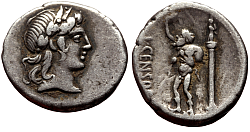 |
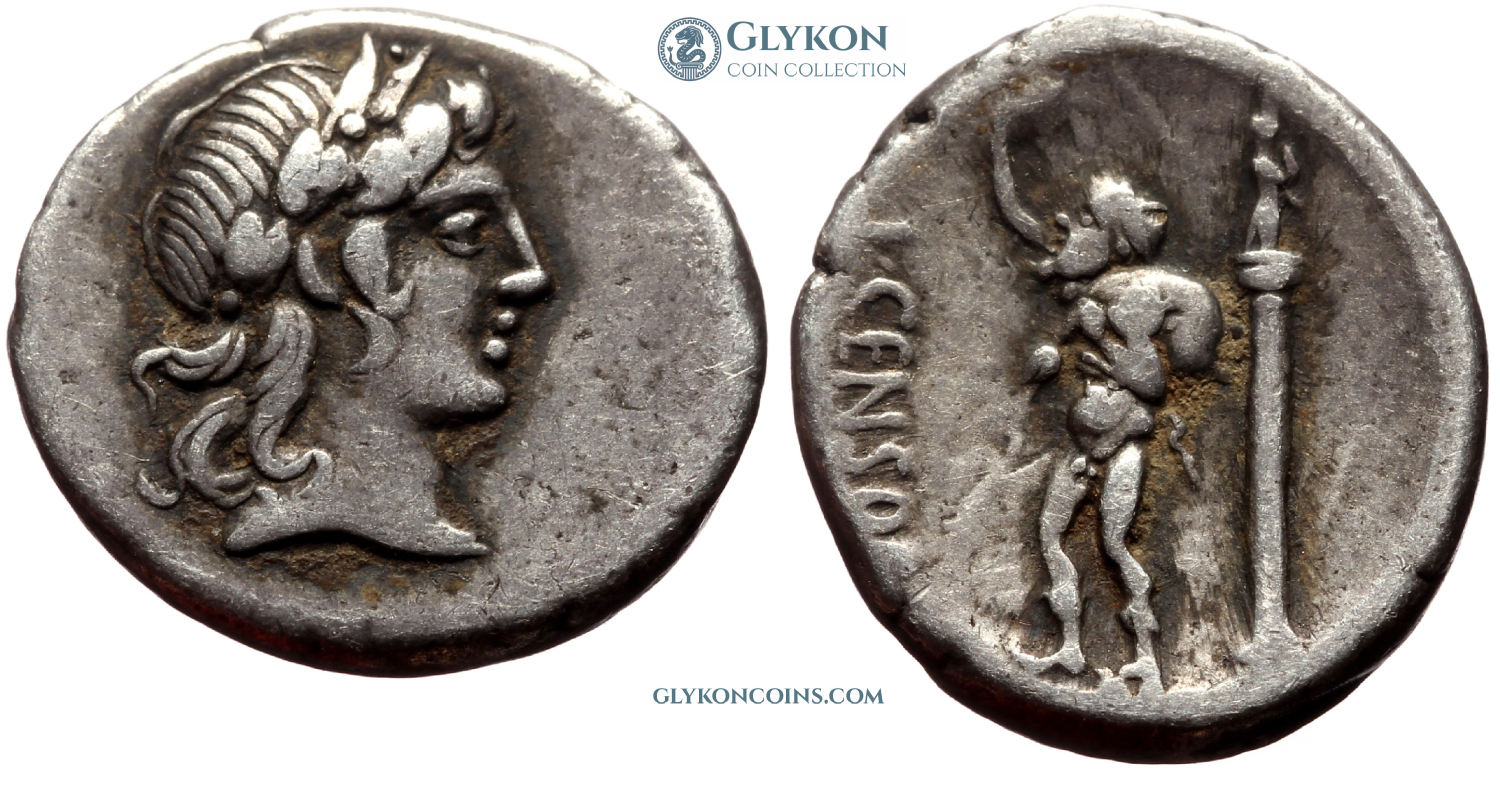
Roman Republic
Denomination: Denarius
Time: 82 BC; moneyer Lucius Marcius Censorinus
Weight: 3.86 g
Diameter: approx. 17.5 mm
Reference: Crawford 363/1
Obverse: Laureate head of Apollo to right. Wreath behind.
Reverse: Nude satyr Marsyas standing to right gazing upwards, holding wineskin and raising right hand. On right a column surmonted by a statue of a deity with hands folded as for prayer. Legend: L·CENSOR.
The coin, minted during the bloody peak of Sullan purges, probably contains a veiled protest against that horror in which the moneyer himself lost many relatives. Marsyas, the mythical ancestor of the Marcii family, raises his hand as if to scream a grievance or a curse to the gods. How such a provocative coin squeezed through the vigilant eyes of Sulla's minions, Jupiter alone deigns to know. |
|
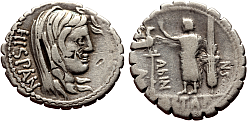 |
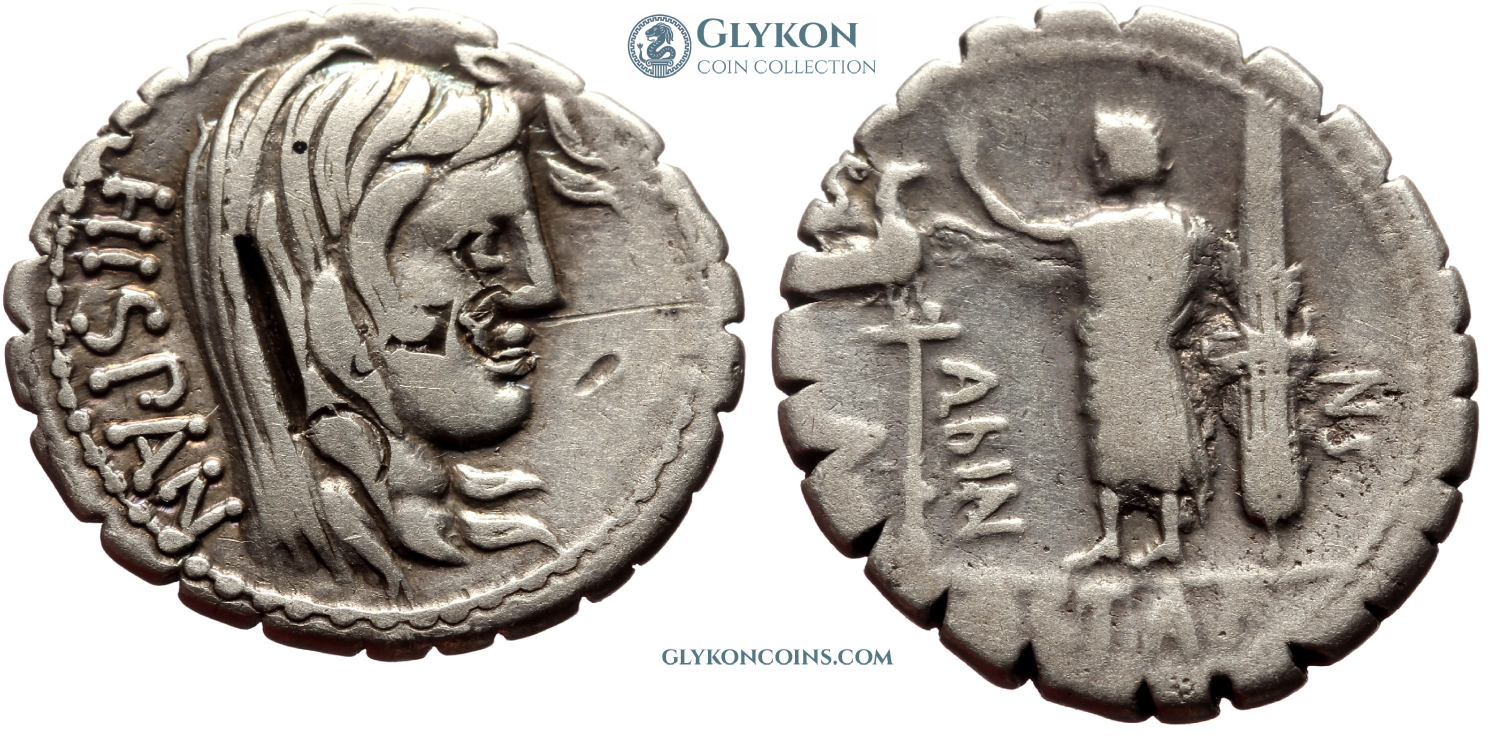
Roman Republic
Denomination: Denarius (serratus)
Time: 81 BC; moneyer A. Postumius A.f. Sp.n. Albinus
Weight: 3.94 g
Diameter: approx. 20.7 mm
Reference: Crawford 372/2
Obverse: Veiled head of Hispania to right. Legend: HISPAN. Banker's mark and test cut.
Reverse: Togate male figure standing to left raising right hand. Dictatorial fasces with an axe on the right. Aquila (legionnary standard with an eagle) on the left. Legend: N·S· – ALBIN - A·; additionally POST·A·F in exergue.
Comment: The huge number of counterfeit coins in circulation prompted the Romans to frantically search for a way to curb this practice. One such method was coins with serrated edges, the so-called serratus denarii. They were based on a simple idea. Most forgeries of that time consisted of a base metal core (e.g. copper) covered with a thin layer of silver (or gold in the case of gold coins). Therefore, if the coin was serrated, this reduced the possible size of the copper core. This was supposed to make forgery unprofitable. As one can easily guess, the authorities suffered a complete defeat in the fight against ancient criminals and counterfeit serrated coins proliferated. The test cut on this coin shows that it was not trusted.
This interesting coin comes from the period of Sulla's bloody dictatorship and the reverse shows a well-recognizable attribute of the Roman dictator - fasces with an axe attached. The standing figure may be Sulla himself. This is not yet a portrait in the likeness of Hellenistic kings, but the taboo on depicting living persons was slowly being broken. On the other hand, the depiction of the personification of Hispania on the obverse is puzzling. At that time, there was a war in Spain with Sertiorius, the last active combatant of Marius' populares. The Marians were defeated and massacred by Sulla everywhere else. Was this a propagandistic assurance that the situation in Spain would soon be under control? |
|
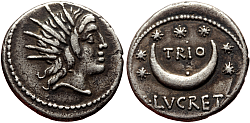 |
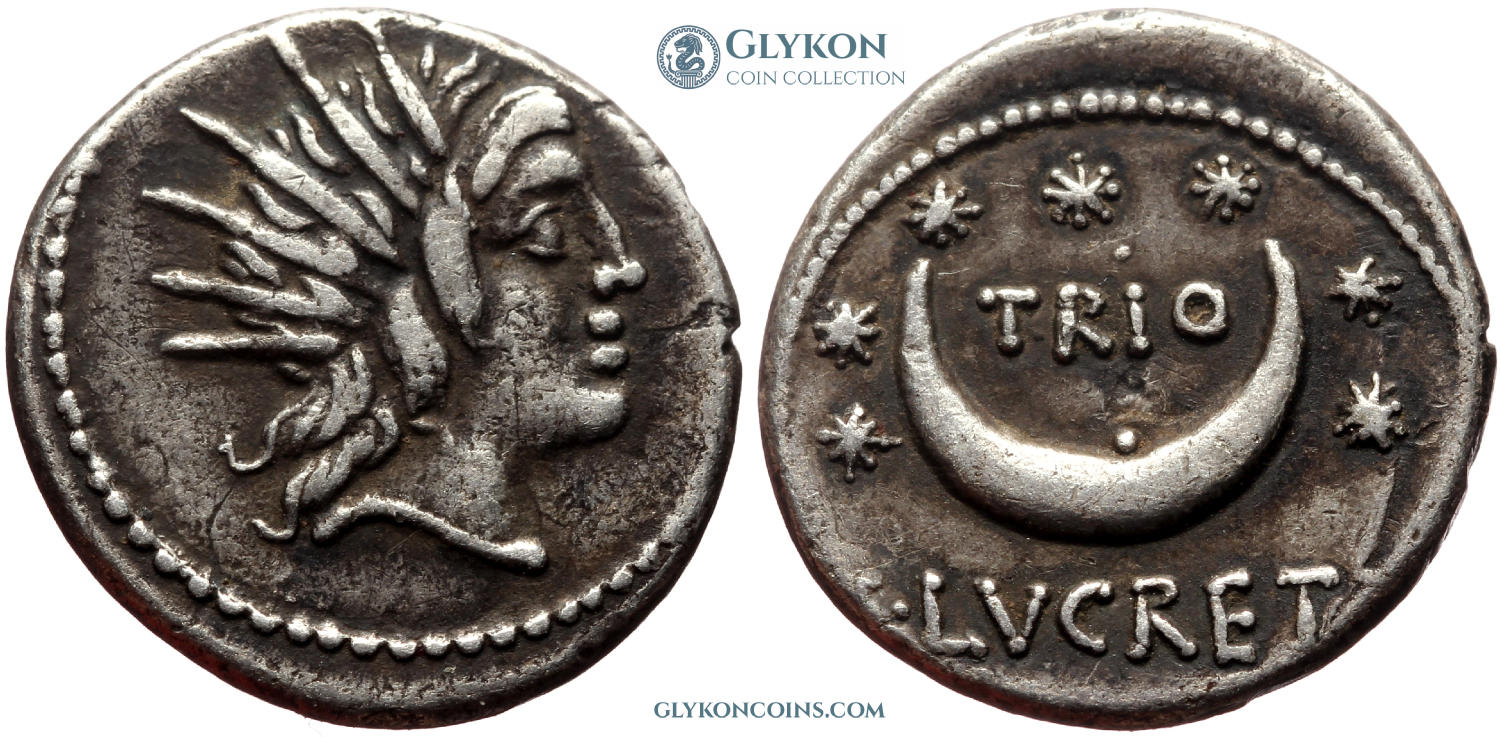
POSSIBLE MODERN (late 19th- early 20th century) FORGERY
Roman Republic
Denomination: Denarius
Time: 74 BC; moneyer L. Lucretius Trio
Weight: 3.26 g
Diameter: approx. 18.4 mm
Reference: Crawford 390/1
Obverse: Head of Sol wearing radiate crown facing right.
Reverse: Upward pointing crescent with a dot. Seven stars around. Legend: TRIO - L·LVCRET.
Comment: It has been brought to my attention that this coin may be a modern (but not recent) forgery. It reportedly bears some marks of a forger's work from the late 19th/early 20th century. Until proven otherwise, I am reluctantly forced to treat it as possibly if not likely inauthentic.
At any rate, it is underweight, so it's also possible that it's a fouree (an ancient counterfeit made from base metal coated with silver). However, even lighter authentic (i.e., genuine but not counterfeit) Roman denarii are also known. |
|
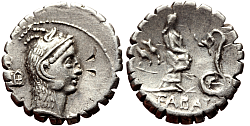 |
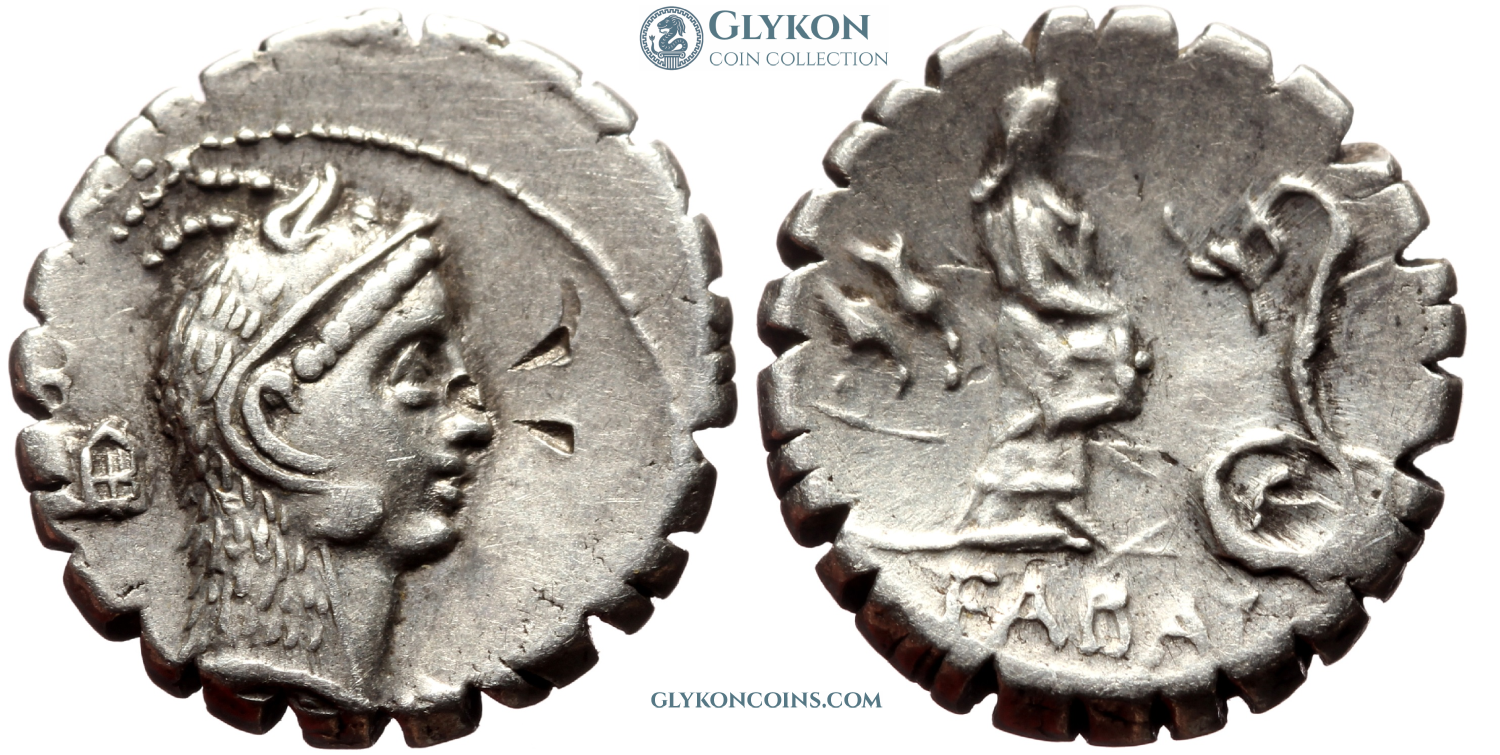
Roman Republic
Denomination: Denarius (serratus)
Time: 64 BC; moneyer Lucius Roscius Fabatus
Weight: 3.94 g
Diameter: approx. 20.7 mm
Reference: Crawford 372/2
Obverse: Head of Juno Sospita (Juno the Protectress) wearing horned goatskin to right. Behind, a chicken coop. Legend: L·ROSCI (not visible on this specimen). Banker's mark.
Reverse: Priestess standing to right feeding an erect oracular serpent. Two oracular chickens feeding on the left. Legend: FABATI in exergue.
Comment: Very rare if not unique variant with a chicken coop and oracular chickens. In general, this coin is full of religious symbolism and shows much of religious life of the Late Republic. We know that the Romans used chickens for divination, and a plethora of Roman religious cults used snakes. |
|
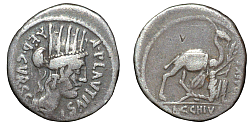 |
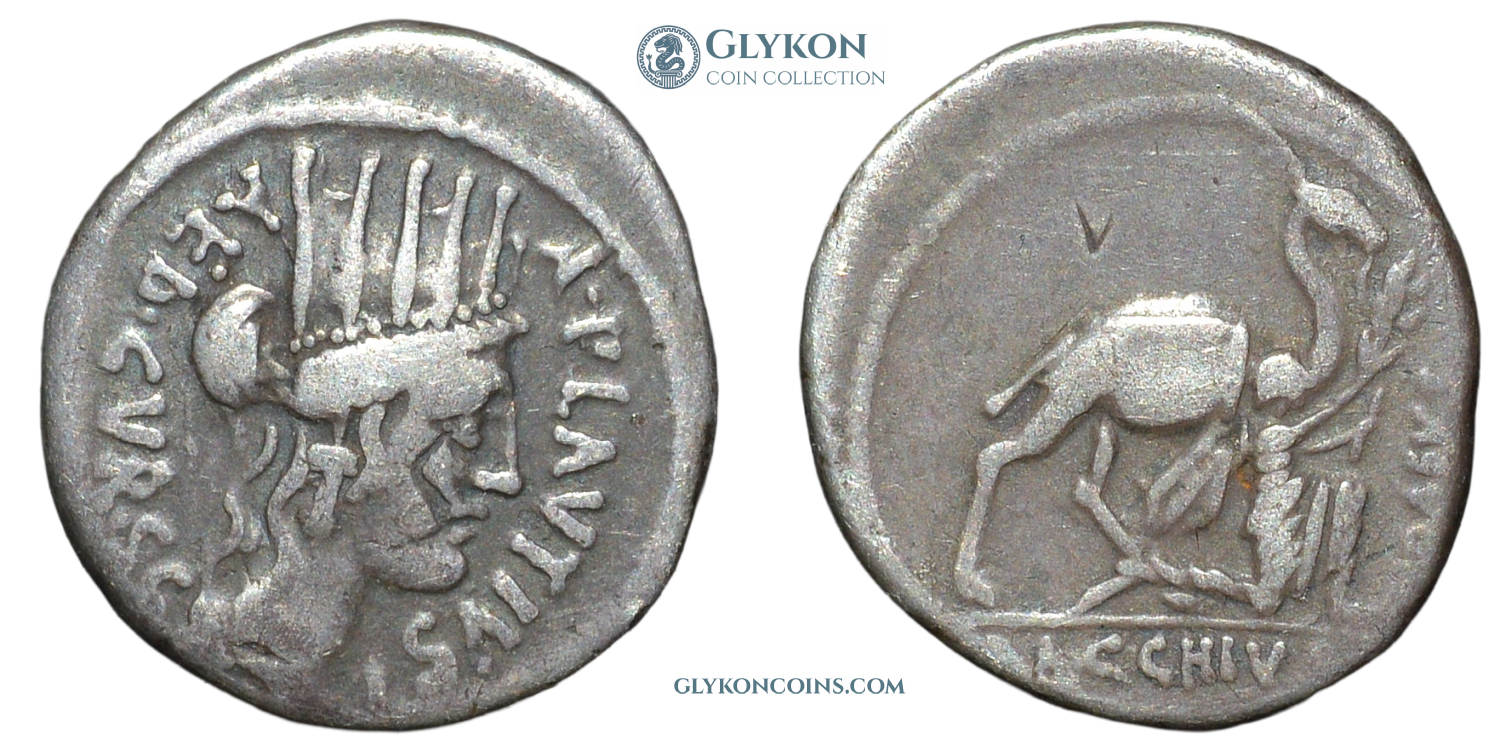
Roman Republic
Denomination: Denarius
Time: 55 BC; moneyer (aedile) Aulus Plautius
Weight: 3.83 g
Diameter: approx. 18.8 mm
Reference: Crawford 431/1
Obverse: Head of Cybele facing right, wearing turreted crown. Legend: A·PLAVTIVS· AED·CVR·S·C. Banker's mark.
Reverse: Kneeling draped male figure facing right, holding a palm or olive branch and reins of a camel which also faces right. Legend: BACCHIVS IVDAEVS. Banker's mark.
Comment: Not only scholarly works but entire books have been written about this coin. This refers, of course, to the mysterious reverse and the strange figure referred to by the enigmatic phrase "Bacchus from Judea."
According to some researchers, this refers to some known, or perhaps unknown, Judean dignitary who was humbled by Rome. At the time many Jews indeed used two names - one Jewish and one Greek. Thus, we have many Jewish Philips, Aristobuluses, Antigonuses, Alexanders, and so on. But none of the known names bore the name of the Roman god Bacchus, or his Greek counterpart Dionysus. The coin's date also doesn't correspond to any particularly important event. Judea had already been conquered by Pompey the Great in 63 BC. In 55 BC, at most a small disturbance still soured the blood of the conquerors. Moneyers often alluded to current events on their coinage, but it's difficult to imagine that the humiliation of Judea eight years earlier was still a hot topic in 55 BC. For lack of a better idea, however, many researchers assume that the figure depicted is actually the High Priest Aristobulus, and his kneeling evokes the humiliation of Judea by Pompey or some minor victory over most diehard rebels.
Which is not to say that this is an unquestionable opinion. There are those, and I must admit that their arguments resonate with me, who argue that the figure depicted is not a human being, but a god. The God of the Jews - Yahweh himself. He was identified by ancient authors (as part of the so-called interpretatio Graeca) with Bacchus/Dionysus, based on pagan observations of Jewish rituals. In such a context, the subjugated "Judean Bacchus" may indicate his acceptance into the Roman pantheon, just as the Romans did with countless other gods of conquered peoples. Including Cybele, depicted on the obverse. Her presence might actually strengthen the argument that the coin is devoted to "transplanted gods".
Regardless, this coin marks the first entry of Jews into the sphere of interest of Roman coinage. |
|
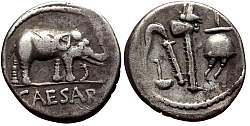 |
Civil Wars or Imperiatorial Period
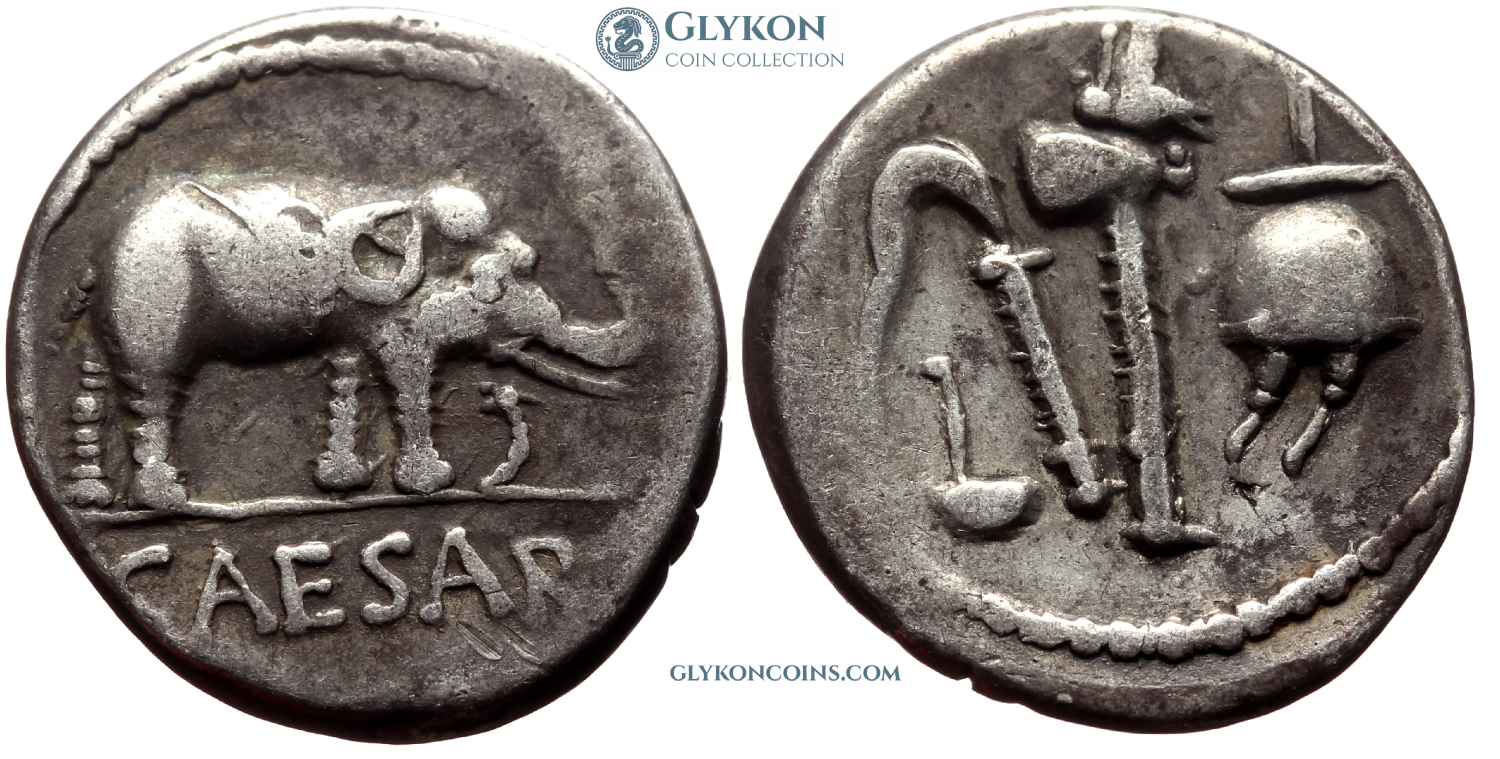
Denomination: Denarius
Time: 49/48 BC; Julius Caesar; field mint perhaps in Italy or Spain
Weight: 3.82 g
Diameter: approx. 17.9 mm
Reference: Crawford 443/1, Sydenham 1006; Ex Baldwin’s 99/2016 lot 624
Obverse: Elephant to right trampling an erect serpent. Legend: CAESAR in exergue.
Reverse: priestly utensils emblematic for the office of the Pontifex Maximus: culullus, aspergillum, axe and apex.
Comment: One of the most famous coins of antiquity, fortunately minted in such huge quantities that it is available even to a modest collector. This is the first of many coins minted by Caesar's mobile mint during his war against the Optimates. Many words have been written about the symbolism of this coin, and it is still not known for sure what it was supposed to represent. Is Caesar allegorically depicted as an masculine elephant effortlessly trampling over his opponents? Or maybe the Optimates are the elephant here and recklessly trample over the rights of Caesar and his soldiers? Or maybe it's just a reference to Caesar's semi-legendary ancestors, one of whom supposedly gained fame by killing an elephant during some war in Africa? Fortunately, the reverse is much more readable. Priestly utensils of Pontifex Maximus, the highest priest of the Roman religion. That is, the symbols of the office that Caesar held and made so much use of.
|
| 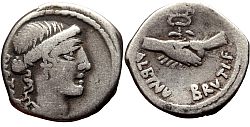 |
Civil Wars or Imperiatorial Period
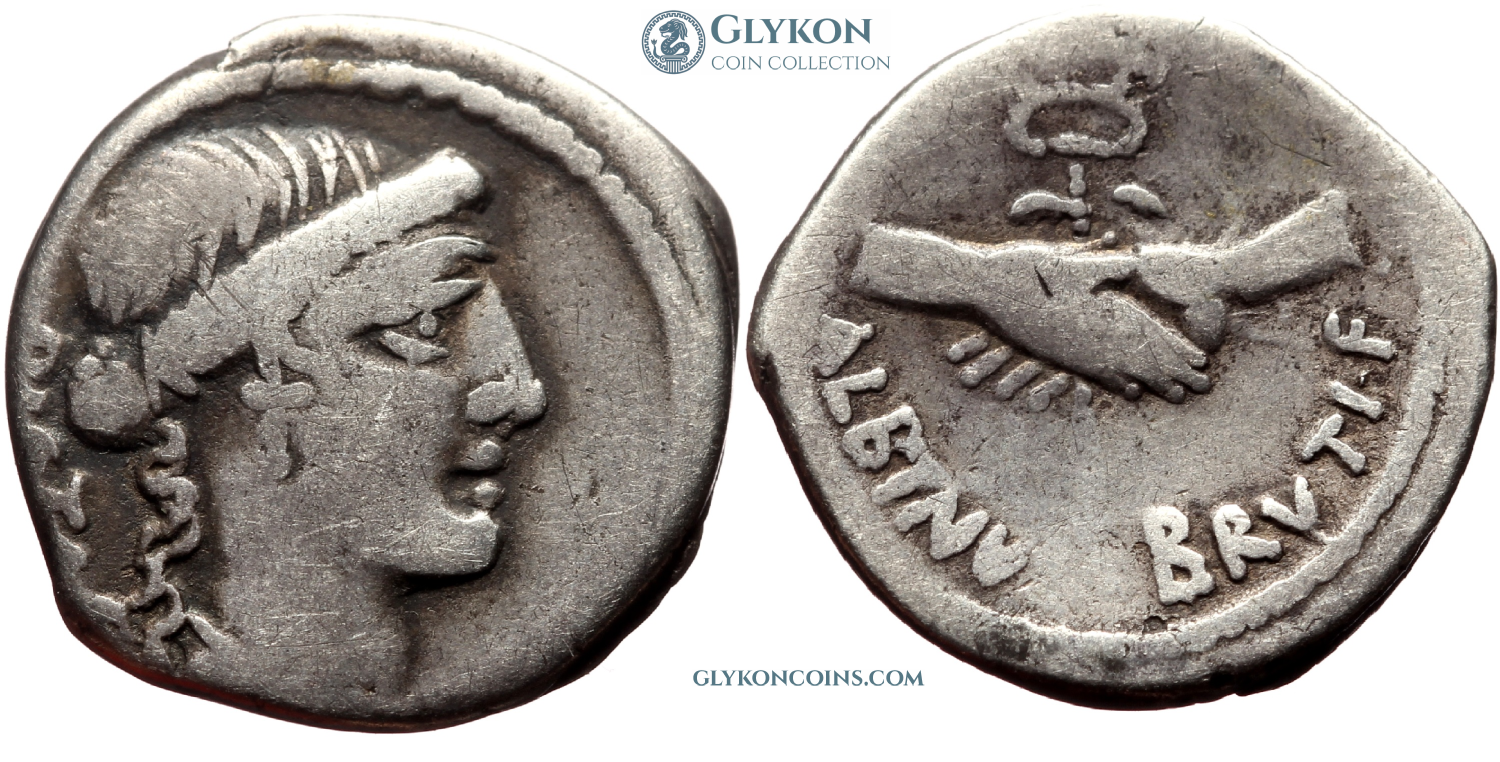
Denomination: Denarius
Time: 48 BC; Decimus Junius Brutus Albinus; minted in field mint somewhere in Gaul, or perhaps in Rome
Weight: 3.55 g
Diameter: approx. 18.5 mm
Reference: Crawford 450/2
Obverse: Head of Pietas to right. Legend: PIETAS.
Reverse: Two hands clasped around a caduceus. Legend: ALBINVS·BRVTI·F.
Comment: “The other Brutus”, though arguably far more proactive and intelligent than his distant but more famous cousin. Decimus Junius Brutus Albinus was initially one of Caesar’s most stalwart friends and supporters and followed him both during the Gallic Wars and the civil war against the Pompeians. This coin was minted in 48 BC, during Caesar’s Civil War against the Pompeiians. Decimus Brutus was left by Caesar to mop up any remaining resistance in the Gallic provinces. In this role Decimus Brutus acted splendidly, brilliantly bringing Massalia (modern Marseilles) to heel, crushing swiftly a potentially dangerous rebellion and generally maintaining peace behind Caesar’s lines.
Decimus however soon became disillusioned with the dictator’s increasingly autocratic behavior. He therefore became one of ringleaders of the plot which culminated in the Ides of March, 44 BC. Nevertheless, up to the last moment Decimus maintained pretense of being Caesar’s closest friend, famously dining with him on the preceding evening. This later turned out to be a massive PR disaster for the plotters, since the Roman public was especially angered at Decimus for this blatant betrayal of a friend's trust and hearth.
Caesar trusted Decimus Brutus to such an extent that he made him a secondary heir in his will and shortly before his death nominated Decimus as governor of the crucial province of Cisalpine Gaul. Aware of the bad air around him, Decimus rushed to the province in the aftermath of the assasination. Mark Antony soon tried to capitalize on public’s anger at Decimus and attempted to seize that province for himself by force. This resulted in the Mutina campaign in 43 BC which helped the young Octavian to assert himself as a powerful political player and head of the Ceasarian party. Octavian, together with two consuls named Hirtius and Pansa relieved the besieged Decimus Brutus but both consuls unexpectedly died in the series of battles. This left Octavian, who had no intent to aid in any way Caesar’s assassins, as master of Italy. After some maneuvering and with coming rapprochement between Antony and Octavian, Decimus Brutus attempted to flee in disguise, only to be recognized and killed on the spot by Antony’s soldiers on some mountain checkpoint.
|
|
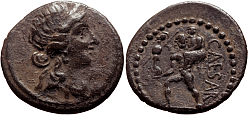 |
Civil Wars or Imperiatorial Period
Denomination: Denarius
Time: 47/46 BC; Julius Caesar; field mint perhaps in Africa
Weight: 3.84 g
Diameter: approx. 18.3 mm
Reference: Crawford 458/1, Sydenham 1013
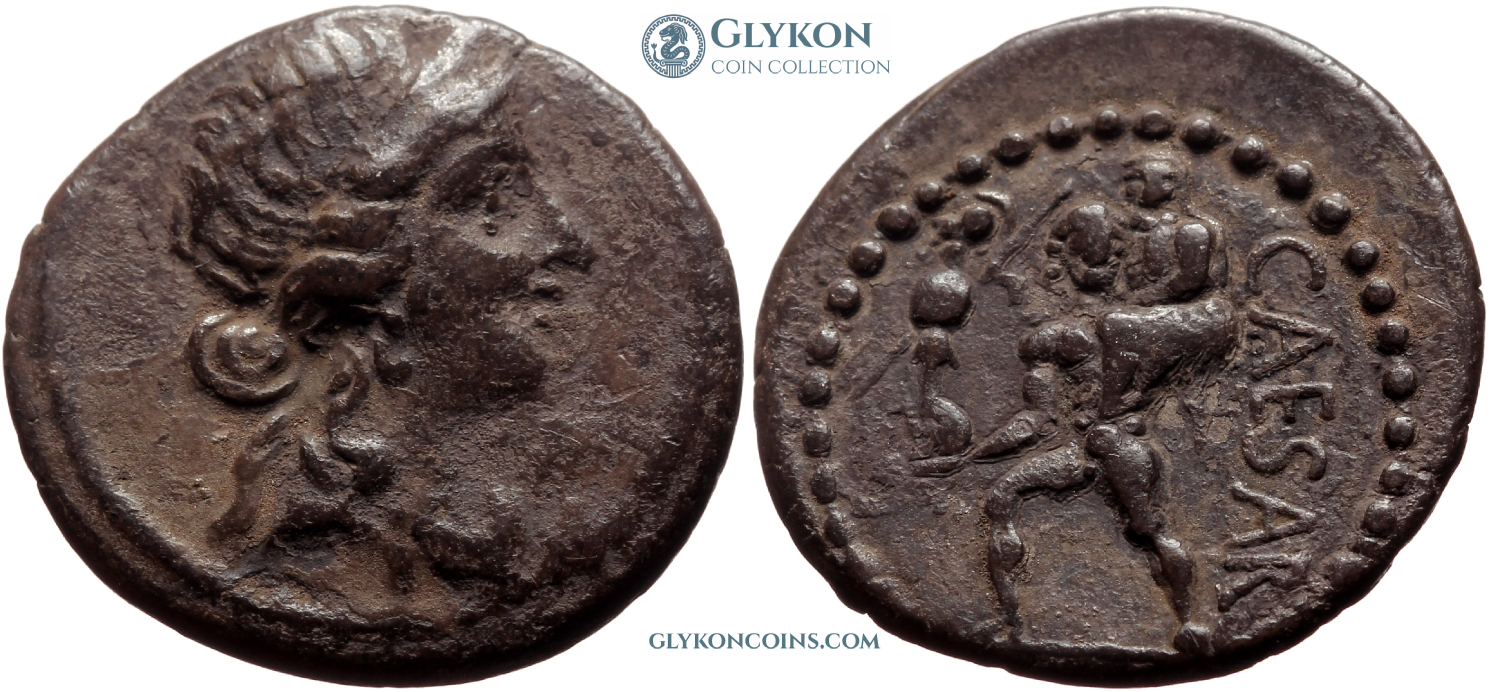
Obverse: Diademed head of Venus to right.
Reverse: Aeneas walking to left, carrying is father Anchises on his left shoulder and a palladium (wooden statue of Athena Pallas) in his right hand. Legend: CAESAR.
Comment: Unlike the elephant denarius above, this one is quite straightforward. This coin depicts Caesar's mythical ancestors - the goddess Venus, her lover Anchises the Trojan, and their common son Aeneas, who led the survivors of Troy to Italy. Every self-respecting aristocrat of the Late Republic period had a whole herd of divine ancestors of his family. Caesar was no exception. The Palladium is interestingly placed on the reverse, symbolizing the transfer of the gods' protection from Troy to Rome. |
|
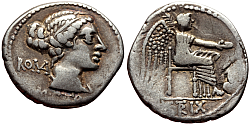 |
Civil Wars or Imperiatorial Period
Denomination: Denarius
Time: 47/46 BC; Marcus Porcius Cato (Cato the Younger); field mint somewhere in Africa
Weight: 3.18 g
Diameter: approx. 18.4 mm
Reference: Crawford 462/1, Albert 1407
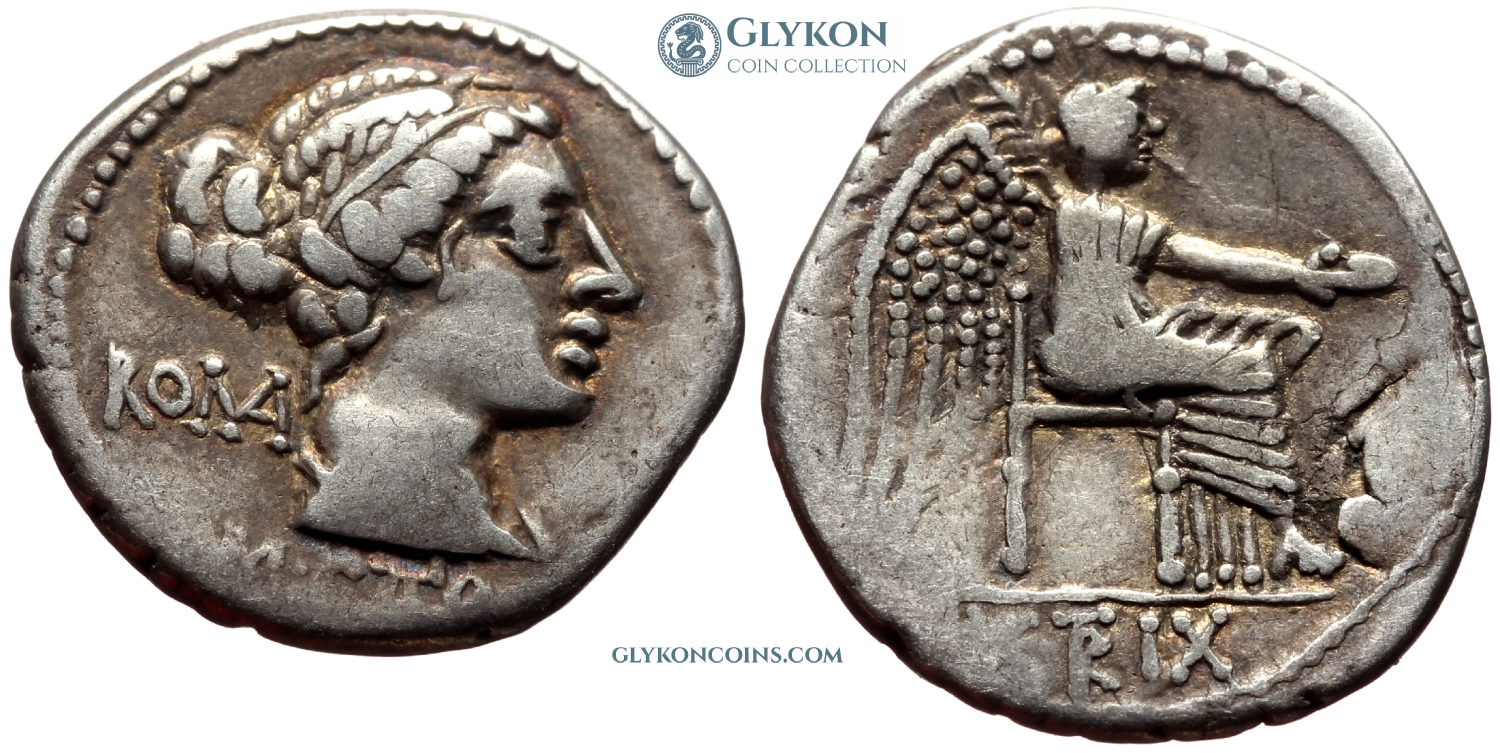
Obverse: Head of Roma to right, hair tied. Legend: ROMA and M·CATO·PRO·PR.
Reverse: Victory seated on a throne to right, holding patera and palm branch. Legend: VICTRIX in exergue.
Comment: Ceasar's personal archenemy. This type is extremely similar and easy to confuse with earlier denarius Crawford 343/1, minted in 89 BC by other relative also named M. Cato. I believe this is 462/1 minted during the Civil War by Cato the Younger due to barely visible what appears to be part od "P" from "PRO·PR". |
|
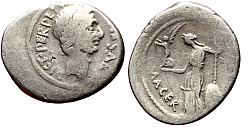 |
Civil Wars or Imperiatorial Period
Denomination: Denarius
Time: January-March 44 BC; Julius Caesar, lifetime as perpetual dictator; moneyer: P. Sepullius Macer
Weight: 3.43 g
Diameter: approx. 19.7 mm
Reference: Crawford 480/10; Ex Naumann 60/2017 lot 390
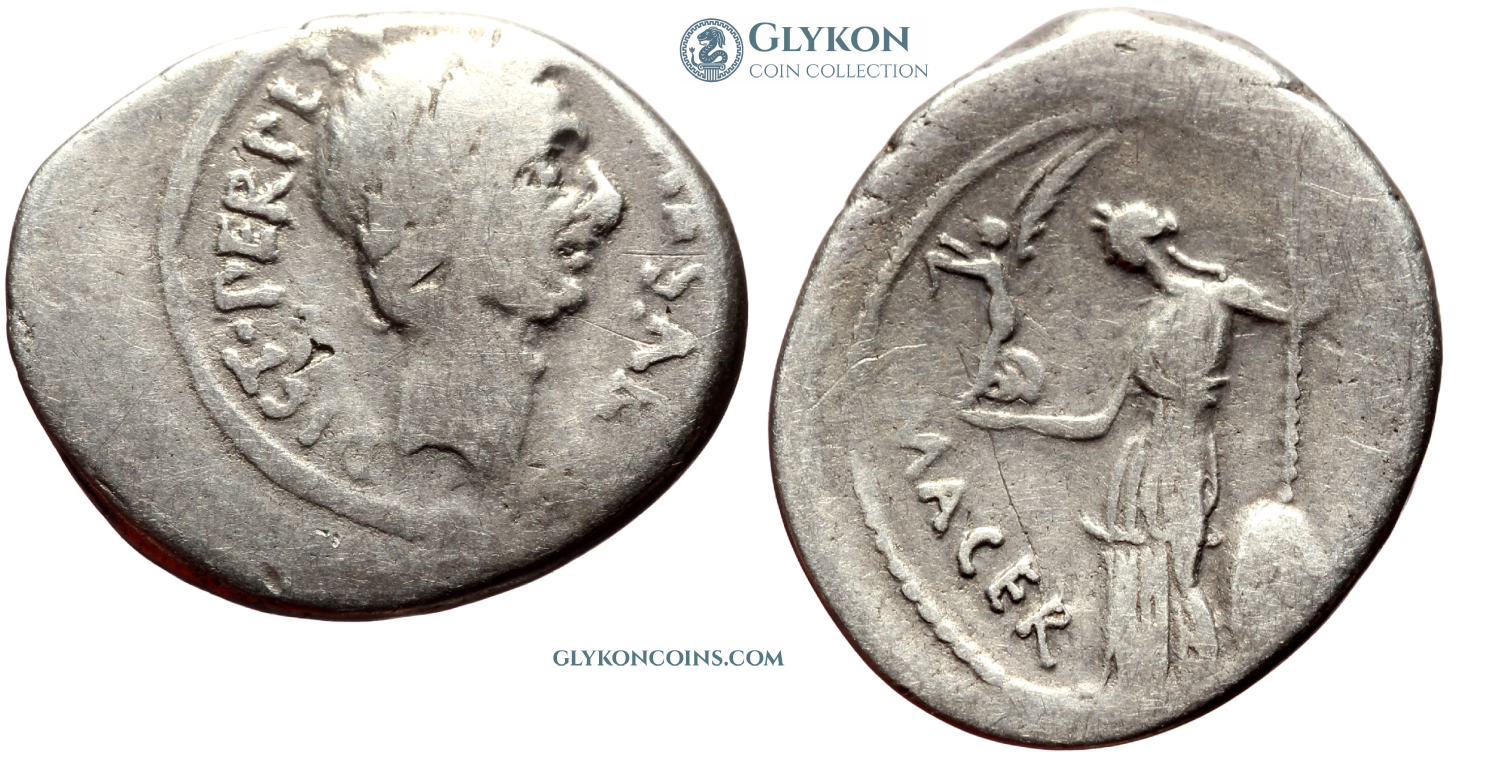
Obverse: Laureate head of Julius Ceasar to right. Legend: CAESAR DICT·PERPETVO.
Reverse: Venus standing to left, holding small Victory in raight hand and scepter in left hand. Legend: P·SEPVLLIVS MACER.
Comment: "The coin that killed Caesar", minted in short period in 44 BC before his assasination in March of that year. Although living persons depicted on Roman coinage weren't unprecedented, this one broke any and all traditional Roman conventions and depicted Ceasar in the vein of Hellenistic monarchs or even as a deity. This was one of the warning signs that Caesar was going to build a royal cult around himself that prompted a group of disgrunted senators to kill him. Coins from this issue are also famous for sometimes sloppy minting. Just like this specimen, which was produced on a very misshapen planchelet. This was primarily due to the fact that these coins were minted en masse and in a hurry in anticipation of Caesar's Parthian campaign that was about to begin. |
|
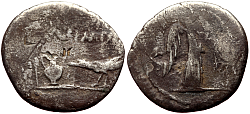 |
Civil Wars or Imperiatorial Period
Denomination: Quinarius (half-Denarius)
Time: 43/42 BC; Mark Antony; field mint somewhere in Gaul after the battle of Mutina
Weight: 1.45 g
Diameter: approx. 15 mm
Reference: Crawford 489/4; Sydenham 1159
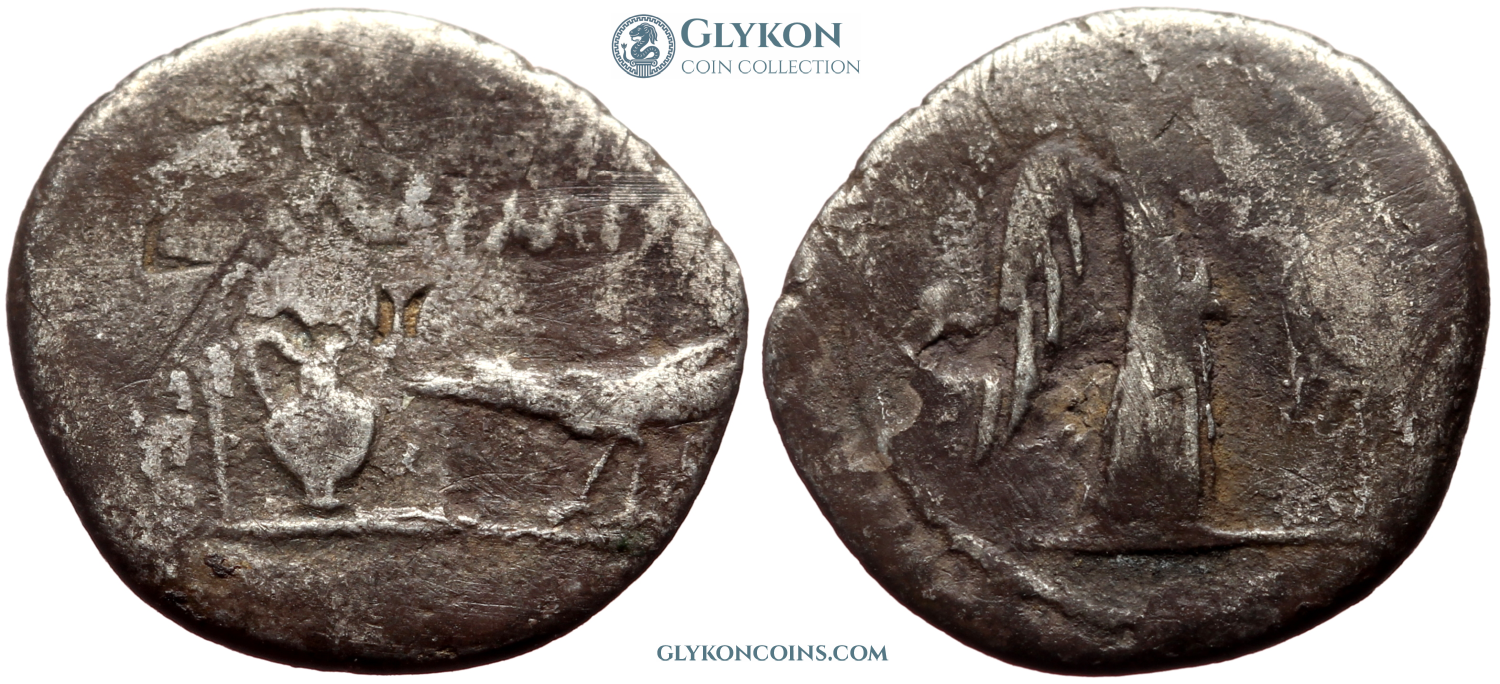
Obverse: Lituus, jug and raven to left. Legend: M ANT IMP. Bankers' marks.
Reverse: Victory standing to right and crowning a tropaeum.
Comment: Caesar is dead, his assassins and former supporters are tearing apart what remains of the Republic's corpse. Mark Antony was the first to take direct action and tried to seize the province of Cisalpine Gaul from Decimius Brutus, one of Caesar's assassins. The plan backfired and was he defeated by a hastily cobbled together coalition of moderate Caesarians, the legal government of the Republic, Decimius Brutus and young Octavian. Marcus had to flee across the Alps to Gaul and lick his wounds with what was left of his army. But the tide was about to turn in his favor. And it was at that time that this tiny coin was minted. Even, or perhaps especially, a defeated army had to be paid or it would abandon its leader. |
|
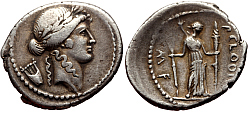 |
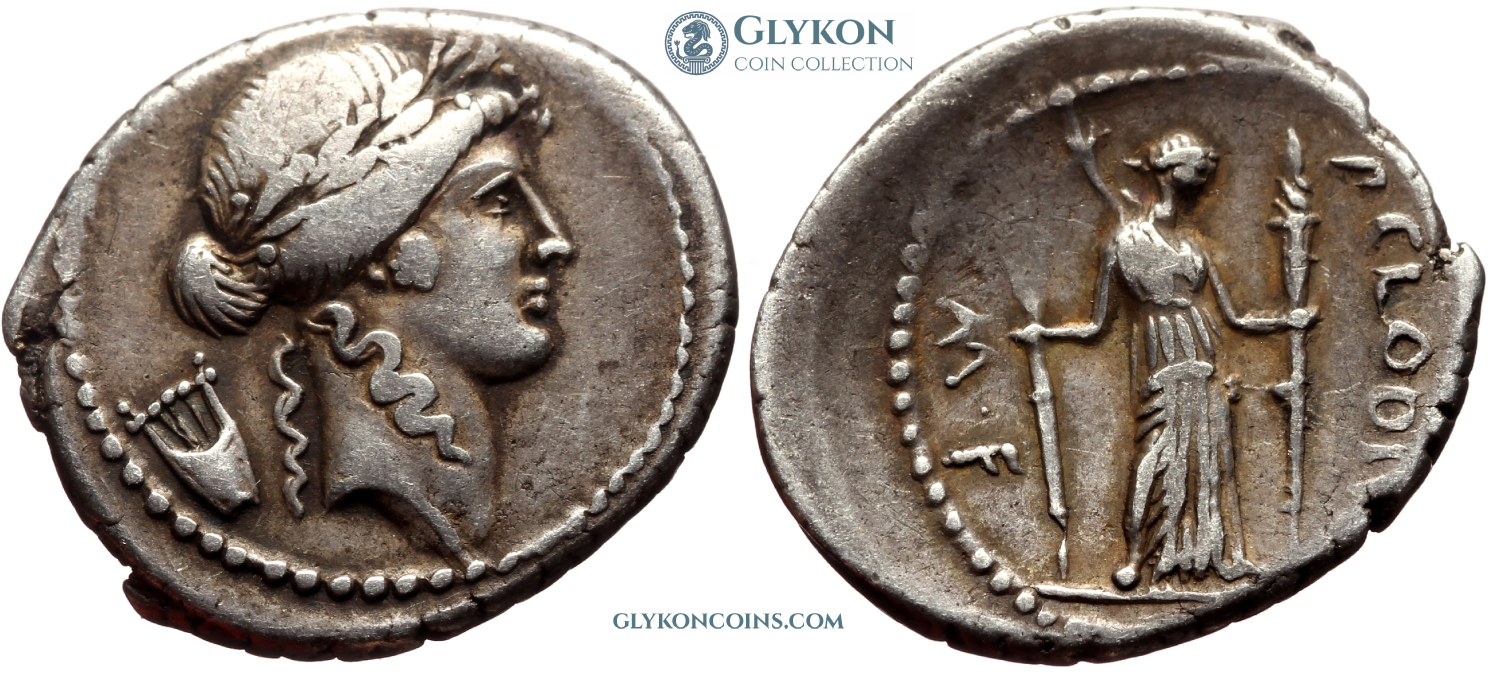
Roman Republic
Denomination: Denarius
Time: 42 BC; moneyer P. Clodius M.f. Turrinus
Weight: 3.58 g
Diameter: approx. 19.3 mm
Reference: Crawford 494/23; Sydenham 1117
Obverse: Laureate head of youthful Apollo to right, small lyre behind.
Reverse: Diana the Lightbringer (Lucifera) standing right holding two long lit torches. Legend: P·CLODIVS·M·F.
Comment: This particular coin is like the last sigh of a dying era. In 42 BC Rome was in the hands of autocratic Triumvirs challenged by equally autocratic Liberatores, and the military mints from either side issued massive quantities of coins praising the new rulers and their agendas. Like in the eye of a storm, some officials left in the city of Rome pretended to function as if everything was normal. Moneyer Clodius somehow slipped in one apolitical design that might well have been made 20 years earlier, at a much happier time. |
|
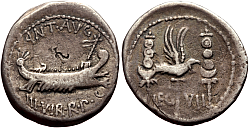 |
Civil Wars or Imperiatorial Period
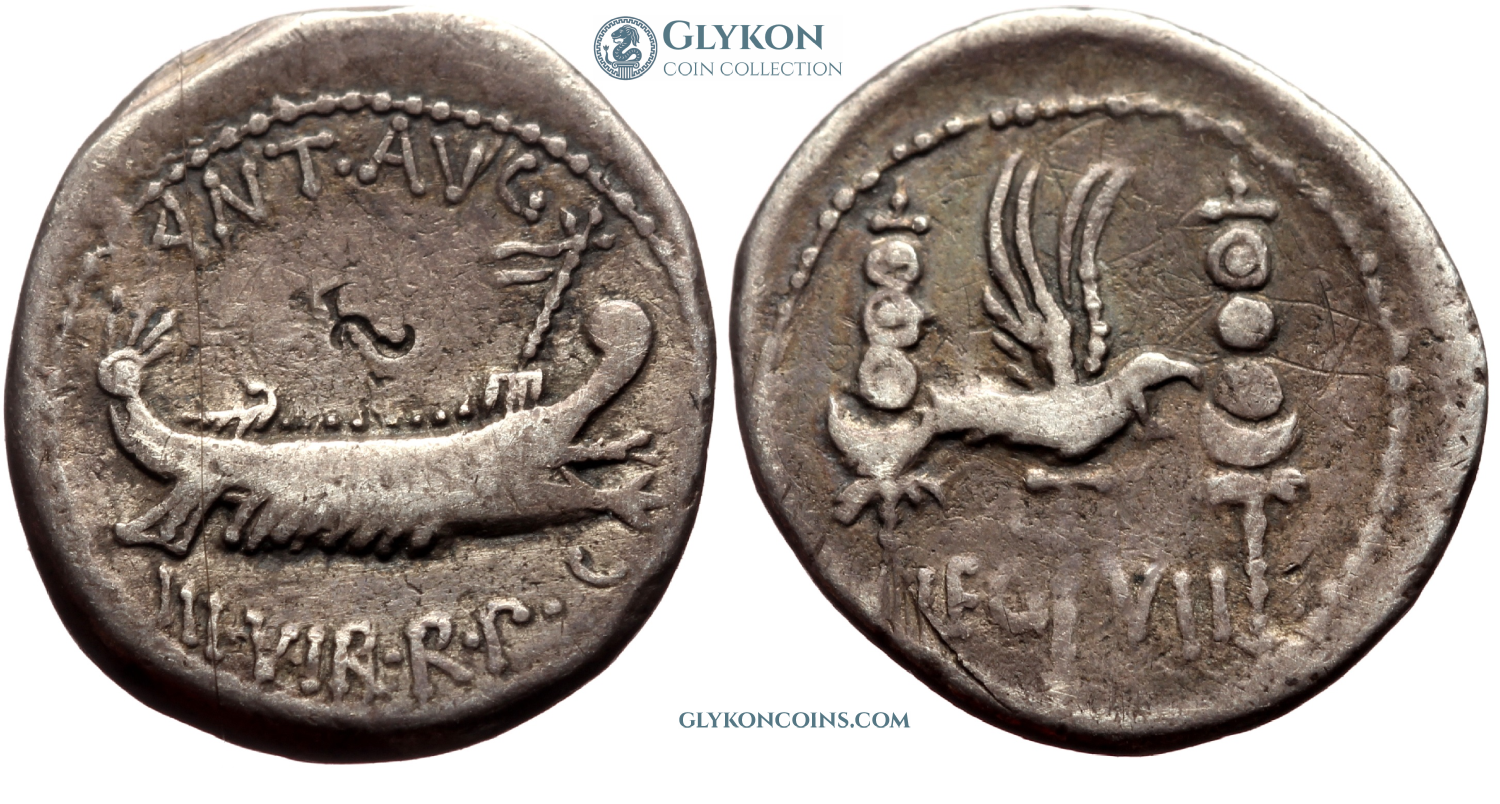
Denomination: Denarius
Time: 32/31 BC; Mark Antony; field mint somewhere in Greece (Patrae?) shortly before the battle of Actium
Weight: 3.51 g
Diameter: approx. 19.2 mm
Reference: Crawford 544/20; Sydenham 1224
Obverse: War galley to the right. Legend: ANT·AVG III·VIR·R·P·C. Bankers' marks.
Reverse: Aquila flanked by two signa. Legend: LEG VII.
Comment: Ahead of us is the final battle that will decide who will rule the Roman world. Unlike the cash-strapped Octavian, Mark Antony had the resources of the entire East at his disposal. For this campaign, he minted a truly massive number of coins, which flooded the market and remained in circulation for entire centuries. Of course, it didn't help him much in the end, because the outcome of the final war of the Republic was decided not by deep pockets but by the fleet and army.
Despite this, the coins minted for the occasion are fascinating. Antony used his coins to honor military units, including individual legions like LEGIO VII here. There is no evidence, however, that individual units were specifically paid with the coins bearing their names. The titulary on these coins is equally intriguing. The abbreviation AVG here does not mean "Augustus," a title that did not yet exist, but rather "Augur," a priestly position held by Antony. Interestingly, although the Triumvirate of Antony, Octavian, and Lepidus had ceased to exist for years, the coin still proclaims Antony as one of the Three Men Called to Restore the Republic.
Please note that the vertical line is a flaw in the photo and does not appear on the coin. |
Spotted an error, misattribution, or a forgery? Please contact me!
|