| No. |
Photo |
Description |
|
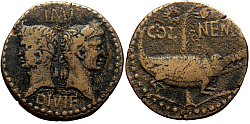 |
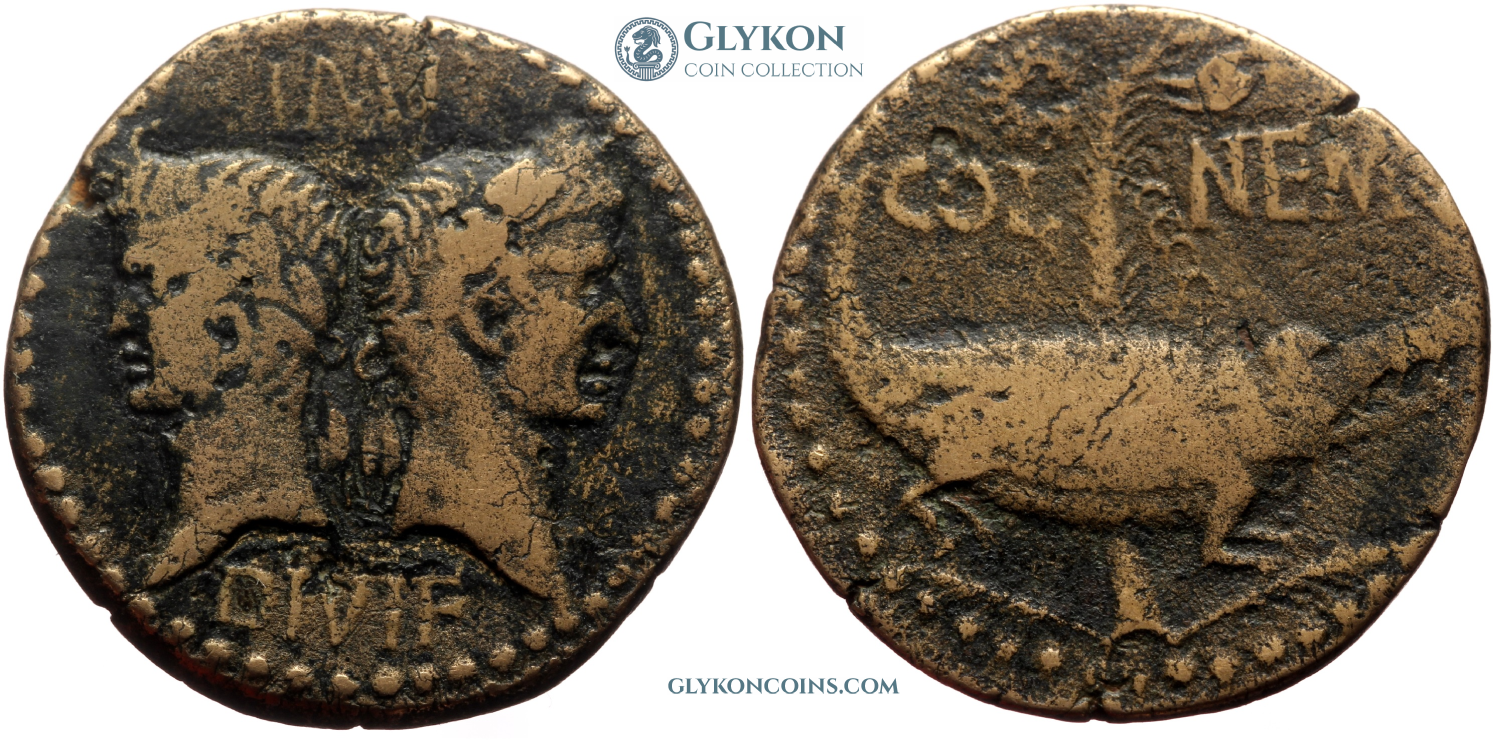
Augustus (27 BC-14 AD)
Denomination: Dupondius (or As according to some sources)
Mint: Nemausus (Nimes) in Gaul
Time: 9-3 BC
Weight: 11.09 g
Diameter: approx. 26.7 mm
Reference: RIC I 158; RPC 524; Cohen 10
Obverse: Laureate head of Augustus to right on right, head of Agrippa wearing rostal (naval) crown to left on left. Legend: IMP DIVI F.
Reverse: Crocodile to right standing on two palm branches, chained to a palm tree. Legend: COL NEM.
Comment: An interesting coin minted in present-day Nimes (France), where many veterans of civil wars, including the Battle of Actium, were settled. The chained crocodile was probably meant to remind former soldiers of their victory and stir their pride. The same went with the images of the commanders the veterans served under. These coins were often broken in half to obtain a smaller denomination. Such "halves" are found in large quantities, usually cut very carefully so that each head is intact. Interestingly, the chained crocodile from the coin is still the symbol of the city to this day. |
|
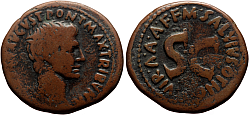 |
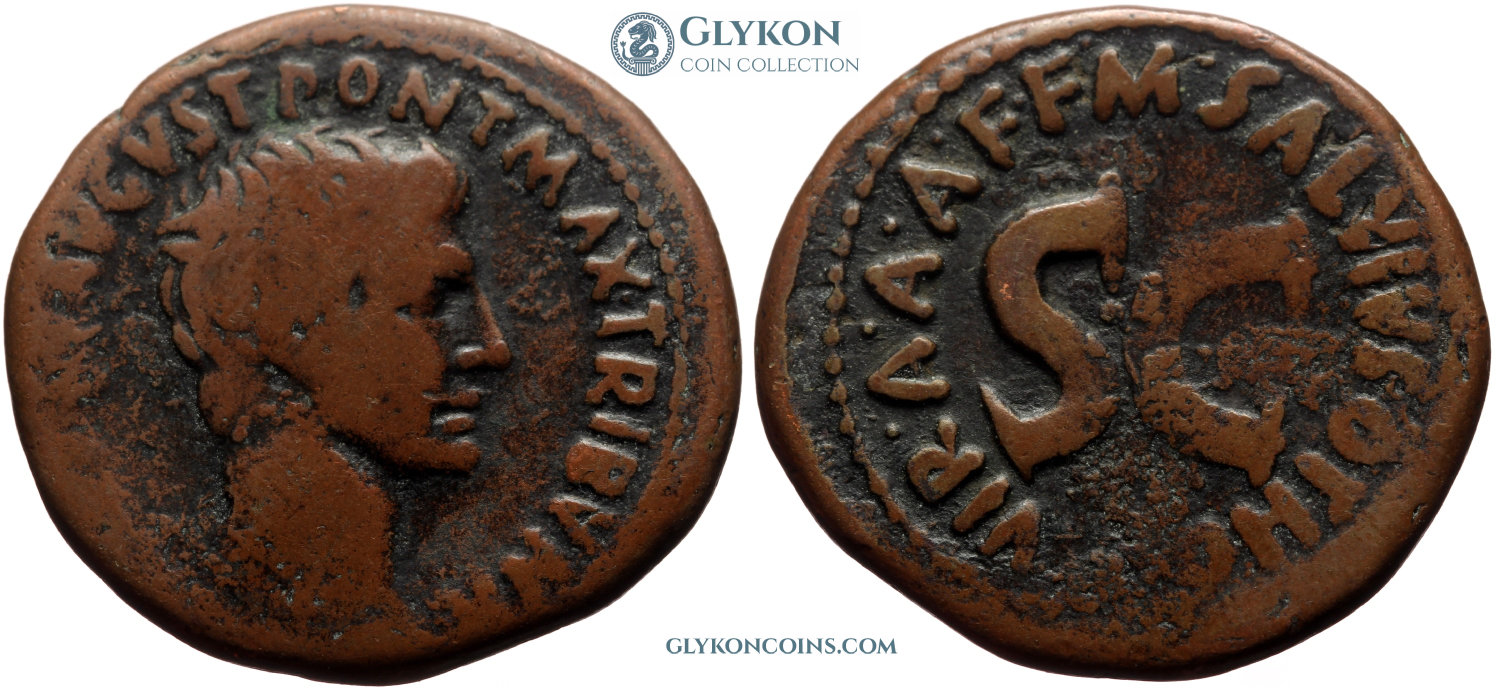
Augustus (27 BC-14 AD)
Denomination: As
Mint: Rome
Time: 7 BC, moneyer M. Salvivus Otho
Weight: 10.86 g
Diameter: approx. 28.0 mm
Reference: RIC I 431; BMC 226; Cohen 515
Obverse: Bare head of Augustus to right. Legend: CAESAR AVGVST·PONT MAX·TRIBVNIC POT.
Reverse: Large SC surrounded by legend: M·SALVIVS·OTHO·III·VIR·A·A·A·F·F·.
Comment: Part of the constitutional settlement of Octavian (henceforth called Augustus) which made him the de facto monarch of Rome was the establishment of new rules regarding the minting of coins in the empire. From then on, the minting of silver and gold coins became the privilege reserved to the emperor alone. The Senate and other old constitutional bodies were left with the minting of much less prestigious copper and brass coins. To indicate this, almost to the end of the 3rd century, the letters SC appear on such coins. This was an acknowledgment that a given issue was minted under authorization made through a resolution (Senatus Consultum) of the Senate. For some time, even the separate office of moneyers known from the times of the Republic was retained and their names appeared on coins such as this one. This settlement did not apply to so-called provincial coins. These were governed by their own rules. |
|
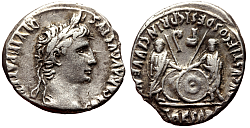 |
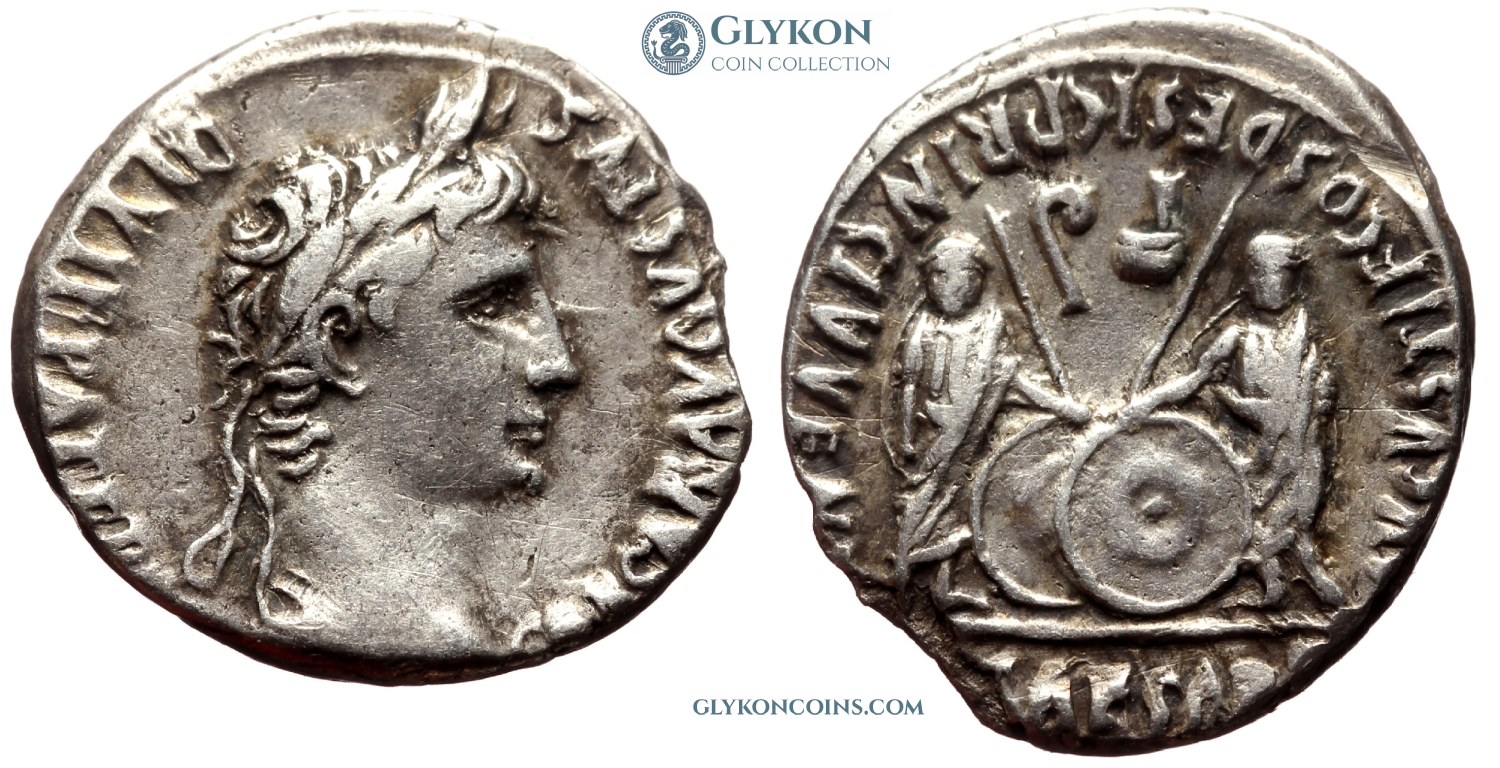
Augustus (27 BC-14 AD)
Denomination: Denarius
Mint: Rome or Lugdunum (Lyon)
Time: 2 BC-4 AD
Weight: 3.69 g
Diameter: approx. 18.7 mm
Reference: RIC I 210; Cohen 143
Obverse: Laureate head of Augustus to right. Legend: CAESAR AVGVSTVS DIVI F PATER PATRIAE.
Reverse: Augustus’ grandsons Gaius and Lucius Caesar standing, togate, each holding hand on a shield and spear, priestly utensils lituss and simpulum above. Legend: C L CAESARES AVGVSTI F COS DESIG PRINC IVVENT.
Comment: This interesting coin was minted under Augustus after the total transformation of the Roman Republic into the monarchic Roman Empire. It blatantly conveyed a dynastic message by featuring Augustus' two eldest grandsons Lucius Caesar and Gaius Caesar, whom Augustus then saw as his potential successors. Interestingly, this coin presents them in all possible roles – that of civil administrators (shown in togas), military commanders (spears and shields) and that of priests of the archaic Roman religion (priestly utensils above – namely simpulum on the left and lituus on the right).
Tragically, Augustus’ family was soon to be decimated by unfortunate events. Both Lucius and Gaius died in quick succession and by the time of Augustus’ own death in 15 AD none of his male grandchildren remained alive. Augustus thus was forced to resort to appoint his adopted son Tiberius as successor. Further tragedies and intentional purges in subsequent generations kept thinning the family. Their hold on the imperial throne was finally ended with the suicide of Nero in 68 AD. Surprisingly though, Augustus’ biological descendants continued to live through a few surviving female members of the dynasty until at least the time of Marcus Aurelius. |
|
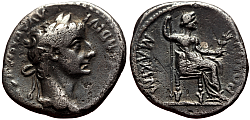 |
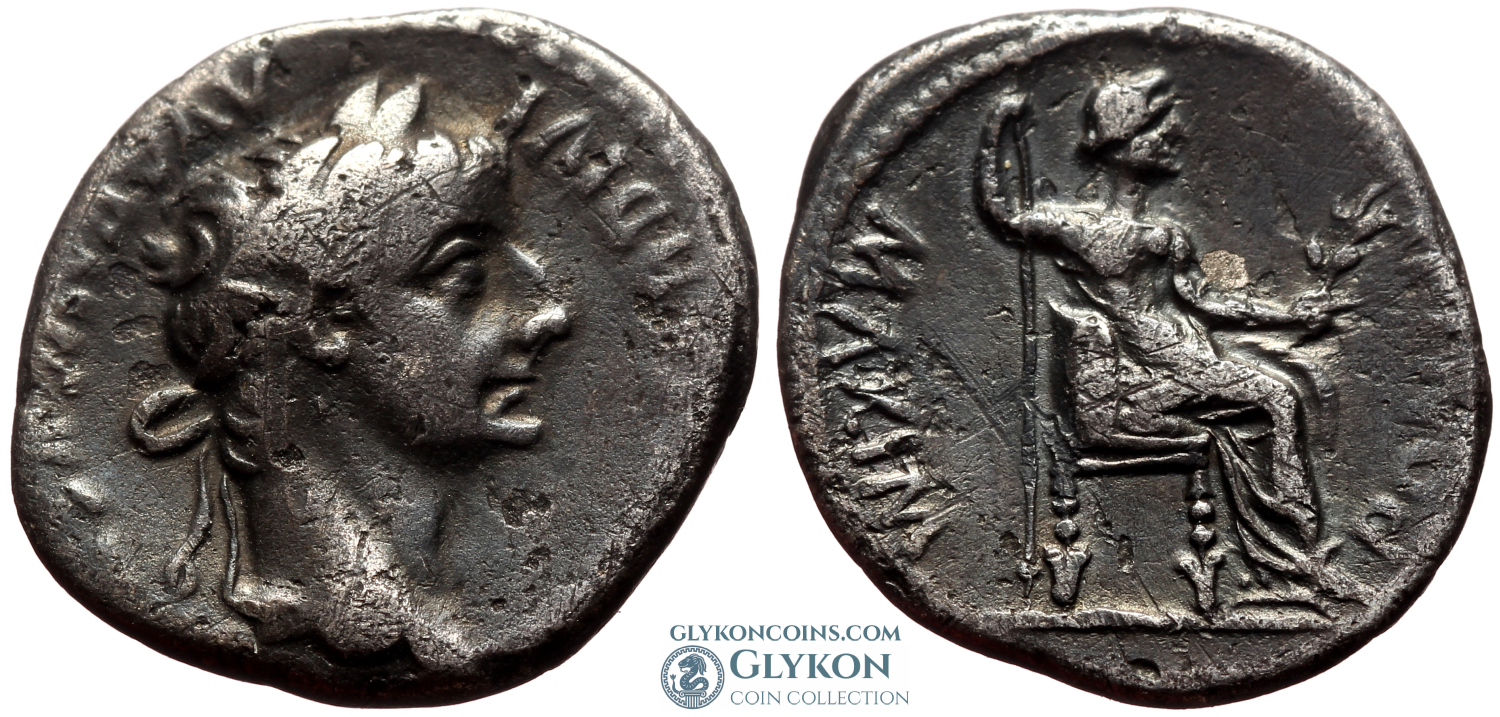
Tiberius (14-37 AD)
Denomination: Denarius
Mint: Lugdunum (Lyon)
Time: 14-37 AD
Weight: 3.44 g
Diameter: approx. 18.9 mm
Reference: RIC 30
Obverse: Laureate head of Tiberius facing right. Legend: TI CAESAR DIVI AVG F AVGVSTVS.
Reverse: Livia (Tiberius' mother) as Pax seated on throne facing right, holding an olive branch and a long scepter. Legend: PONTIF MAXIM.
Comment: The famous "Tribute penny" issue, commonly associated with the Biblical "Render unto Caesar" story.
Controversially perhaps to some, I consider this coin to be one of the most important in the history of human civilization. No matter whether you are religious or not, Christian or not, the aforementioned episode was seminal to the development of the idea of separation between religion and the state. Nobody had thought about this before, as religion and statecraft were always linked. And this passage provided the ideological basis for the entire concept for future philosophers and statesmen.
This specimen is of course worn out, on irregular flan and harshly cleaned to boot. But who cares? It's the tribute penny! |
|
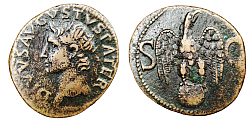 |
Tiberius (14-37 AD)
Denomination: As
Mint: Rome
Time: 34-37 AD
Weight: 10.95 g
Diameter: approx. 28.3 mm
Reference: RIC Tiberius 82
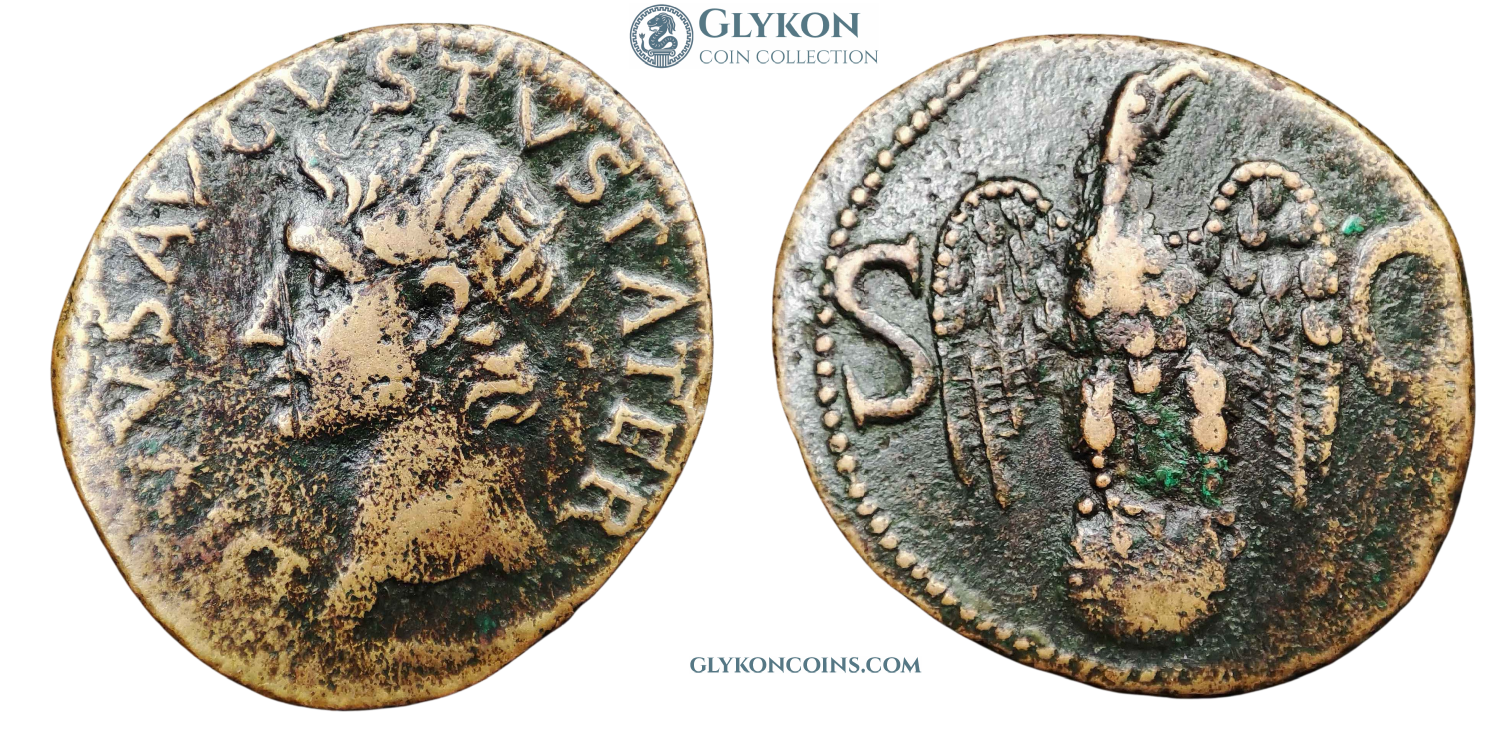
Obverse: Radiate head of deified Augustus facing left. Legend: DIVVS AVGVSTVS PATER.
Reverse: Eagle facing, wings spread, head turned right, standing on a globe, surrounded by S and C.
Comment: Posthumous issue celebrating the deified Augustus. |
|
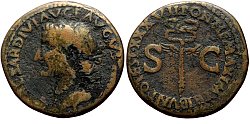 |
Tiberius (14-37 AD)
Denomination: As
Mint: Rome
Time: 35-36 AD
Weight: 10.28 g
Diameter: approx. 26.7 mm
Reference: RIC 59; Cohen 22; BMC 120; Sear 1771
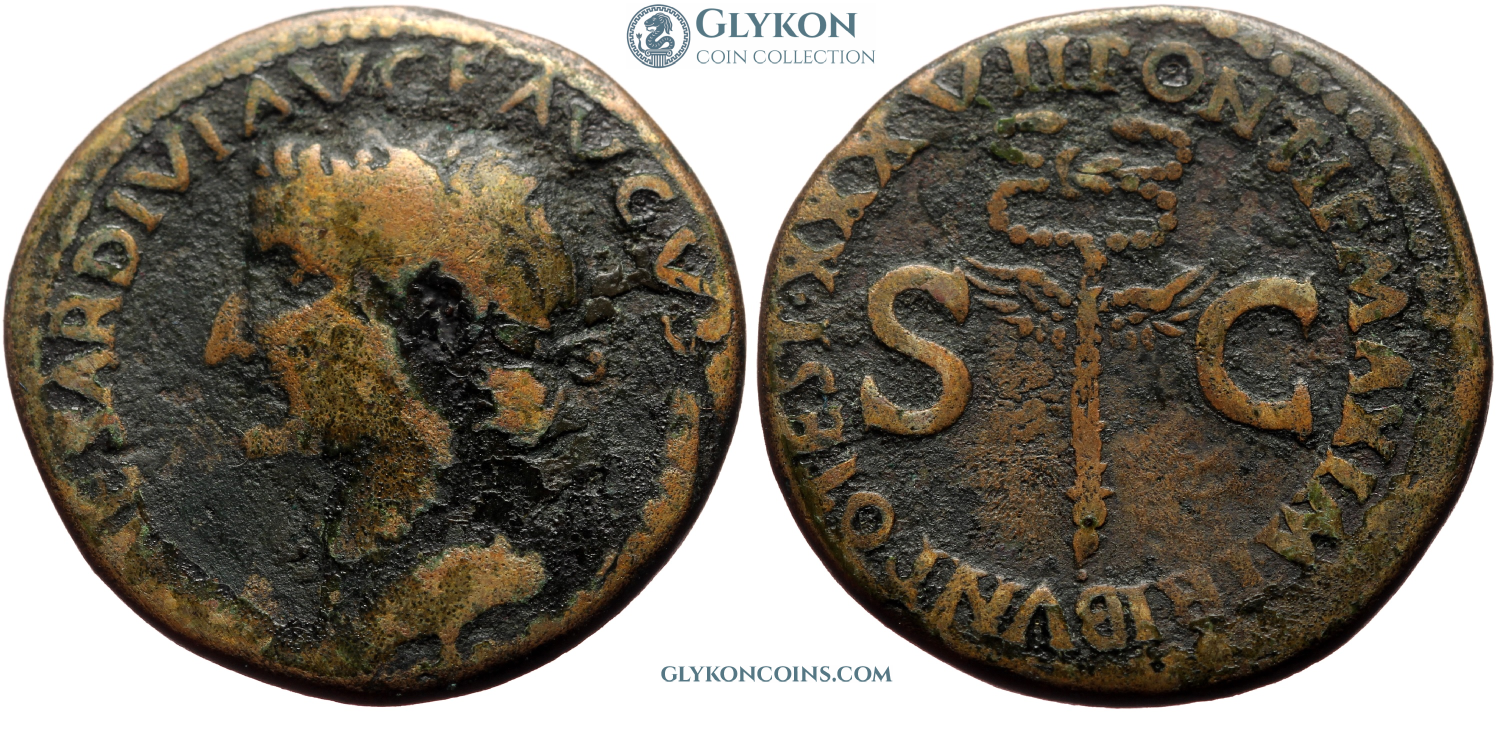
Obverse: Laureate head facing left. Legend: TI CAESAR DIVI AVG F AVGVST IMP VIII.
Reverse: Winged caduceus surrounded by S and C. Legend: PONTIF MAX TR POT XXXVII |
|
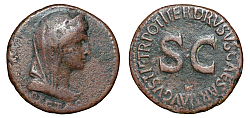 |
Tiberius (14-37 AD), issued in the name of Drusus Caesar
Denomination: Dupondius
Mint: Rome
Time: 22-23 AD
Weight: 12.68 g
Diameter: approx. 28.5 mm
Reference: RIC 43; Cohen 1; Sear 1741
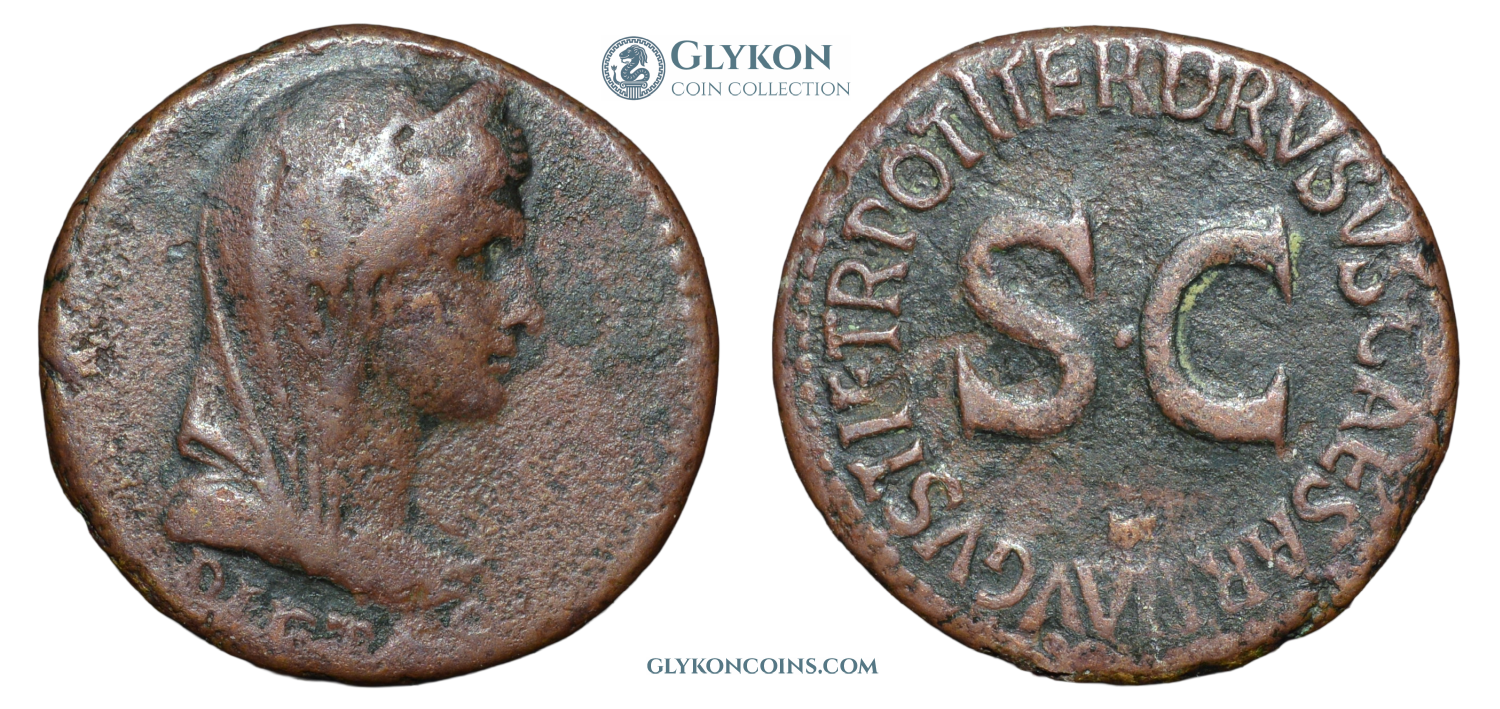
Obverse: Veiled, diademed and draped bust of Pietas (Piety) facing right. Legend: PIETAS.
Reverse: Large S·C. Legend: DRVSVS CAESAR TI AVGVSTI F TR POT ITER
Comment: Among the well known ancient coins, much debate has been devoted to identifying the female whose bust serves as Pietas' (deified personification of Piety) effigy. Various theories propose many Roman noblewomen including but not limited to Livia (Tiberius' mother and Augustus' third wife), Livilla (Tiberius' niece and daughter-in-law, Drusus Caesar's wife) or Vipsania (Tiberius' wife). Finally, it may simply be the image of the goddess without referencing any real person. |
|
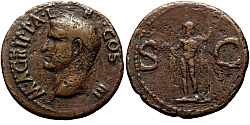 |
Caligula (37-41 AD)
Denomination: As
Mint: Rome
Time: 41 AD
Weight: 10.48 g
Diameter: approx. 28.8 mm
Reference: RIC I 58; Cohen 3; BMC 161
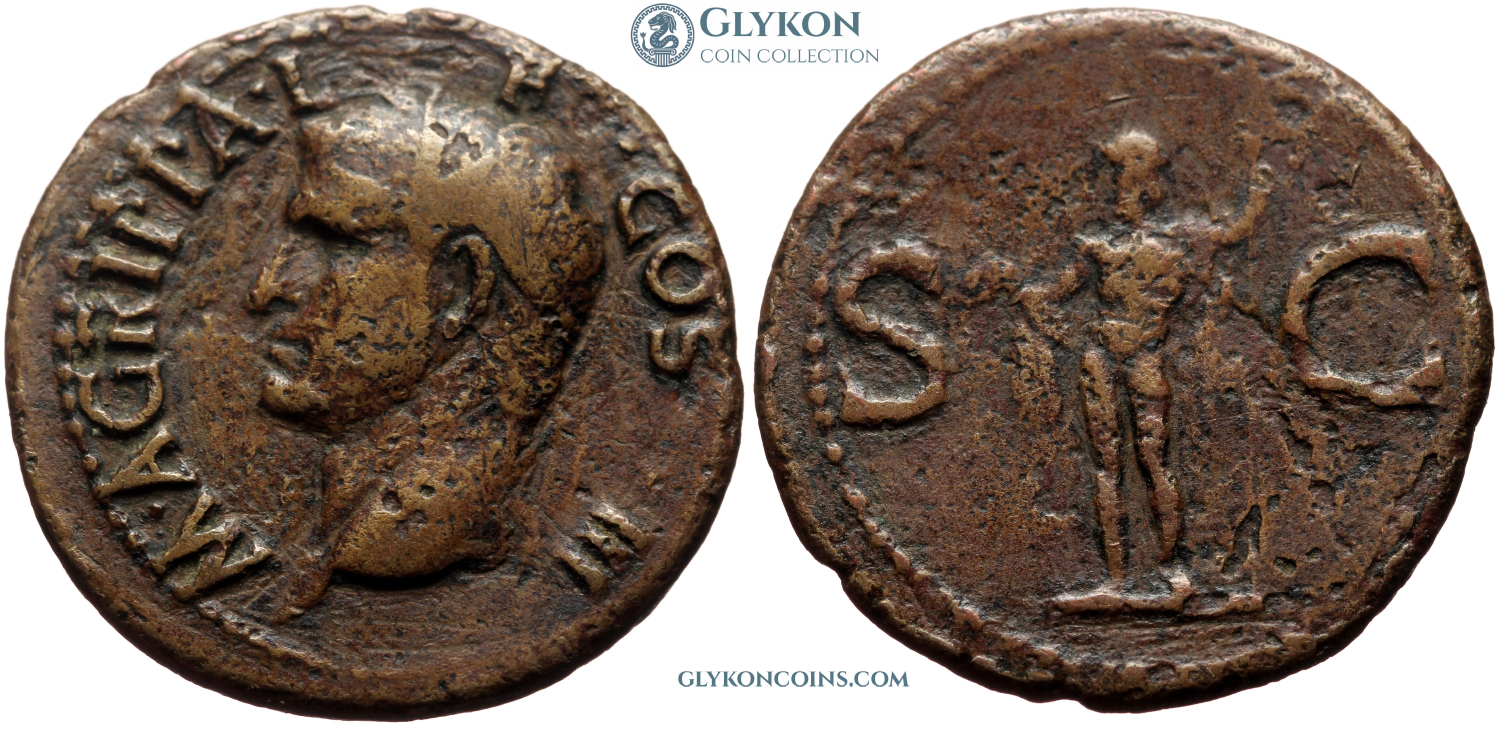
Obverse: Head of Agrippa wearing rostal (naval) crown facing left. Legend: M·AGRIPPA·L F·COS·III.
Reverse: Neptune standing facing, head turned left, naked and draped in a cloak, holding a dolphin in his right hand and a trident in his left hand, surrounded by S and C. |
|
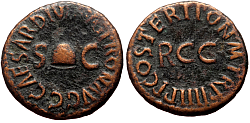 |
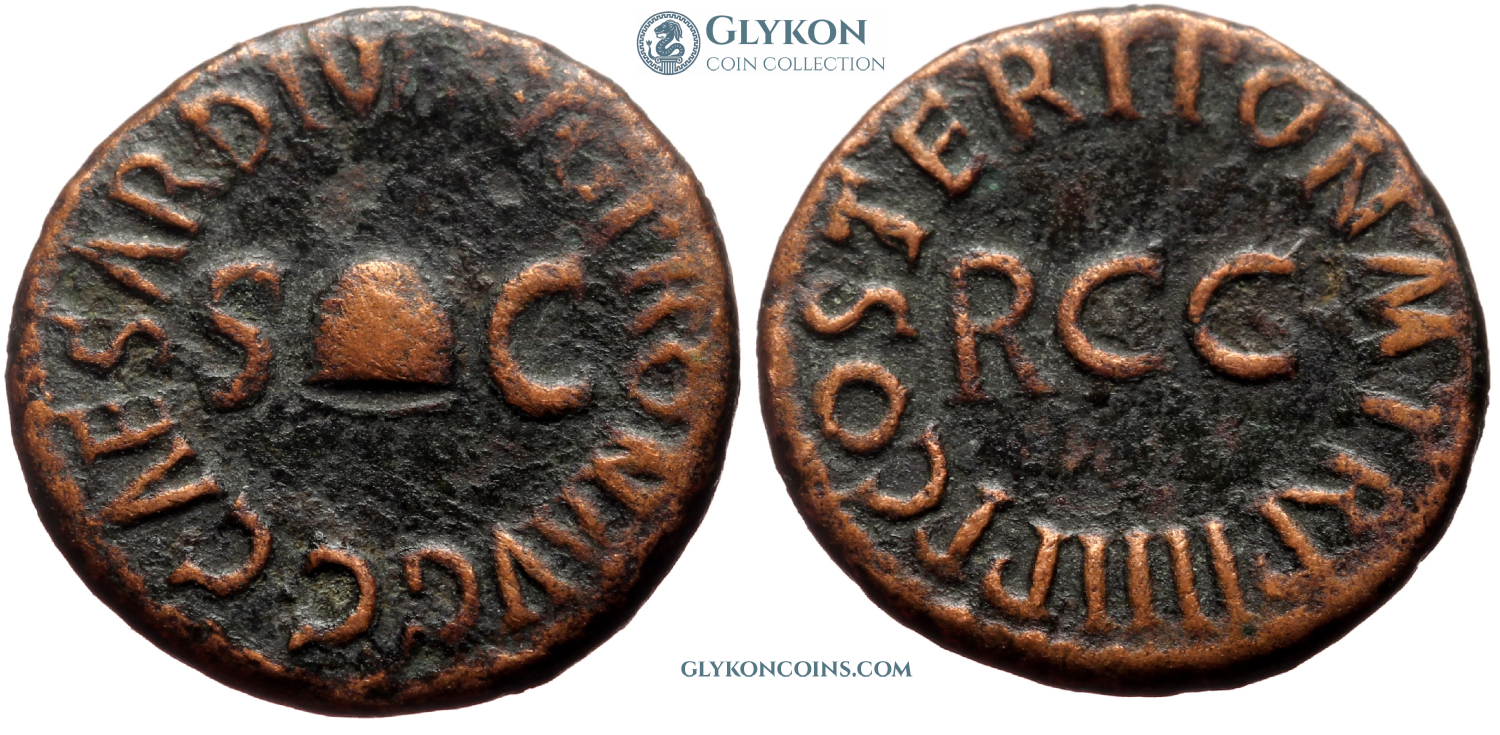
Caligula (37-41 AD)
Denomination: Quadrans
Mint: Rome
Time: 37-41 AD
Weight: 3.04 g
Diameter: approx. 17.3 mm
Reference: RIC 52; Cohen 7; BMC 64; CBN 109
Obverse: Pileus (liberty hat) between S and C. Legend: C CAESAR DIV AVG PRON AVG.
Reverse: Large RCC surrounded by legend. Legend: COS TERT PON M TR P IIII P P. |
|
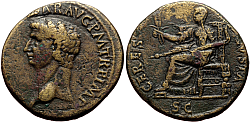 |
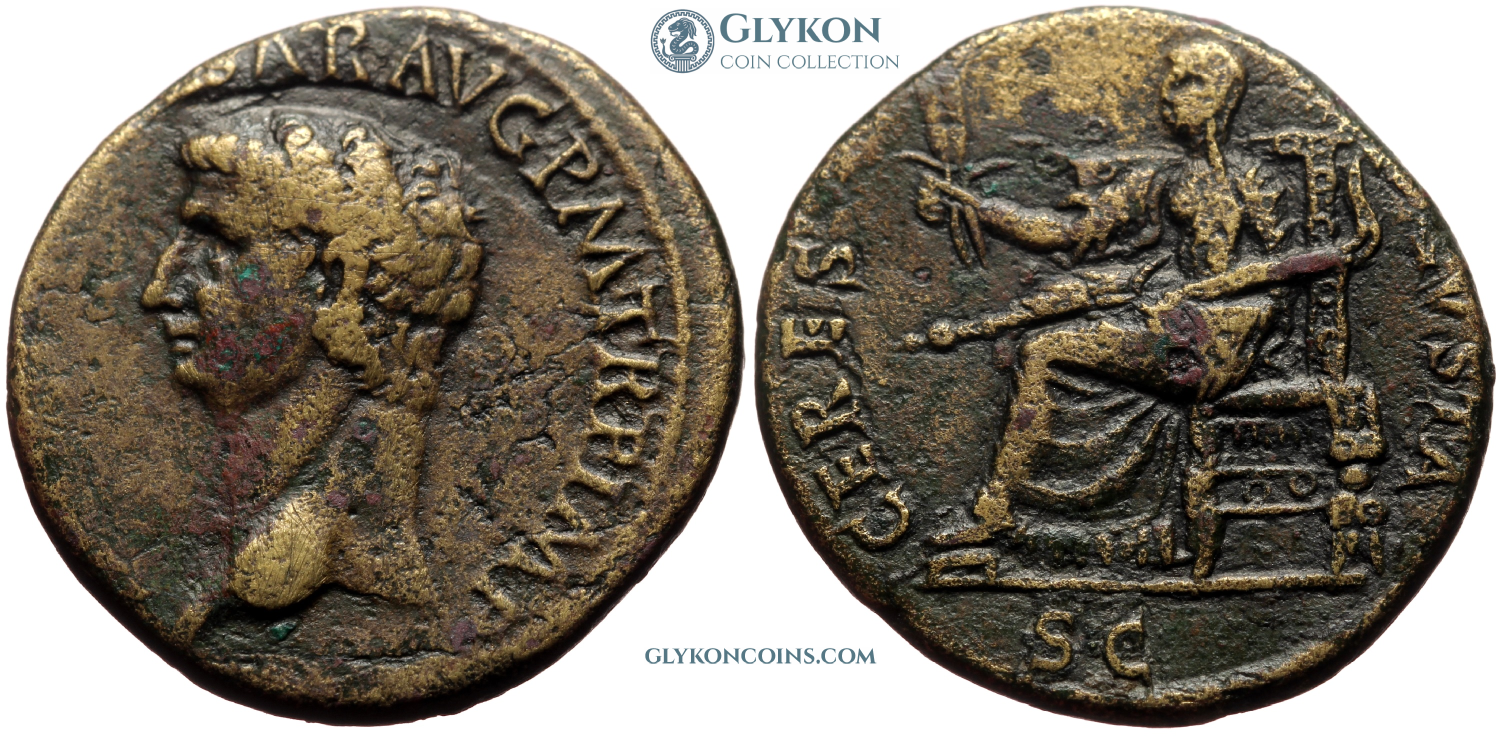
Claudius (41-54 AD)
Denomination: As
Mint: Rome
Time: 41-45 AD
Weight: 12.22 g
Diameter: approx. 27.1 mm
Reference: RIC I 94
Obverse: Bare head of Claudius facing left. Legend: TI CLAVDIVS CAESAR AVG P M TR P IMP.
Reverse: Drapped and veiled Ceres siting on a throne facing left, holding a bundle of corn ears and a long torch. Legend: CERES AVGVSTA. SC below in exergue. |
|
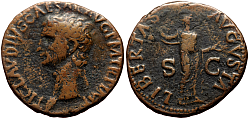 |
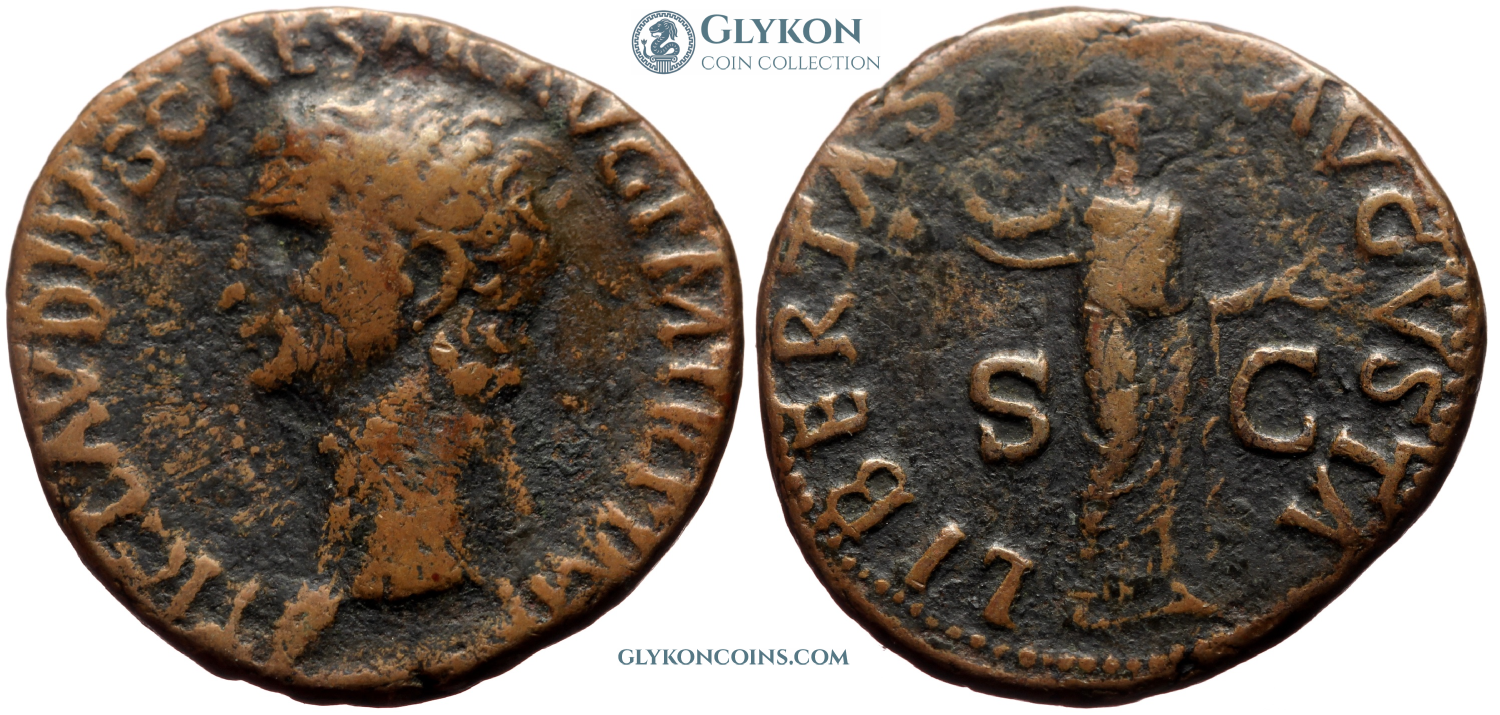
Claudius (41-54 AD)
Denomination: As
Mint: Rome
Time: 50-54 AD
Weight: 11.70 g
Diameter: approx. 25.3 mm
Reference: RIC I Claudius 113
Obverse: Bare head of Claudius facing left. Legend: TI CLAVDIVS CAESAR AVG P M TR P IMP P P.
Reverse: Between large S and C draped Libertas standing facing right, holding pileus (liberty hat) in right hand and extending left hand. Legend: LIBERTAS AVGVSTA.
|
|
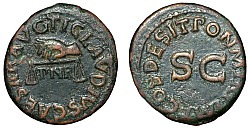 |
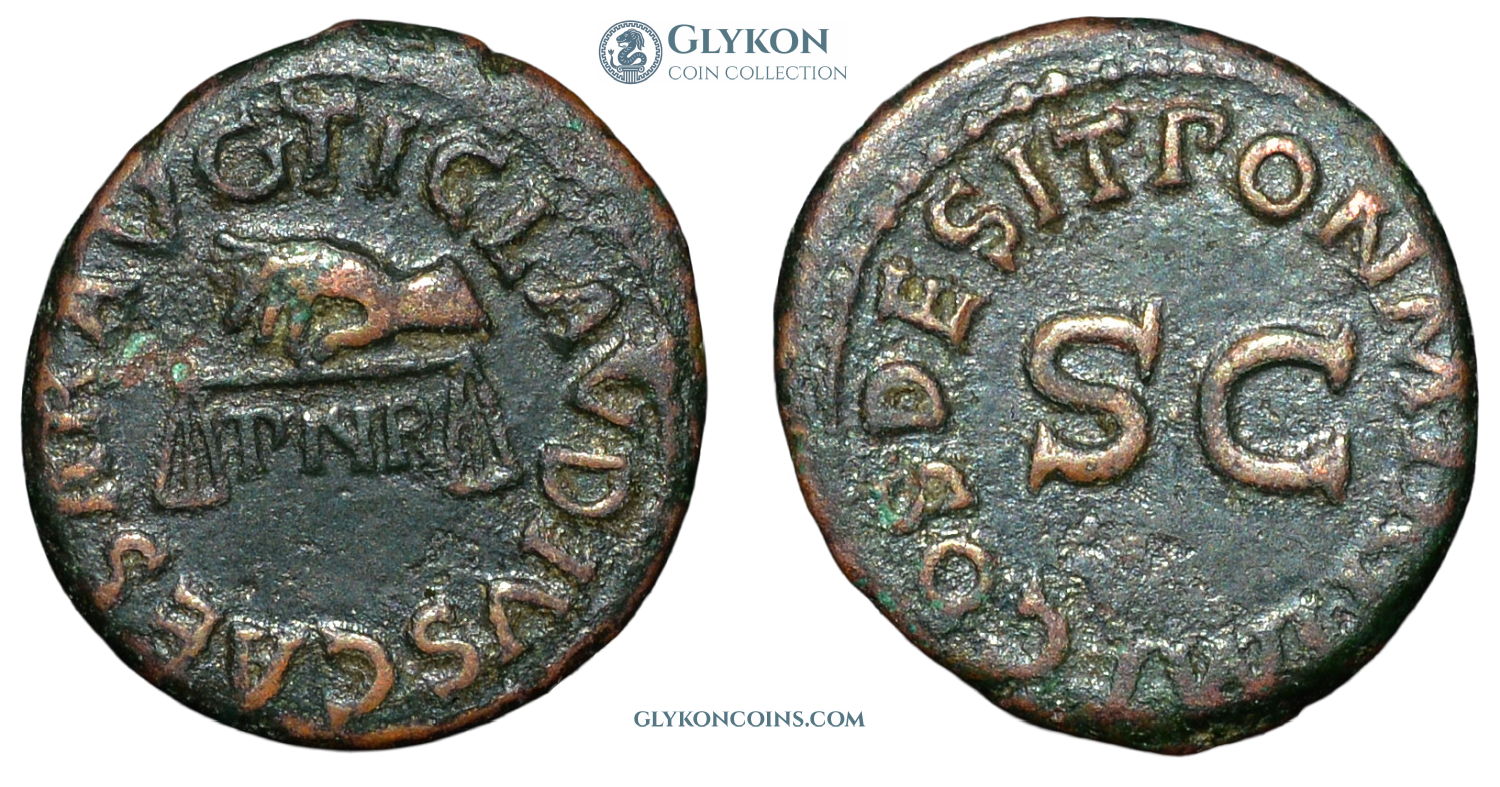
Claudius (41-54 AD)
Denomination: Quadrans
Mint: Rome
Time: 41-42 AD
Weight: 3.31 g
Diameter: approx. 17.7 mm
Reference: RIC I 85
Obverse: Hand holding a set of scales. PNR below. Legend: TI CLAVDIVS CAESAR AVG.
Reverse: Large SC. Legend: PON M TR P IMP COS DES IT.
Comment: Numismatists and historians still debate what the enigmatic "PNR" represents. The leading theory is that is should be read "Pondus Nummorum Restitutum", that is "Weight of the coins (has been) restored. It could mean that Claudius is boasting that some inflationary/debasement trends under Caligula have been reversed. The weakness of that theory is that there was no significant debasement under Caligula. |
|
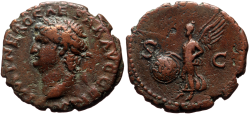 |
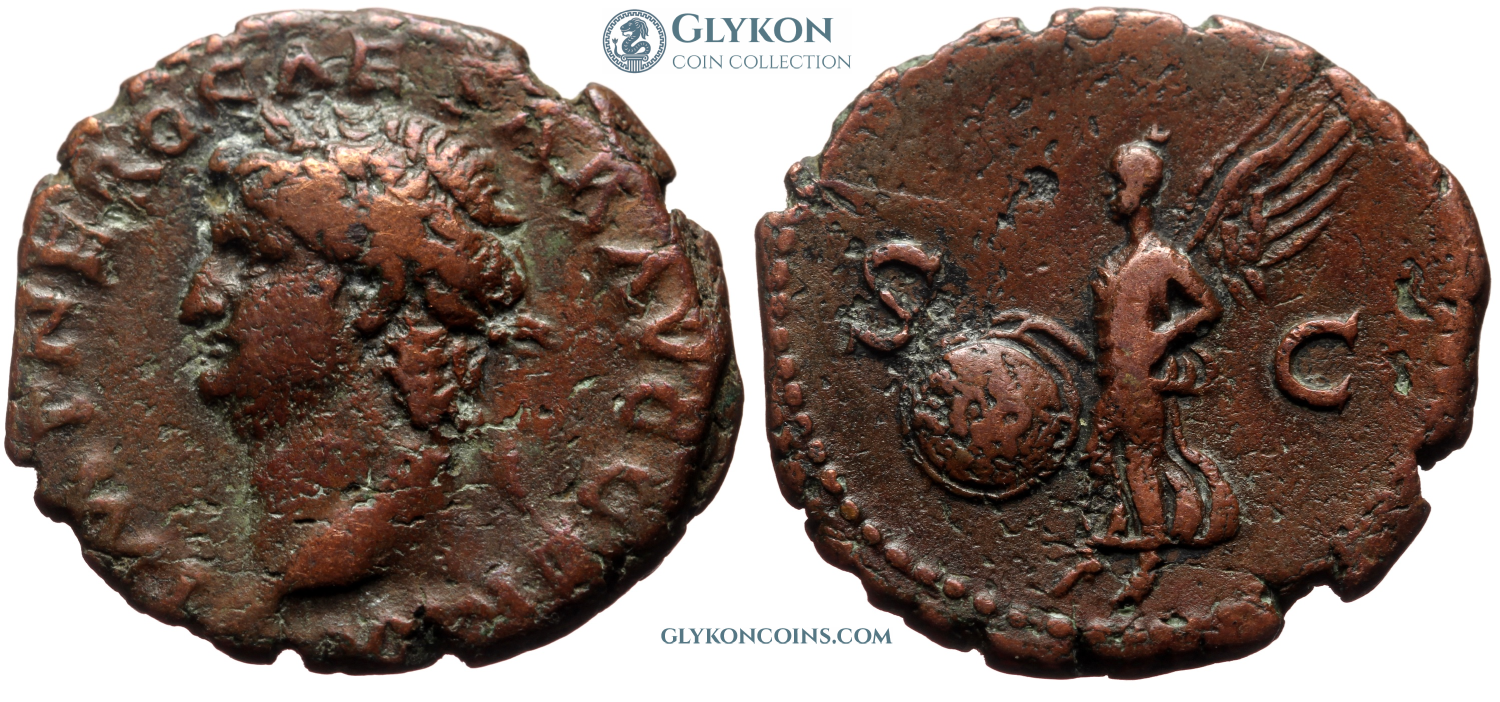
Nero (54-68 AD)
Denomination: As
Mint: Rome
Time: 66 AD
Weight: 10.22 g
Diameter: approx. 27.8 mm
Reference: RIC I 352
Obverse: Laureate head of Nero to left. Legend: IMP NERO CAESAR AVG GERM.
Reverse: Drapped winged Victory advancing to left, holding a round shield labelled SPQR, surrounded by S and C. |
|
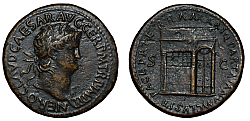 |
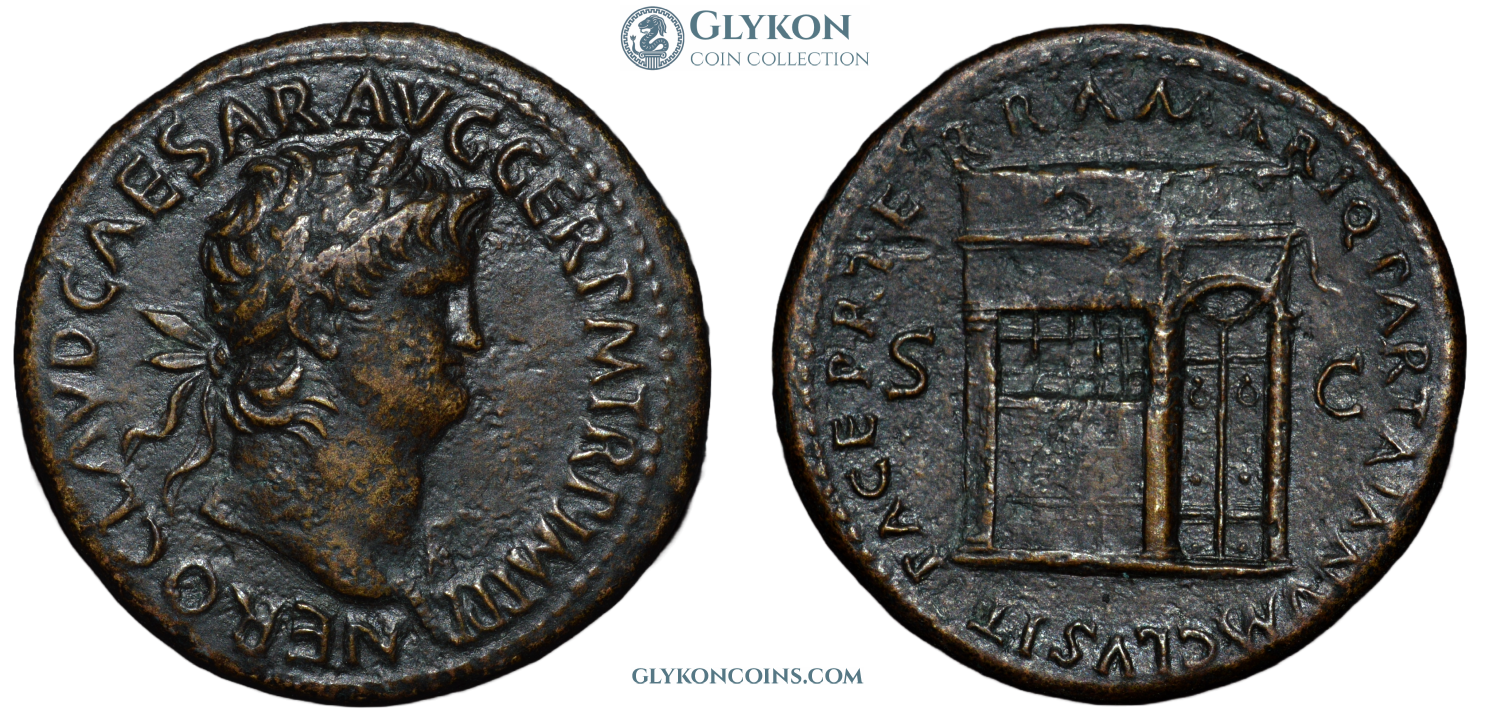
Nero (54-68 AD)
Denomination: Sestertius
Mint: Rome
Time: 65 AD
Weight: 25.92 g
Diameter: approx. 35.7 mm
Reference: RIC I 264, Cohen 146; Provenance: InAsta, Auction 68 (23 May 2017), Lot 427; https://www.coinarchives.com/a/openlink.php?l=1348498%7C2727%7C427%7Cf64dc076ec36b12deef8d10856b005d1 (misidentified)
Obverse: Laureate head of Nero facing right, Aegis on left shoulder. Legend: NERO CLAVD CAESAR AVG GER PM TR P IMP PP.
Reverse: Garlanded temple of Janus in Rome with latticed windows and closed gate, surrounded by S and C. Legend: PACE P R TERRA MARIQ PARTA IANVM CLVSIT. |
|
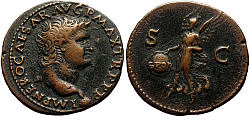 |
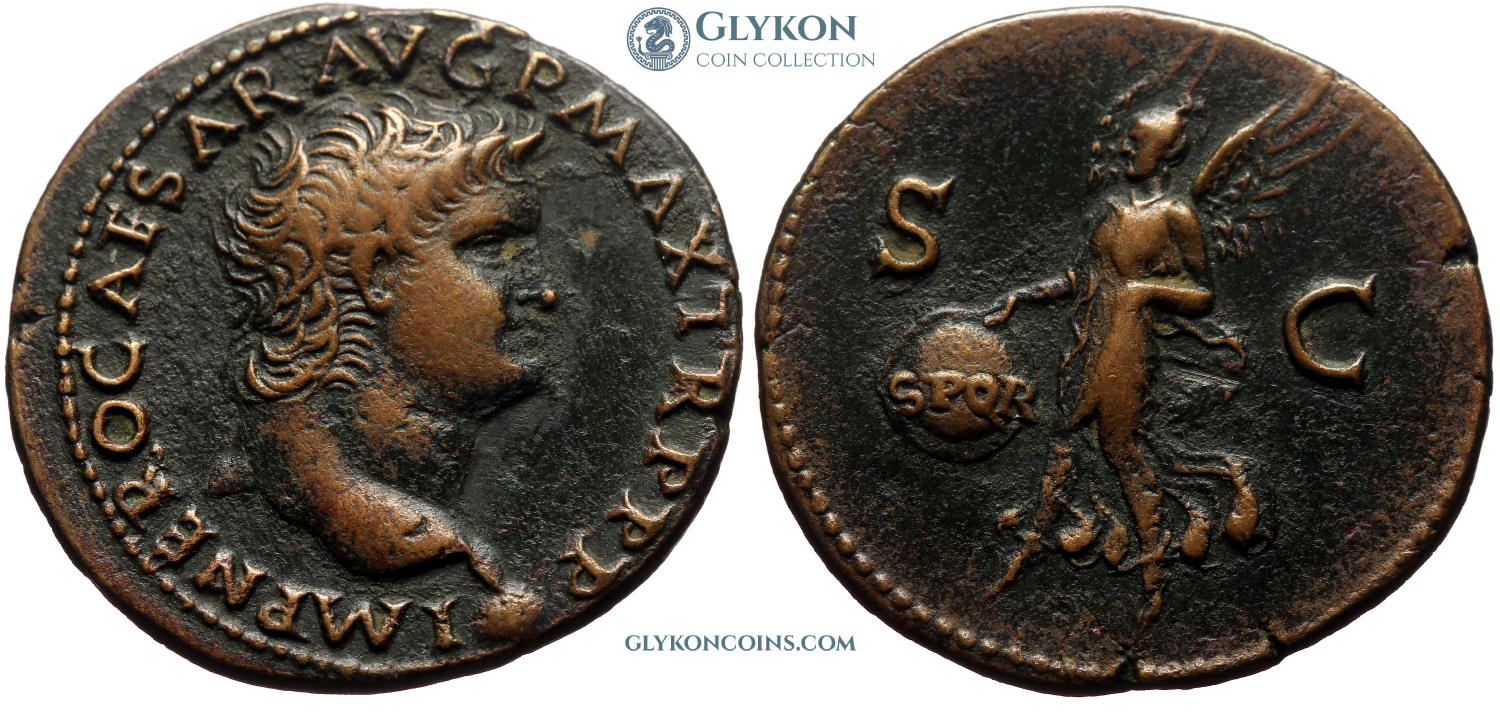
Nero (54-68 AD)
Denomination: As
Mint: Lugdunum (Lyon)
Time: 65-68 AD
Weight: 10.96 g
Diameter: approx. 28.5 mm
Reference: RIC I 543
Obverse: Bare head of Nero facing right. Small globe on lower right, touching neck. Legend: IMP NERO CAESAR AVG P MAX TRP PP.
Reverse: Drapped winged Victory advancing to left, holding a round shield labelled SPQR, surrounded by S and C. |
|
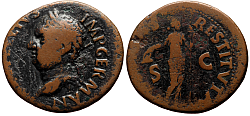 |
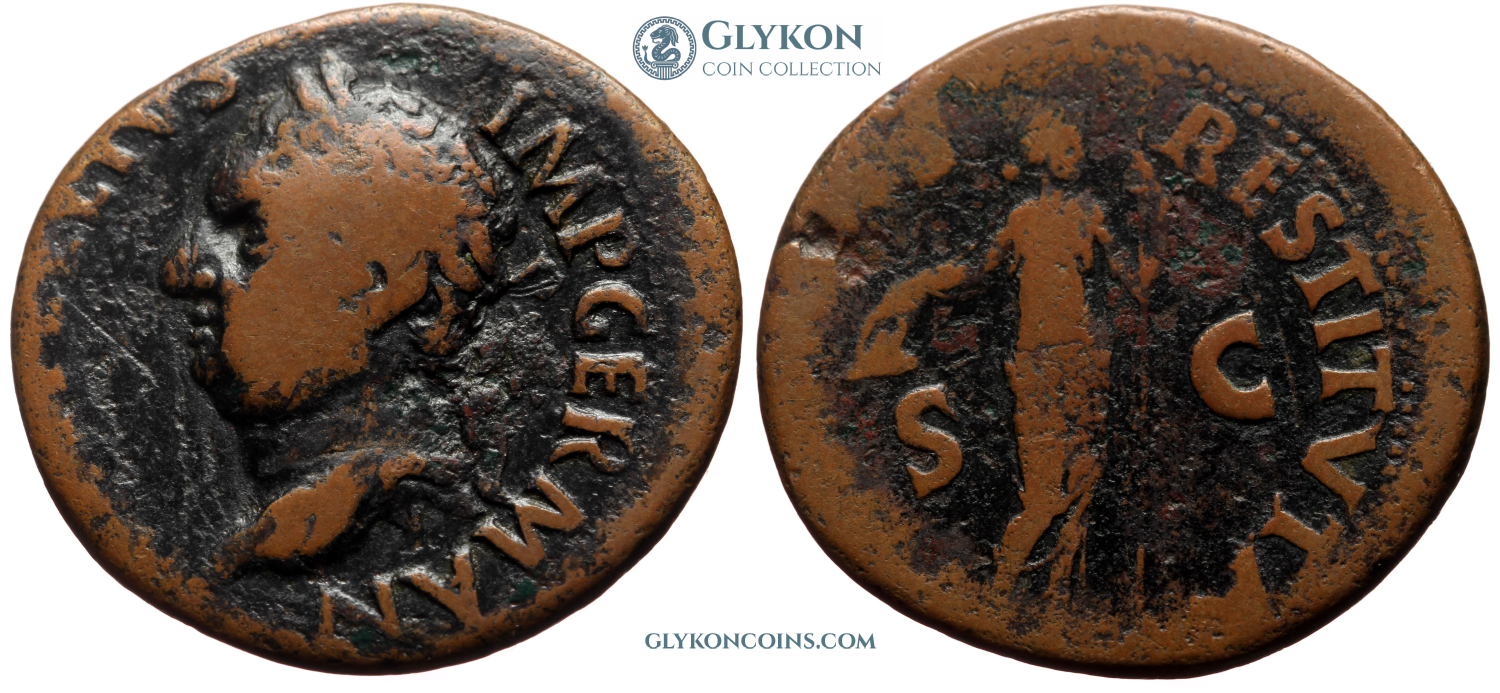
Vitellius (69 AD)
Denomination: As
Mint: probably Tarraco (modern Tarragona) in Spain
Time: 69 AD
Weight: 8.68 g
Diameter: approx. 27.5 mm
Reference: RIC I 43
Obverse: Laureate head of Vitellius facing left. Legend: A VITELLIVS IMP GERMAN.
Reverse: Draped Libertas standing front between S and C, head hacing right, holding a pileus (liberty hat) in right hand and a spear or rod in left hand. Legend: LIBERTAS RESTITVTA.
|
|
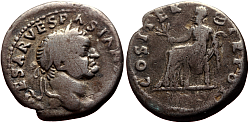 |
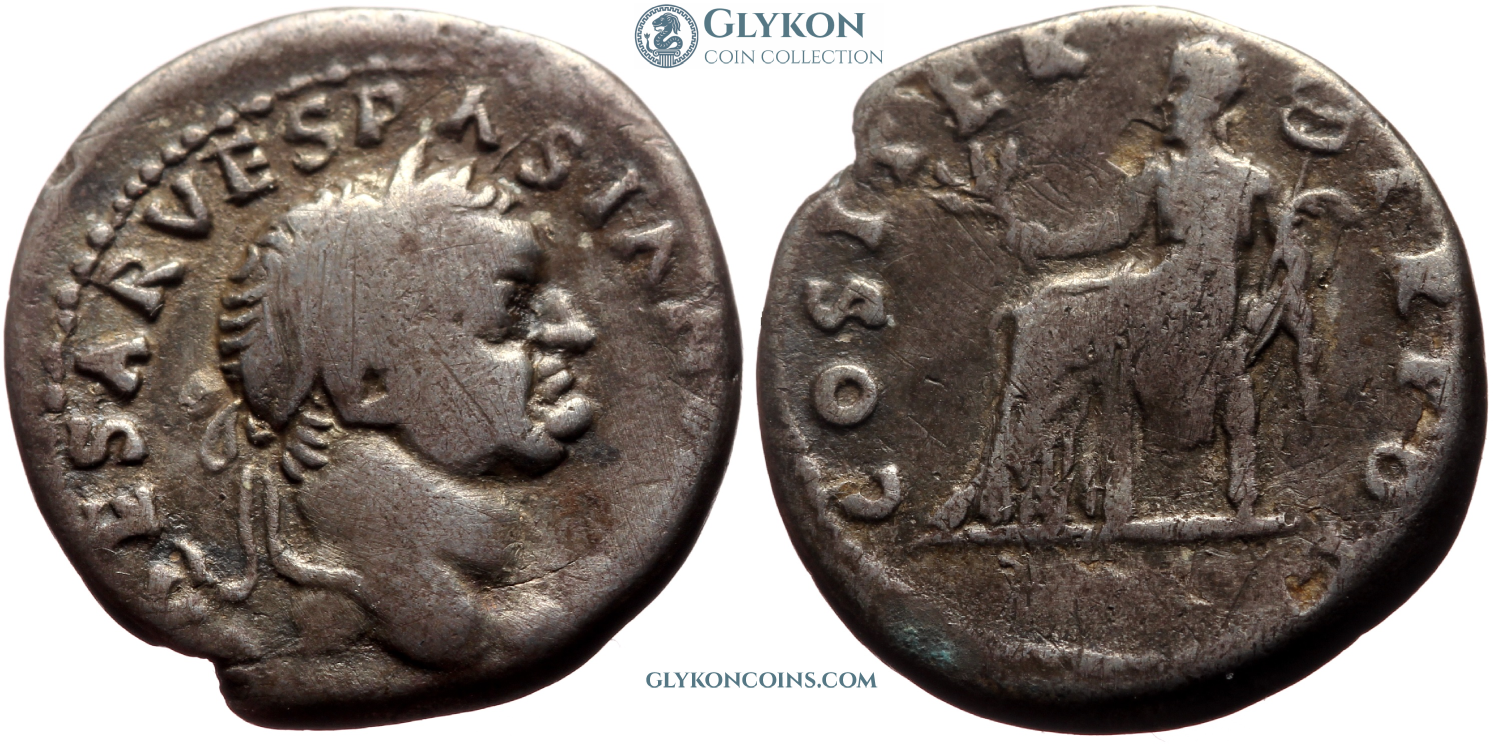
Vespasian (69-79 AD)
Denomination: Denarius
Mint: Rome
Time: 69-71 AD
Weight: 3.12 g
Diameter: approx. 17.5 mm
Reference: RIC II 29; Sear 2285, BMCRE 26-30
Obverse: Laureate head of Vespasian facing right. Legend: IMP CAESAR VESPASIANVS AVG.
Reverse: Draped Pax seated facing left, holding a branch in right hand and a winged caduceus in left hand. Legend: COS ITER TR POT. |
|
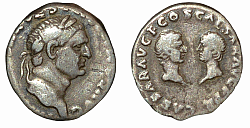 |
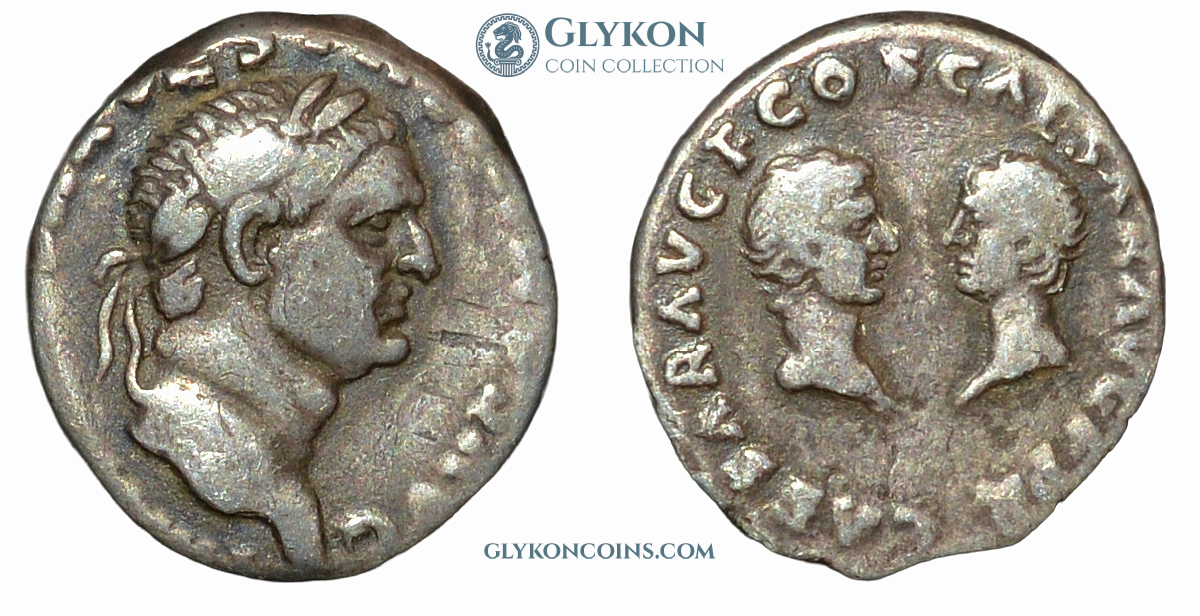
Vespasian (69-79 AD)
Denomination: Denarius
Mint: Rome
Time: 70 AD
Weight: 3.17 g
Diameter: approx. 16.2 mm
Reference: MIR 595; Coh. 5; BMC 3; RIC 16; Sear 2399; ex Kunker 326/1357
Obverse: Laureate head of Vespasian facing right. Legend: IMP CAESAR VESPASIANVS AVG.
Reverse: Heads of Titus (left) and Domitian (right) facing each other. Legend: CAESAR AVG F COS CAESAR AVG F PR.
Comment: Interesting dynastic type, advertising the sons of Vespasian, both of whom would be emperors. |
|
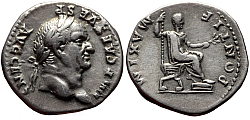 |
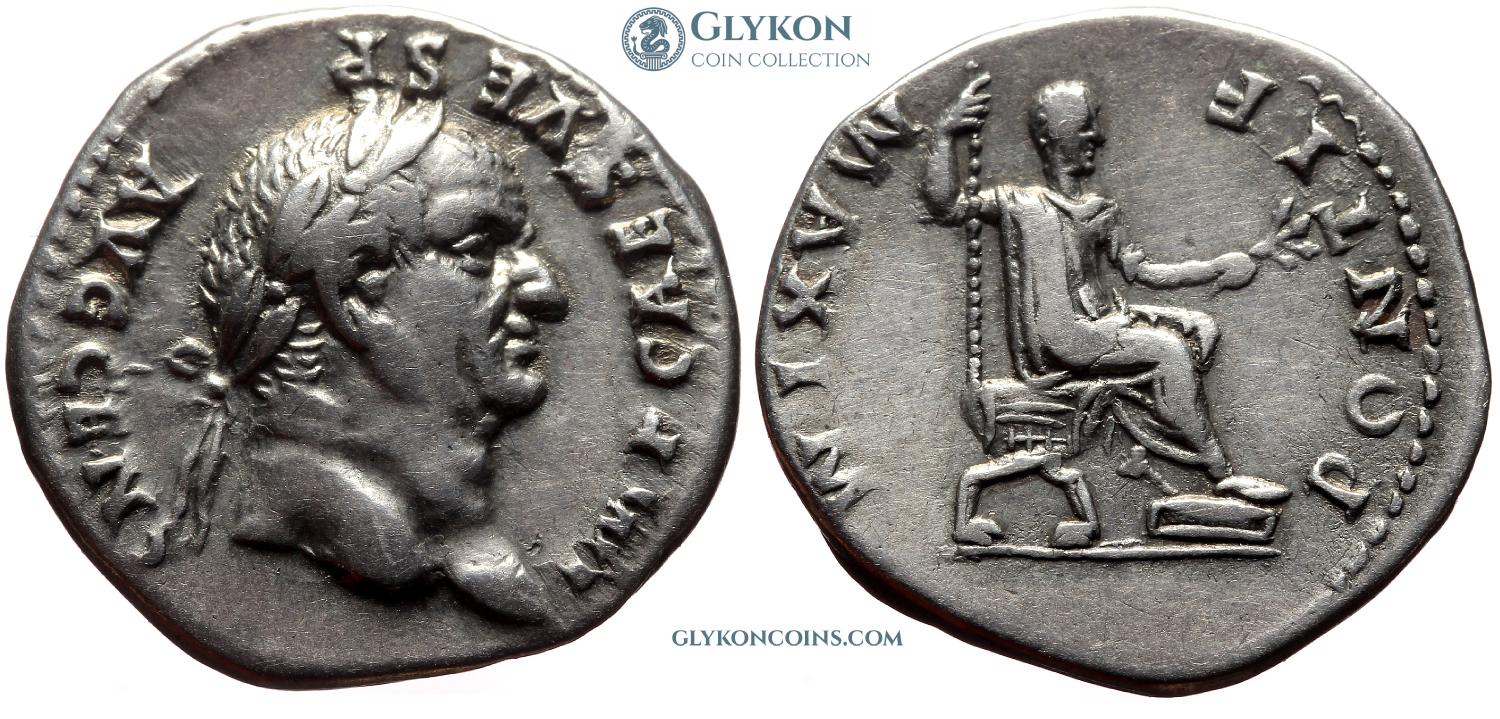
Vespasian (69-79 AD)
Denomination: Denarius
Mint: Rome
Time: 73 AD
Weight: 3.49 g
Diameter: approx. 19.3 mm
Reference: RIC 546; Sear 2305
Obverse: Laureate head of Vespasian facing right. Legend: IMP CAES VESP AVG CENS (Imperator Caesar Vespasianus Augustus Censor).
Reverse: Vespasian as Pontifex Maximus seated to right, holding a branch and a scepter. Legend: PONTIF MAXIM. |
|
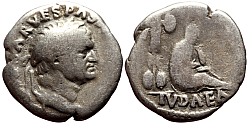 |
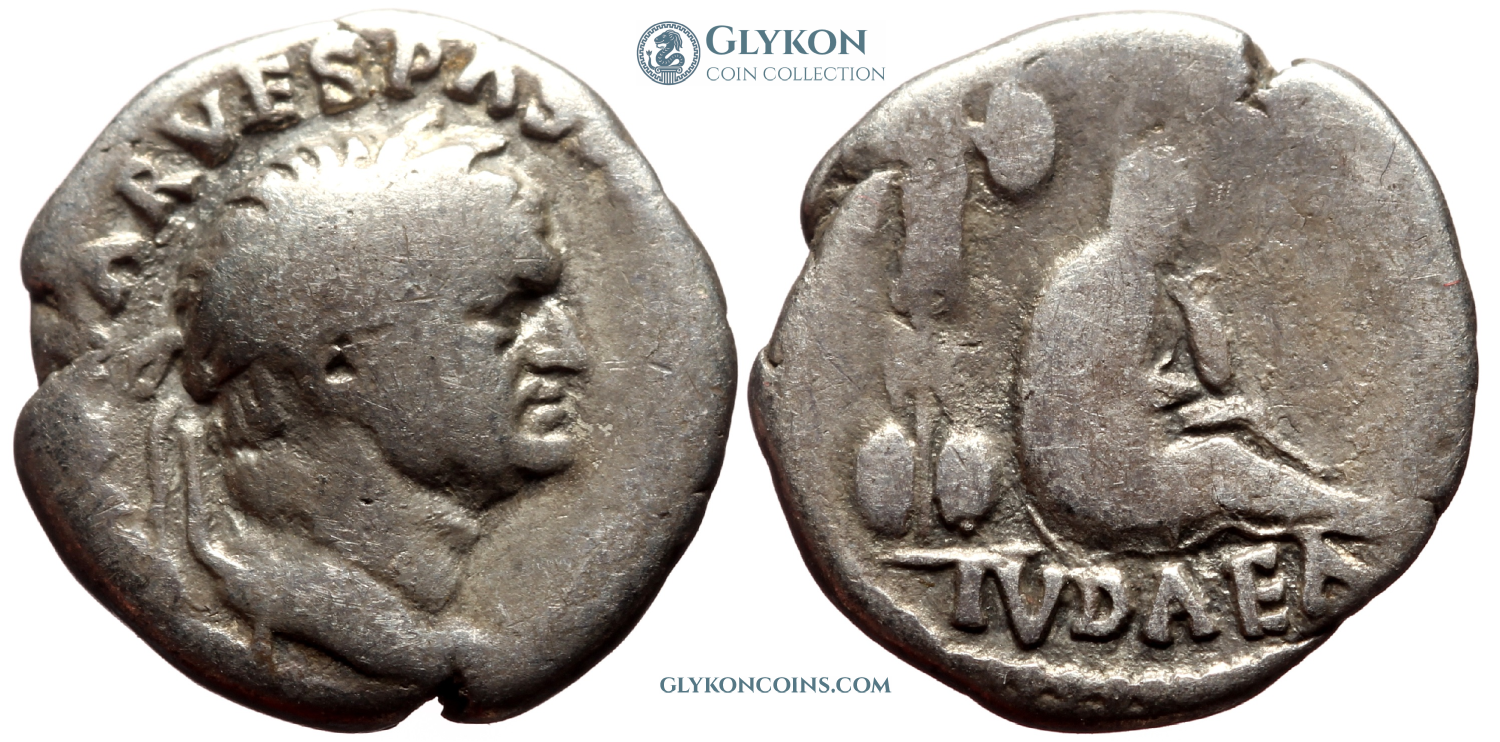
Vespasian (69-79 AD)
Denomination: Denarius
Mint: Rome
Time: 69/70 AD
Weight: 2.54 g
Diameter: approx. 16.2 mm
Reference: RIC II 2; Hendin 1479
Obverse: Laureate head of Vespasian facing right. Legend: IMP CAESAR VESPASIANVS AVG
Reverse: Mourning personified Judaea seated facing right, trophy on the left. Legend: IVDAEA
Comment: Part of the famous "Judaea Capta" series commemorating the crushing of the Jewish Revolt. |
|
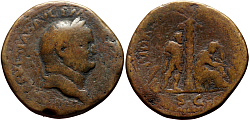 |
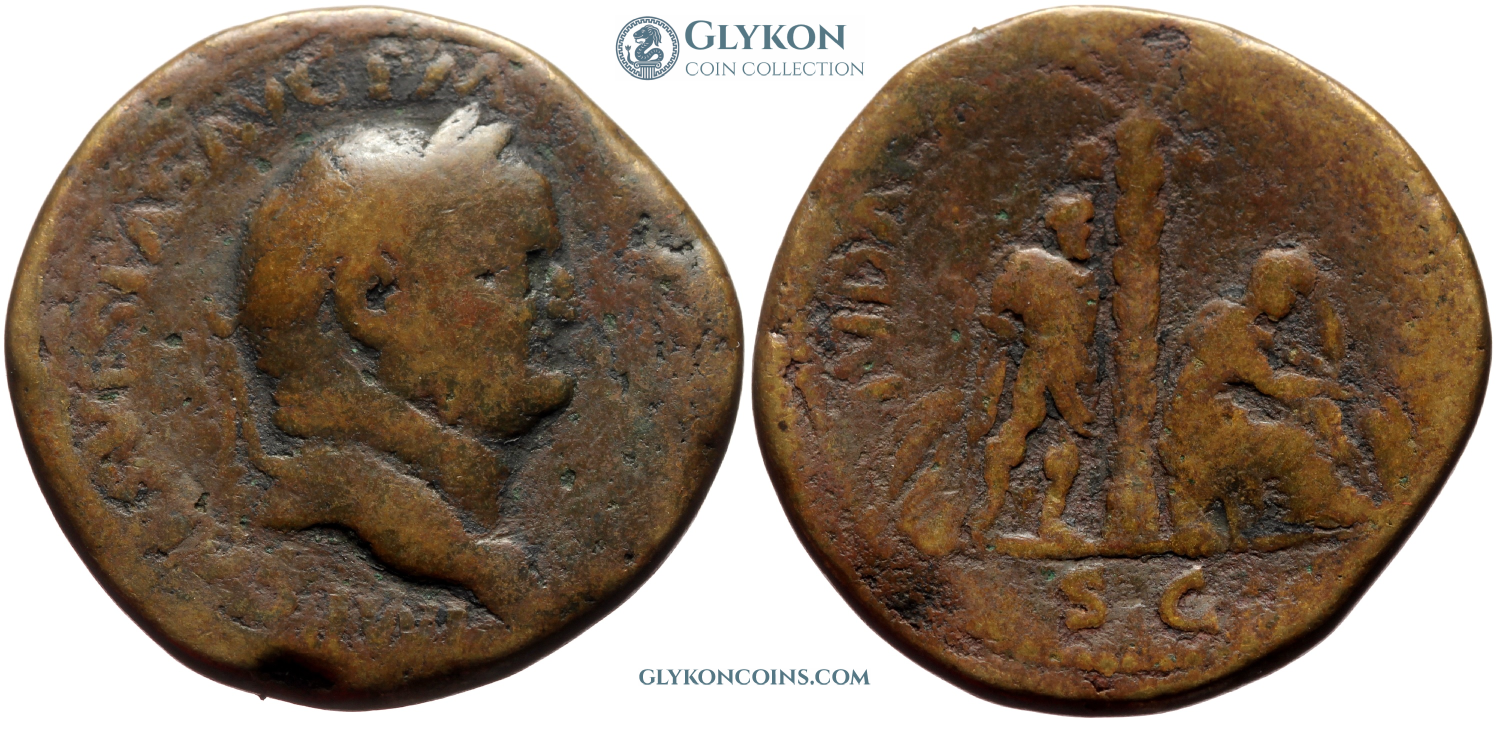
Vespasian (69-79 AD)
Denomination: Sestertius
Mint: Rome
Time: 71 AD
Weight: 21.44 g
Diameter: approx. 32.2 mm
Reference: RIC II 159
Obverse: Laureate head of Vespasian facing right. Legend: IMP CAES VESPASIAN AVG PM TR PPP COS III
Reverse: Mourning personified Judaea seated under a palm tree facing right, behind the tree a captive standing facing right with hands tied. On the left discarded three shields, a helmet and two spears. Legend: IVDAEA CAPTA, and SC in exergue.
Comment: Part of the famous "Judaea Capta" series commemorating the crushing of the Jewish Revolt. |
|
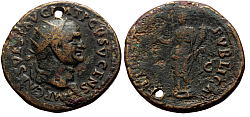 |
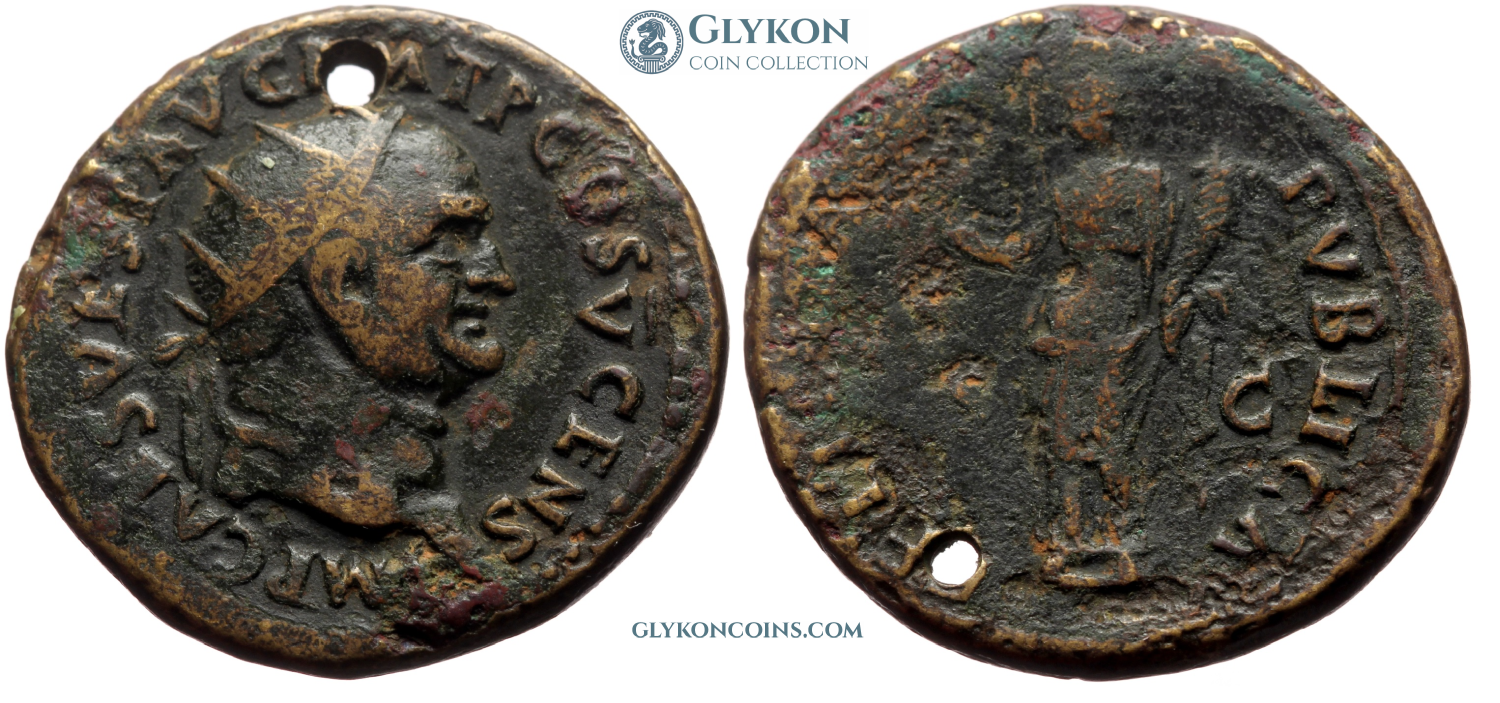
Vespasian (69-79 AD)
Denomination: Dupondius
Mint: Rome
Time: 74 AD
Weight: 13.48 g
Diameter: approx. 27.3 mm
Reference: RIC II 715, Cohen 153
Obverse: Radiate head of Vespasian facing right. Legend: IMP CAES VESP AVG P M T P COS V CENS.
Reverse: Felicitas standing facing left, flanked by large S and C, holding cornucopia in left hand and caduceus in right hand. Legend: FELICITAS PVBLICA. |
|
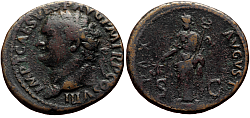 |
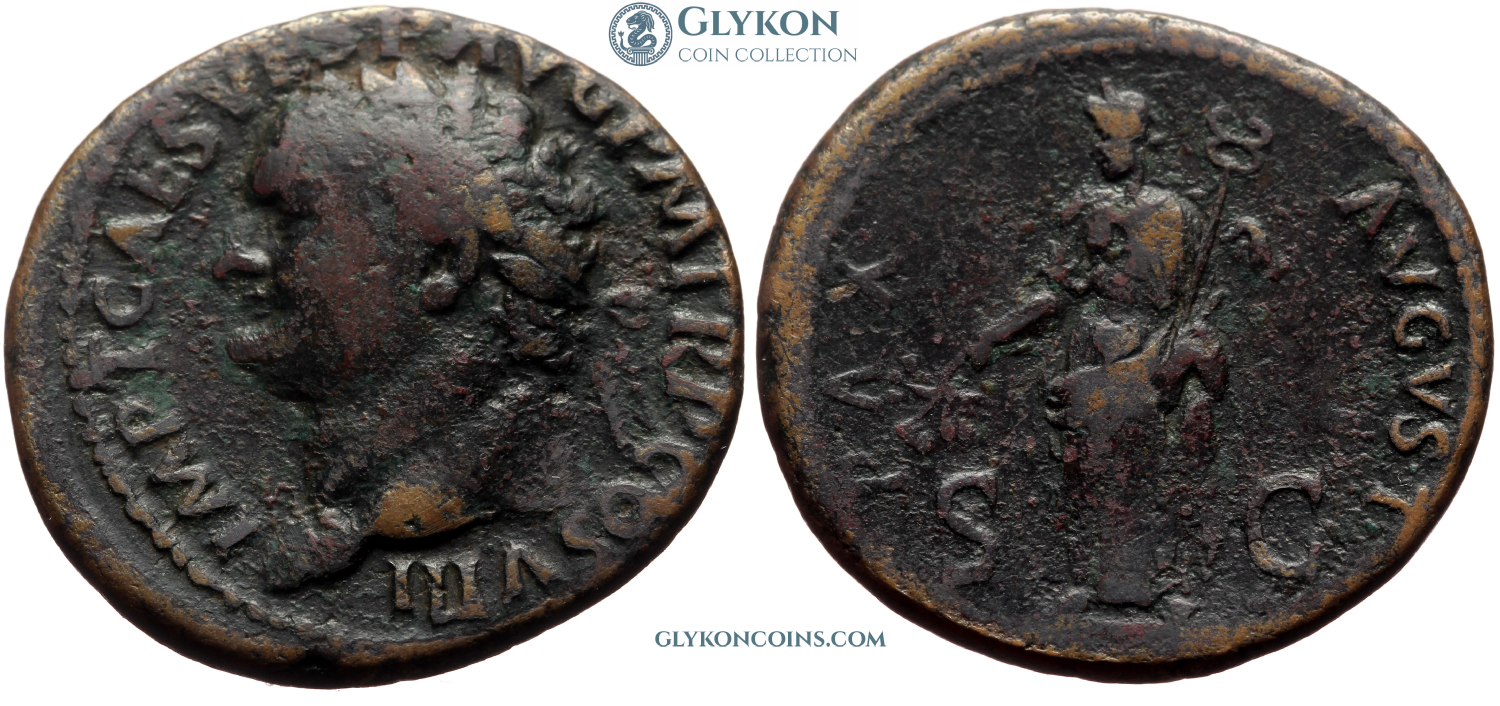
Titus (79-81 AD)
Denomination: As
Mint: Rome
Time: 80 AD
Weight: 10.65 g
Diameter: approx. 27.6 mm
Reference: RIC II 230; BMC 212
Obverse: Laureate head of Titus facing left. Legend: IMP T CAES VESP AVG P M TR P COS VIII.
Reverse: Pax standing facing left flanked by on the bottom by large S and C, holding branch and winged caduceus. Legend: PAX AVGVST. |
|
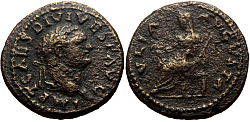 |
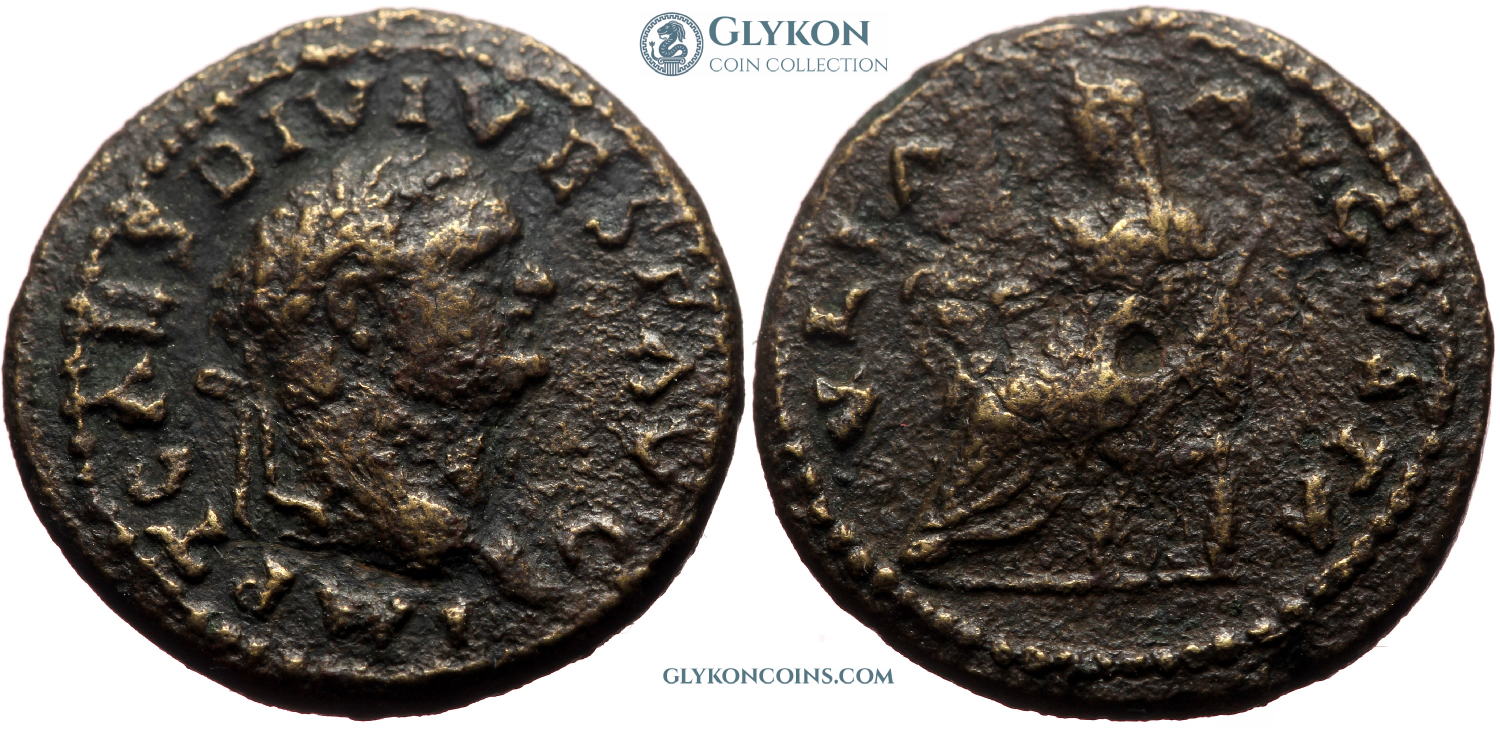
Titus (79-81 AD)
Denomination: Quadrans
Mint: Unknown mint in the Balkan region, possibly Heraclea Perinthus
Time: 80-81 AD
Weight: 2.96 g
Diameter: approx. 15.8 mm
Reference: RIC II 505-506
Obverse: Laureate head of Titus facing right. Legend: IMP T CAES DIVI VES F AVG.
Reverse: Julia Titi (Titus daughter) seated facing left, holding patera and sceptre. Legend: IVLIA AVGVSTA. |
|
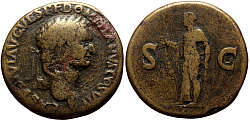 |
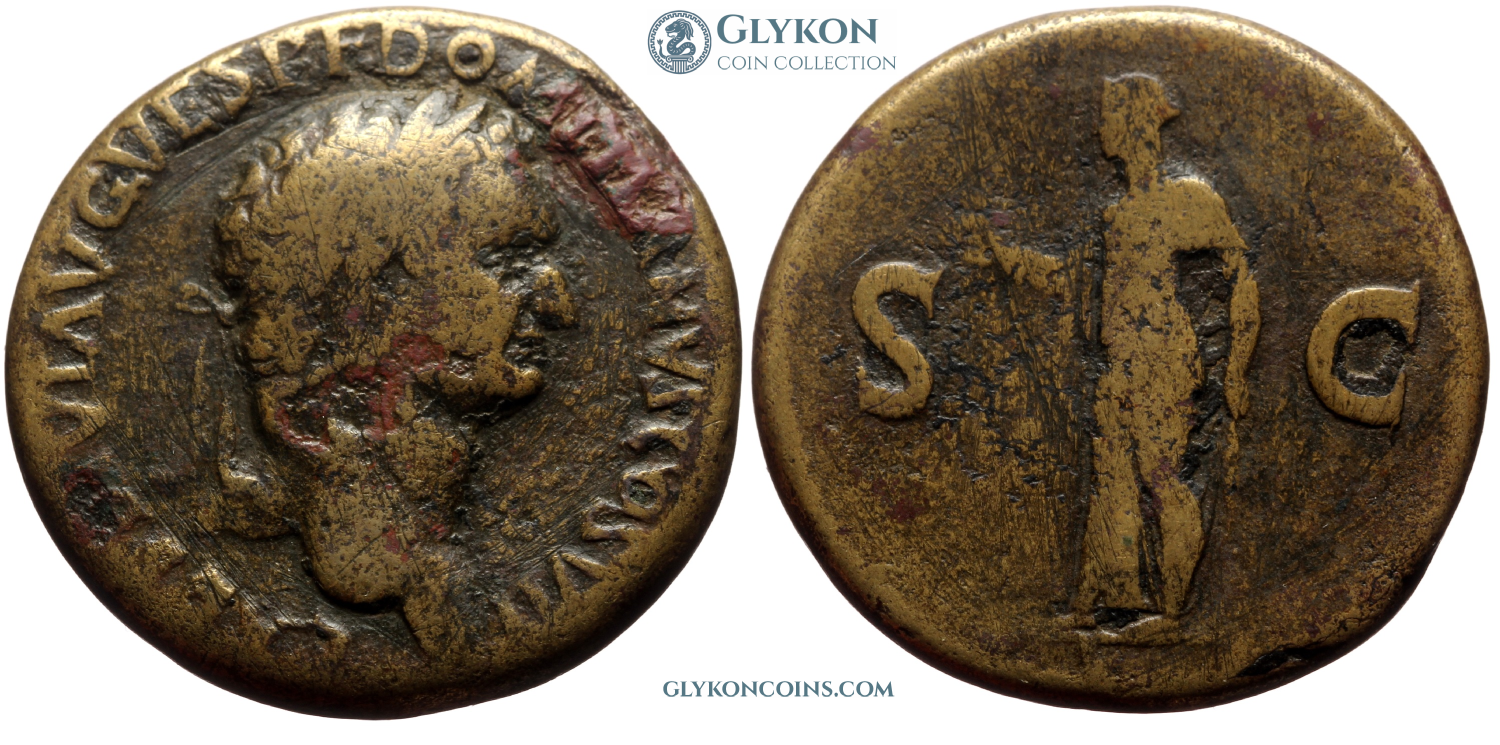
Domitian (81-96 AD)
Denomination: Sestertius
Mint: Rome
Time: 79-81 AD (as junior emperor under Titus)
Weight: 24.48 g
Diameter: approx. 33.3 mm
Reference: RIC 298; Cohen 460; BMC 234
Obverse: Laureate head of Domitian facing right. Legend: CAES DIVI AVG VESP F DOMITIANVS COS VII.
Reverse: Spes flanked by large S and C advancing towards left, raising her robe with left hand and holding flower in raised right hand. |
|
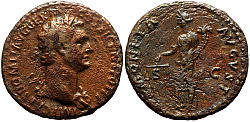 |
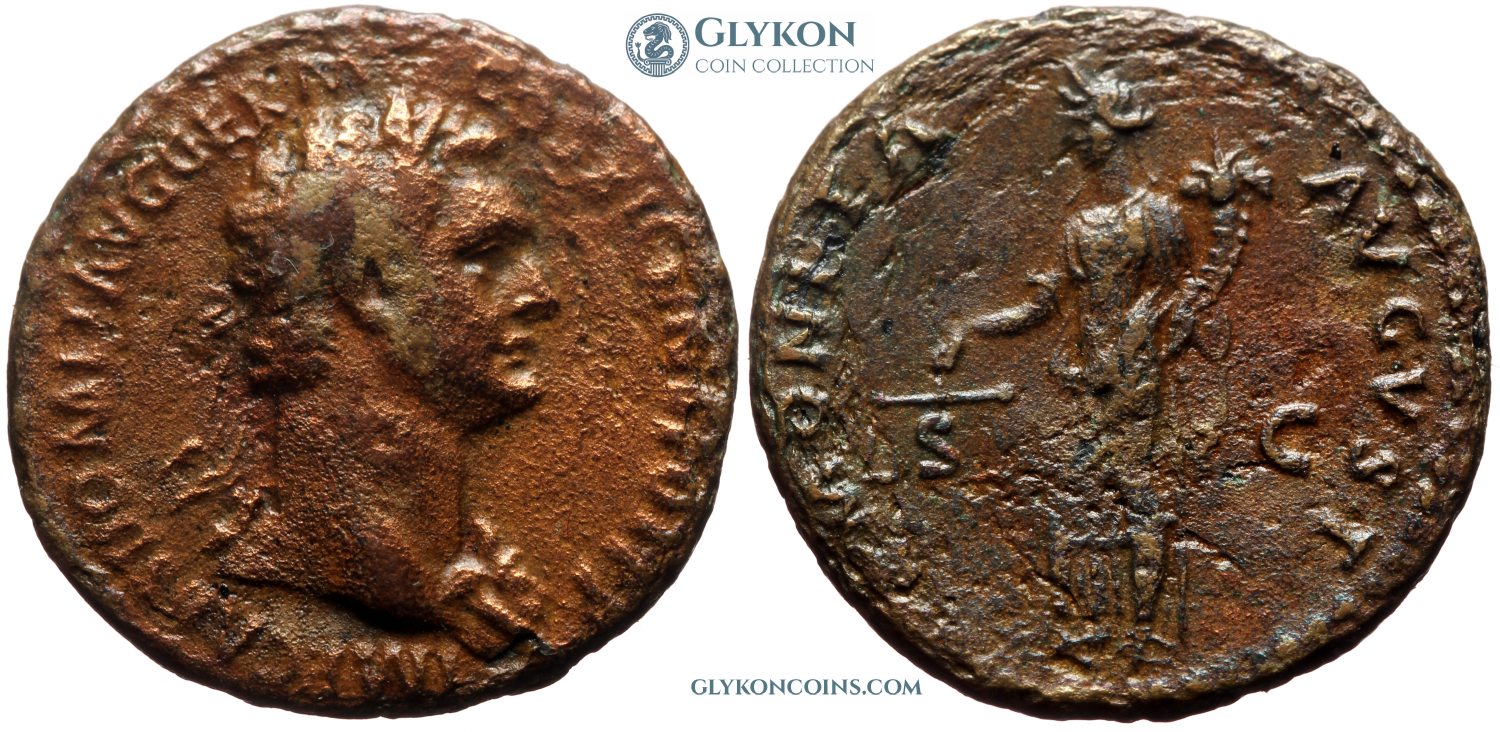
Domitian (81-96 AD)
Denomination: As
Mint: Rome
Time: 85 AD
Weight: 10.17 g
Diameter: approx. 26.1 mm
Reference: RIC II 383; Cohen 332f; BMC 449
Obverse: Laureate head of Domitian facing right. Legend: IMP CAES DOMIT AVG GERM COS XI CENS POT PP.
Reverse: Draped Moneta, flanked by large S and C, standing facing left, holding scales in right hand and cornucopia in left hand. |
|
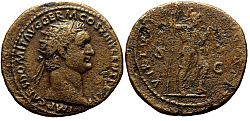 |
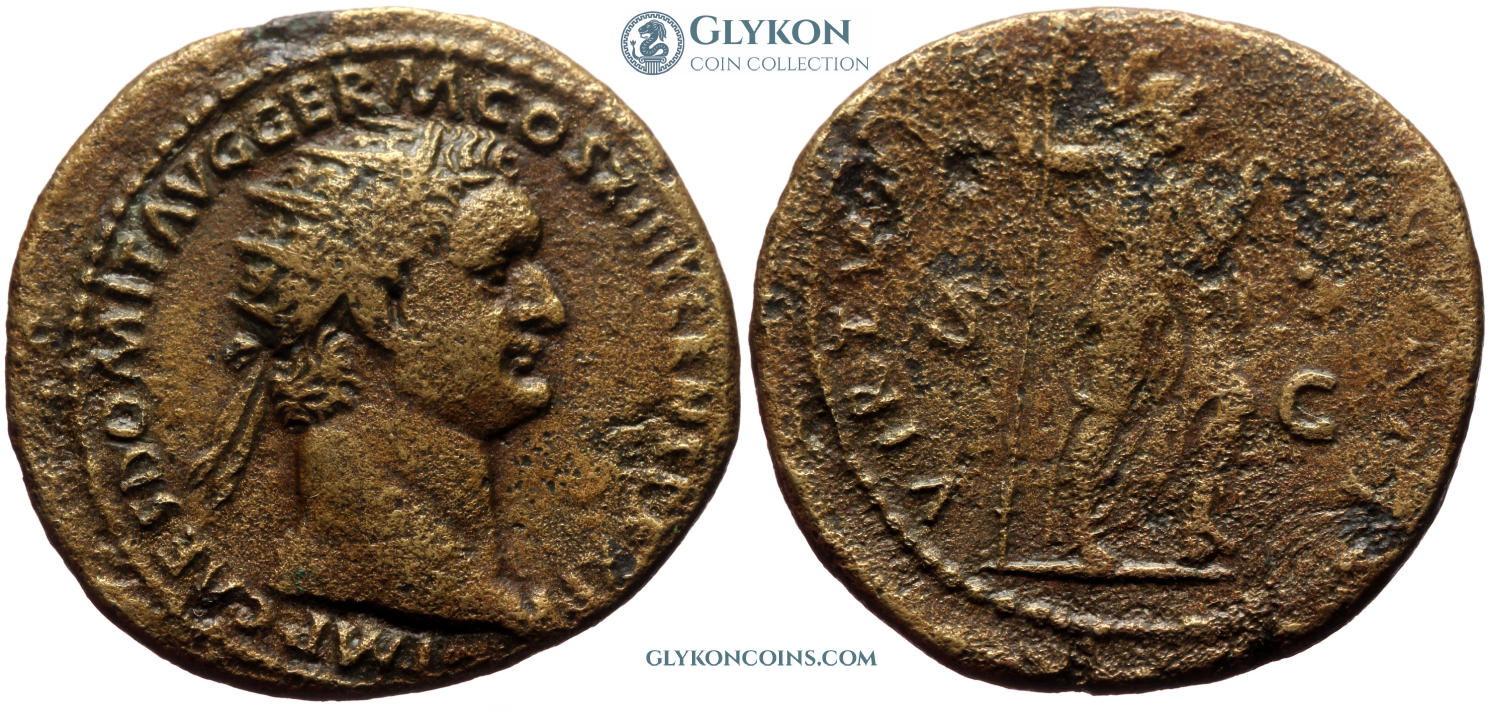
Domitian (81-96 AD)
Denomination: Dupondius
Mint: Rome
Time: 88/89 AD
Weight: 12.26 g
Diameter: approx. 29.1 mm
Reference: RIC 644; BMC 413
Obverse: Radiate head of Domitian facing right. Legend: IMP CAES DOMIT AVG GERM COS XIIII CENS PER PP.
Reverse: Draped and helmeted Virtus, flanked by large S and C, standing facing right, lifting her left leg over a helmet, holding spear in right hand and parazonium (ceremonial dagger) in left hand. Legend: VIRTVTI AVGVSTI. |
|
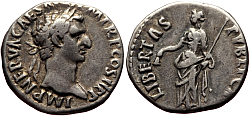 |
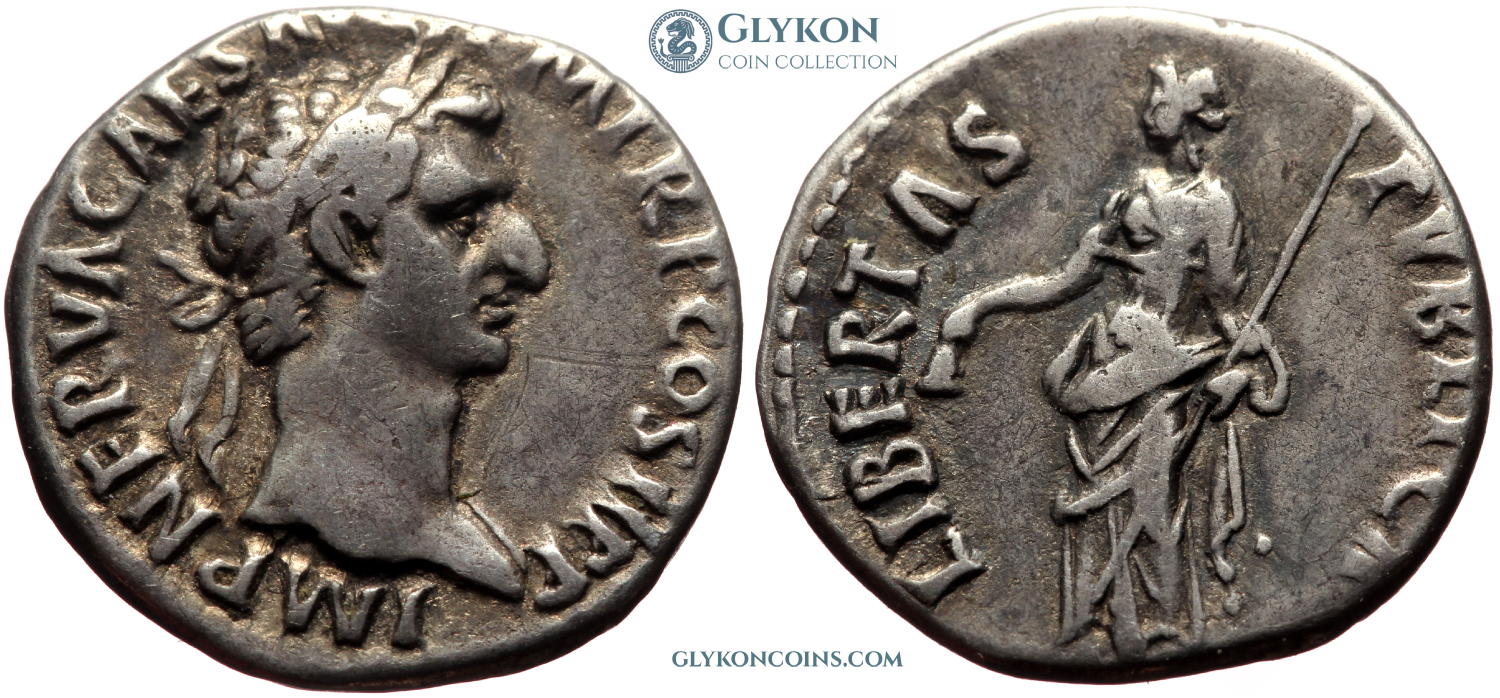
Nerva (96-98 AD)
Denomination: Denarius
Mint: Rome
Time: 97 AD
Weight: 3.20 g
Diameter: approx. 17.4 mm
Reference: RIC II 19
Obverse: Laureate head of Nerva facing right. Legend: IMP NERVA CAES AVG PM TR P COS III PP.
Reverse: Draped Libertas stanging facing left, holding a pileus (liberty cap) in oustretched right hand and a spear in left hand. Legend: LIBERTAS PVBLICA |
|
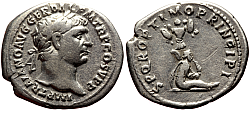 |
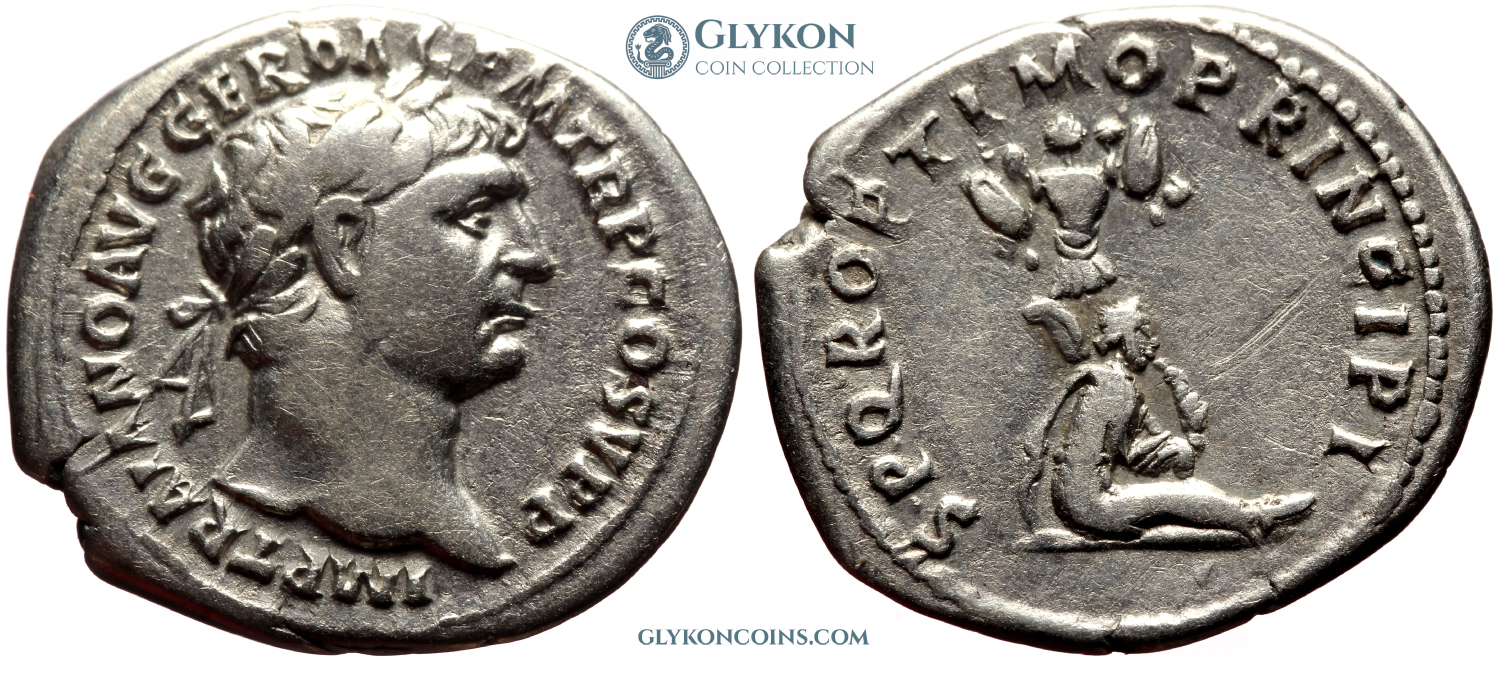
Trajan (98-117 AD)
Denomination: Denarius
Mint: Rome
Time: 103-111 AD
Weight: 3.19 g
Diameter: approx. 19.7 mm
Reference: RIC 223
Obverse: Laureate head of Trajan facing right. Legend: IMP TRAIANO AVG GER DAC PM TR P COS V PP.
Reverse: Mourning Dacian sitted facing right under a trophy of arms. Legend: SPQR OPTIMO PRINCIPI. |
|
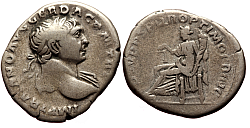 |
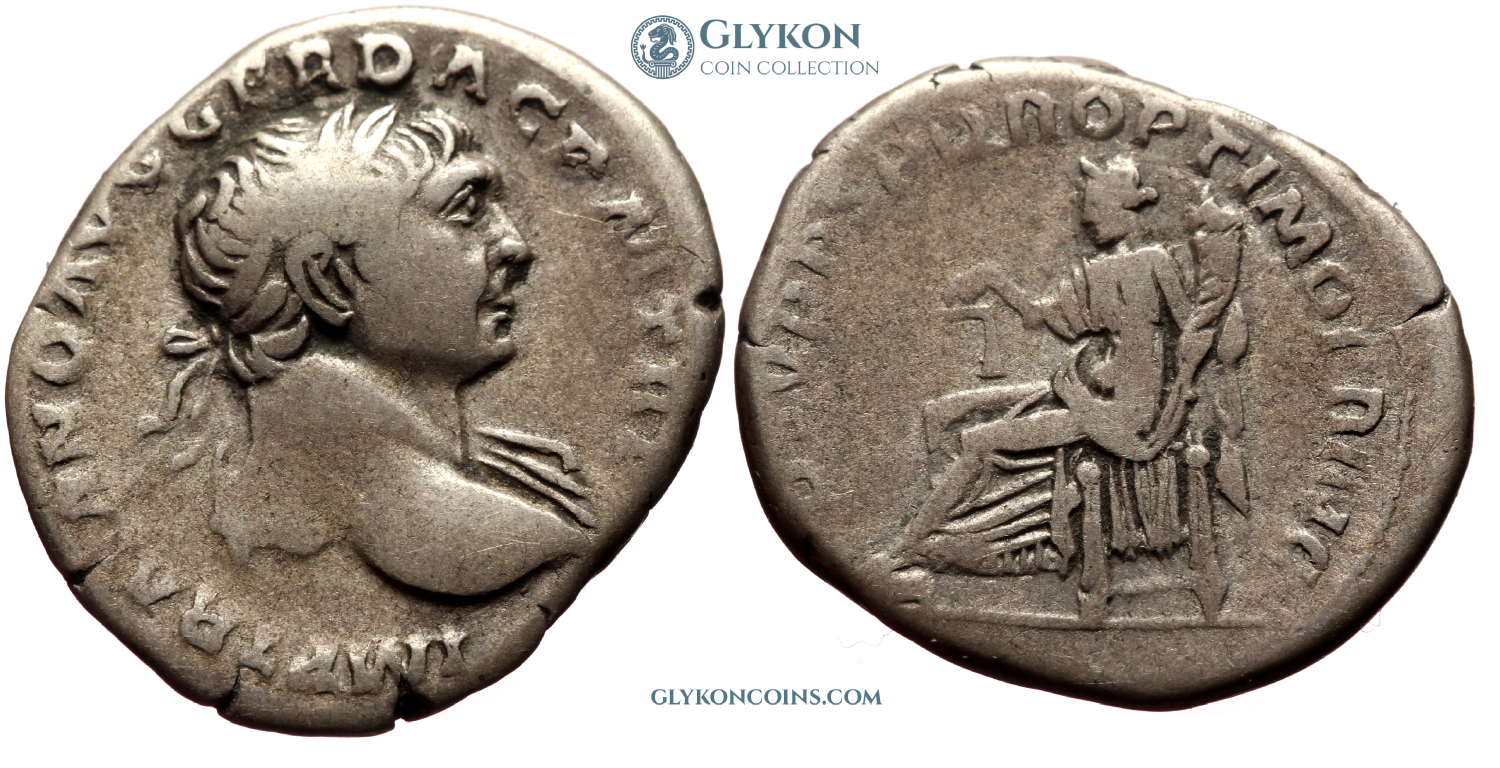
Trajan (98-117 AD)
Denomination: Denarius
Mint: Rome
Time: 103-111 AD
Weight: 3.32 g
Diameter: approx. 19.5 mm
Reference: RIC 119; RSC 86; BMC 288; Sear 3123
Obverse: Laureate head of Trajan facing right with sligh drapery on left shoulder. Legend: IMP TRAIANO AVG GER DAC PM TR P.
Reverse: Draped Aequitas seated facing left, holding scales and cornucopia Legend: COS V PP SPQR OPTIMO PRINC. |
|
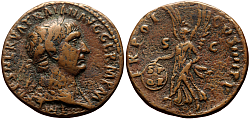 |
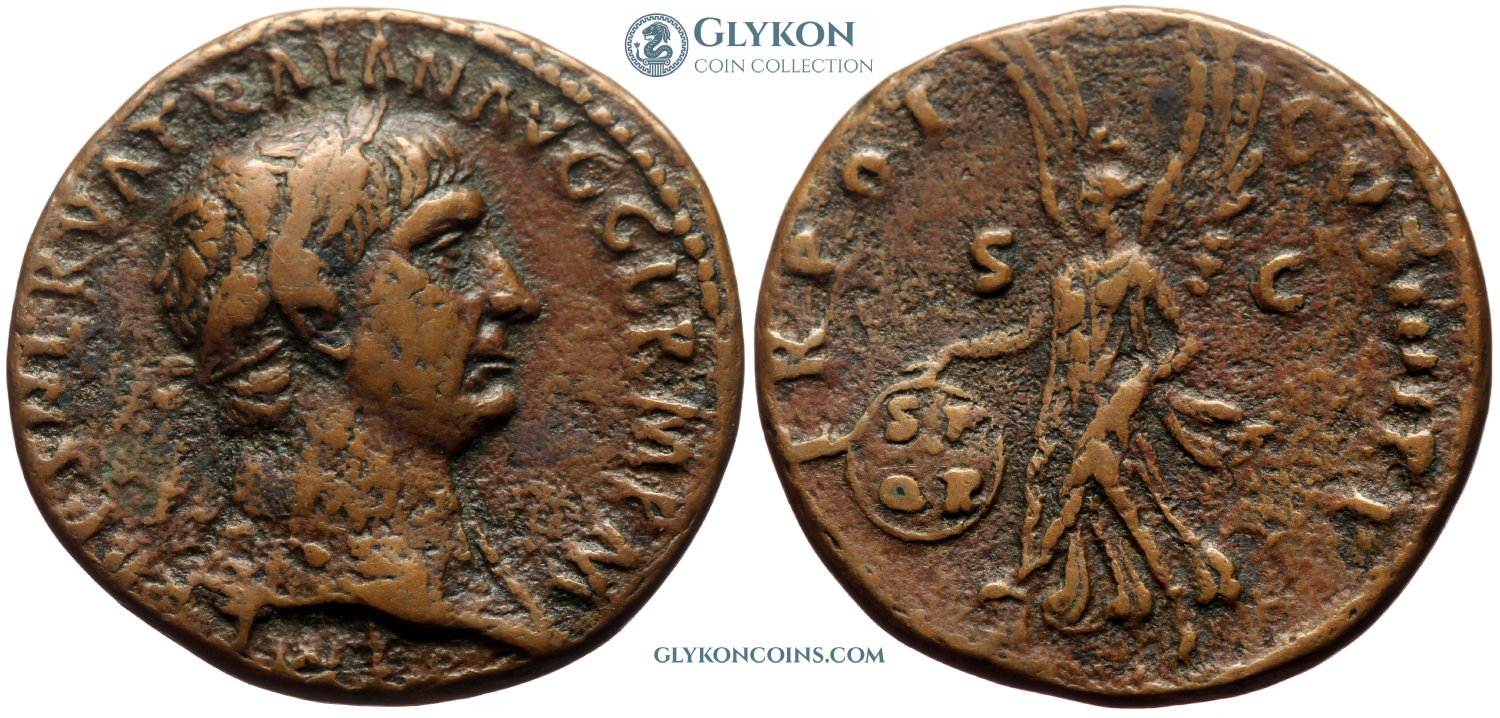
Trajan (98-117 AD)
Denomination: As
Mint: Rome
Time: 101/102 AD
Weight: 9.33 g
Diameter: approx. 26.4 mm
Reference: RIC 434; Cohen 640
Obverse: Laureate head of Trajan facing right. Legend: IMP CAES NERVA TRAIAN AVG GERM PM.
Reverse: Drapped winged Victory advancing facing left, holding a round shield labelled SPQR, surrounded by S and C. Legend: TR POT COS IIII PP. |
|
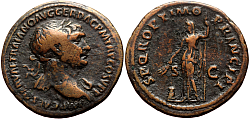 |
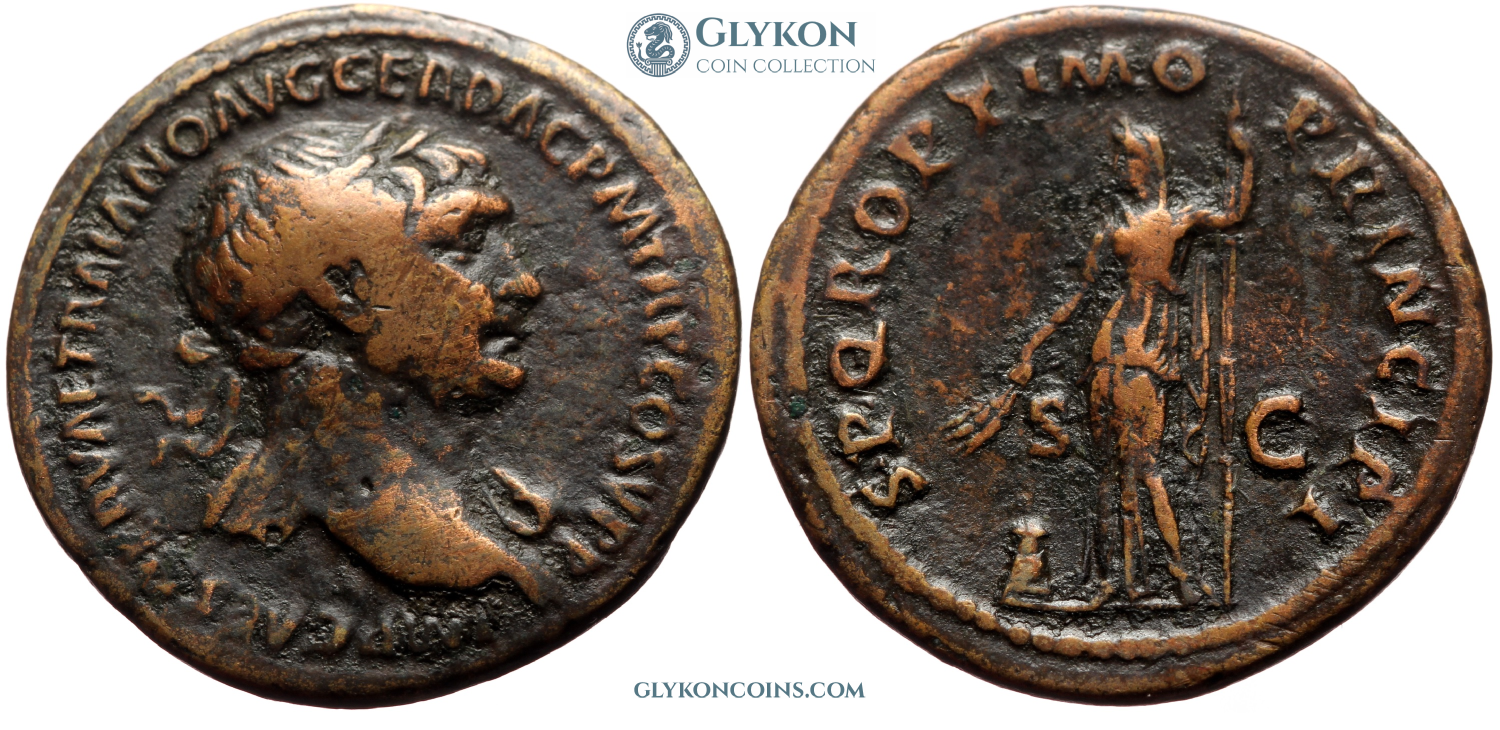
Trajan (98-117 AD)
Denomination: As
Mint: Rome
Time: 103-111 AD
Weight: 9.23 g
Diameter: approx. 27.8 mm
Reference: RIC 479
Obverse: Laureate head of Trajan facing right. Legend: IMP CAES NERVAE TRAIANO AVG GER DAC PM TR P COS V PP.
Reverse: Drapped Ceres, flanked by large S and C, standing facing left, holding grain-ears in lowered right hand over modius, and long upwards pointing torch in left hand. Legend: SPQR OPTIMO PRINCIPI. |
|
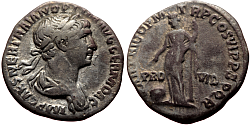 |
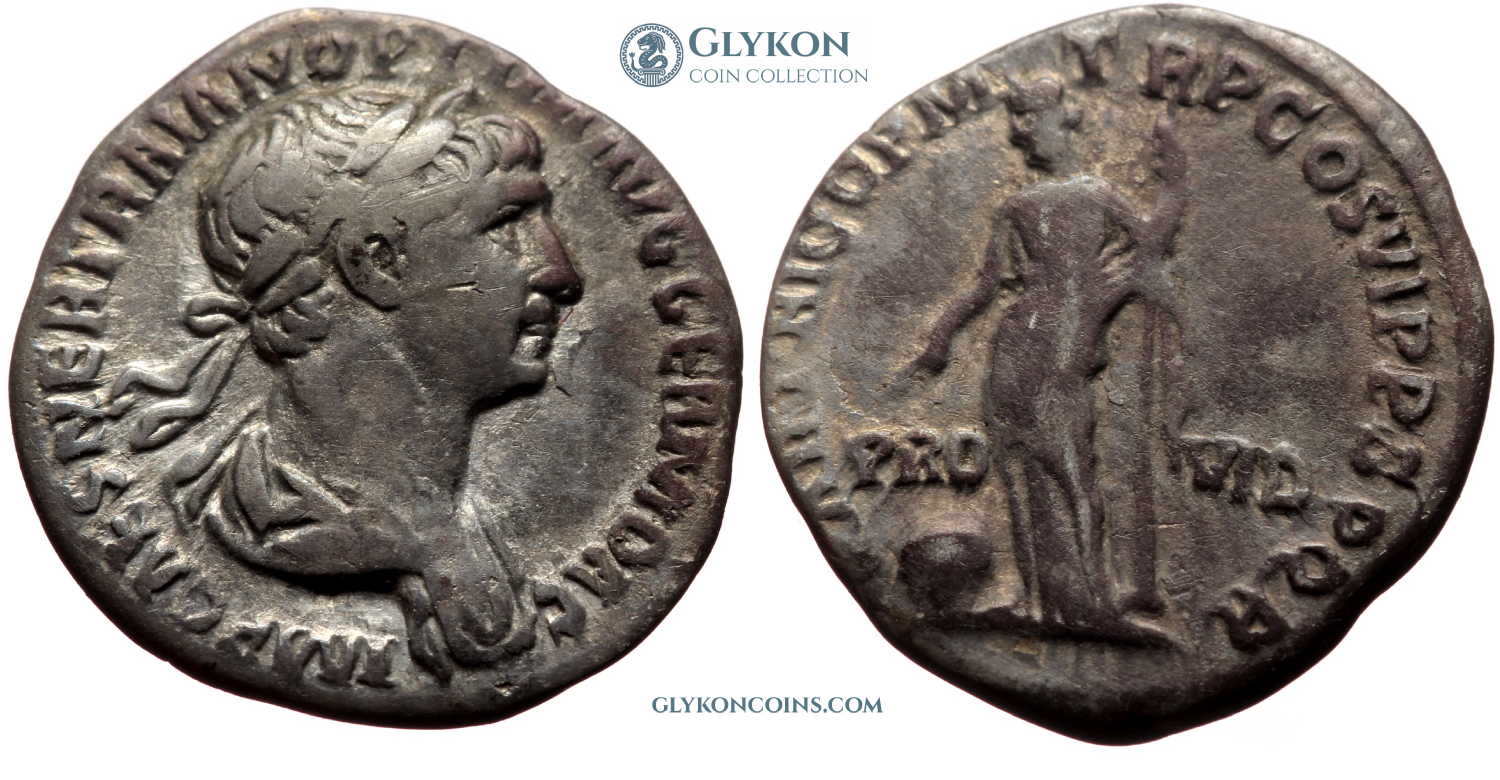
Trajan (98-117 AD)
Denomination: Denarius
Mint: Rome
Time: 114-117 AD
Weight: 2.72 g
Diameter: approx. 18.6 mm
Reference: RIC 361; BMC 640; RSC 313
Obverse: Laureate and draped bust of Trajan facing right. Legend: IMP CAES NER TRAIAN OPTIM AVG GERM DAC.
Reverse: Draped Providentia surrounded by PRO and VID, standing facing left, holding sceptre in left hand, pointing a globe at her right feet with lowered right hand. Legend: PARTHICO PM TR P COS VI PP SPQR. |
|
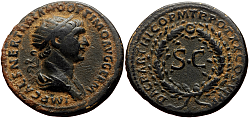 |
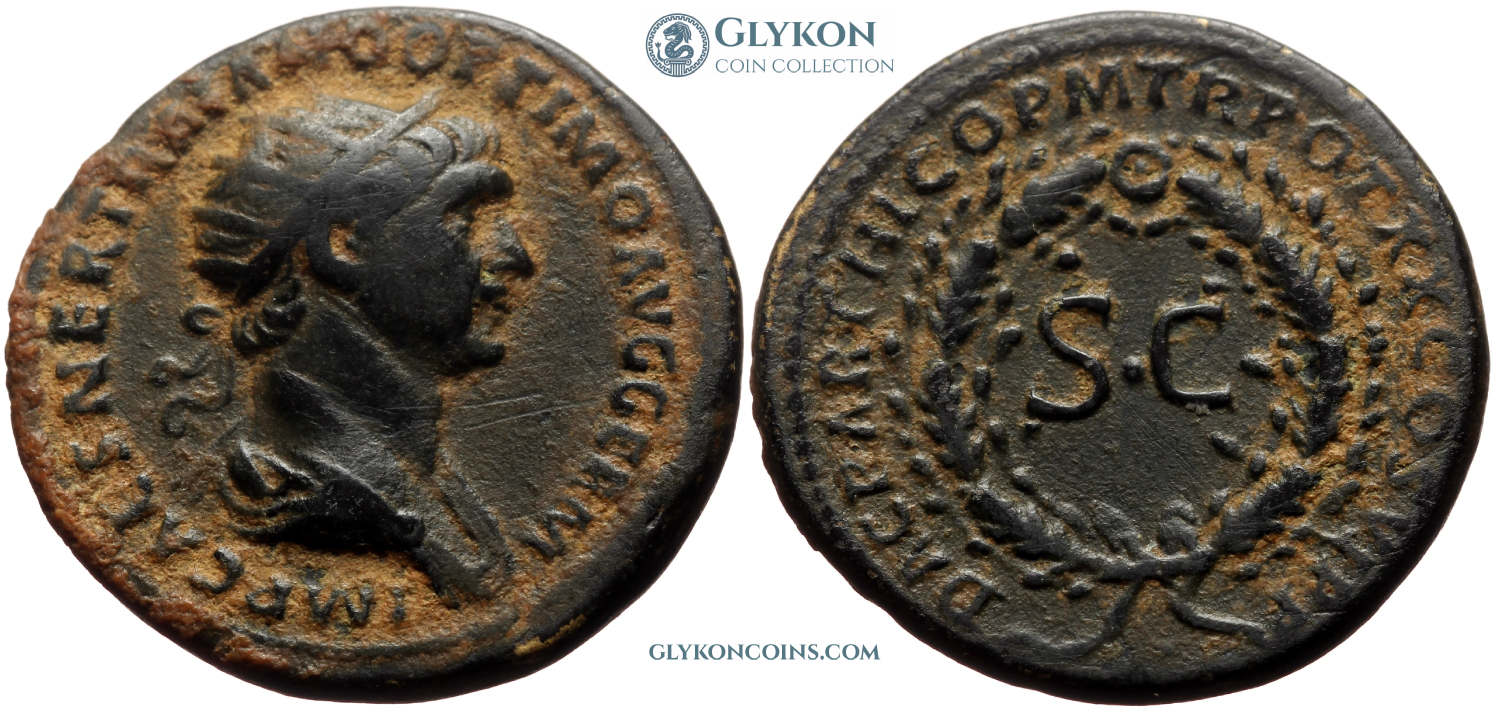
Trajan (98-117 AD)
Denomination: Orichalcum As
Mint: Rome
Time: 116 AD
Weight: 7.43 g
Diameter: approx. 23.5 mm
Reference: RIC 645
Obverse: Radiate and draped bust of Trajan facing right. Legend: IMP CAES NER TRAIANO OPTIMO AVG GERM.
Reverse: Large SC within circular decorated wreath. Legend: DAC PARTHICO PM TR POT XX COS VI PP.
Comment: Interesting emission of smaller size, minted in a brass alloy named orichalcum, considered by the Romans to be double the value of copper, which was usually used to mint asses. This coin, though minted in Rome, was intended to be used as pay during the Eastern campaign of Trajan. |
|
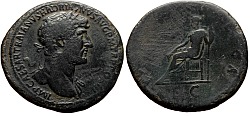 |
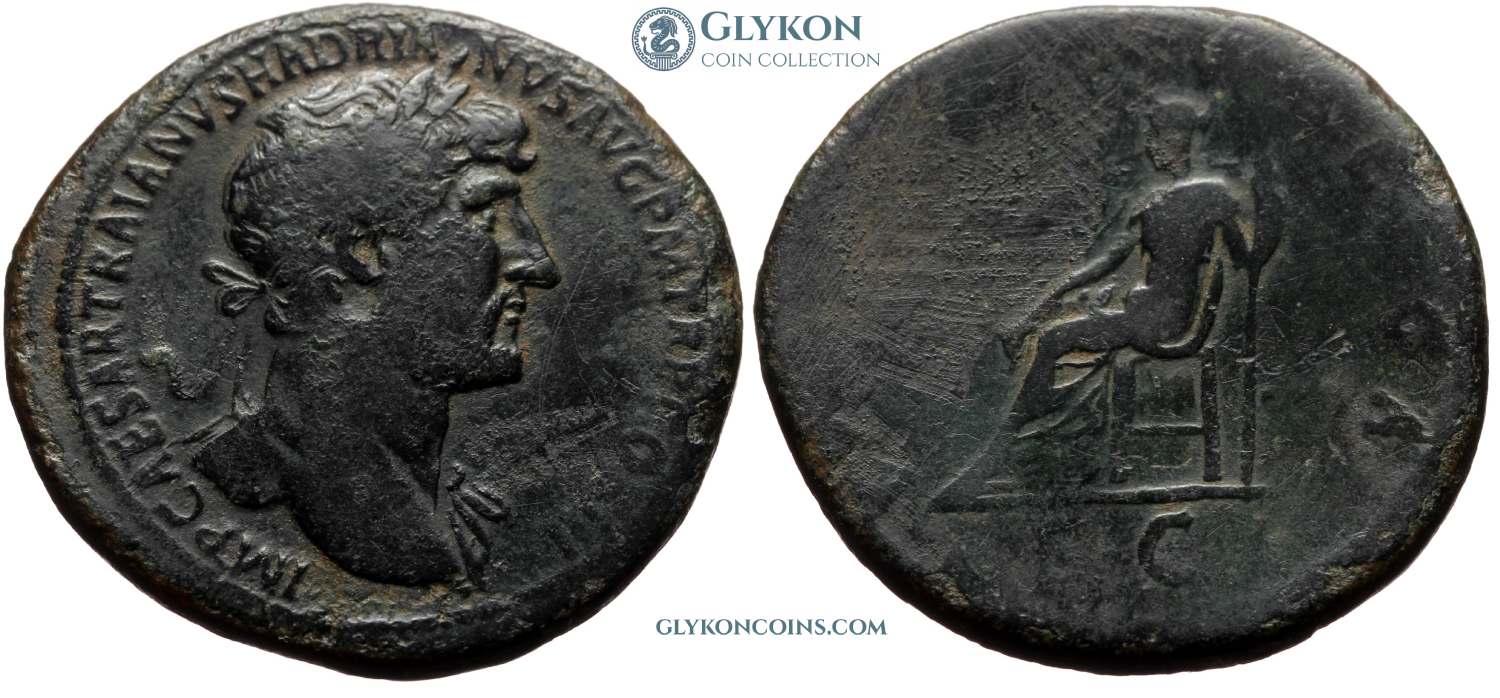
Hadrian (117-138 AD)
Denomination: Sestertius
Mint: Rome
Time: 120/121 AD
Weight: 23.42 g
Diameter: approx. 35.1 mm
Reference: RIC II 423
Obverse: Laureate bust of Hadrian facing right, some drapery on farther shoulder. Legend: IMP CAESAR TRAIANVS HADRIANVS AVG PM TR P COS III.
Reverse: Draped Libertas seated facing left, holding branch and sceptre. Large SC in exergue. Legend: LIBERTAS PVBLICA. |
|
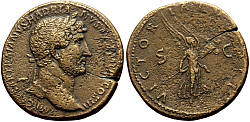 |
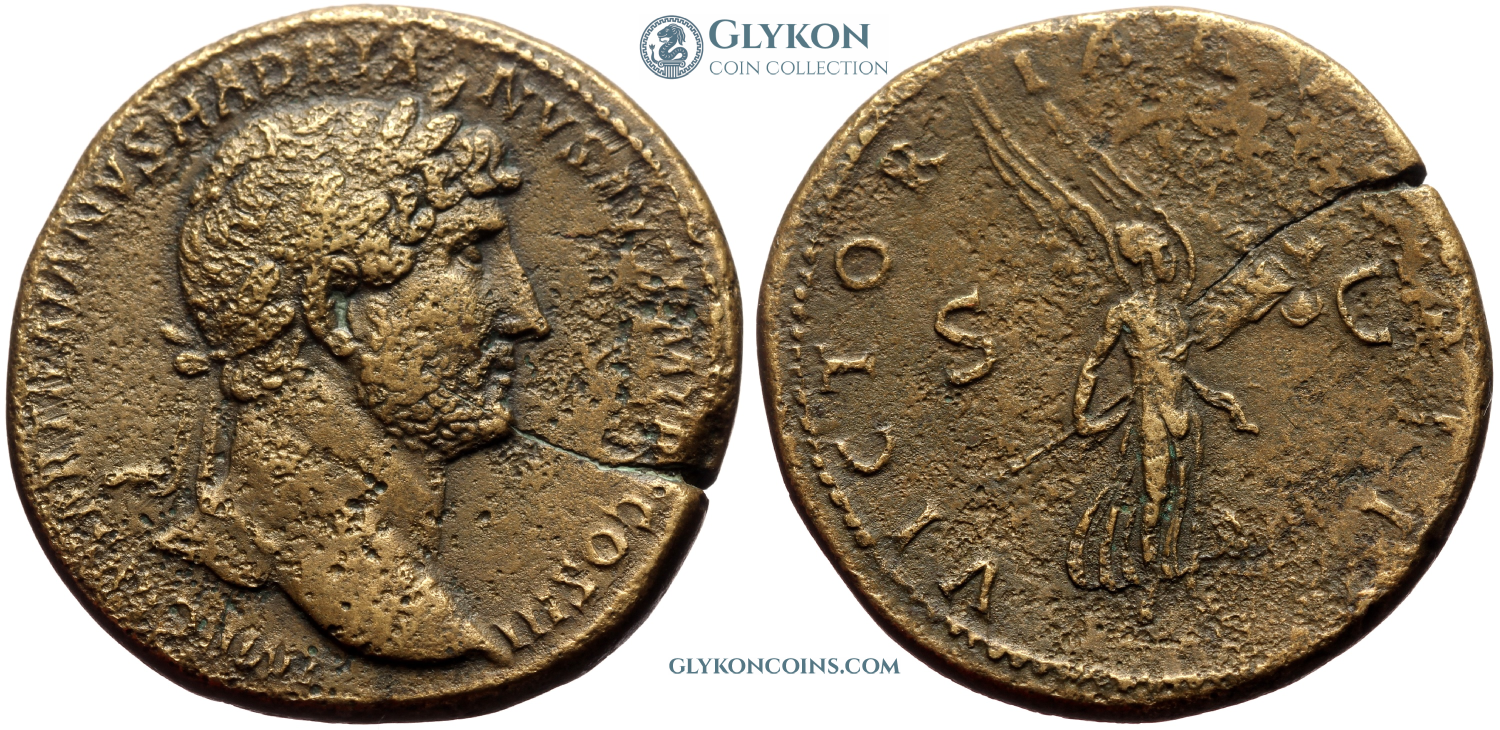
Hadrian (117-138 AD)
Denomination: Sestertius
Mint: Rome
Time: 120/121 AD
Weight: 24.66 g
Diameter: approx. 33.4 mm
Reference: RIC II 454
Obverse: Laureate head of Hadrian facing right. Legend: IMP CAESAR TRAIANVS HADRIANVS AVG PM TR P COS III.
Reverse: Draped winged Victory, flanked by large S and C, advancing right holding a trophy in both hands. Legend: VICTORIA AVGVSTI. |
|
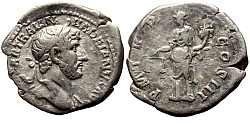 |
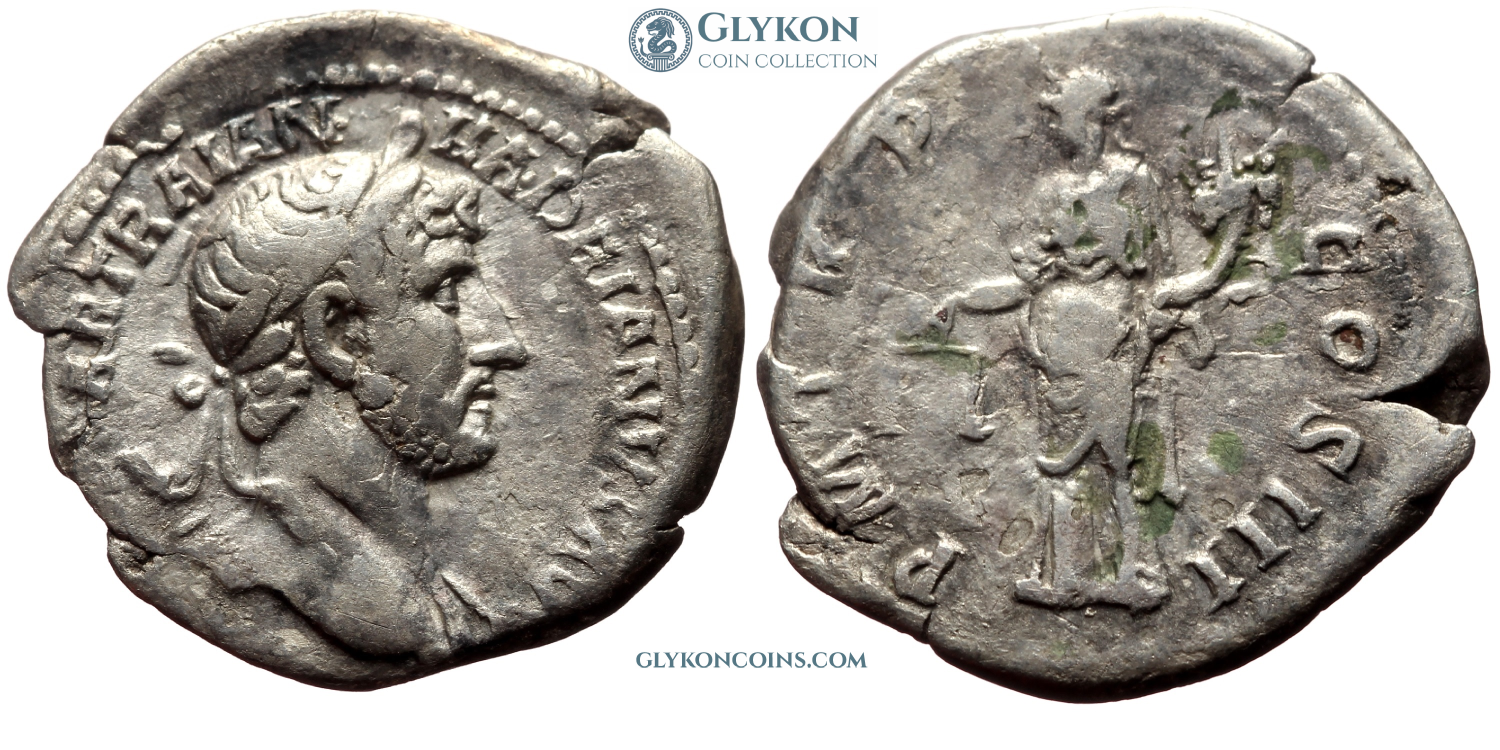
Hadrian (117-138 AD)
Denomination: Denarius
Mint: Rome
Time: 119-122 AD
Weight: 3.06 g
Diameter: approx. 19.7 mm
Reference: RIC II 80
Obverse: Laureate head of Hadrian facing right. Legend: IMP CAESAR TRAIAN HADRIANVS AVG.
Reverse: Draped Aequitas standing facing left, holding scales in right hand and cornucopia in left hand. Legend: PM TR P COS III. |
|
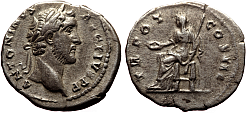 |
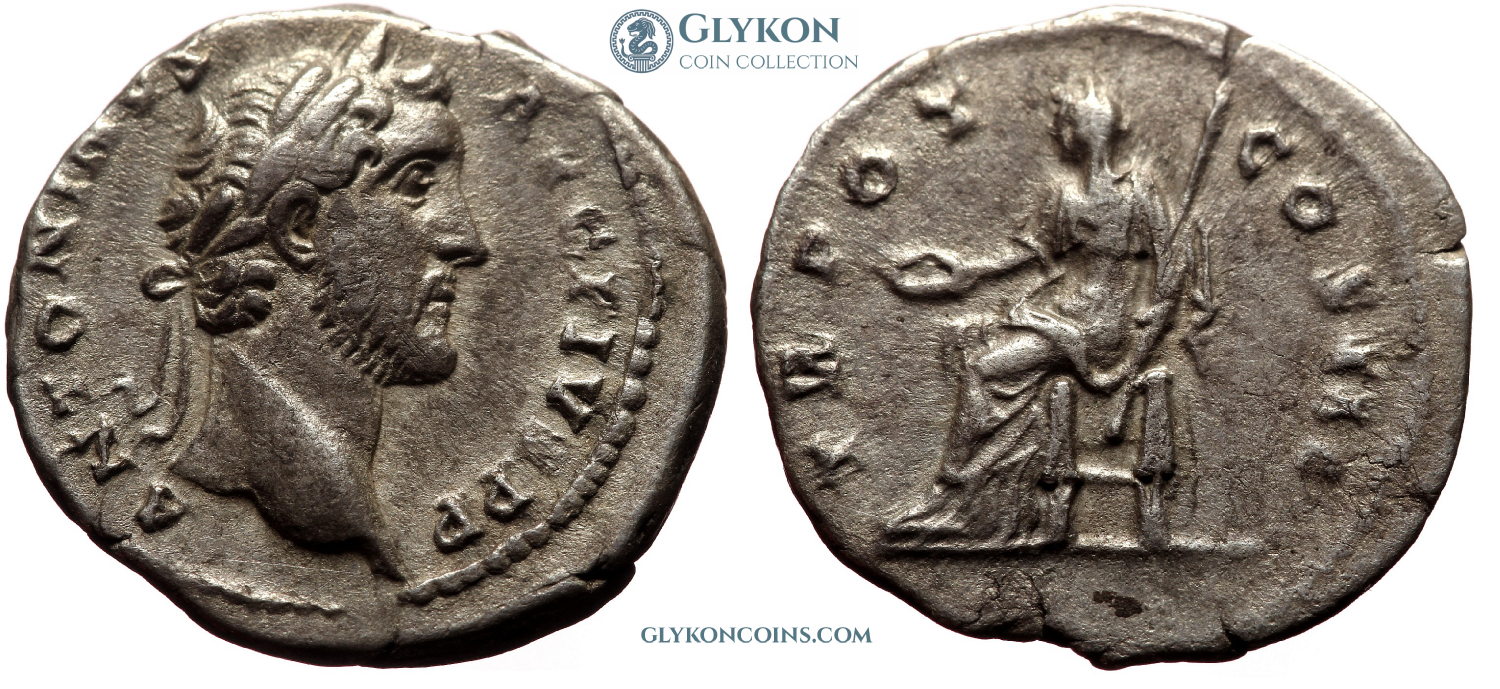
Antoninus Pius (138-161 AD)
Denomination: Denarius
Mint: Rome
Time: 140-143 AD
Weight: 2.84 g
Diameter: approx. 17.9 mm
Reference: RIC 84; RSC 888; BMC 233
Obverse: Laureate head of Antoninus facing right. Legend: ANTONINVS AVG PIVS PP.
Reverse: Vesta seated facing left, holding patera and scepter. Legend: TR POT COS III. |
|
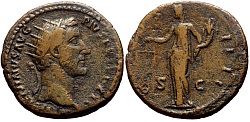 |
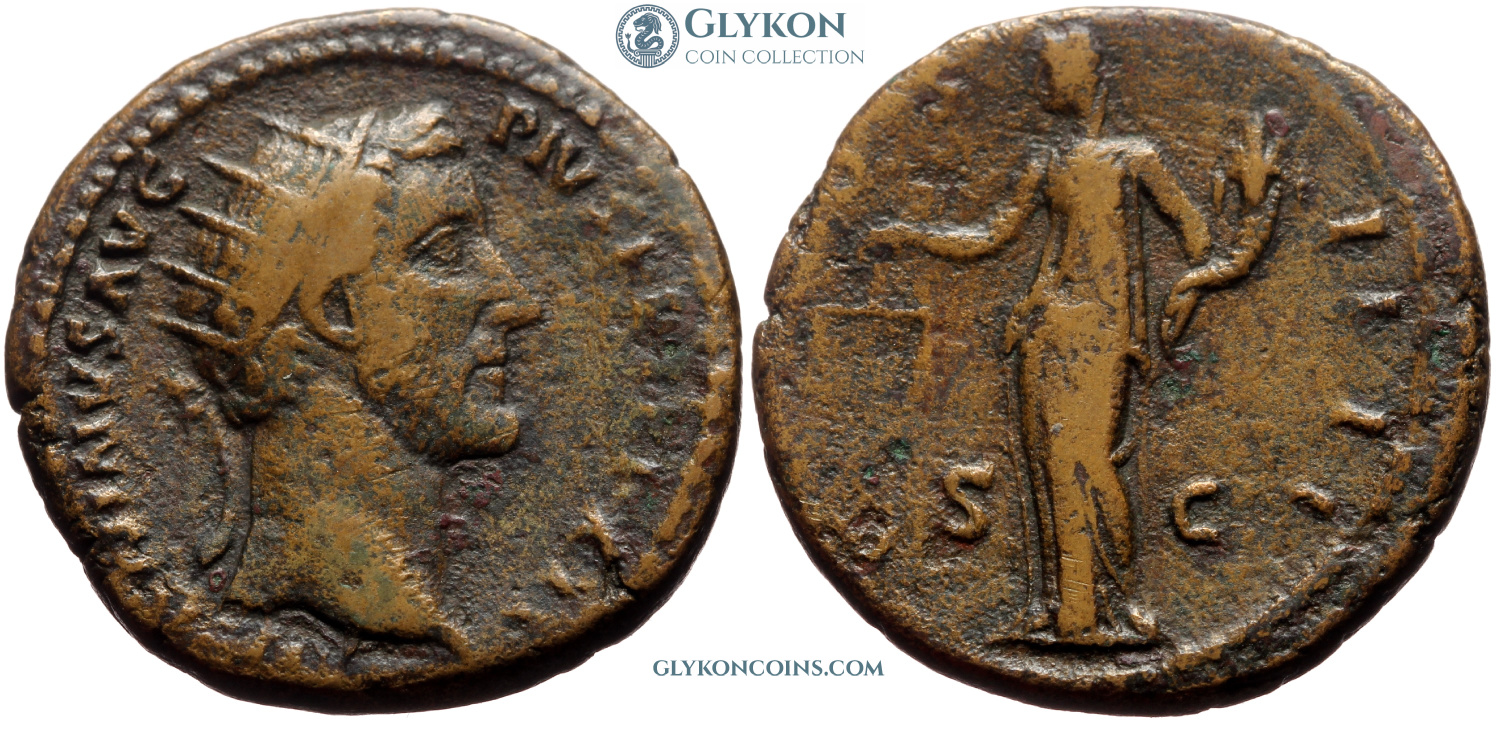
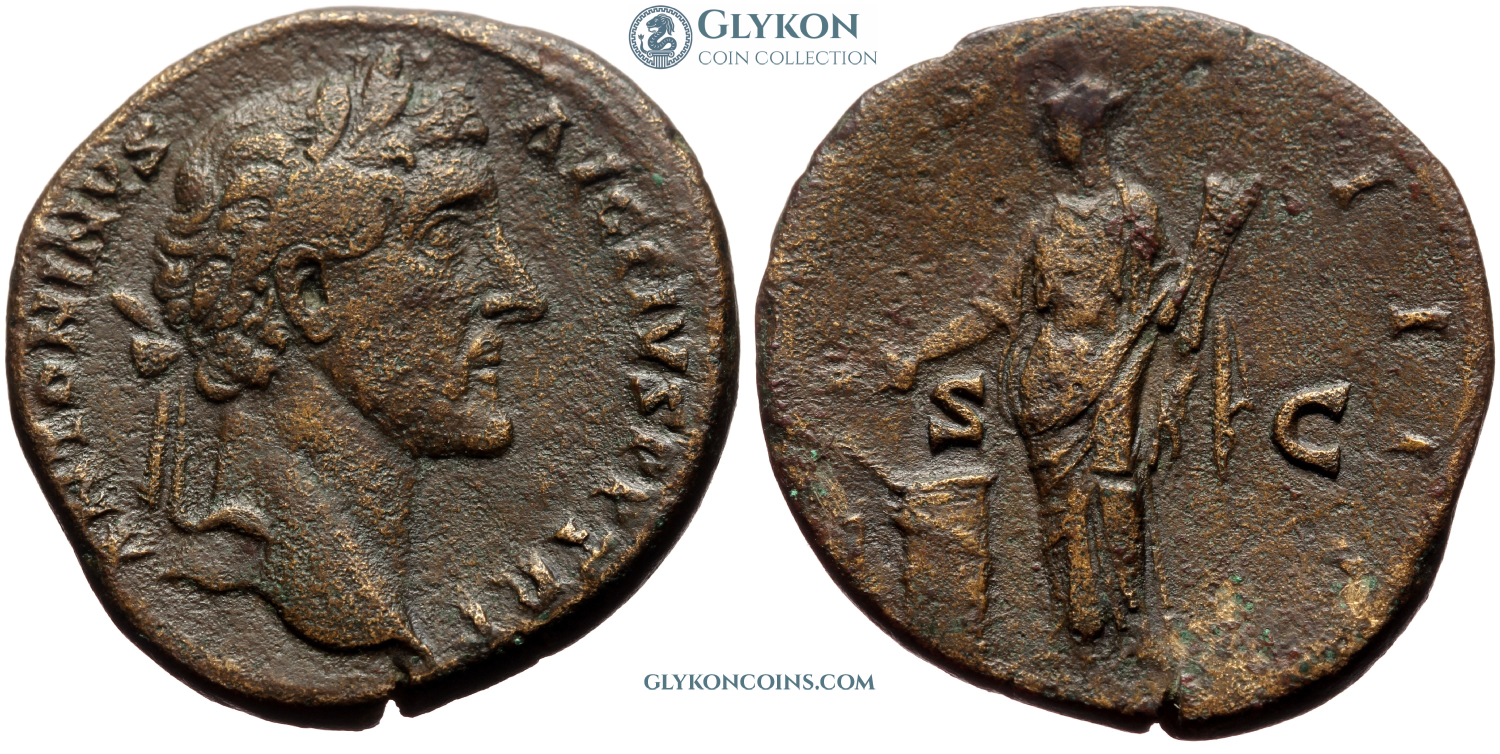
Antoninus Pius (138-161 AD)
Denomination: Dupondius
Mint: Rome
Time: 148-149 AD
Weight: 13.17 g
Diameter: approx. 26.5 mm
Reference: RIC III 858; Cohen 233
Obverse: Radiate head of Antoninus facing right. Legend: ANTONINVS AVG PIVS PP TR P XII.
Reverse: Draped Aequitas standing facing left, flanked low by large S and C, holding scales and cornucopia. Legend: COS IIII. |
|
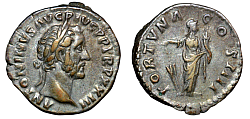 |
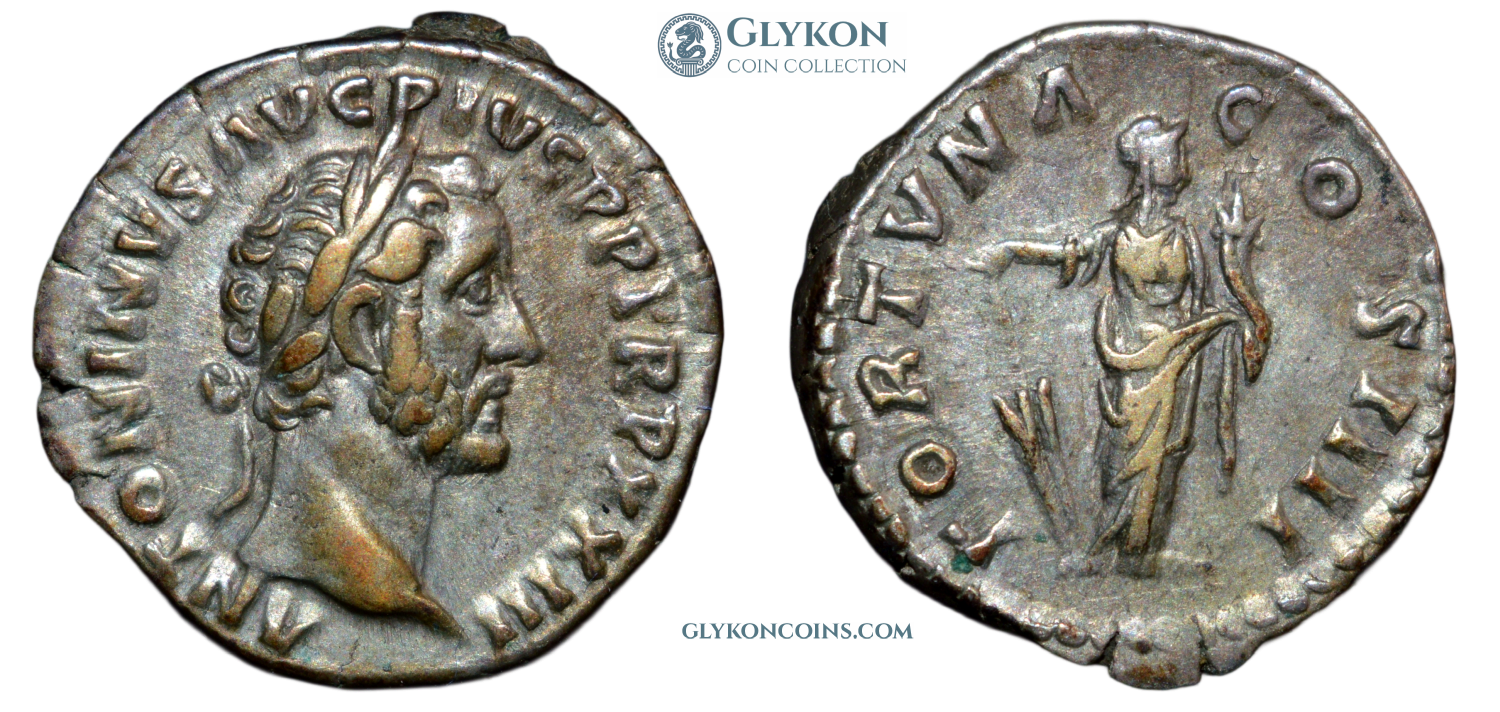
Antoninus Pius (138-161 AD)
Denomination: Denarius
Mint: Rome
Time: 159-160 AD
Weight: 3.31 g
Diameter: approx. 17.3 mm
Reference: RIC 300; RSC 383; Ex Künker Auction 433/2025 (group lot)
Obverse: Laureate head of Antoninus facing right. Legend: ANTONINVS AVG PIVS PP TR P XXIII
Reverse: Fortuna standing facing with head turned right, holding rudder and cornucopiae. Legend: FORTVNA COS IIII |
|
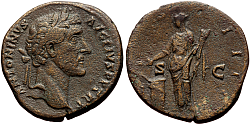 |
Antoninus Pius (138-161 AD)
Denomination: Sestertius
Mint: Rome
Time: 146 AD
Weight: 17.98 g
Diameter: approx. 30.1 mm
Reference: RIC III 761; Cohen 282; Sear 4164
Obverse: Laureate head of Antoninus facing right. Legend: ANTONINVS AVG PIVS PP TR P.
Reverse: Salus standing facing left, flanked by large S and C, holding an upright rudder in her left hand and feeding a serpent coiling around an altar with a patera in her right hand. Legend: COS IIII. |
|
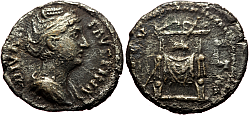 |
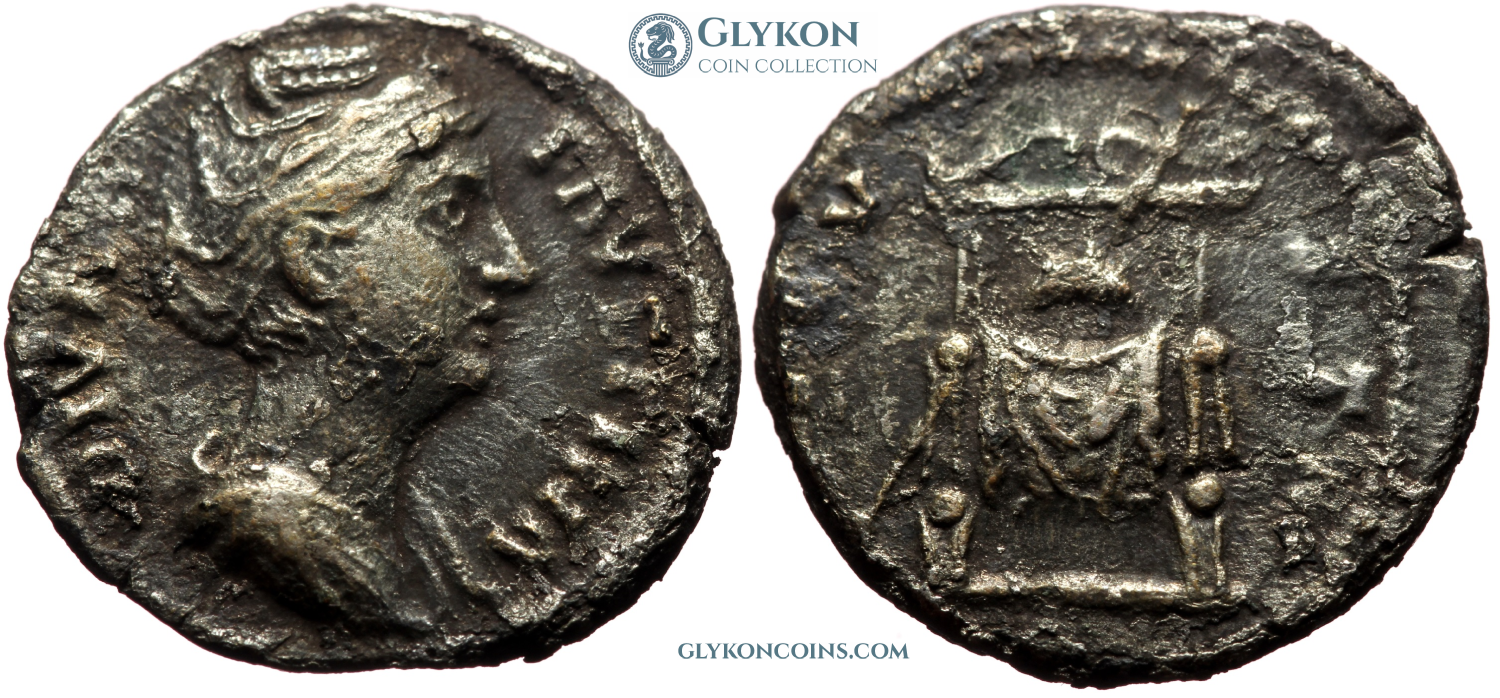
Faustina the Elder, wife of Antoninus Pius (138-161 AD)
Denomination: Denarius
Mint: Rome
Time: after 140 AD (posthumous issue)
Weight: 3.11 g
Diameter: approx. 17.3 mm
Reference: RIC III 377; RSC 131; BMC 454
Obverse: Draped bust of Faustina facing right. Legend: DIVA FAVSTINA.
Reverse: Empty throne of Juno with a scepter placed on top. Legend: AVGVSTA.
In contrast to many others in antiquity, Antoninus and Faustina were a happy, loving couple. When she died early in his reign, the emperor was devastated and honored her memory in every way he could. The now-deified empress became the patroness of several foundations, while mints across the empire produced vast quantities of coins bearing her likeness as part of an extensive commemorative series. Many of these issues were struck for distribution during public ceremonies and religious dedications in her honor. |
|
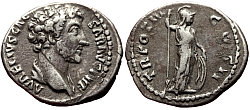 |
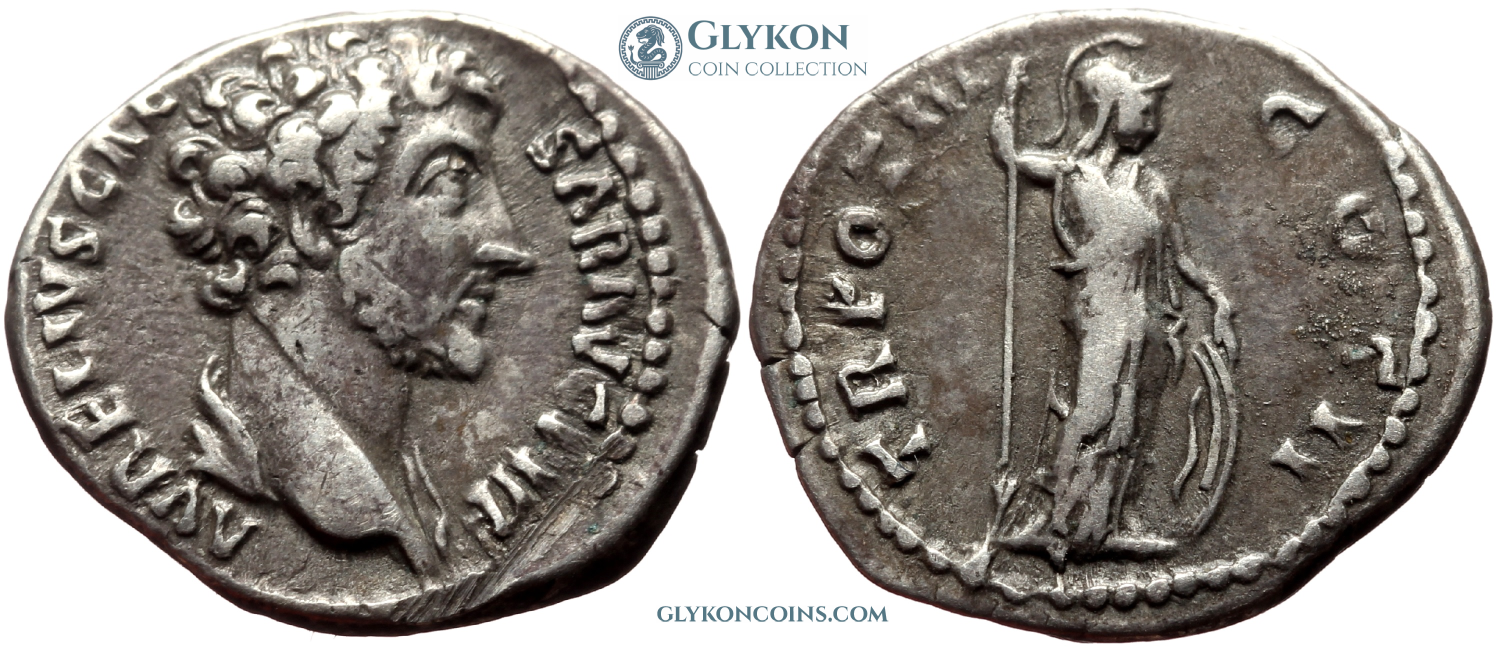
Marcus Aurelius (161-180 AD) as Caesar
Denomination: Denarius
Mint: Rome
Time: 148/149 AD (under Antoninus Pius)
Weight: 3.13 g
Diameter: approx. 18.6 mm
Reference: RIC III 444 [Antoninus Pius]
Obverse: Bare head of youthful Marcus facing right. Legend: AVRELIVS CAESAR AVG PII F.
Reverse: Helmeted Minerva standing facing right, holding a spear in her right hand and resting her left hand on a shield. Legend: TR POT III COS II. |
|
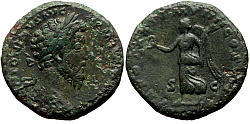 |
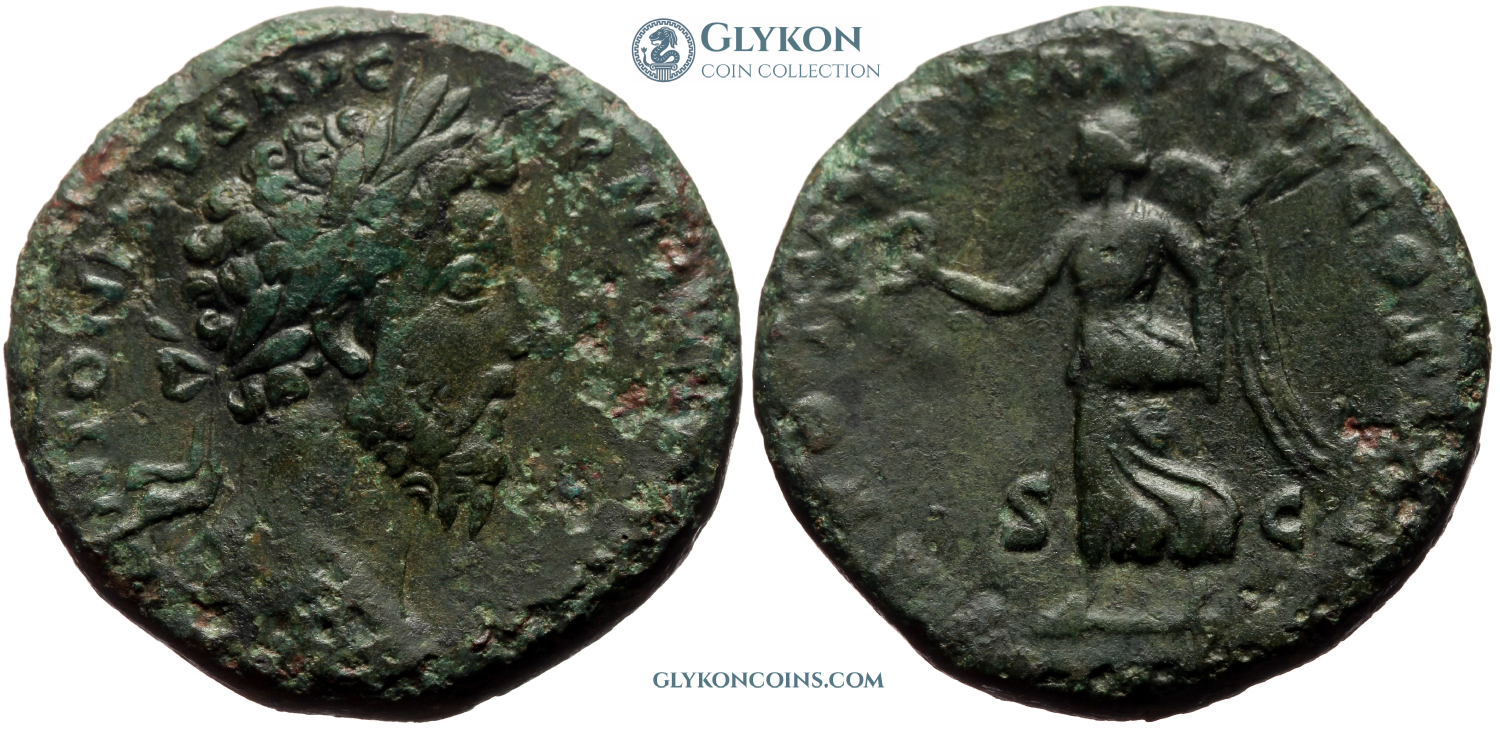
Marcus Aurelius (161-180 AD)
Denomination: Sestertius
Mint: Rome
Time: 166/167 AD
Weight: 22.90 g
Diameter: approx. 31.0 mm
Reference: RIC III 948; Sear 5011
Obverse: Laureate head of Marcus facing right. Legend: M ANTONINVS AVG ARM PARTH MAX.
Reverse: Winged Victory, flanked low by large S and C, advancing left, holding wreath and palm branch. Legend: TR POT XXI IMP IIII COS III. |
|
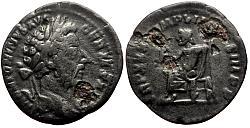 |
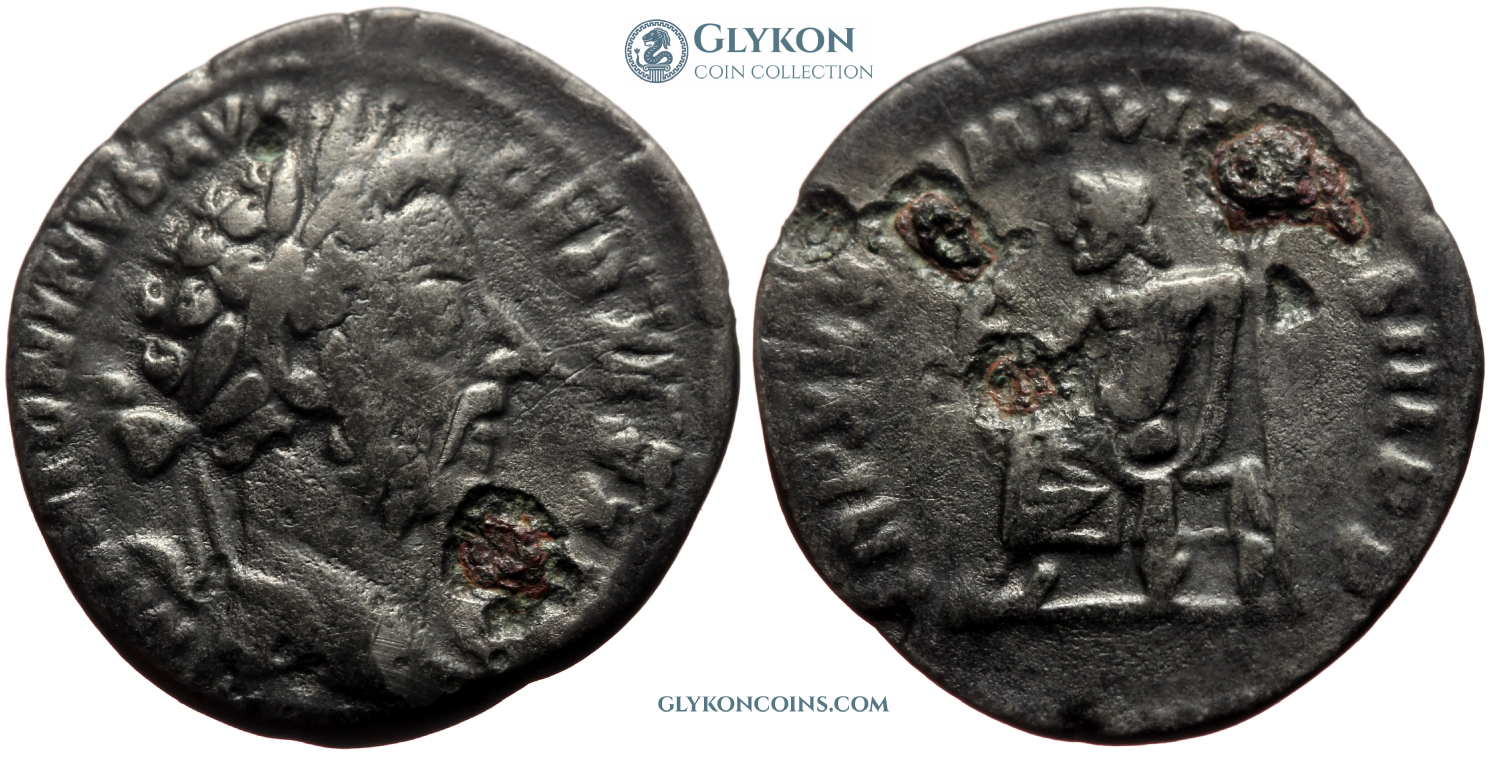
Marcus Aurelius (161-180 AD)
Denomination: "Limes" Denarius
Mint: Unknown (see comment)
Time: 174 AD or later (based on the legible legend)
Weight: 2.66 g
Diameter: approx. 18.9 mm
Reference: none, similar to RIC 227, but different legend
Obverse: Laureate head of Marcus facing right. Legend: M ANTONINVS AVG GER MAX? (partially illegible).
Reverse: Jupiter? seated facing left, holding perhaps a thunderbolt of a bird. Only partly legible legend: (...)P(...)IMP VII(...)COS III.
One of the so-called "Limes" denarii, a mysterious type of coin found in areas that correspond to what was back then the frontier of the Empire, but also in nearby provinces and in Barbaricum (areas outside of Roman borders). They are coins minted in base metals (usually copper and lead alloys), sometimes with an addition of silver. Their quality and appearance heavily varies, from specimens clearly made from official dies to ones made from unique dies but still made by skillful engravers, to dies that look official but don't follow any pattern of coinage minted elsewhere, to crude coins created by semi-skilled personnel. They appear mostly from the mid-second century AD up to the early 3rd century, though most of them seem to correspond to the time between the rule of Marcus Aurelius and Septimius Severus. Notably, many of them appear to be struck with worn dies.
Their purpose and nature elude us, since no surviving written source appears to reference them. Thus, we are forced to resort to theories. According to some, this is emergency "frontier" money minted directly in field camps and fortifications for the needs of soldiers garrisoning them. As such, they would be likely redeemable for better money in the hinterland, ensuring they would be accepted by merchants and servicepeople visiting the posted soldiers. The aesthetic quality and metal content would be meaningless under such circumstances. This would also explain both the existence of worn dies, dies that don't follow any known type, and dies that look like imitations. They would be produced from dies transported from elsewhere, perhaps after being used up, or simply made on-site according to current military needs, by persons who might not have been skilled engravers. Their appearance and disappearance could thus be explained either by changes in how frontier troops were supplied with money or perhaps by a crisis and subsequent reestablishment of order after the end of the Marcomannic Wars..
Others, however, point out a possible alternative purpose: that they were forgeries made in more lawless places on the borderland, or outside the Limes and thus beyond the easy reach of Roman authorities. The proponents of such theories point out the unusual frequency of heavily worn dies on the "good-looking" coinage. This would indicate they were struck from dies that were well beyond their usual lifespan. Typically, such dies would be destroyed to prevent unauthorized (and fraudulent) minting, but it doesn't defy possibility that some escaped destruction with the help of dishonest and corrupt mint workers and supervising officials and were smuggled away from Rome or any other minting center. Or even outside of the empire, beyond the easy reach of Roman authorities. Having an official die would be truly a golden opportunity for any criminal, as they would be able to produce coins that looked exactly like original ones at a fraction of the cost (by using base metals). Perhaps the increasing frequency of such coins suggests the rise of criminal syndicates strong enough to conduct such a risky and convoluted operation. Why these disappeared is another matter. Perhaps the syndicates were clamped down on by a strong emperor like Septimius Severus. Or perhaps the gradual debasement of genuine coins made such criminal practice less profitable and not worth the risk and effort.
More than one theory can be right at the same time. |
|
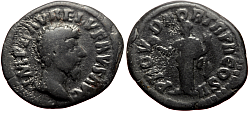 |
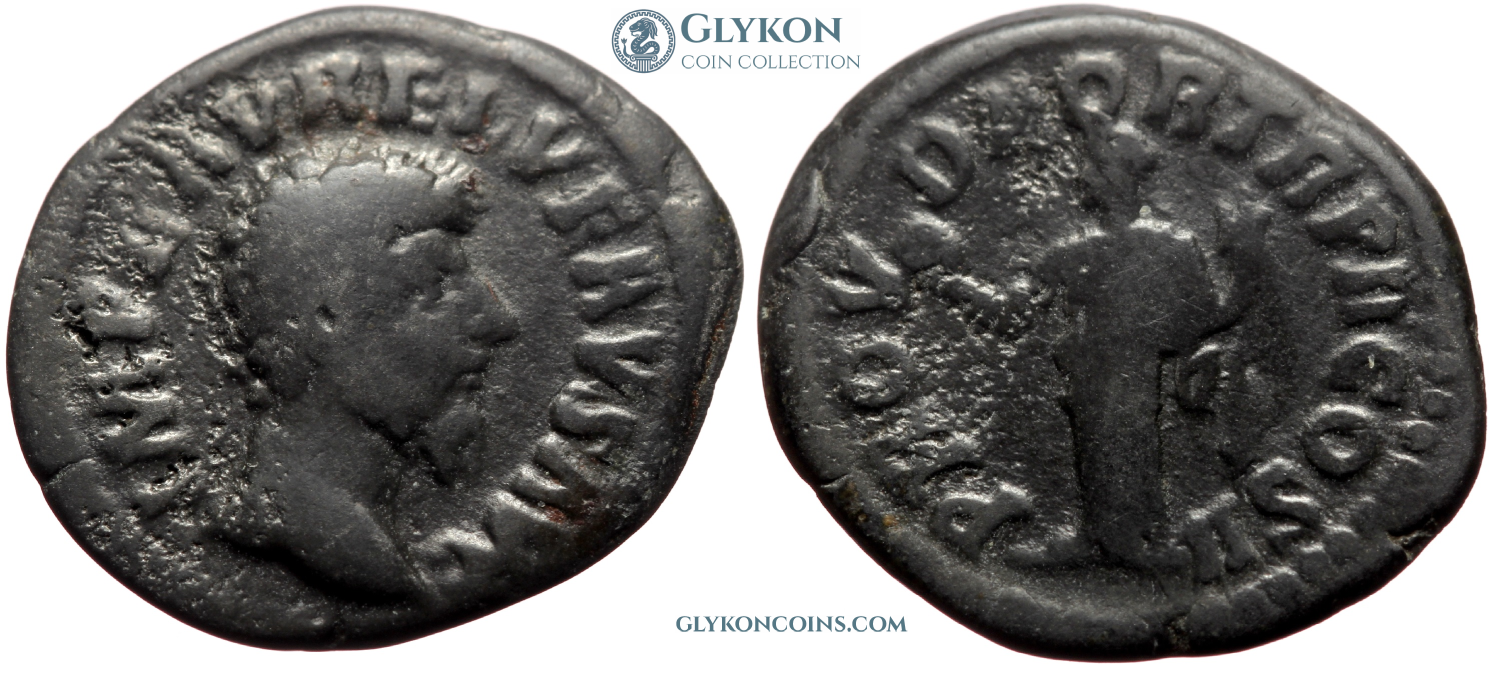
Lucius Verus (161-169 AD)
Denomination: "Limes" Denarius
Mint: Unknown (see comment on the coin above)
Time: 163-163 AD or later (based on the legible legend)
Weight: 2.69 g
Diameter: approx. 19.1 mm
Reference: none, similar to RIC 482
Obverse: Bare head of Lucius facing right. Legend: IMP L AVREL VERVS AVG.
Reverse: Providentia? standing facing left, holding a globe and a cornucopia. Legend: PROV DEOR TR P II COS II.
See the comment on the coin above. This specimen appears to be made either from official dies or from dies that closely follow the official pattern. |
|
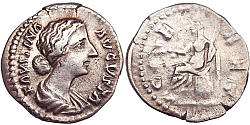 |
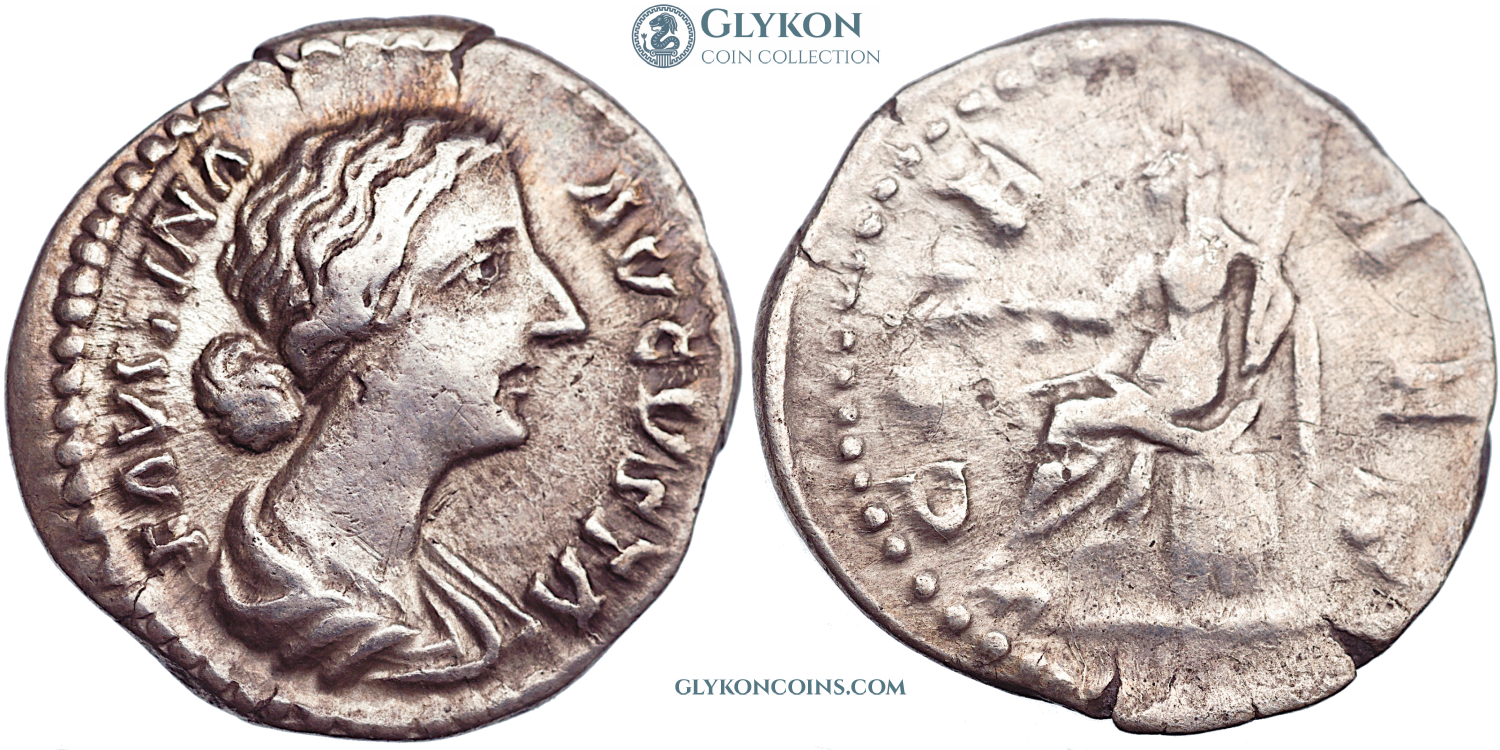
Faustina the Younger, wife of Marcus Aurelius (161-180 AD)
Denomination: Denarius
Mint: Rome
Time: 161-175 AD
Weight: 2.82 g
Diameter: approx. 18.8 mm
Reference: RIC 669
Obverse: Draped bust of Faustina facing right. Legend: FAVSTINA AVGVSTA.
Reverse: Veiled Ceres seated facing left, holding ears of grain in oustretched right hand and a torch in left hand. Legend: CERES. |
|
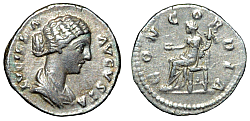 |
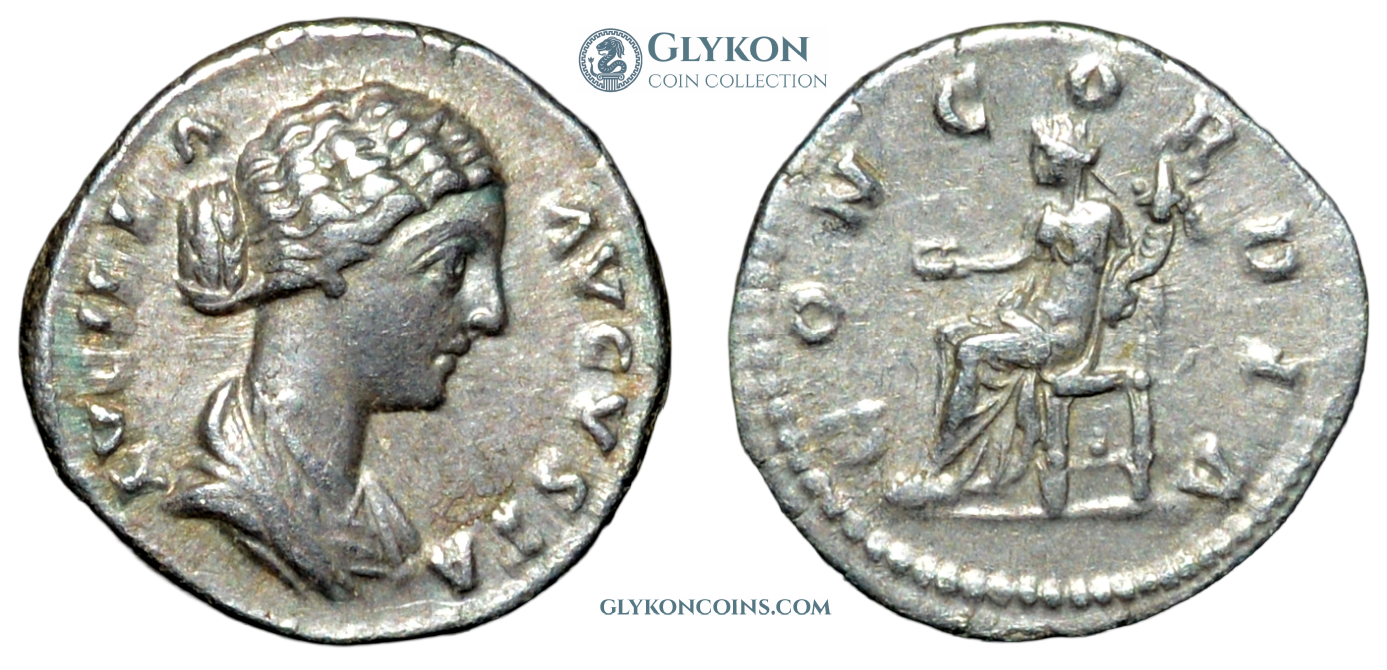
Lucilla, daughter of Marcus Aurelius (161-180 AD), wife of Lucius Verus (161-169 AD)
Denomination: Denarius
Mint: Rome
Time: 164 AD
Weight: 3.32 g
Diameter: approx. 19.2 mm
Reference: RIC 759
Obverse: Draped bust of Lucilla facing right. Legend: LVCILLA AVGVSTA.
Reverse: Seated Concordia facing left, holding patera and cornucopia. Legend: CONCORDIA. |
|
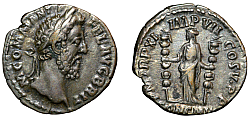 |
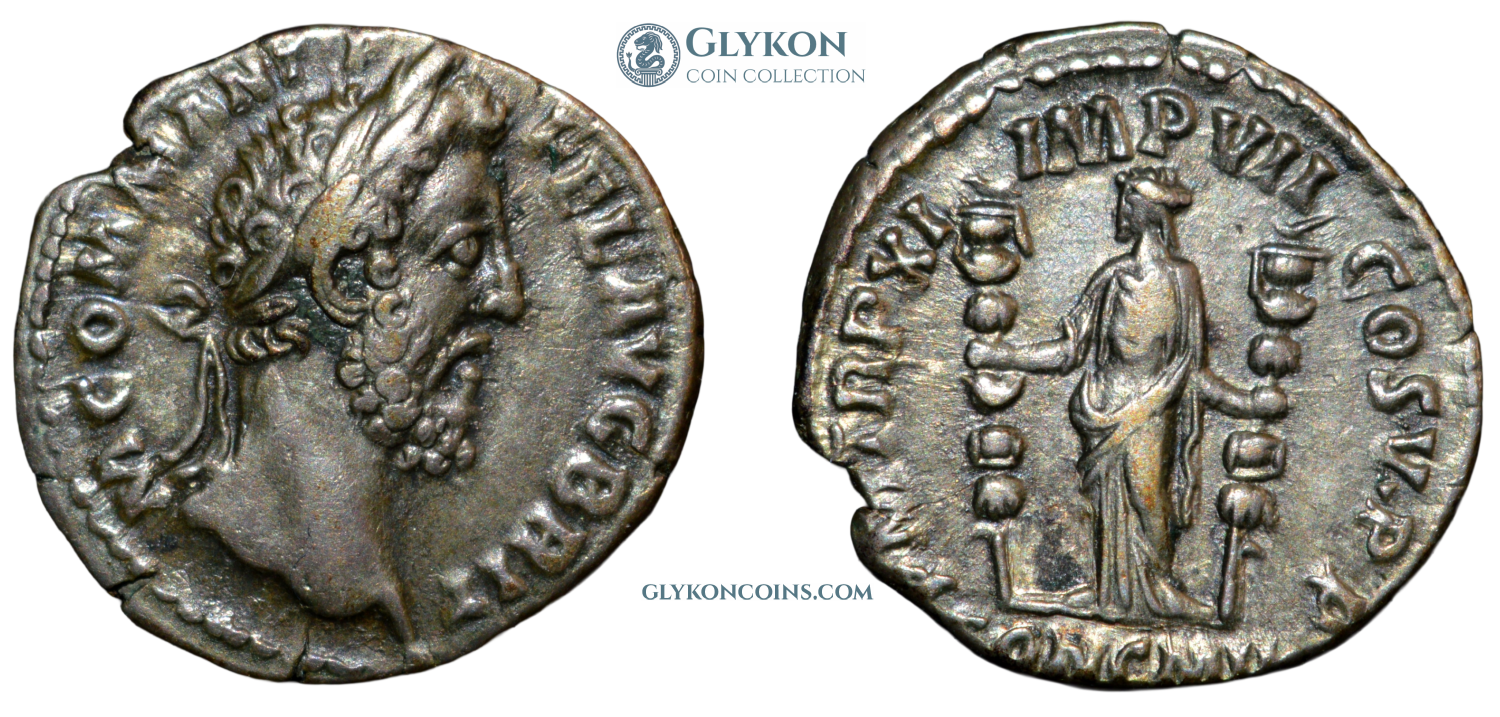
Commodus (180-192 AD)
Denomination: Denarius
Mint: Rome
Time: 184/185 AD
Weight: 3.19 g
Diameter: approx. 18.4 mm
Reference: RIC 107; RSC 51; Ex Künker Auction 433/2025 (group lot)
Obverse: Laureate head of Commodus facing right. Legend: M COMM ANT P FEL AVG BRIT
Reverse: Concordia standing facing front, head turned left, holding two military standards. Legend: P M TR P XI IMP VII COS V PP; CONC MIL on the bottom
Commodus' reign is often seen as the starting point from which the decline of Rome began. I personally find this ridiculous, as the empire in the West lasted for three more centuries, while the East collapsed more than one thousand years later. And both ended their existence due to factors independent of Commodus. If anything, Commodus' erratic reign is a testament to what happens when absolute power is given to a teenager who is only interested in what other late teens are, the interests in question being sports and sex. |
|
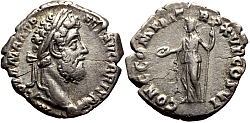 |
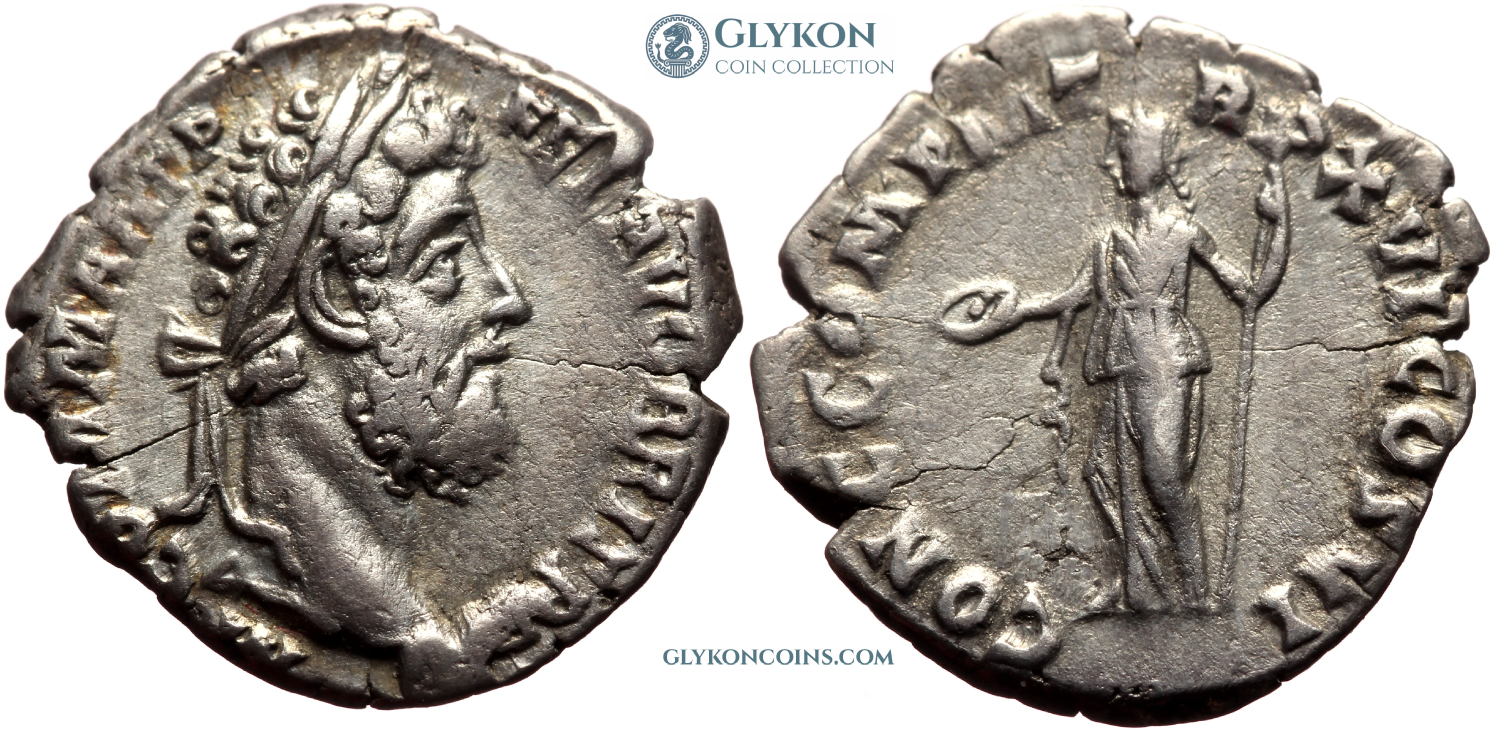
Commodus (180-192 AD)
Denomination: Denarius
Mint: Rome
Time: 190/191 AD
Weight: 2.46 g
Diameter: approx. 17.7 mm
Reference: RIC III 219
Obverse: Laureate head of Commodus facing right. Legend: M COMM ANT P FEL AVG BRIT PP
Reverse: Concordia standing facing left, holding a patera and a scepter. Legend: CONC COM P M TR P XVI COS VI |
|
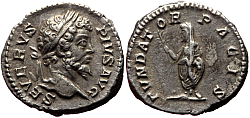 |
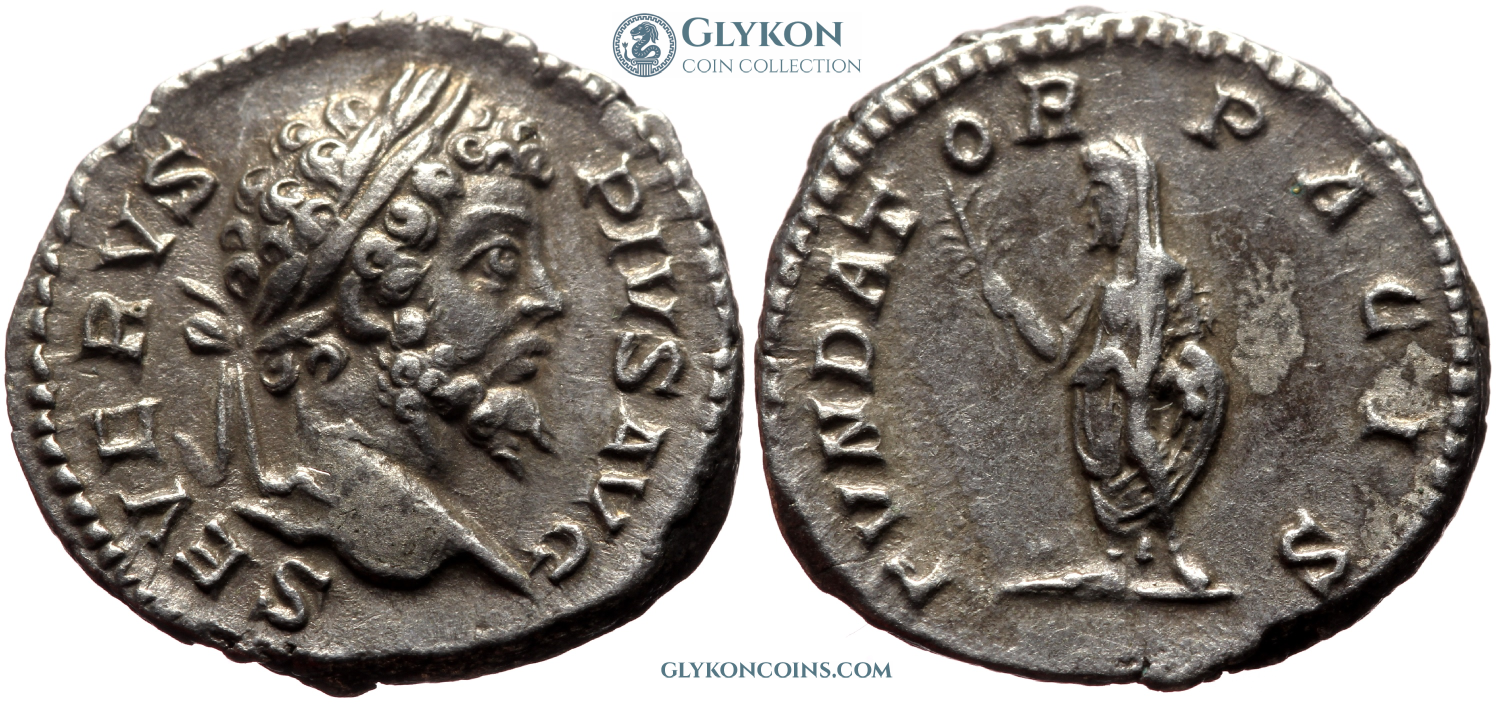
Septimius Severus (193-211 AD)
Denomination: Denarius
Mint: Rome
Time: 202-210 AD
Weight: 3.54 g
Diameter: approx. 18.3 mm
Reference: RIC 265; Sear 6282; RSC 205
Obverse: Laureate head of Septimius facing right. Legend: SEVERVS PIVS AVG.
Reverse: Togate and capite velato (with covered head) emperor standing facing left, holding his toga in an olive branch. Legend: FVNDATOR PACIS. |
|
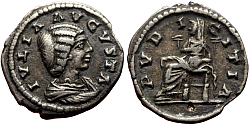 |
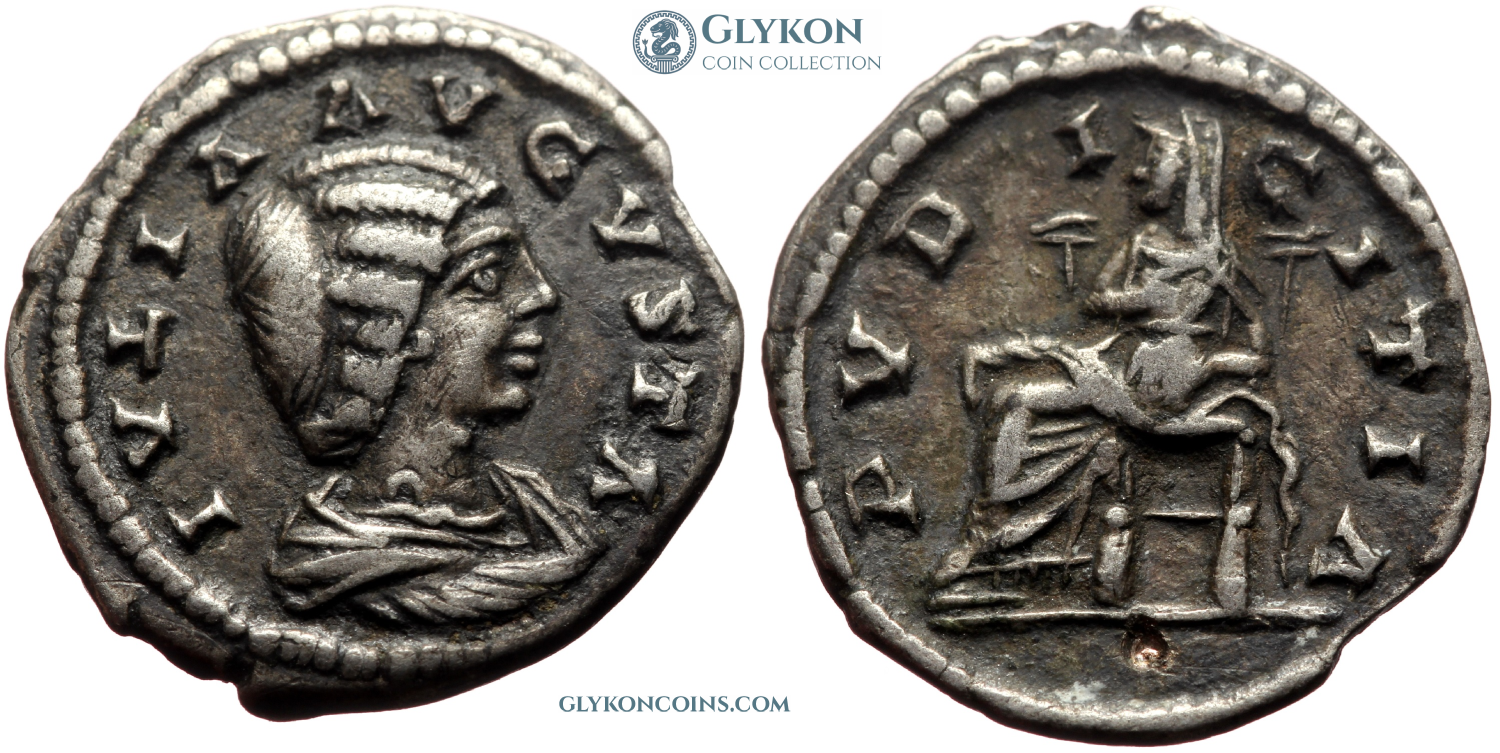
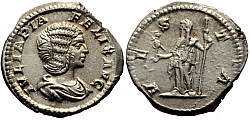
Julia Domna, Augusta (193-217), wife of Septimius Severus (193-211 AD)
Denomination: Denarius
Mint: Eastern mint, perhaps Laodicea in Syria
Time: 196-202 AD
Weight: 2.73 g
Diameter: approx. 19.3 mm
Reference: RIC 644; Sear 6602
Obverse: Draped bust of Julia in elaborate headdress facing right. Legend: IVLIA AVGVSTA.
Reverse: Draped Pudicitia (Modesty) seated facing left. Legend: PVDICITIA. |
|
 |
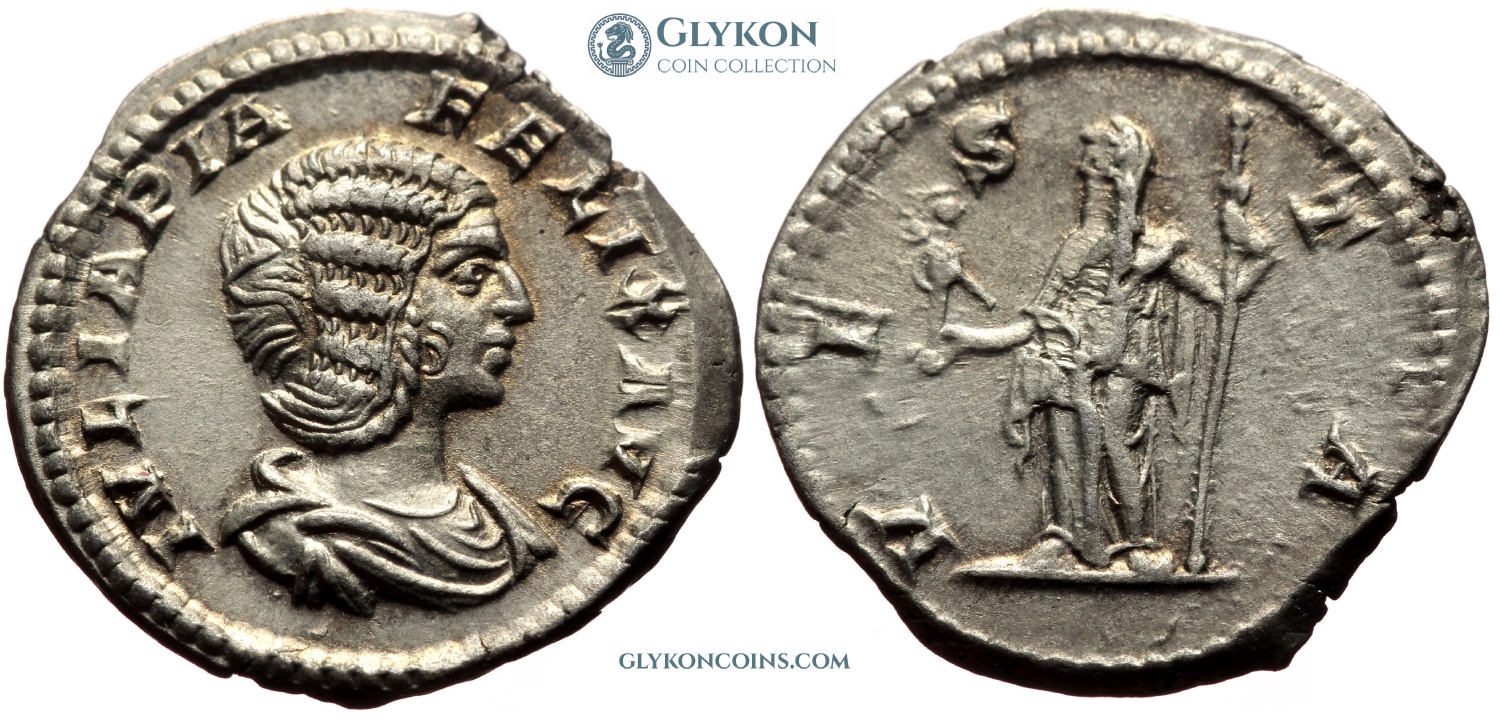
Julia Domna, Augusta (193-217), wife of Septimius Severus (193-211 AD)
Denomination: Denarius
Mint: Rome
Time: 213 AD
Weight: 3.54 g
Diameter: approx. 18.3 mm
Reference: RIC 265; Sear 6282; RSC 205
Obverse: Draped bust of Julia in elaborate headdress facing right. Legend: IVLIA PIA FELIX AVG.
Reverse: Draped Vesta standing facing left holding scepter and palladium. Legend: VESTA. |
|
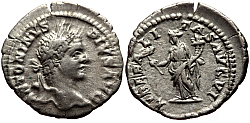 |
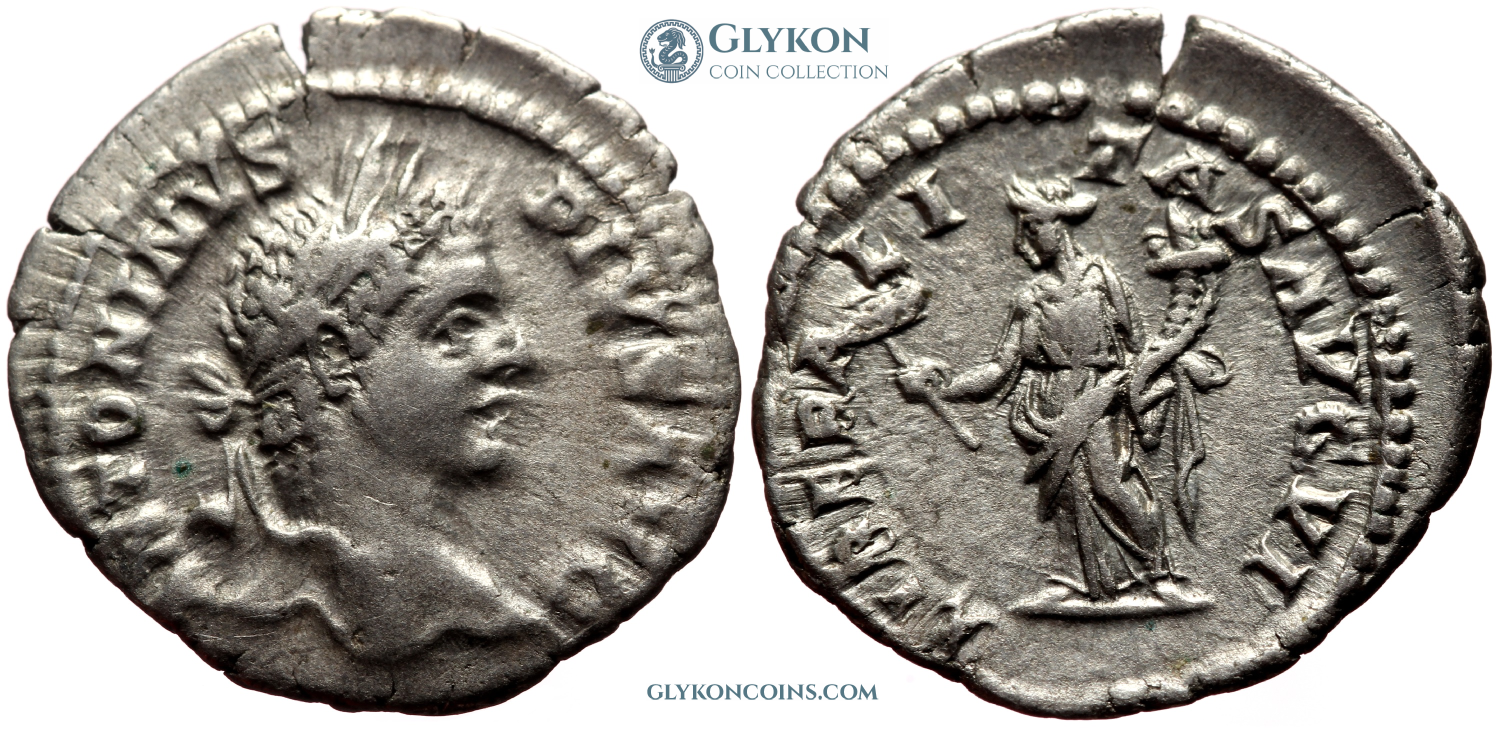
Caracalla (211-217 AD), as younger emperor under Septimius Severus
Denomination: Denarius
Mint: Rome
Time: 206-210 AD
Weight: 2.86 g
Diameter: approx. 19.8 mm
Reference: RIC IVa 158; Sear 6815
Obverse: Laureate head of youthful Caracalla facing right. Legend: ANTONONINVS PIVS AVG.
Reverse: Liberalitas standing facing left holding cornucopia and a coin counter. Legend: LIBERALITAS AVG VI. |
|
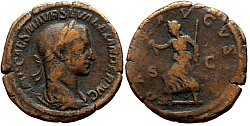 |
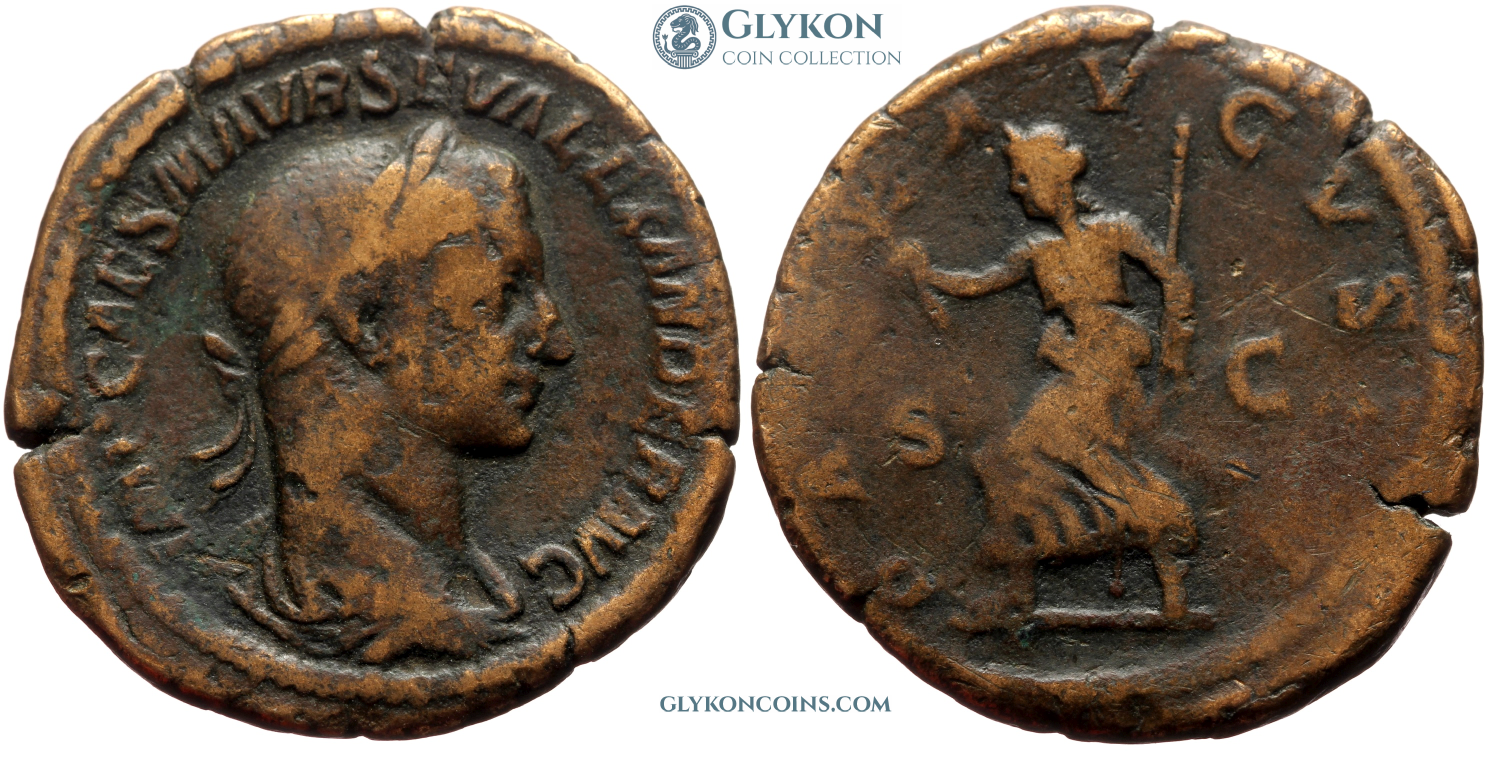
Alexander Severus (222-235 AD)
Denomination: Sestertius
Mint: Rome
Time: 231-235 AD
Weight: 17.18 g
Diameter: approx. 33.1 mm
Reference: RIC IV 592; Cohen 189cf; BMC 368; Sear 7984
Obverse: Laureate bust of Alexander facing right, some drapery around the neck. Legend: IMP CAES M AVR SEV ALEXANDER AVG.
Reverse: Draped Pax, flanked by large S and C, advancing left, holding branch and scepter. Legend: PAX AVGVSTI. |
|
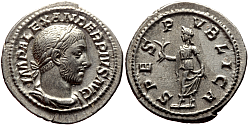 |
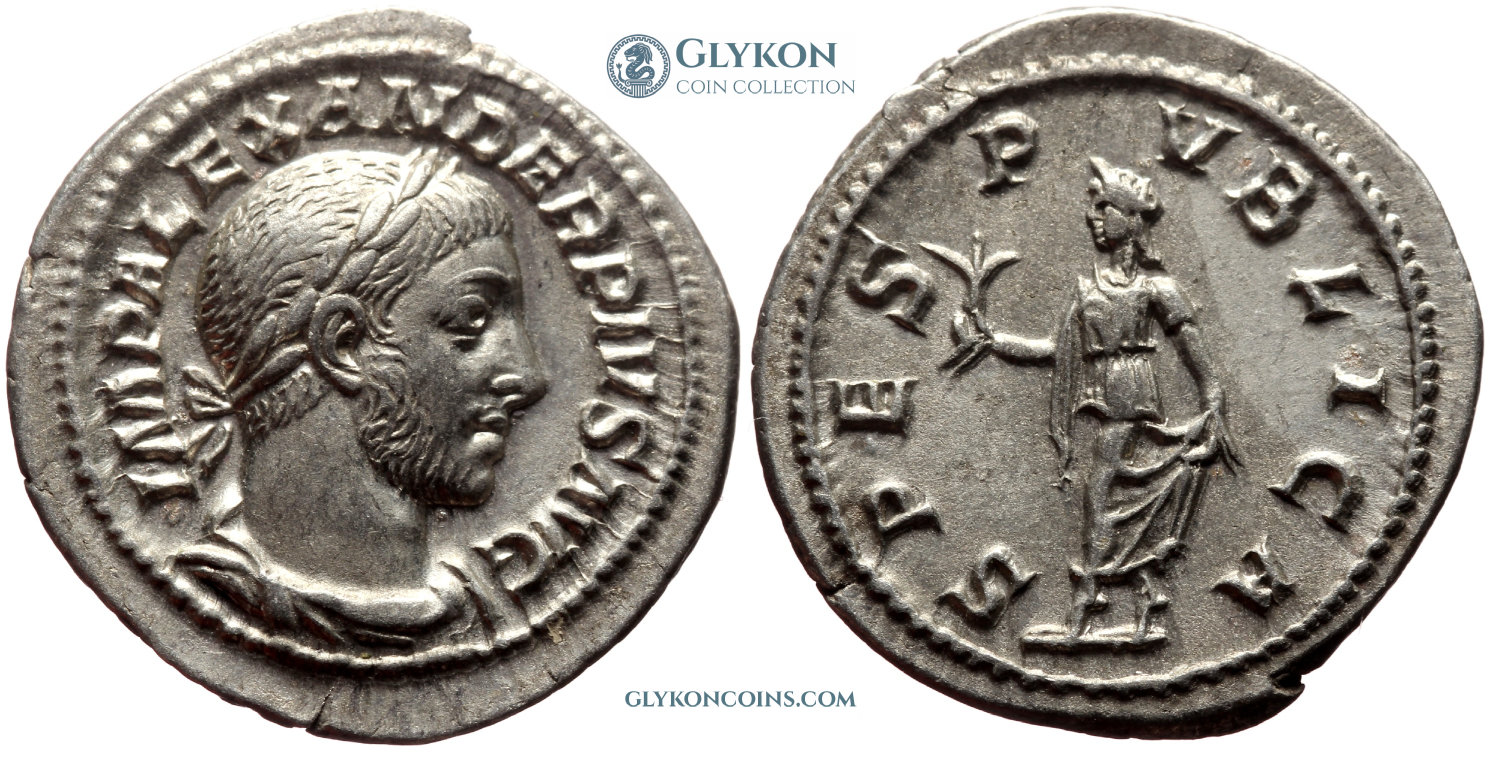
Alexander Severus (222-235 AD)
Denomination: Denarius
Mint: Rome
Time: 232 AD
Weight: 3.48 g
Diameter: approx. 20.5 mm
Reference: RIC IV 254; Sear 7927
Obverse: Laureate and draped bust of Alexander facing right. Legend: IMP ALEXANDER PIVS AVG.
Reverse: Draped Spes advancing left, holding a flower and the hem of her drapery. Legend: SPES PVBLICA. |