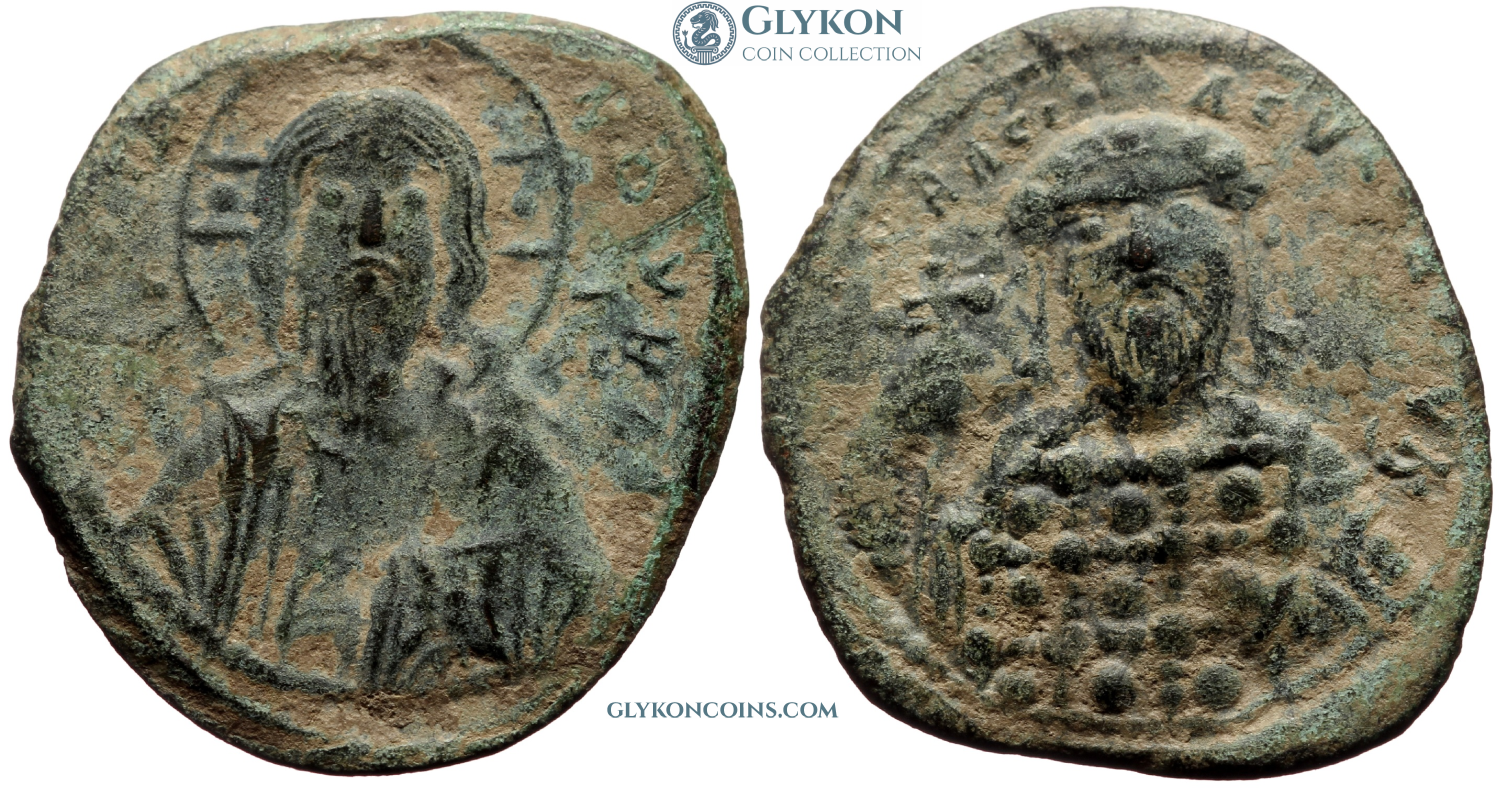
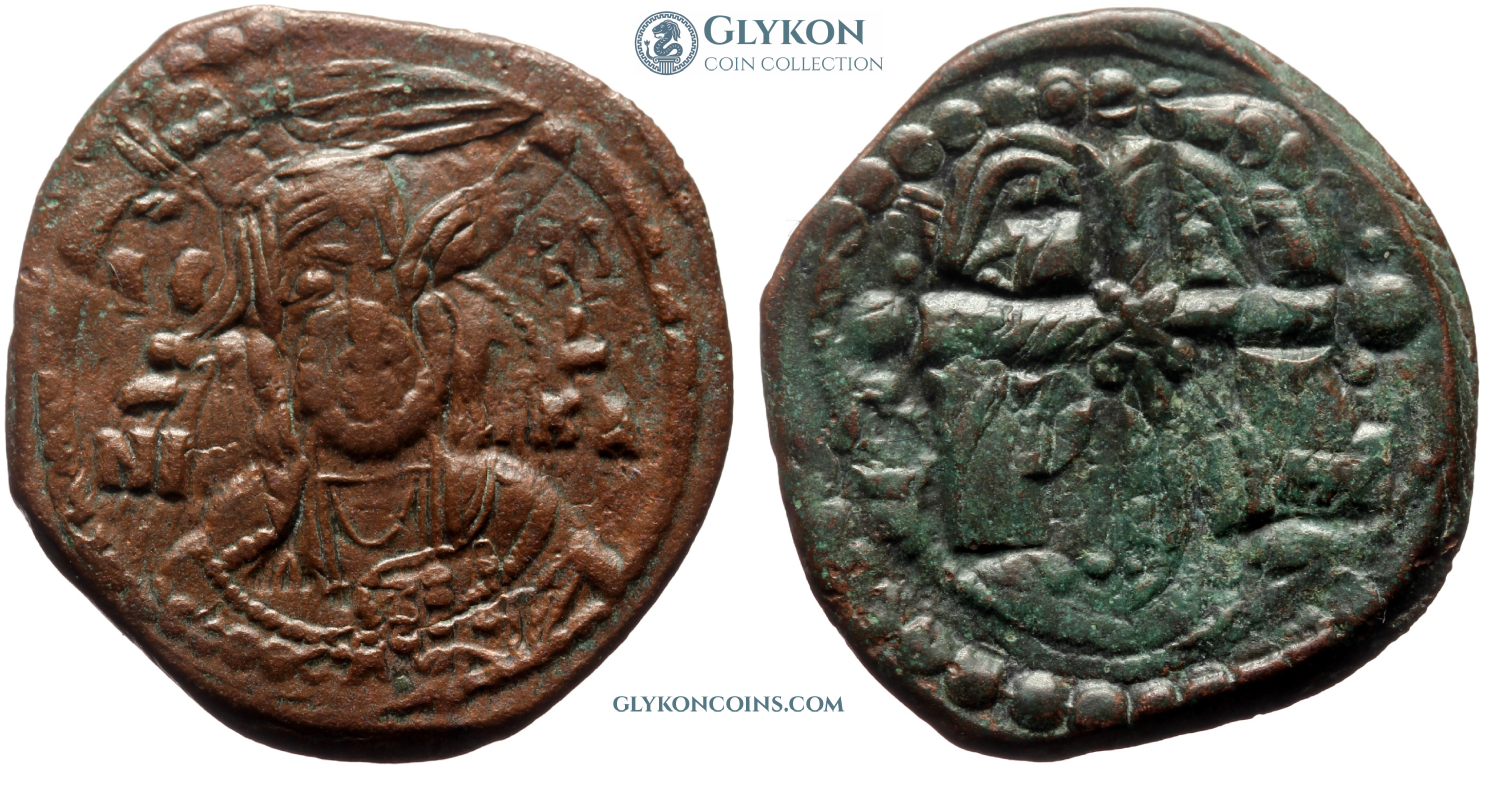
Coinage of the High Byzantine period (610 to 1071 AD)
| No. |
Photo |
Description |
|
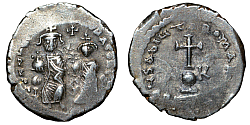 |
Heraclius (610-641 AD)
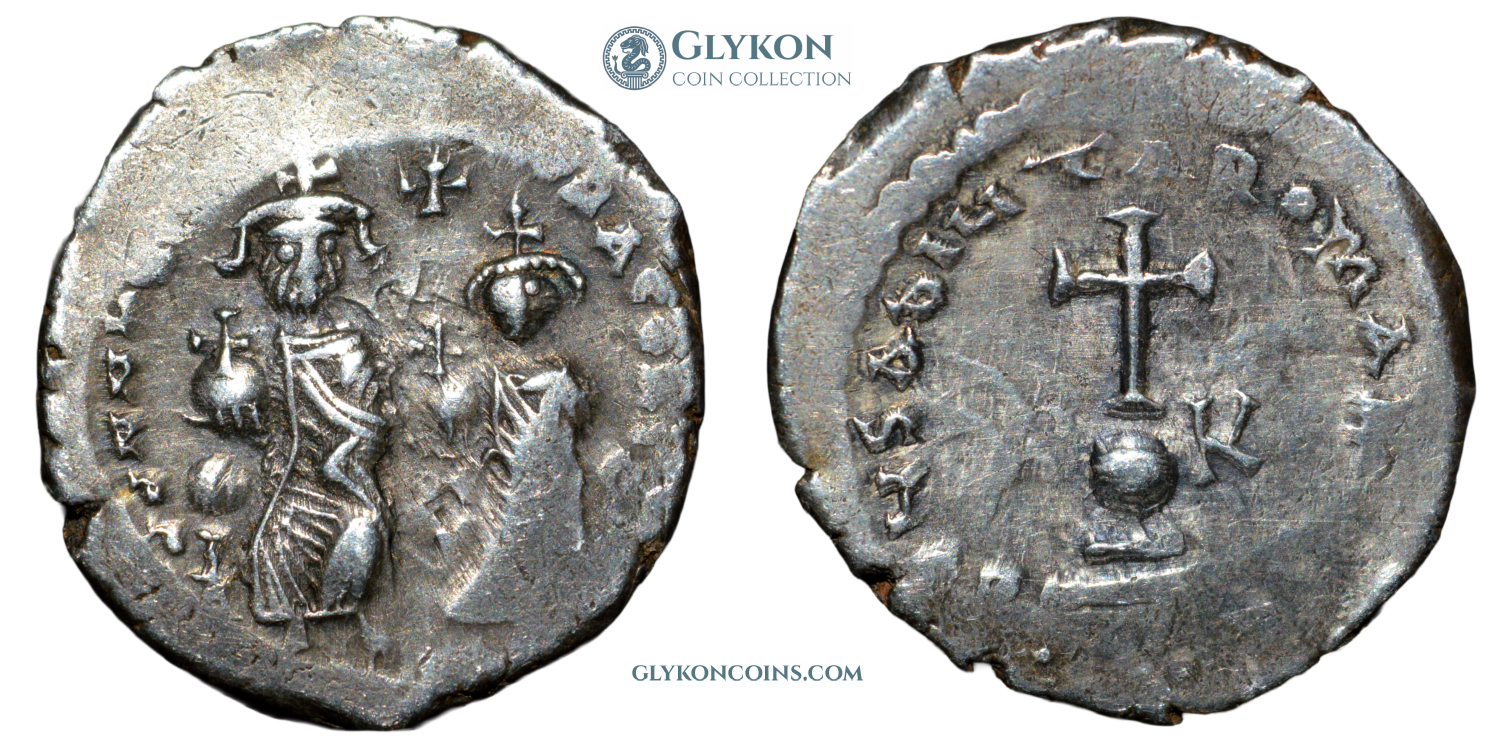
Denomination: Hexagram
Mint: Constantinople
Time: 615-638 AD
Weight: 6.74 g
Diameter: approx. 23.2 mm
Reference: Sear 798
Obverse: Heraclius and his son Heraclius Constantine seated facing, each wearing crucigerous crown and chlamys and each holding a globus cruciger. Small cross above, two globes on the sides. Legend in bungled letters: dd NN hERACLIUS Et hERA CONSt
Reverse: Cross potent on a globe and three steps with K on the right. Legend in bungled letters: dEUS AdIUtA ROmANIS
Comment: The long and tragic reign of Heraclius is something to behold. Full of defeats and victories, dramatic reversals of fortune, the emperor's own ineptitude and sloth interspersed by flashes of brilliance and resilience, family drama, and of course skillful propaganda that attributed Heraclius' failures to his predecessor at the meager cost of changing the timeline of events. Heraclius' reign witnessed first the climactic war with Sassanid Persia, in which the Empire for a moment seemed poised to collapse, followed by a brilliant, sudden and massive victory. Only for this victory to be engulfed by the unstoppable wave of Islamic invasions. This dramatic and chaotic period is reflected in the coinage. In desperation during the low ebb of the war with Persia, Heraclius ordered the melting down of church treasures. This marked the sudden return of silver coins onto the market after almost complete absence for about two centuries. These silver coins, conventionally named hexagrams, reflect the horrific times in which they were produced. The reverse legend plainly pleads “May God save the Romans!”, as if only divine intervention could have saved the Empire from the situation it found itself in. |
|
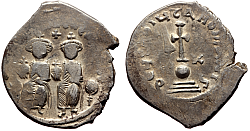 |
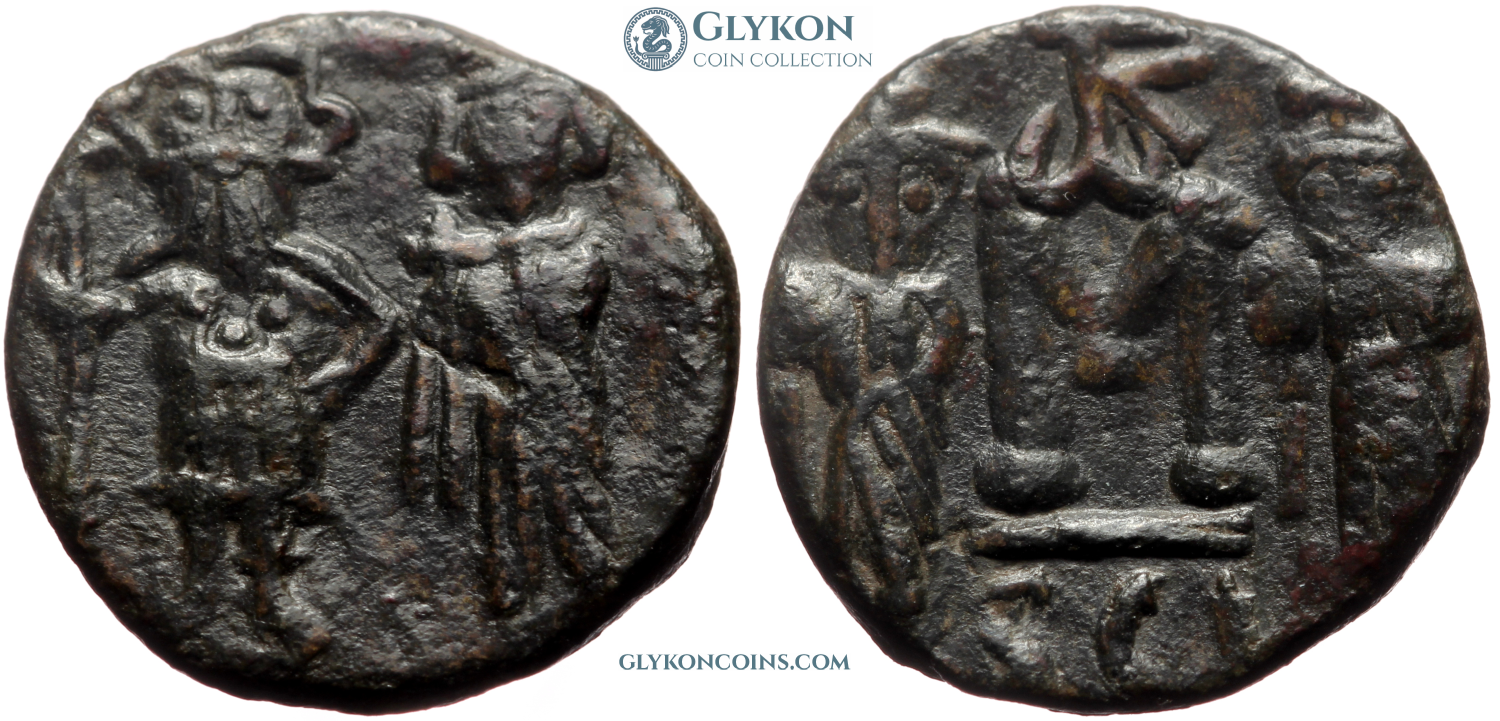
Heraclius (610-641 AD)
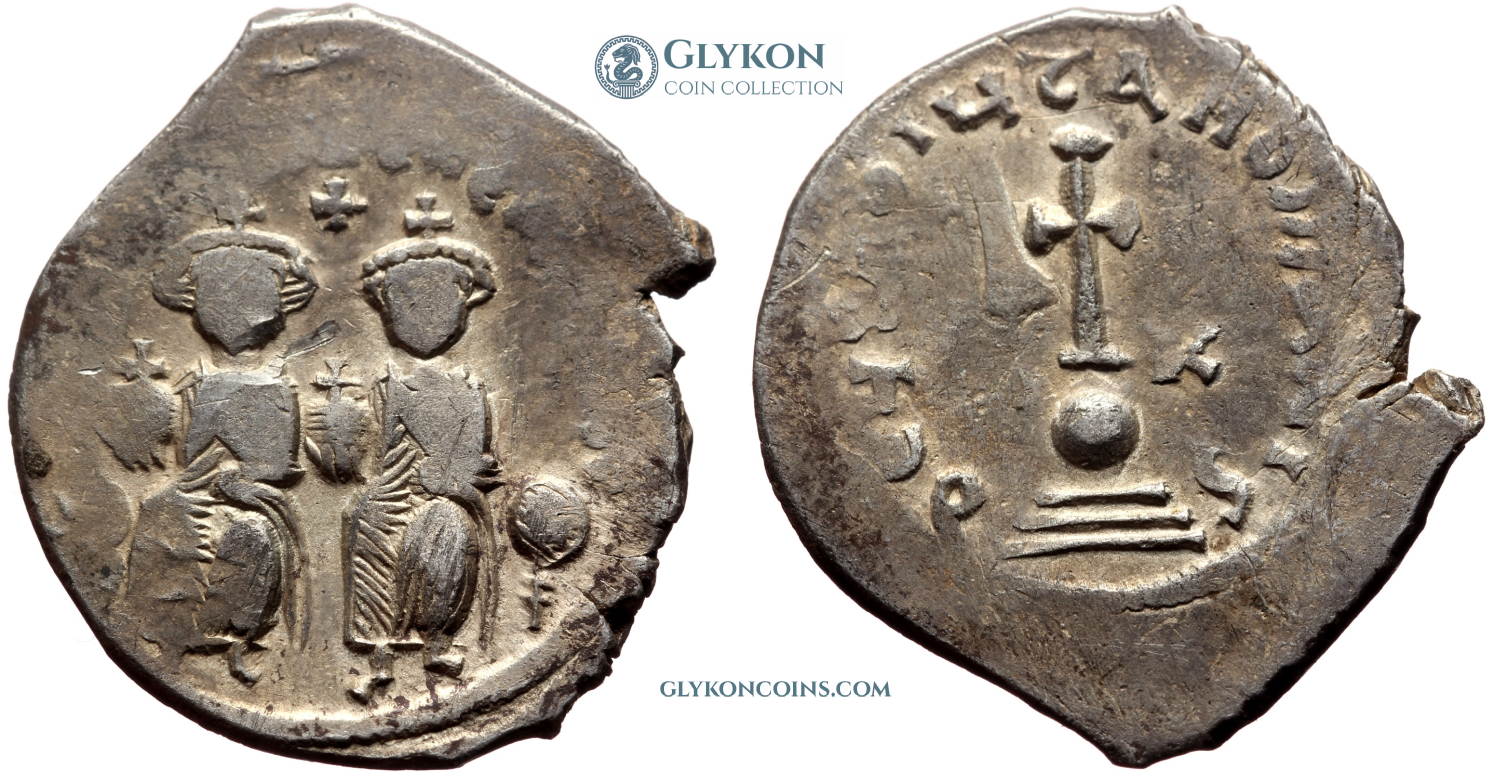
Denomination: Hexagram
Mint: Constantinople
Time: 615-638 AD
Weight: 5.86 g
Diameter: approx. 25.5 mm
Reference: Sear 798
Obverse: Heraclius and his son Heraclius Constantine seated facing, each wearing crucigerous crown and chlamys and each holding a globus cruciger. Small cross above, two globes on the sides. Legend in bungled letters: dd NN hERACLIUS Et hERA CONSt
Reverse: Cross potent on a globe and three steps with K on the right. Legend in bungled letters: dEUS AdIUtA ROmANIS
Comment: Same type as above. This specimen shows clear signs of having been struck over a hastily heated and roughly cut sheet of silver. Some traces of earlier designs are still visible. Perhaps some fragment of an ancient church chalice or candelabrum is looking at us here, with faint echoes of its former beauty. |
|
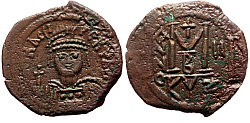 |
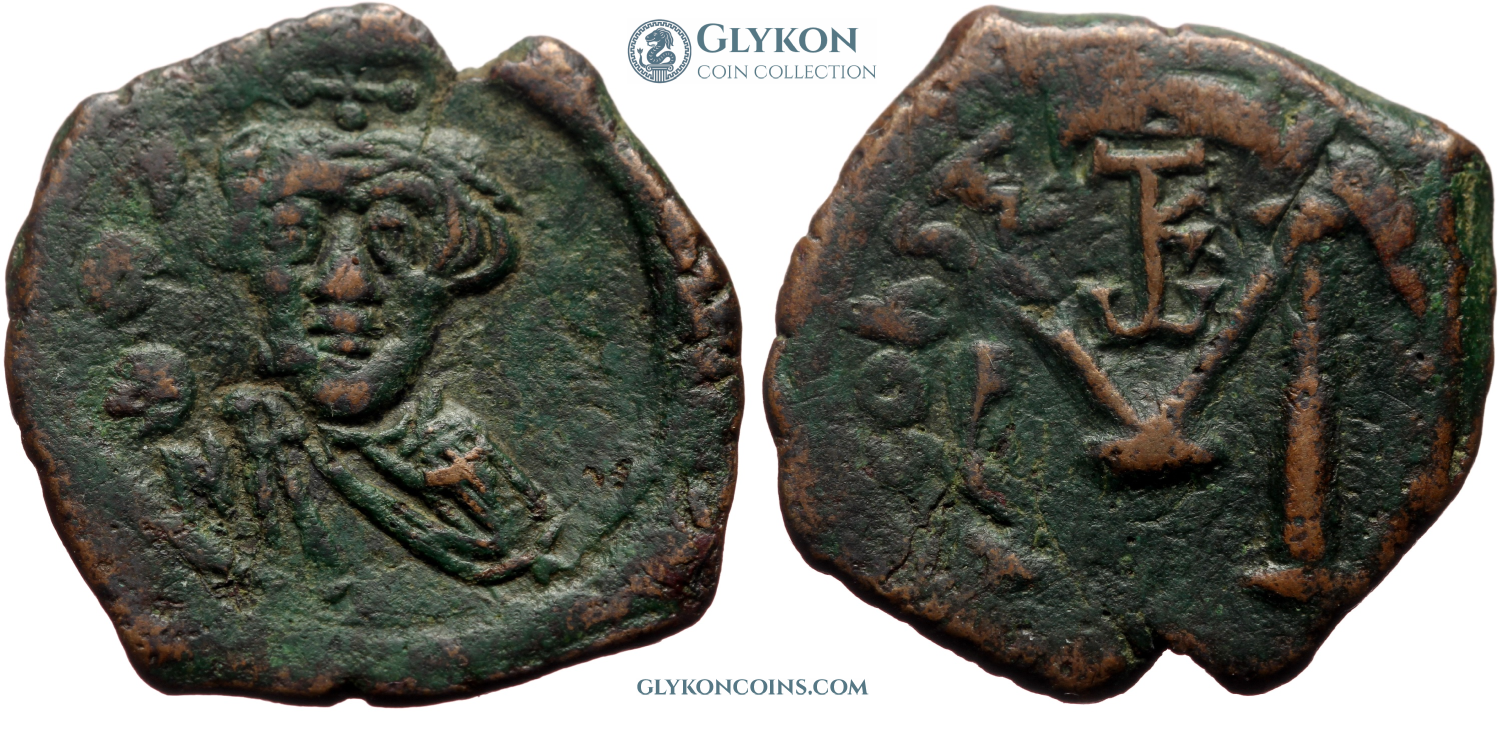
Heraclius (610-641 AD)
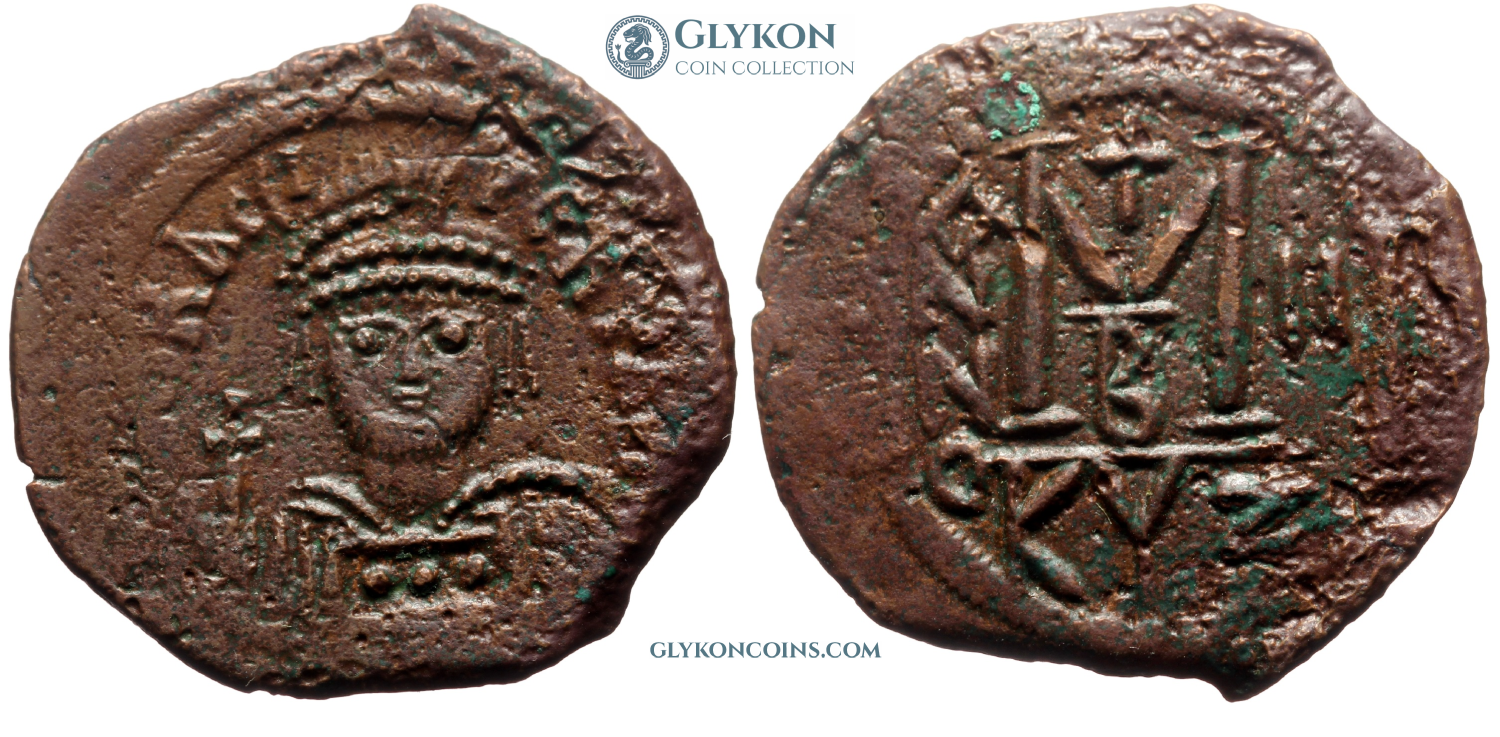
Denomination: 40 nummi (follis)
Mint: Cyzicus
Time: 611-612 AD
Weight: 10.29 g
Diameter: approx. 30.7 mm
Reference: Sear 839; MIB 184
Obverse: Facing bust of youthful Heraclius with short beard, cuirassed, wearing helmet-diadem with short plume, holding globus cruciger in right hand and shield in left hand. Legend in bungled letters: DN hRACLI PERP AVG
Reverse: Large M indicating denomination of 40 nummi. Cross above, officina symbol B (sexond officina) below. Left and right ANNO and regnal year II (2). KYZ below in exergue. |
|
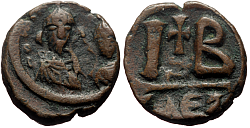 |
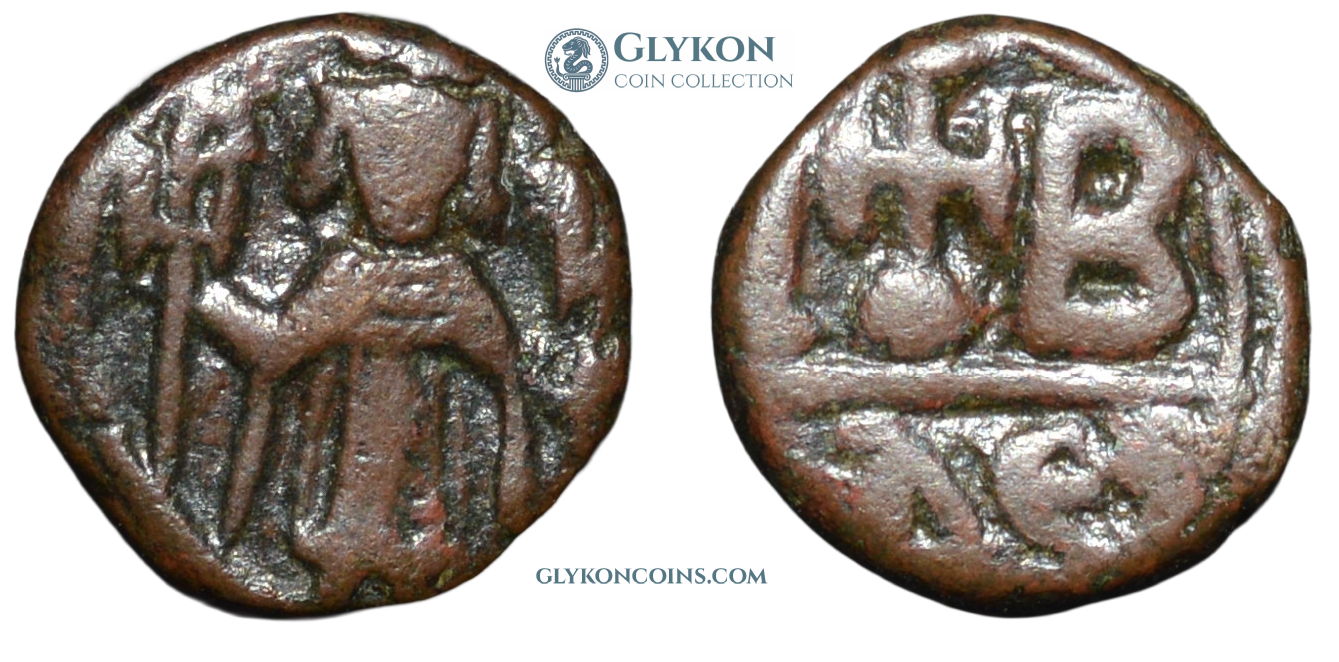
Heraclius (610-641 AD)
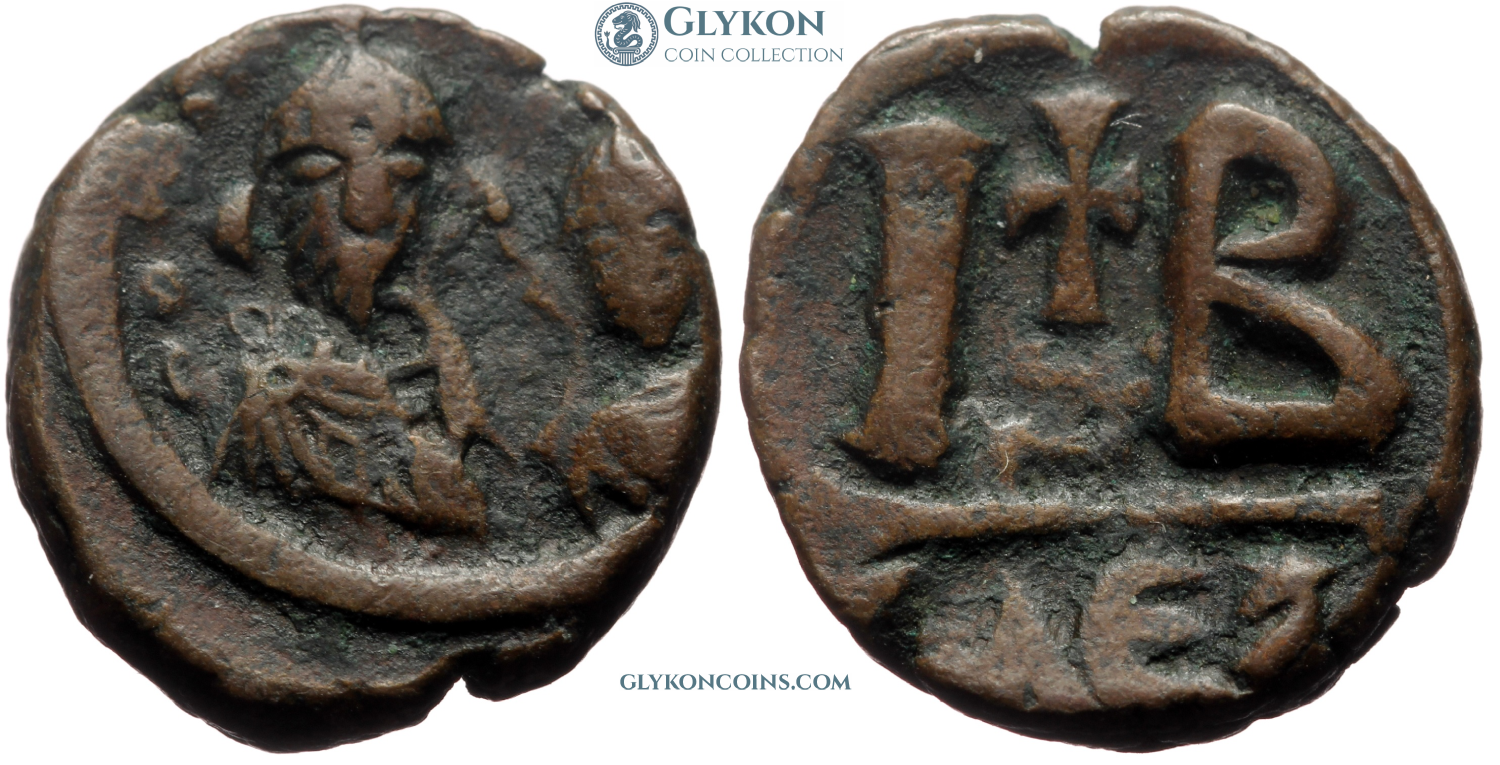
Denomination: 12 nummi (dodekanummium)
Mint: Alexandria
Time: 613-618 AD
Weight: 4.71 g
Diameter: approx. 16.7 mm
Reference: Sear 853; MIB 200; DOC 189
Obverse: Facing busts of bearded Heraclius on the left and beardless Heraclius Constantine on the right, each crowned and wearing chlamys. Legend: dd mm h hERAC
Reverse: Large I and B indicating denomination of 12 nummi. Between them large cross potent on two steps. ΑΛЄƵ below in exergue.
Comment: Remarkably, Egypt retained many monetary peculiarities into the very latest Byzantine era. East Romans continued the monetary policy dating back to the age of the ancient Ptolemies to maintain different standards in order to prevent monetary outflow from Egypt. This is exemplified by dodekanummi being the standard copper coin in Byzantine Egypt, a coin that in many ways, including their globular shape, resembled the latest debased Egyptian tetradrachms of the late Roman Empire. |
|
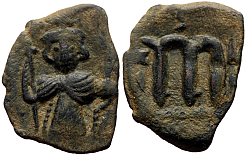 |
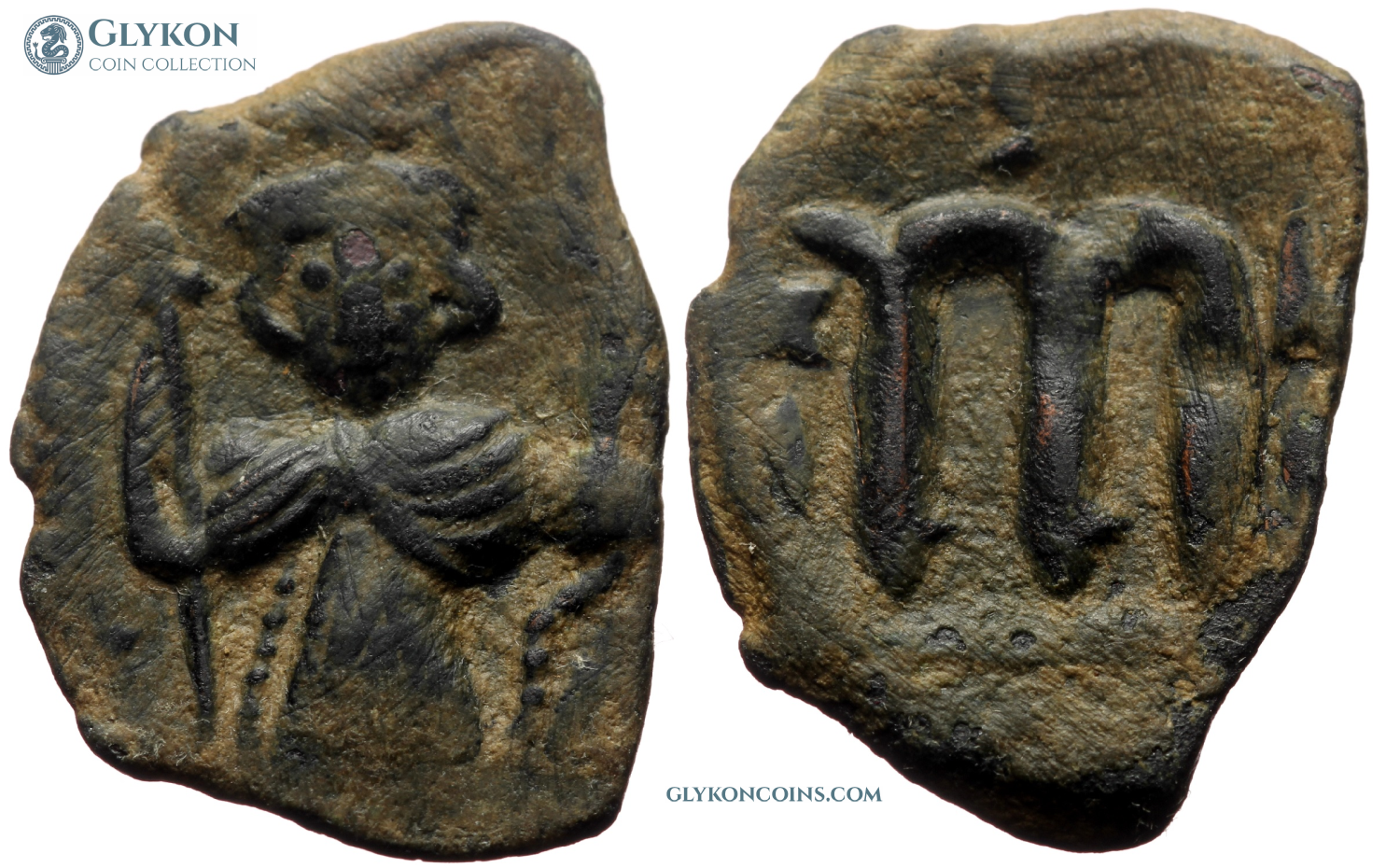
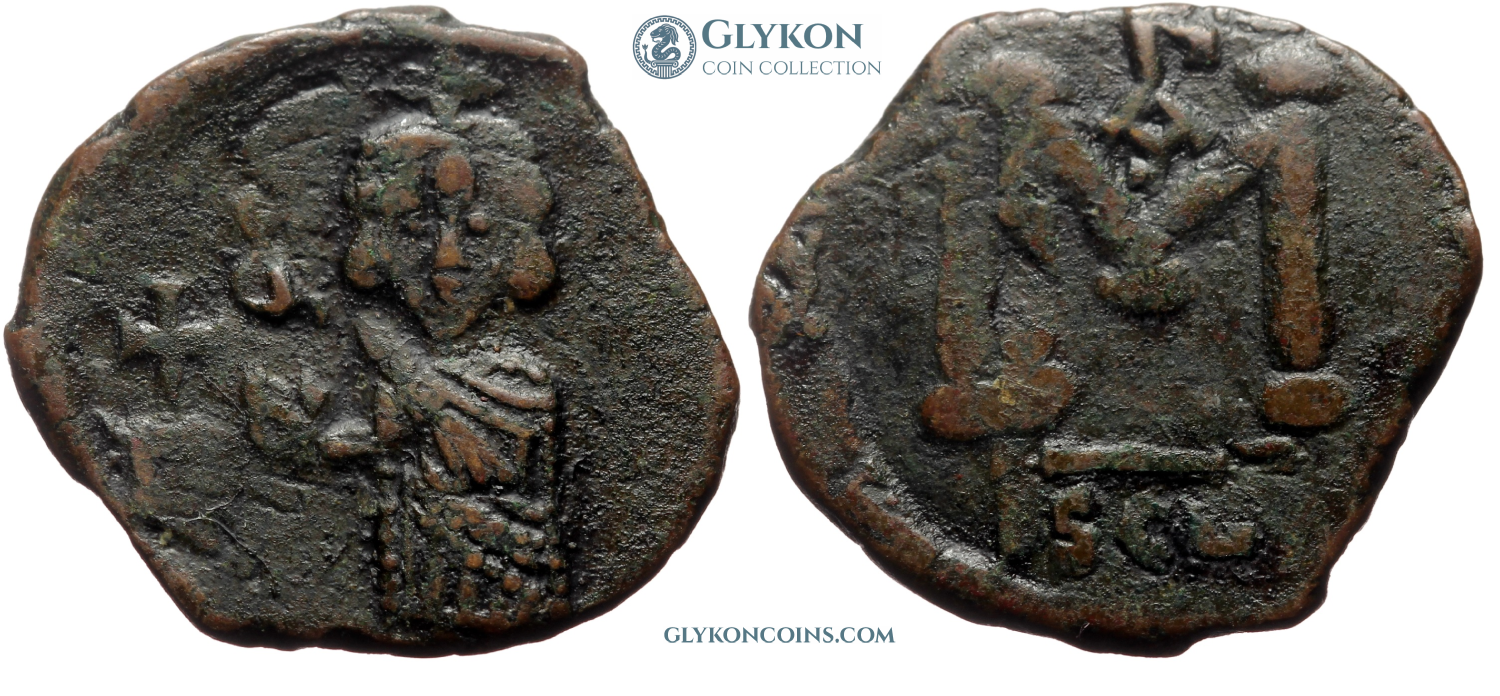
Constans II (641-668 AD)
Denomination: 40 nummi (follis)
Mint: Constantinople
Time: 647-668 AD
Weight: 3.40 g
Diameter: approx. 23.5 mm
Reference: Sear 1000, 1001, or other, similar type
Obverse: Facing figure of crowned youthful Constans beardless or with short beard, wearing chlamys, holding long cross-topped scepter and globus cruciger. Legend: ???
Reverse: Large M indicating denomination of 40 nummi, some other, indiscernible signs.
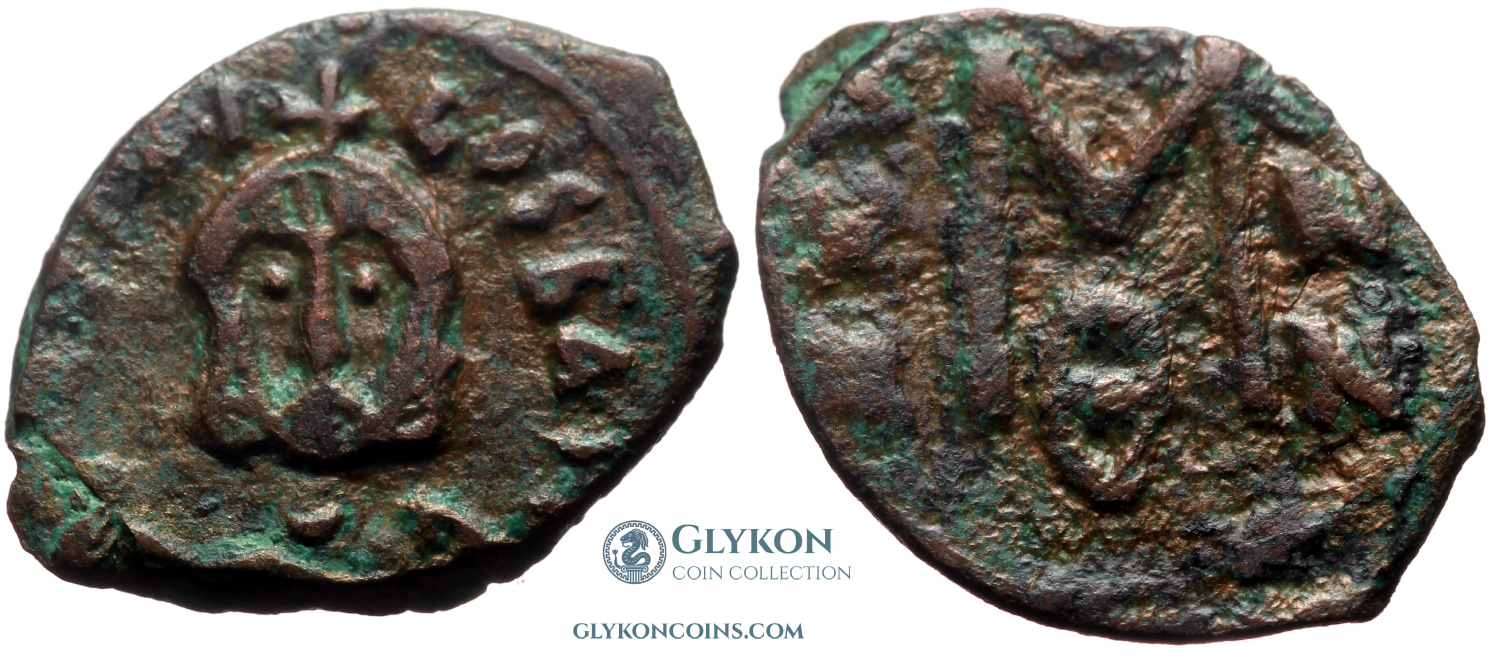
Comment: Constans II (regnal name: Constantine, "Constans" was a nickname that established itself even in contemporary sources) was notable as the conscientious emperor who tried to do the right thing, but failed at each task. He fought hard to defend and later retake Egypt from the Arabs, but his armies failed miserably. He also fought the Arabs at sea, only to suffer one of the worst Roman naval defeats in history (the famous battle of the Masts in 655) and barely escaped with his life. Awarded a brief respite due to Islamic civil war, he tried to personally relieve the battered Roman positions in Italy, only to be badly defeated by the Lombards. He notably visited Rome, as the last East Roman emperor who did it while still the nominal sovereign of the old capital. And then he proceeded to thoroughly loot Rome and Italy in general of anything of value and sent it to Constantinople. Statues, gold, monuments, nothing was safe. Even copper roofs of ancient Roman buildings were stripped and shipped away. Weirdly, people who complain so much about the Latin looting of Constantinople in 1204 fail to note this particular event. At any rate, Constans then moved on to Sicily and reportedly wanted to make his personal base there, these plans were cut short by his assassination by disgruntled court members.
In short, the empire under Constans was in an utterly wretched state, which is reflected by his miserable coinage. Although his gold coinage still somewhat maintained standards, his copper coins were in freefall, both due to metal shortage and collapse of administrative structures to effectively run and supervise the mint. His folles were minted onto clipped flans of earlier coins, like this specimen, minted on what seems to be 1/3rd or 1/4th of some earlier coin. Dies were simply ugly, and minted extremely carelessly, which often makes their identification problematic.
The coinage under Constans II was often in such a bad shape that Arabs, who still minted imitations of Byzantine coins at the time, including imitations of those by Constans, produced better specimens than the official mint. |
|
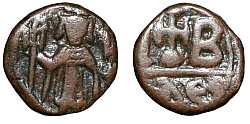 |
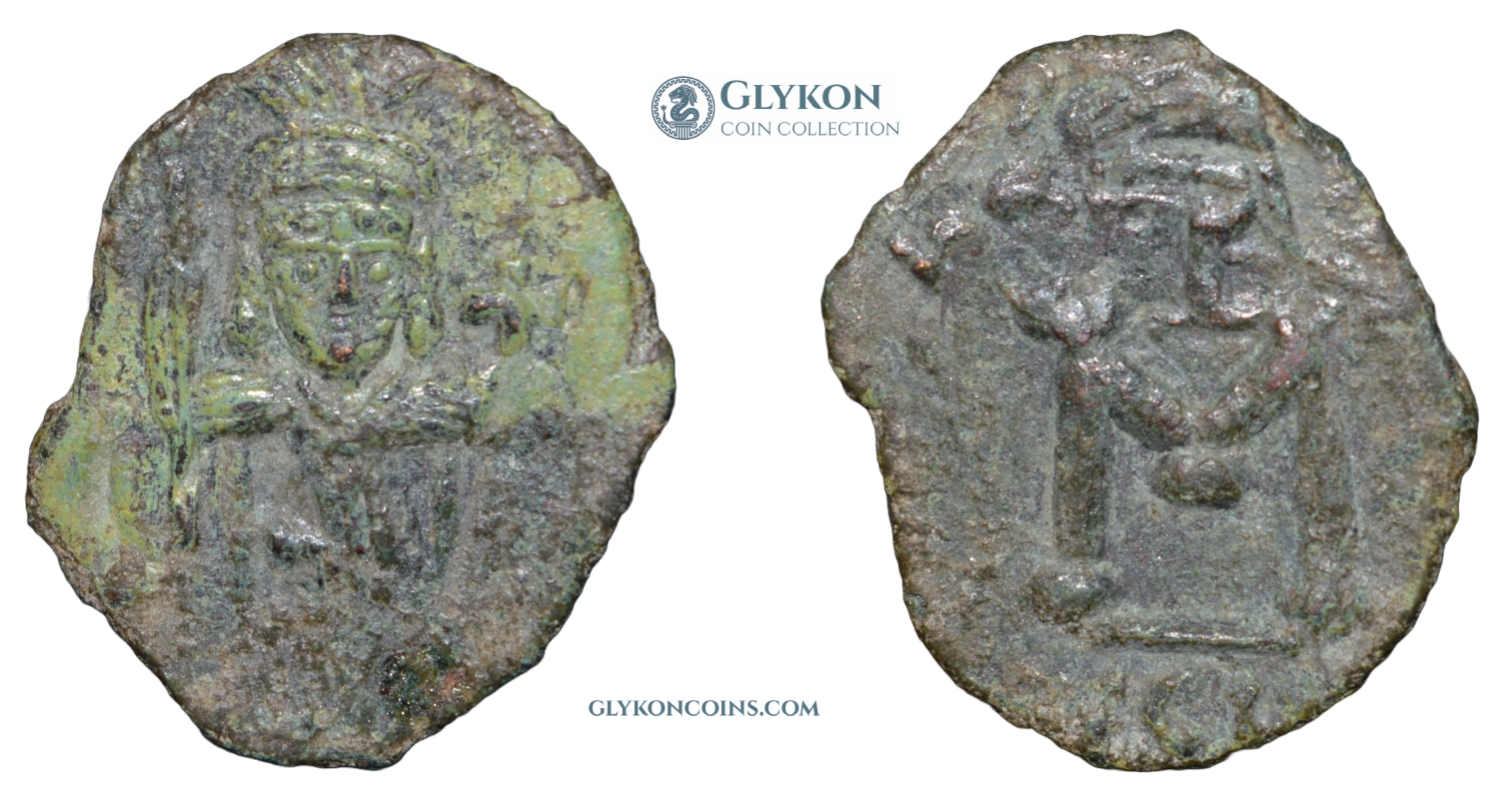
Constans II (641-668 AD)
Denomination: 12 nummi (dodekanummium)
Mint: Alexandria
Time: 645-646 AD
Weight: 5.84 g
Diameter: approx. 17.2 mm
Reference: Sear 1027
Obverse: Facing figure of crowned Constans beardless or with short beard, wearing chlamys, holding long cross-topped scepter and globus cruciger.
Reverse: Large I and B indicating denomination of 12 nummi. Between them a large cross potent. ΑΛЄƵ below in exergue.
Comment: This interesting small coin was minted in an extremely thin time window. The Eastern Romans didn't just watch their empire being taken piece by piece by the Arabs. Egypt was lost in early 640s, but in 645 emperor Constans II launched at a great expense a naval expedition to retake it. The expedition succeeded at first, and the local population welcomed the Romans as liberators. It seems that the Romans quickly went to restore the old administration and restarted the mint. However, the expedition's military commander wasted time and moreover quickly earned the enmity of the locals with his avarice. The Arabs regrouped and counterattacked in 646, and the Romans had little to do but evacuate in haste. This was the last time a Christian power occupied much of Egypt until the arrival of Napoleon's army at the end of the 18th century. Arabization and Islamization of the world's oldest civilization could therefore proceed without impediment. |
|
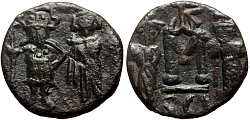 |
Constans II (641-668 AD)
Denomination: 40 nummi (follis)
Mint: Syracuse
Time: 647-668 AD
Weight: 3.06 g
Diameter: approx. 16.2 mm
Reference: Sear 1110; DOC 18
Obverse: Two crowned figures standing facing: Constans II, bearded and armored, holding a long cross; and his son Constantine (later Constantine IV), beardless and in chlamys, holding a globus cruciger. No legend.
Reverse: Large M indicating denomination of 40 nummi. Monogram above, SCL below. Standing facing figures of Constans' younger sons, each crowned, wearing chlamys and holding globus cruciger: Heraclius on the left and Tiberius on the right.
Comment: During Byzantine times Sicily, much like Egypt, had its own monetary system. Theoretically the island used the same denominations as the core part of the empire, but in reality it had a local mint that produced coins of much smaller size and often strikingly different designs, usually adorned with the SCL monogram. When Constantinopolitan folles are found in Sicily, they almost invariably bear a countermark (also SCL, emperor's bust, or both) indicating that they were specifically allowed for circulation on the island. |
|
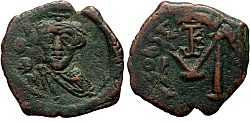 |
Constans II (641-668 AD)
Denomination: 40 nummi (follis)
Mint: Syracuse
Time: 647-668 AD
Weight: 4.93 g
Diameter: approx. 25.3 mm
Reference: Sear 1104
Obverse: Facing beardless bust of Constans, wearing crucigerous crown and holding globus cruciger. No legend.
Reverse: Large M indicating denomination of 40 nummi. Monogram above, SCL below.
Comment: Visible traces, especially residual lettering, indicate that this coin was overstruck. Most likely the underlying type is Sear 1103. |
|
|
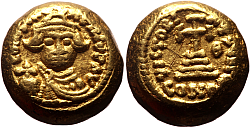 |
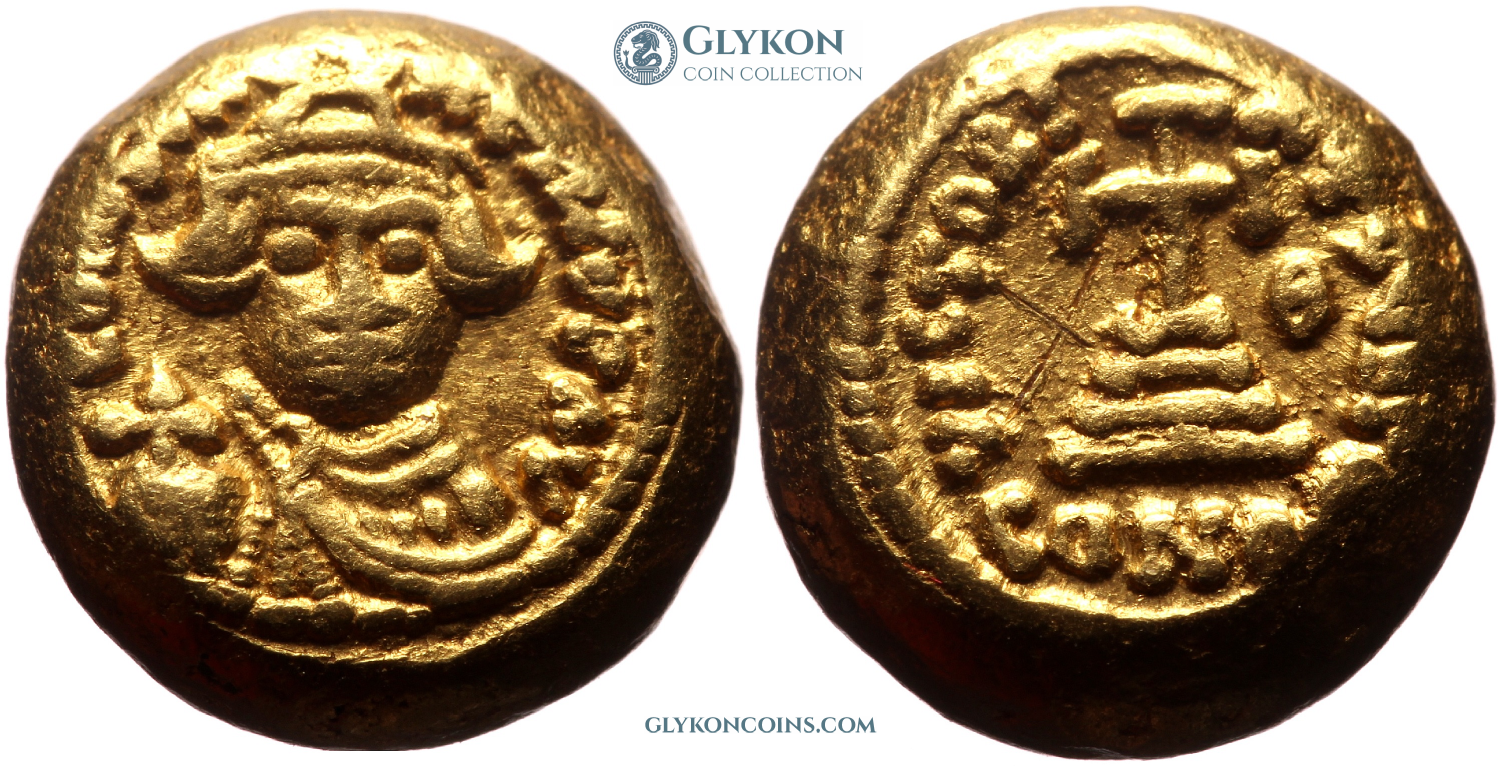
Constans II (641-668 AD)
Denomination: Solidus
Mint: Carthage
Time: 647-648 AD
Weight: 4.40 g
Diameter: approx. 10.3 mm
Reference: Sear 1033
Obverse: Facing bust of youthful beardless Constans II, wearing crown and chlamys, holding globus cruciger. Legend in bungled letters: DN CONSTANTIN P
Reverse: Cross potent on three steps with Θ on right. Legend in bungled letters: VICTORIA AVGU. Officina mark Γ. CONOB below.
Comment: During the final decades of East Roman rule in North Africa, the mint in Carthage, for inexplicable reasons, produced gold solidi in a unique, small and globular shape instead of the standard flat form seen elsewhere in the empire. These globular coins, thicker and smaller in diameter, likely emerged in response to local practices or economic conditions, though their precise purpose remains unclear. Interestingly, even after the Arab conquest of Carthage, the new rulers continued minting gold coins in this unusual format, suggesting that the distinct design had gained acceptance in the region’s monetary system. |
|
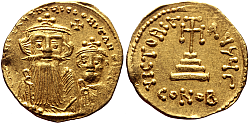 |
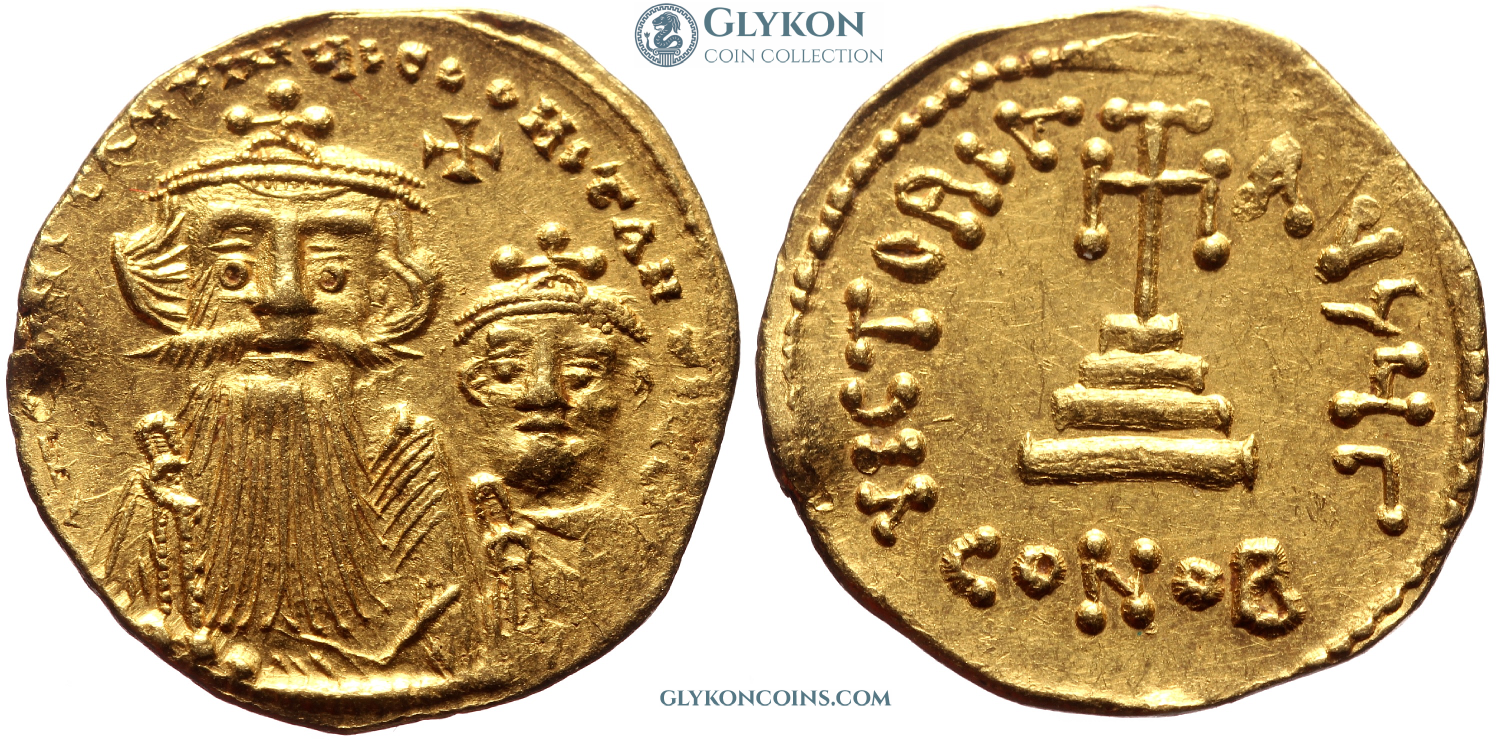
Constans II (641-668 AD)
Denomination: Solidus
Mint: Constantinople
Time: 647-668 AD
Weight: 4.42 g
Diameter: approx. 20.6 mm
Reference: Sear 959
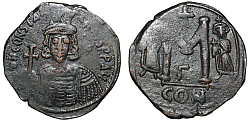
Obverse: Facing busts of Constans II bearded and young Constantine IV beardless, each wearing crucigerous crown and chlamys. Legend in bungled letters: dN CONSTANTINUS C CONSTAN
Reverse: Cross potent on three steps. Legend in bungled letters: VICTORIA AVGU. Officina mark Γ. CONOB below. |
|
 |
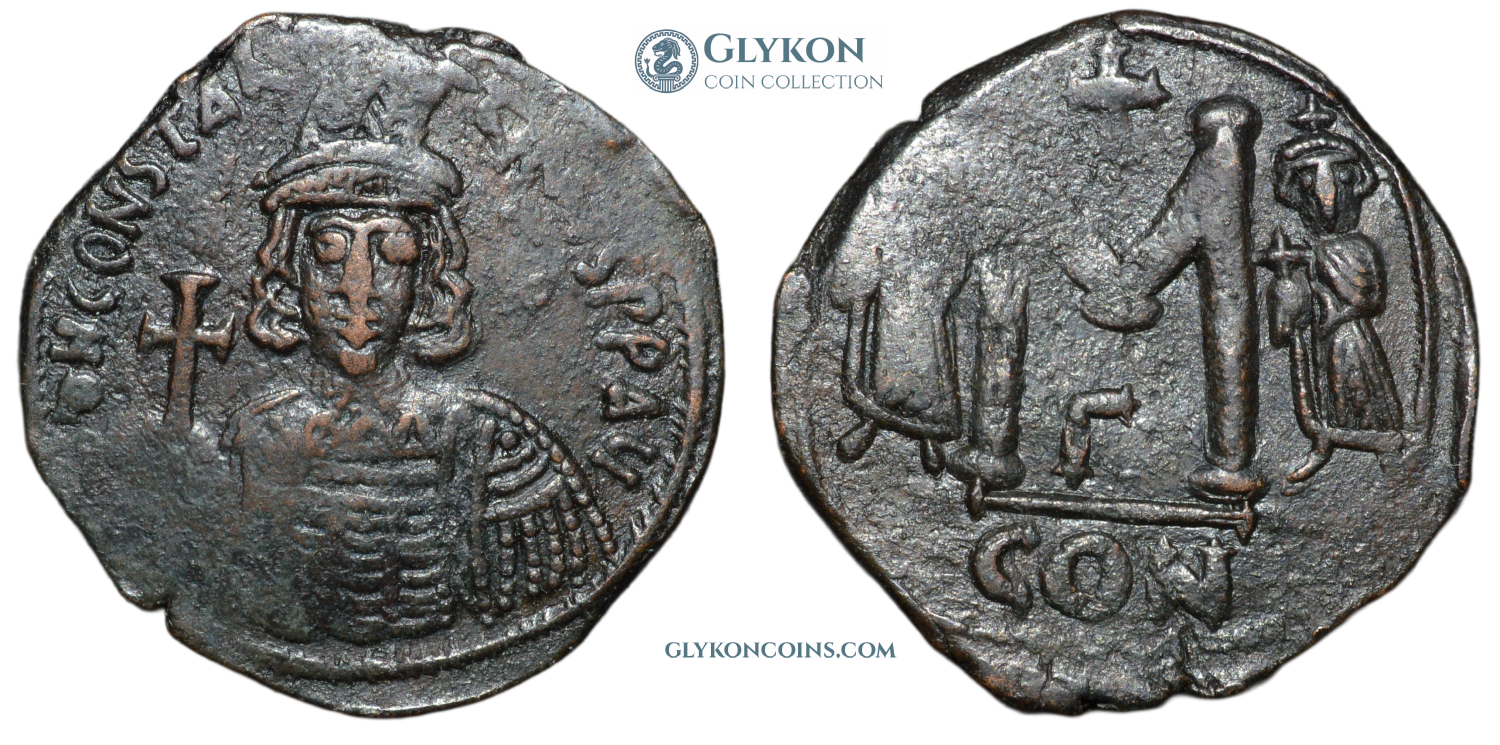
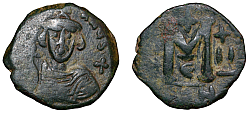
Constantine IV (668-685)
Denomination: 40 nummi (follis)
Mint: Constantinople
Time: 668-681 AD
Weight: 18.33 g
Diameter: approx. 37.1 mm
Reference: Sear 1173
Obverse: Facing bust of Constantine IV, wearing cuirass and plumed helmet, holding globus cruciger. Legend: dN CONSτANτINЧS PP AЧ
Reverse: Large M indicating denomination, flanked by junior emperors Heraclius and Tiberius, both wearing chlamys and crucigerous crown and both holding globus cruciger, cross above, officina symbol Γ below. CON in exergue.
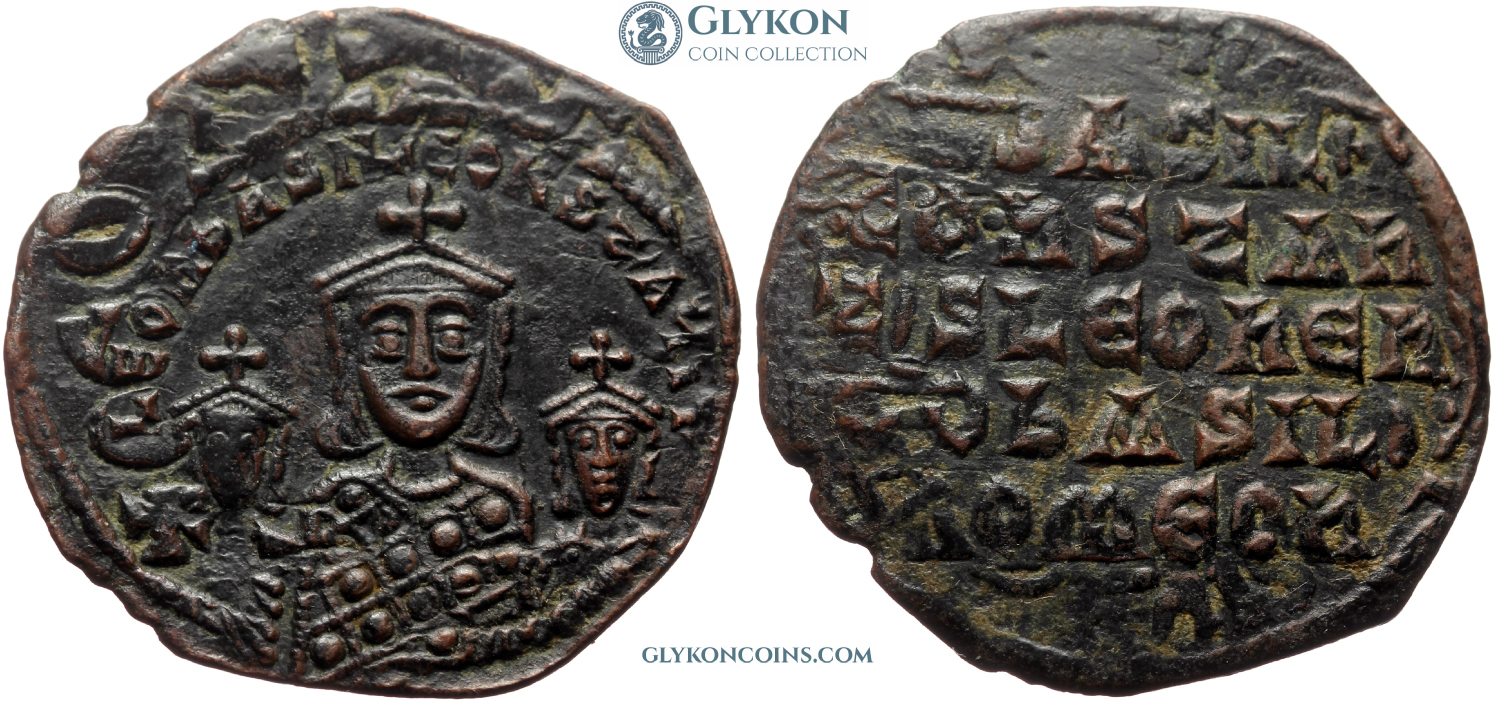
Comment: Constans' firstborn son Constantine IV was perhaps the most successful emperor of the Heraclian dynasty. He's the only one who managed to preserve his empire relatively intact, briefly checking the unstoppable Arab advance, though suffering defeats at the hands of Bulgars and Lombards. He also briefly reversed the debasement of copper coinage and increased its size, weight and appearance. It's quite a mystery how Constantine managed, despite the general societal collapse around him, to gain the necessary metal needed for such an operation. After all, other emperors tended to progressively decrease the weight and size of copper coins. My personal theory is that Constantine used copper plundered by his father Constans in Italy, and especially in Rome. As such, perhaps the metal in my coin came from some ancient Roman statue, or perhaps the roof of the Pantheon. Some boring historians might disagree, but I like sticking to this thought. At any rate, the reform did not outlive Constantine, as succeeding emperors continued the debasement trend. Constantine's own folles were then cut into two or even four pieces and shoddily restruck on visibly cut flans. As such they are exceedingly rare today.
Also of note is that this coin features Constantine's younger brothers and nominal co-emperors. As such, it was minted before the tragic events of 681, when both brothers were mutilated by Constantine for unknown offences and removed from the imperial palace. Perhaps their only offence was that they stood in line of succeeding the throne instead of Constantine's son Justinian. |
|
 |
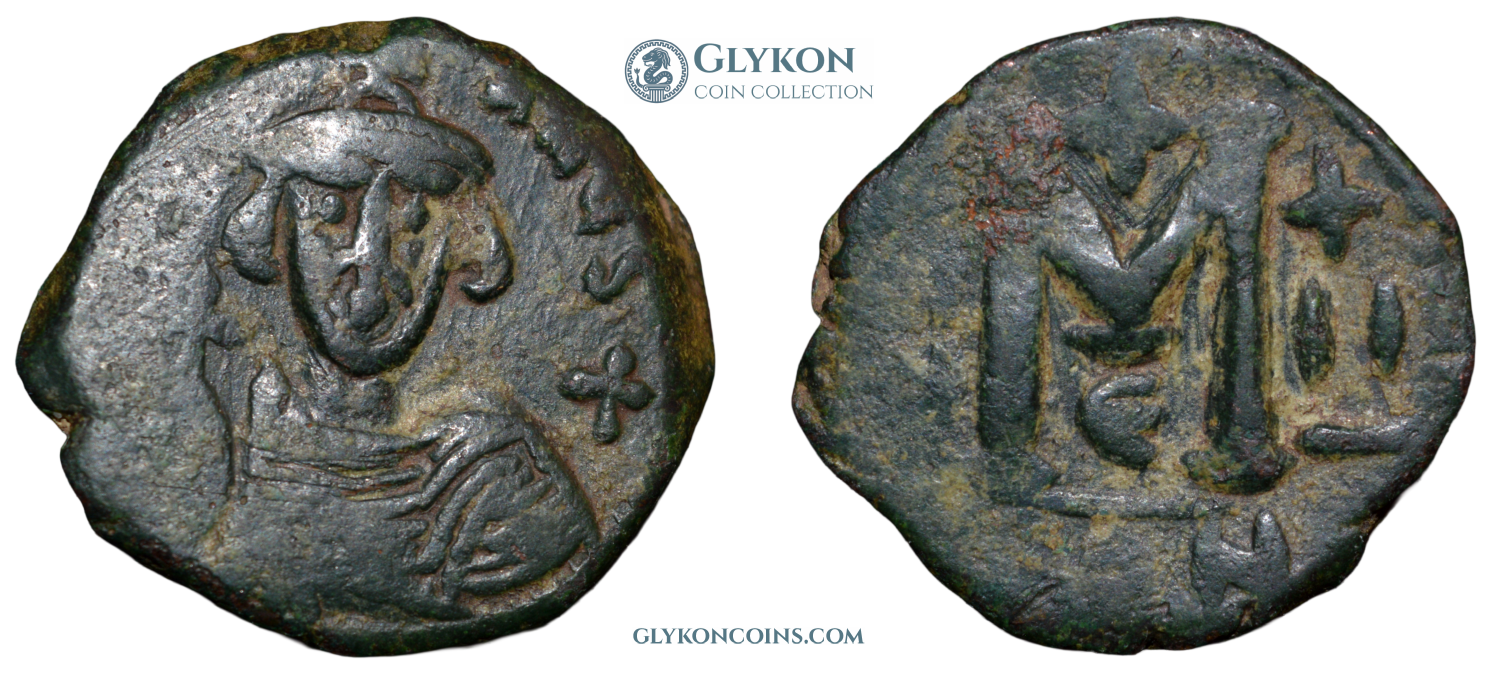
Justinian II (685-695 and 705-711 AD)
Denomination: 40 nummi (follis)
Mint: Constantinople
Time: 686-687 AD (first reign)
Weight: 9.70 g
Diameter: approx. 26.3 mm
Reference: Sear 1260
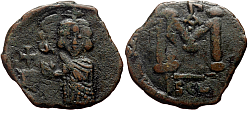
Obverse: Facing bust of youthful Justinian II, wearing crucigerous crown and chlamys, holding globus cruciger. Legend: IЧSTINIANЧS+
Reverse: Large M indicating denomination with a cross above, officina symbol Є below. CON in exergue. On the right regnal year II between a cross above and a dash below.
Comment: Got your nose! |
|
 |
Justinian II (685-695 and 705-711 AD)
Denomination: 40 nummi (follis)
Mint: Syracuse
Time: 685-695 AD (first reign)
Weight: 5.22 g
Diameter: approx. 23.3 mm
Reference: Sear 1298
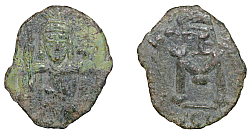
Obverse: Facing figure of Justinian II, wearing chlamys and holding globus cruciger in right hand. No legend.
Reverse: Large M indicating denomination. Monogram above, SCL in exergue below.
Comment: Clear signs of overstrike, perhaps over follis of Constantine IV, Sear 1207.
Overstrikes, that is coin minted by stricking the dies over an existing coin, with the latter's patterns remaining visible, are relatively common in Byzantine numismatics. But they are extremely frequent during the chaotic periods, such as those between the reign of Heraclius and when a modicum of order was re-established by Leo III in the early 8th century. It seems that mint workers didn’t melt coins that returned to the treasury, but simply heated them in haste and struck them with new dies. Whether that was a cost-saving measure in the battered empire, whether quality control completely collapsed, or both, is still to be determined. |
|
 |
Justinian II (685-695 and 705-711 AD)
Denomination: 40 nummi (follis)
Mint: Syracuse
Time: 685-695 AD (first reign)
Weight: 3.28 g
Diameter: approx. 22.2 mm
Reference: Sear 1301
Obverse: Facing figure of Justinian II in armor and plumed helmet, holding spear in right hand and globus cruciger in left hand. No legend.
Reverse: Large M indicating denomination, SCL in exergue. Additional monograms or remnants of overstruck previous patterns. |
|
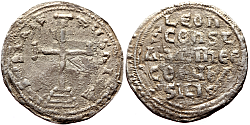 |
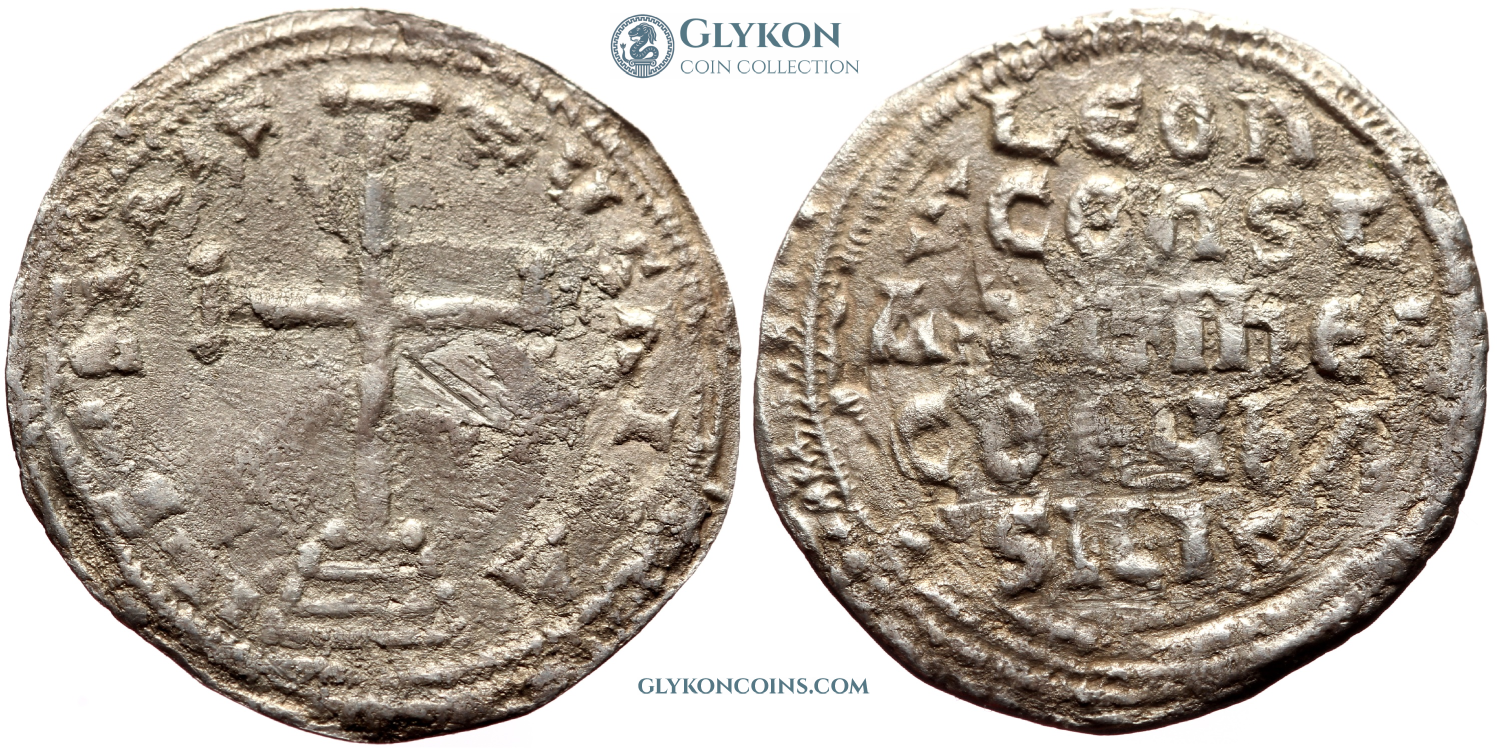
Leo III the Isaurian (717-741 AD)
Denomination: Miliaresion
Mint: Constantinople
Time: 720-741 AD
Weight: 1.79 g
Diameter: approx. 22.4 mm
Reference: Sear 1512
Obverse: Cross potent on three steps. Legend: IhSuS XRIStuS nICA
Reverse: Legend in five lines: LЄOn / S COnSt / AntInЄ Є / C ΘЄu ba/SILIS
Comment: First effectual emperor since the death of Constantine IV, Leo's accession III put an end to the so-called Twenty Years’ Anarchy that ravaged the battered empire and reduced it to Anatolia, Thrace, Sicily and a few scattered islands and territories on European coasts. Leo managed to push back the hitherto unstoppable Islamic wave at the gates of Constantinople during the famous Great Siege of 717-718. The restored semblance of order allowed for a slow and modest economic and institutional recovery. This is reflected among other things by the sudden improvement of the quality and size of bronze coinage. Or by the sudden reestabishment of silver coinage in significant quantity. In the latter case, this is connected to the establishment of trade relations with the Muslim world, as the Caliphate commanded control over vast silver mines in Central Asia and other places. Indeed, several ealry silver miliaresions are even ovestruck over Islamic dirhams. |
|
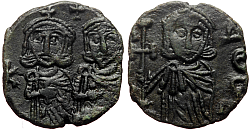 |
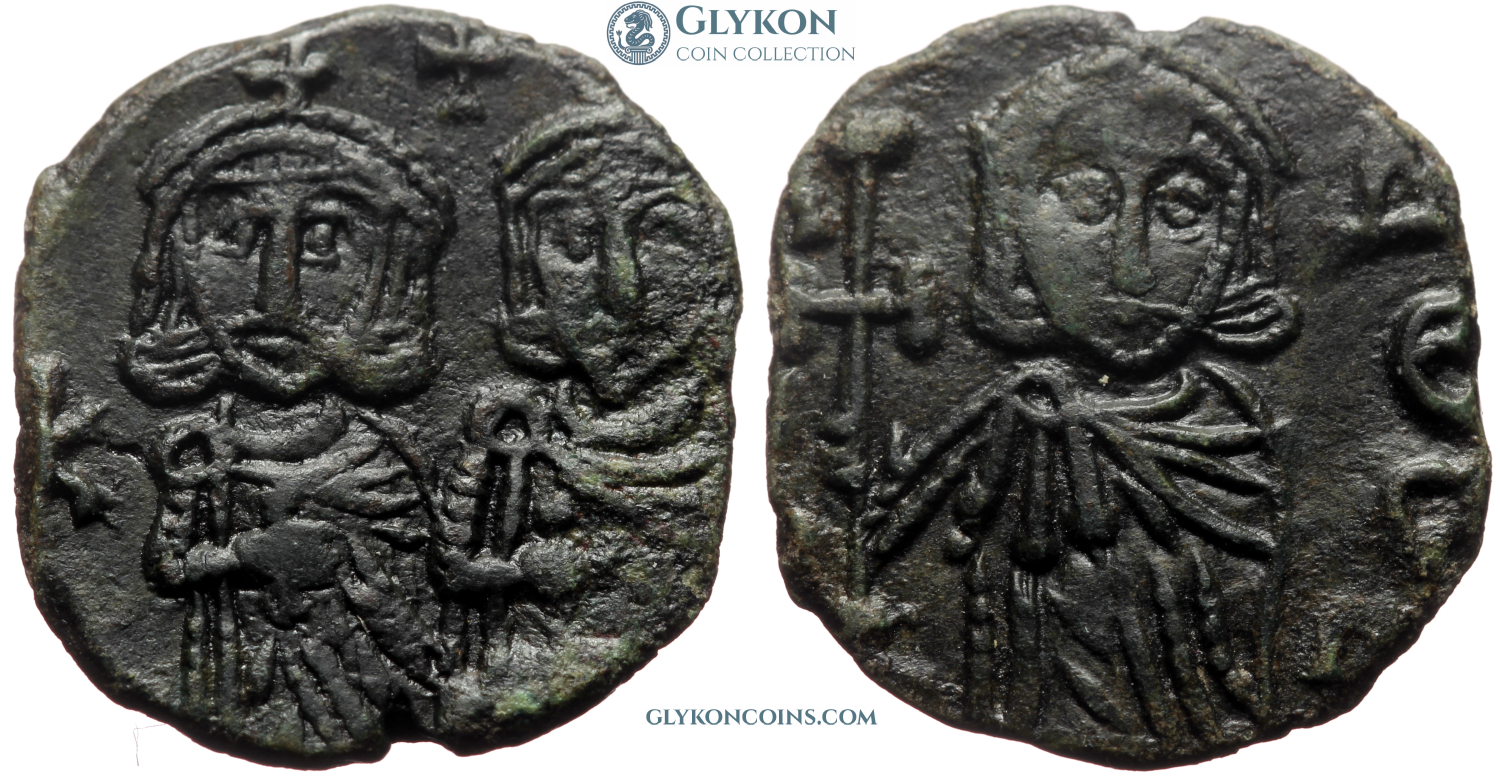
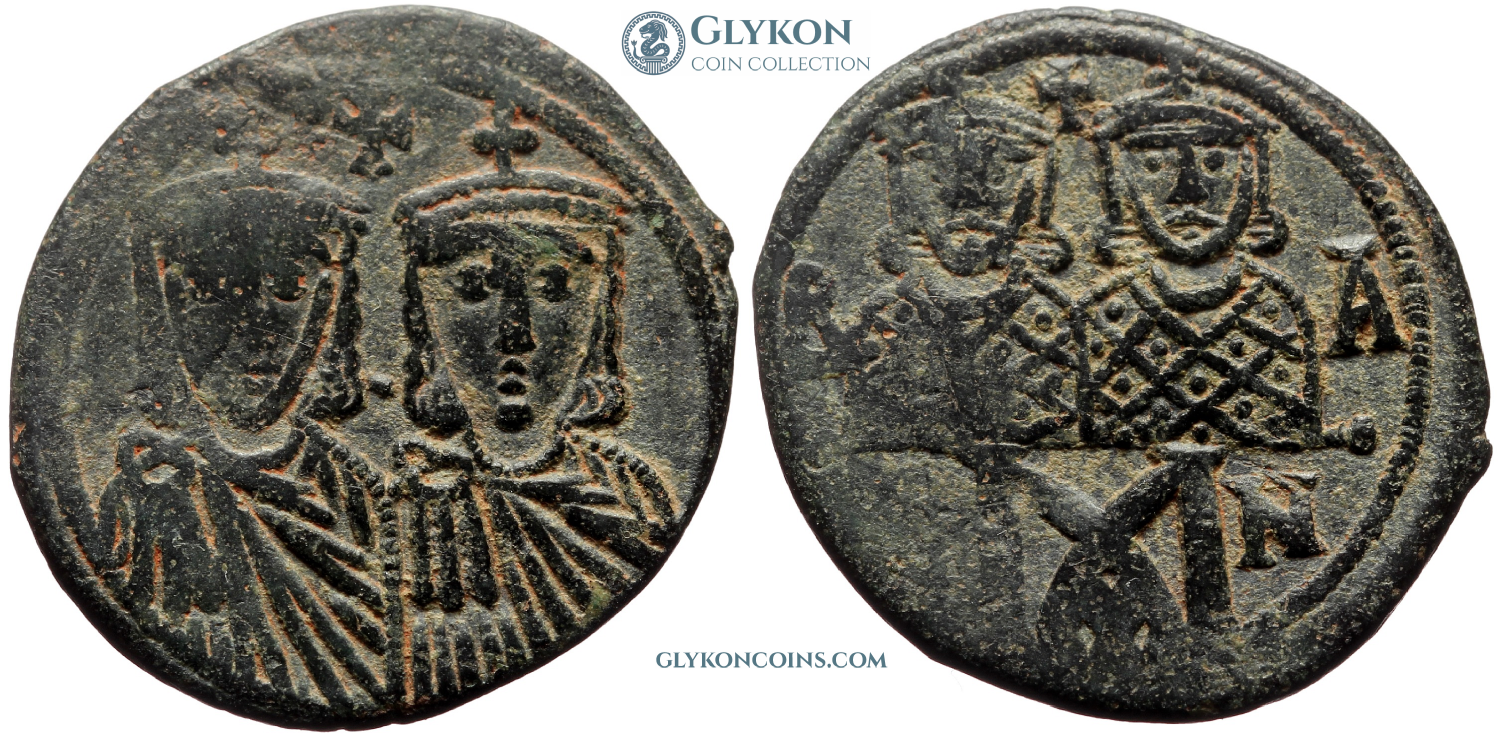
Constantine V (751-775 AD)
Denomination: 40 nummi (follis)
Mint: Syracuse
Time: after 751 AD
Weight: 2.92 g
Diameter: approx. 19.4 mm
Reference: Sear 1569; DOC III 19; Calciati 77
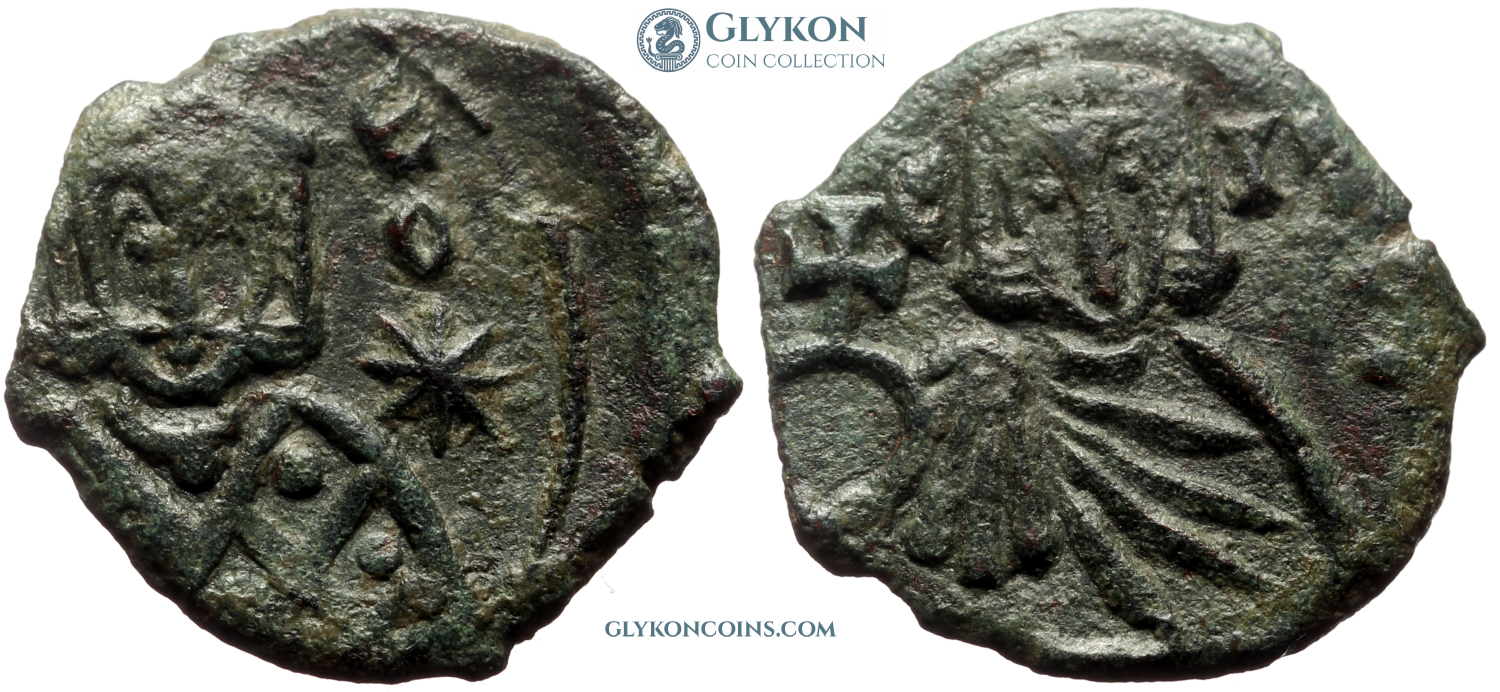
Obverse: Standing figures of Constantine V bearded and (future) Leo IV beardless, each wearing crucigerous crown, chlamys and holding akakia. Cross between them. Legend: K ΛЄOn
Reverse: Standing figure of bearded Leo III wearing crucigerous crown, chlamys and holding a large cross potent. Legend: ΛЄOn ΔЄCP |
|
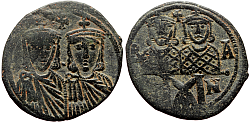 |
Leo IV the Khazar (775-780 AD)
Denomination: 40 nummi (follis)
Mint: Constantinople
Time: 775-780 AD
Weight: 5.12 g
Diameter: approx. 24.2 mm
Reference: Sear 1586; DOC 4
Obverse: Facing busts of Leo IV with short beard and youthful Constantine VI beardless, each wearing crucigerous crown and chlamys. Cross above.
Reverse: Facing busts of Leo III and Constantine V, each bearded, wearing crucigerous crown and loros. B-A on sides. Below large M indicating denomination, between X and N. Monogram MA below. |
|
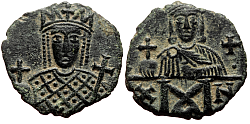 |
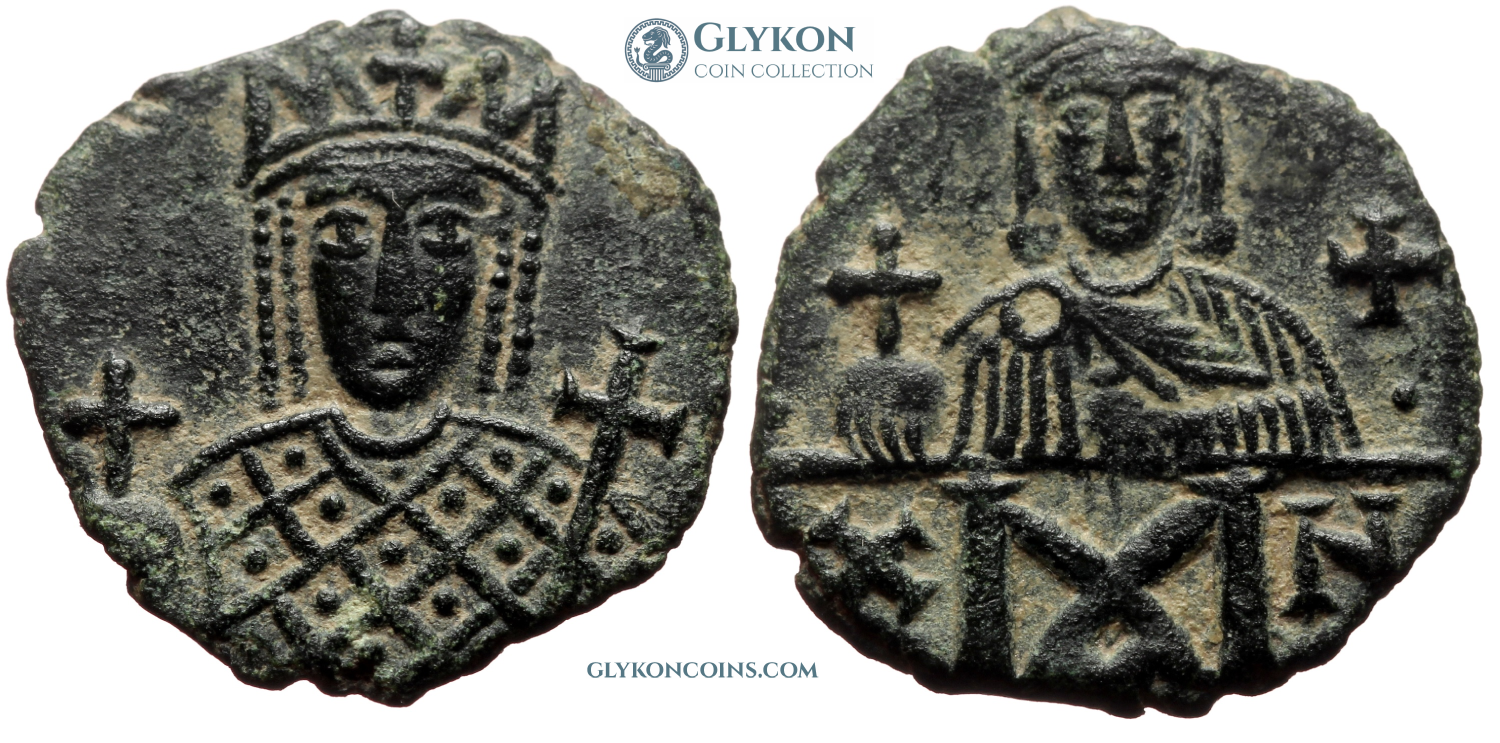
Constantine VI (780-797 AD) and Irene
Denomination: 40 nummi (follis)
Mint: Constantinople
Time: 780-797 AD
Weight: 2.47 g
Diameter: approx. 18.4 mm
Reference: Sear 1598; DOC 7
Obverse: Crowned, facing bust of Irene wearing loros, holding globus cruciger and cross-headed sceptre
Reverse: Small, crowned, facing bust of Constantine VI, unbearded, wearing chlamys, holding globus cruciger. Cross and a small pellet to the right. Below a horizontal line at about one-third height, large M-A as value indication flanked by X and N.
Comment: Pictured here is the drama of one of the darkest Byzantine stories: a mother fighting with her own son for power. We can already see how she pushes her son to the background, relegating him to the role of a smaller figure on the reverse. She finally had him blinded and killed, a crime that shocked the world at that time. This bloody usurpation was also one of the reasons why, in the faraway and barbaric west, a new empire arose that soon threw down the gauntlet in the fight for legitimacy as the true Roman Empire. |
|
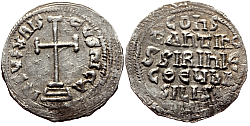 |
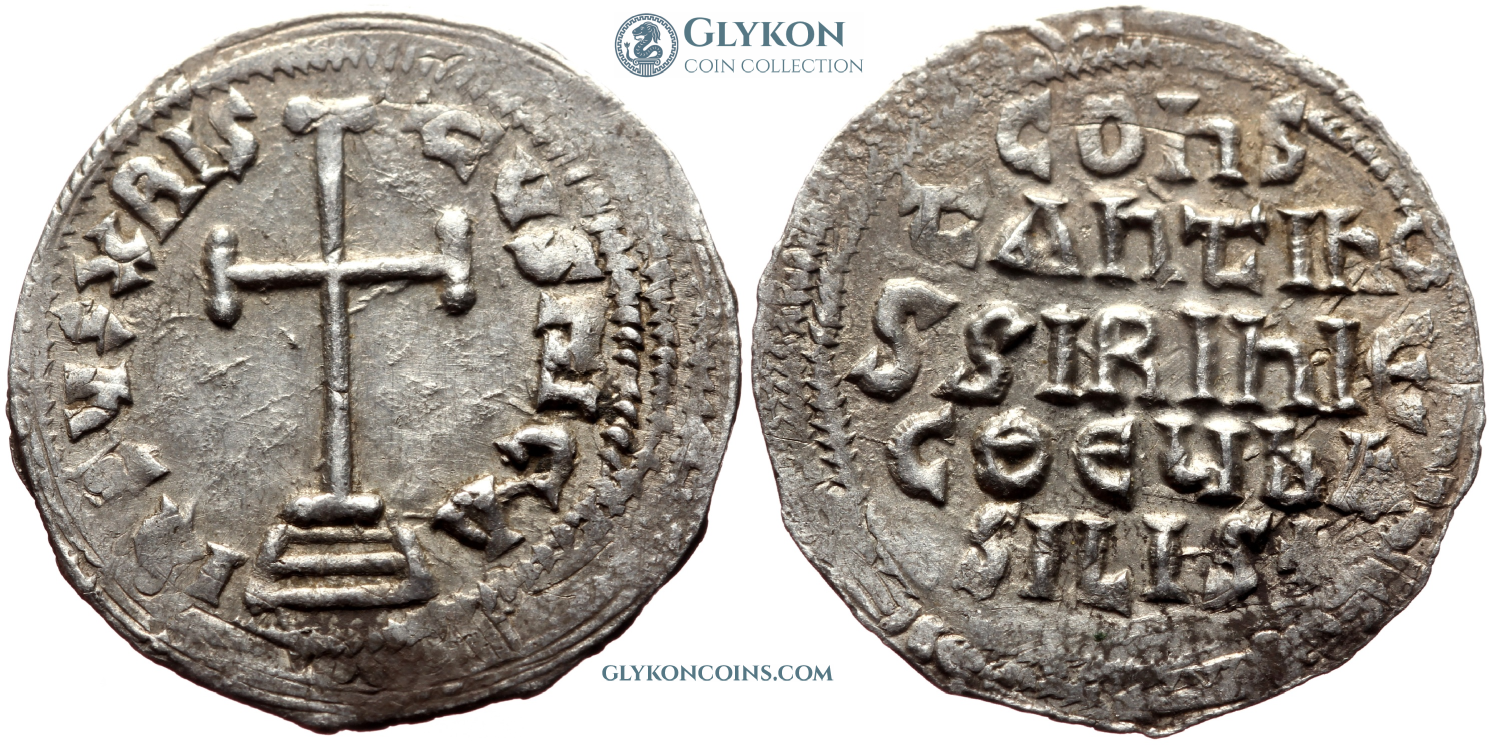
Constantine VI (780-797 AD) and Irene
Denomination: Miliaresion
Mint: Constantinople
Time: 780-797 AD
Weight: 2.05 g
Diameter: approx. 22.9 mm
Reference: Sear 1595
Obverse: Cross potent on three steps. Legend: IhSuS XRIStuS nICA
Reverse: Legend in five lines: COnS / tAntIno / S S IRInIЄ / CO ΘЄu bA / SILIS |
|
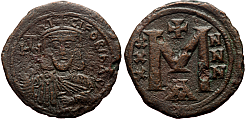 |
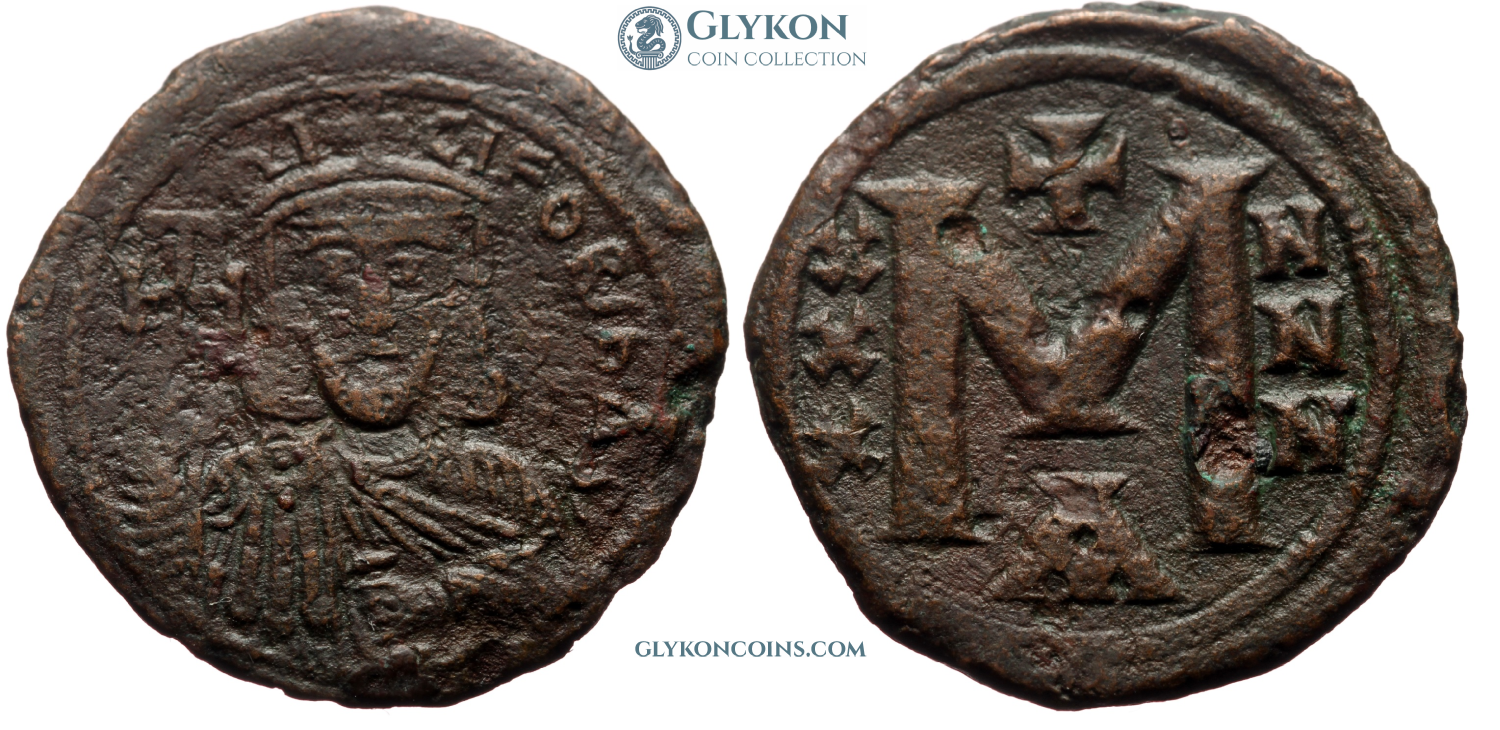
Nicephorus I (802-811 AD)
Denomination: 40 nummi (follis)
Mint: Constantinople
Time: 802-811 AD
Weight: 4.81 g
Diameter: approx. 23.5 mm
Reference: Sear 1606
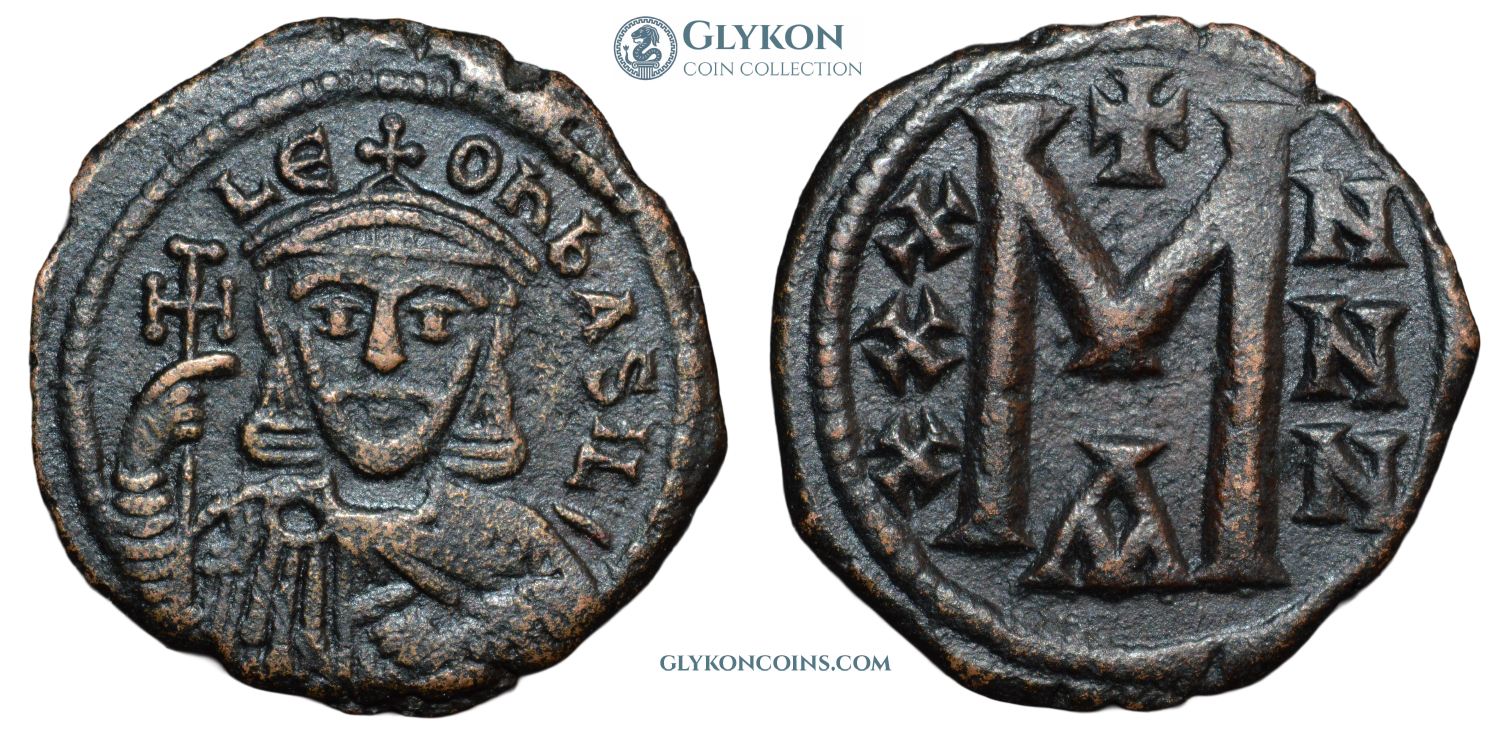
Obverse: Facing bust of Nicephorus, wearing chlamys and crucigerous crown, holding patriarchal cross in right hand and akaka in left hand. Legend: nICIFOR' bASIL'
Reverse: Large M indicating denomination between XXX and NNN. Cross above, A below. |
|
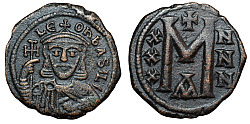 |
Leo V (813-820 AD)
Denomination: 40 nummi (follis)
Mint: Constantinople
Time: 813-820 AD
Weight: 5.82 g
Diameter: approx. 22.4 mm
Reference: Sear 1629
Obverse: Facing bust of Leo, wearing chlamys and crucigerous crown, holding patriarchal cross in right hand and akaka in left hand. Legend: LЄOn bASIL'
Reverse: Large M indicating denomination between XXX and NNN. Cross above, A below. |
|
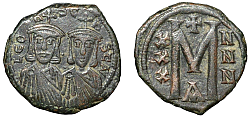 |
Leo V (813-820 AD)
Denomination: 40 nummi (follis)
Mint: Constantinople
Time: 813-820 AD
Weight: 5.44 g
Diameter: approx. 21.6 mm
Reference: Sear 1630
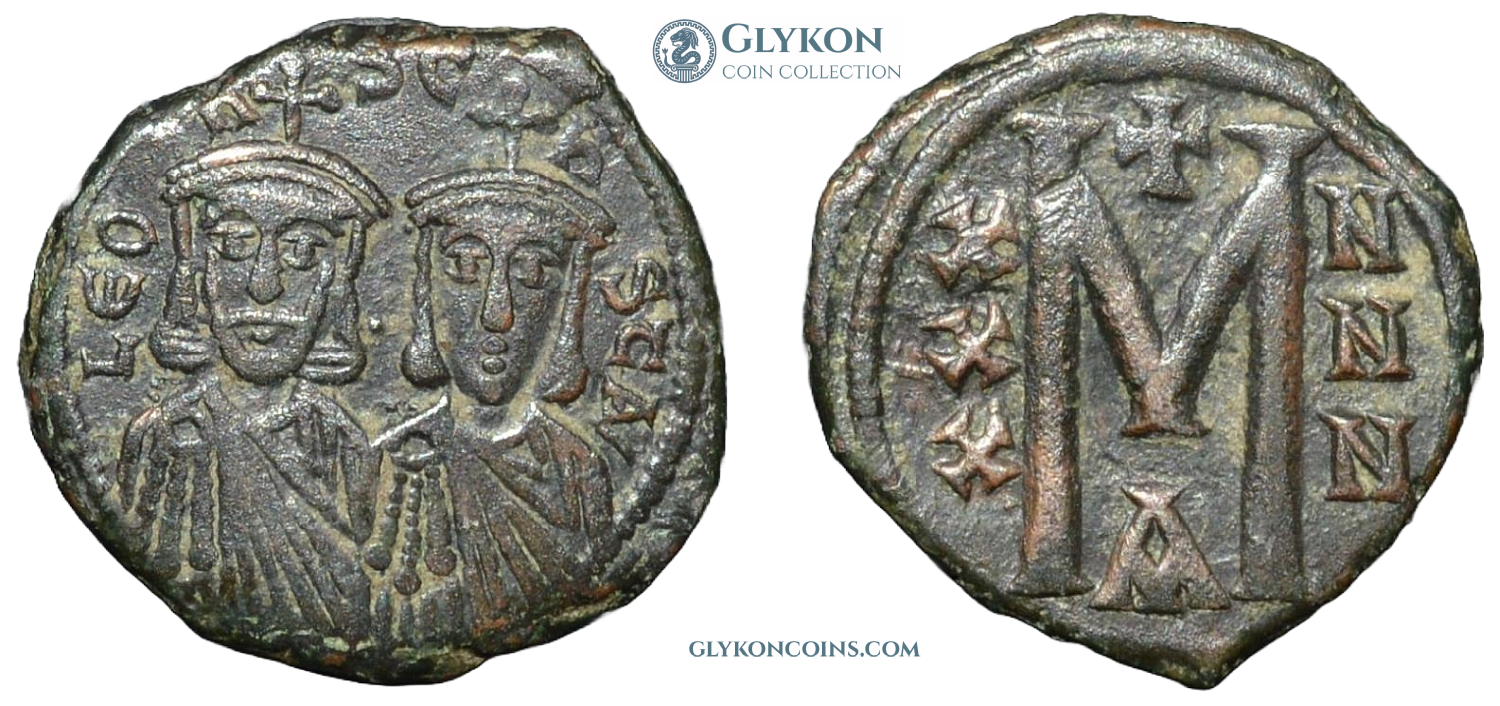
Obverse: Facing busts of Leo V bearded and Symbiatos-Constantine beardless, each wearing crucigerous crown and chlamys. Legend: LЄOn S COnSt
Reverse: Large M indicating denomination, between XXX and NNN. Cross above, A below. |
|
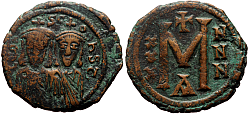 |
Leo V (813-820 AD)
Denomination: 40 nummi (follis)
Mint: Constantinople
Time: 813-820 AD
Weight: 7.47 g
Diameter: approx. 24.0 mm
Reference: Sear 1630
Obverse: Facing busts of Leo V bearded and Symbiatos-Constantine beardless, each wearing crucigerous crown and chlamys. Legend: LЄOn S COnSt
Reverse: Large M indicating denomination, between XXX and NNN. Cross above, A below.
Comment: Same type as above. |
|
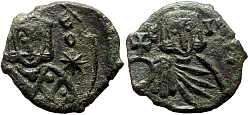 |
Leo V (813-820 AD)
Denomination: 40 nummi (follis)
Mint: Syracuse
Time: 813-820 AD
Weight: 3.83 g
Diameter: approx. 19.5 mm
Reference: Sear 1636
Obverse: Facing bust of bearded Leo, wearing loros and crucigerous crown, holding large cross potent in the right hand. Legend: ΛЄOn*
Reverse: Facing bust of beardless Symbiatos-Constantine, wearing chlamys and crucigerous crown, holding globus cruciger in the right hand. Legend: KOnCt C-I
|
|
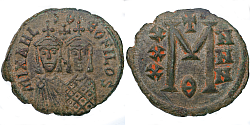 |
Michael II the Amorian (820-829 AD)
Denomination: 40 nummi (follis)
Mint: Constantinople
Time: 821-829 AD
Weight: 7.98 g
Diameter: approx. 31.1 mm
Reference: Sear 1642; DOC 9-11
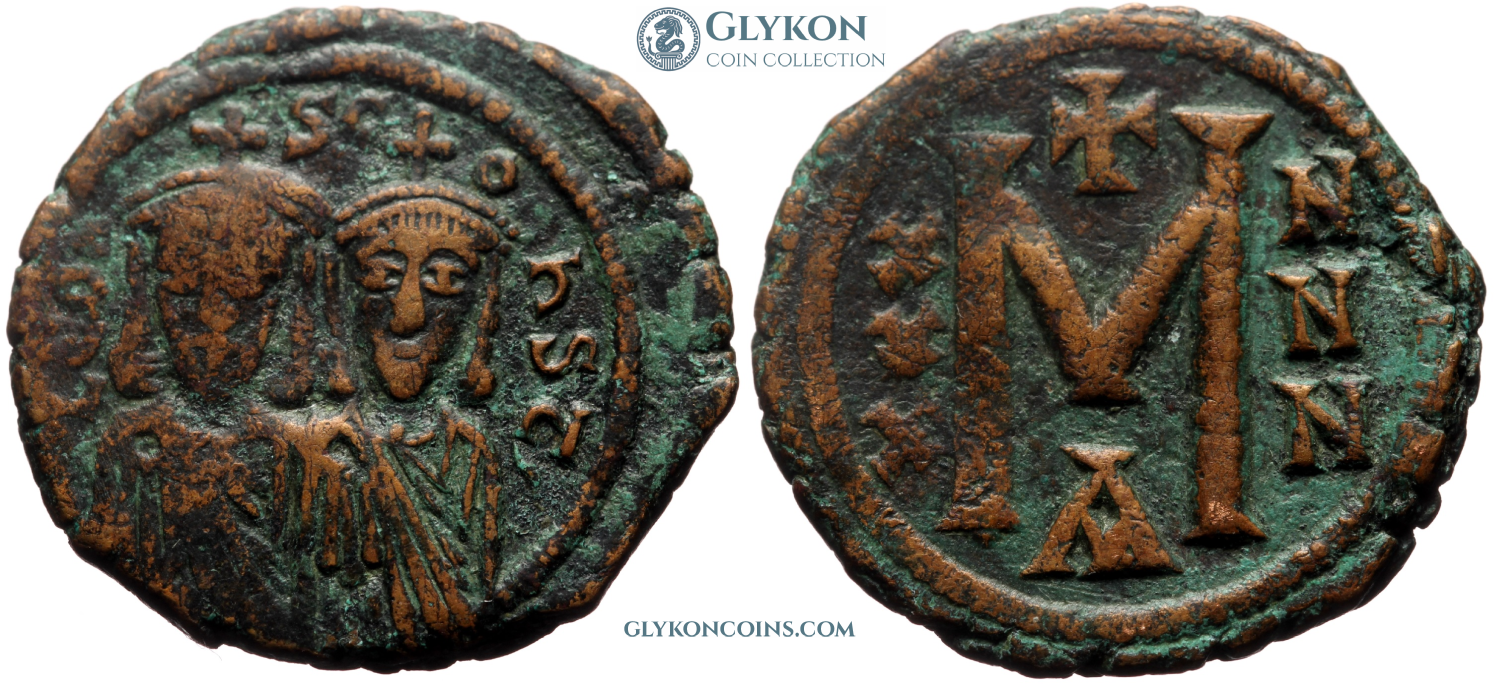
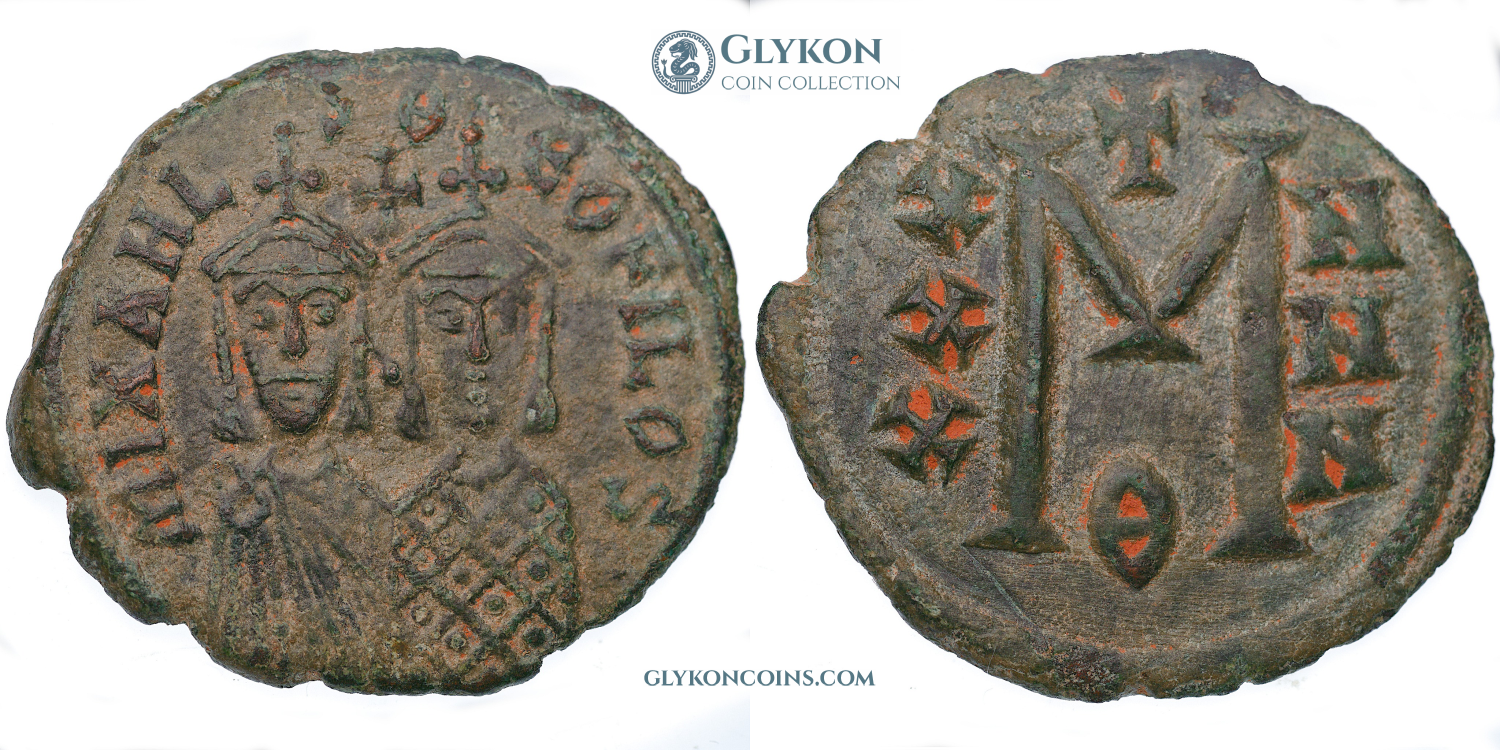
Obverse: Facing busts of Michael II with short beard wearing chlamys and youthful Theophilos beardless wearing loros, each wearing crucigerous crown. Cross above. Legend: mIXAHL S ΘЄOFILOS
Reverse: Large M indicating denomination between XXX and NNN. Cross above, Θ below. |
|
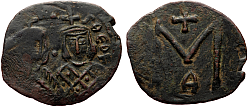 |
Michael II the Amorian (820-829 AD)
Denomination: 40 nummi (follis)
Mint: Syracuse
Time: 821-829 AD
Weight: 3.82 g
Diameter: approx. 24.9 mm
Reference: Sear 1652; DOC III 21; Ratto 1814
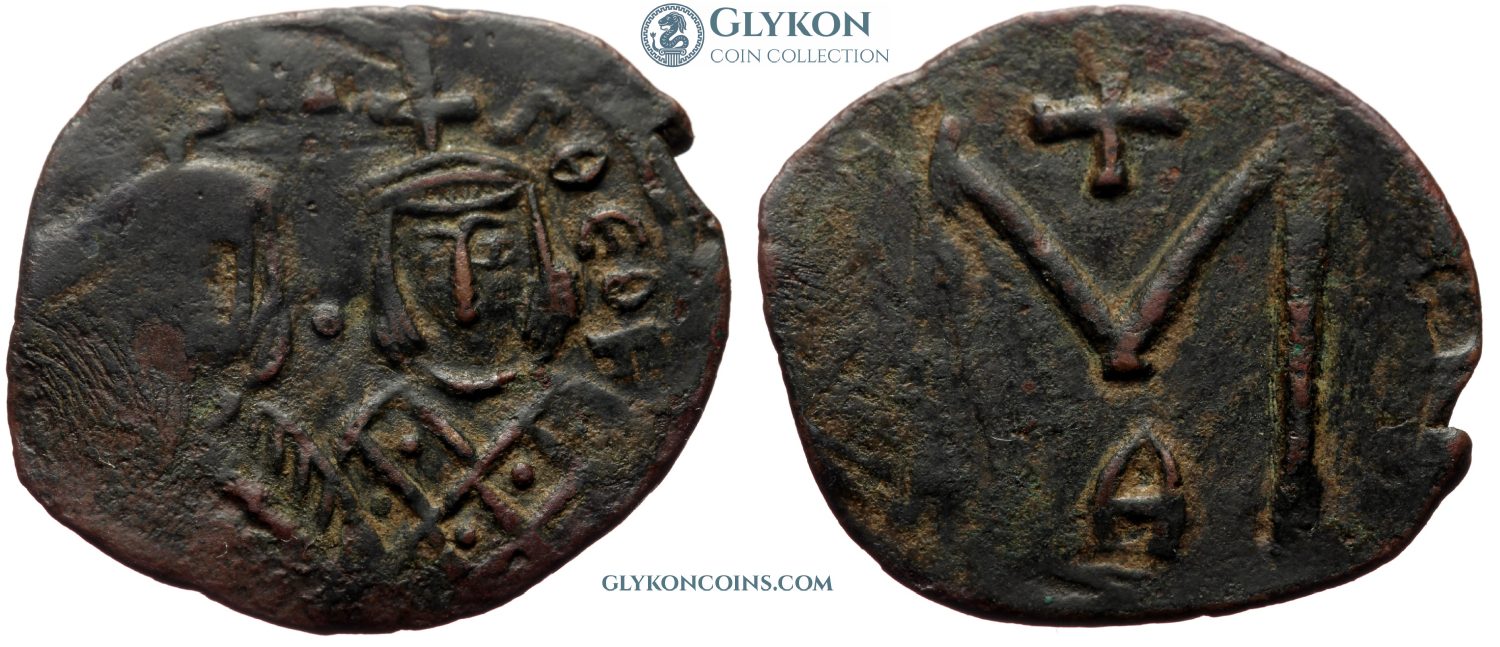
Obverse: Facing busts of Michael II with short beard wearing chlamys and youthful Theophilos beardless wearing loros, each wearing crucigerous crown. Cross above, a dot between them. Legend: mIXAHL S ΘЄOF
Reverse: Large M indicating denomination. Cross above, Θ below. |
|
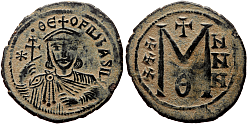 |
Theophilus (829-842 AD)
Denomination: 40 nummi (follis)
Mint: Constantinople
Time: 829-830 AD
Weight: 7.93 g
Diameter: approx. 30.8 mm
Reference: Sear 1666
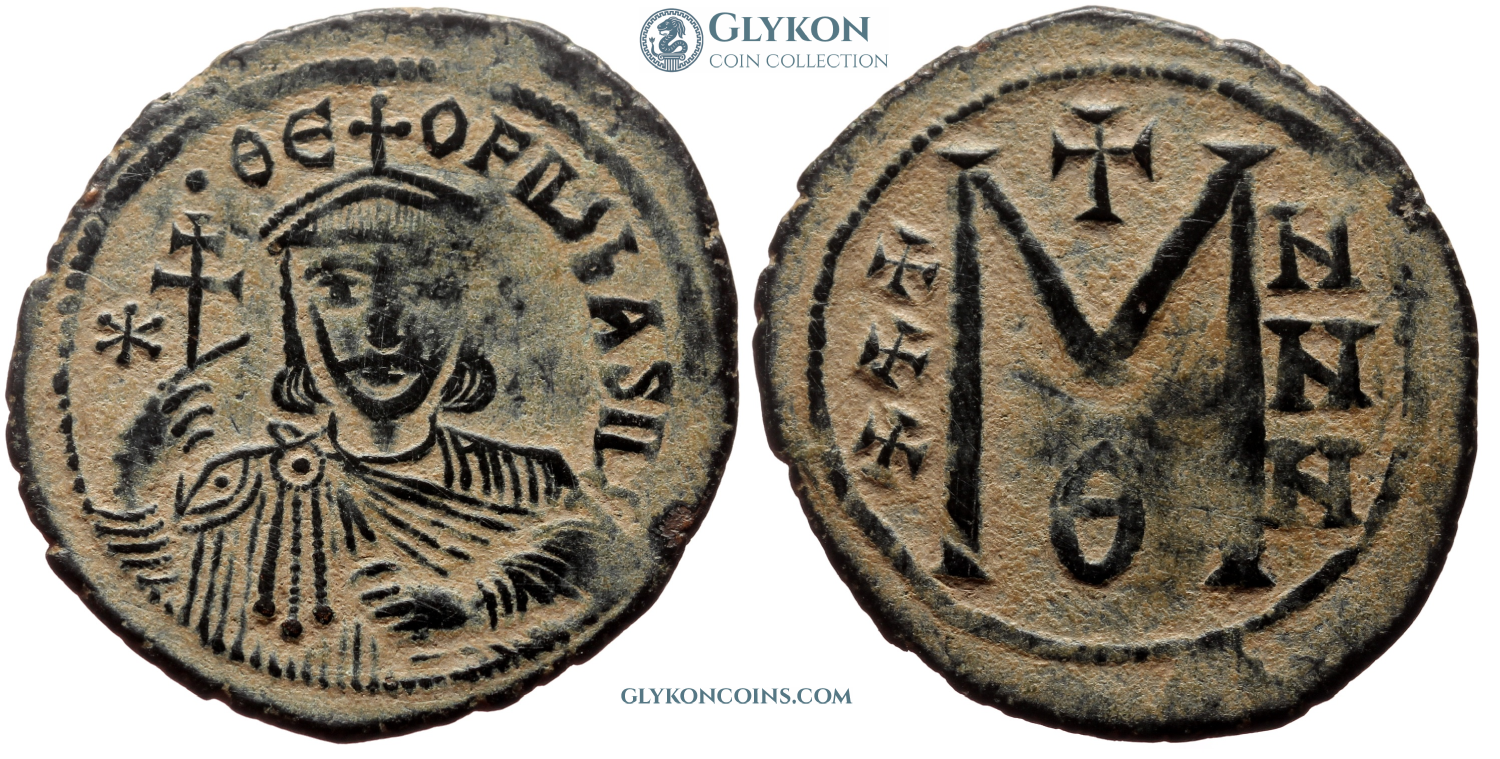
Obverse: Facing bust of Theophilus, wearing chlamys and crucigerous crown, holding patriarchal cross in right hand and akaka in left hand. Cross above. Star on the left. Legend: •ΘЄOFIL bASIL
Reverse: Large M indicating denomination between XXX and NNN. Cross above, Θ below.
Comment: Last follis minted in Constantinople to bear the traditional indication of denomination. By that time it was entirely a matter of convention and inertia, as smaller change was no longer minted for about 110 years. Aside from unusual mintages from remote places like Crimea, the follis was the only coin used in smaller transactions throughout the empire and its small value meant that several of them were often used for each of daily purchases. |
|
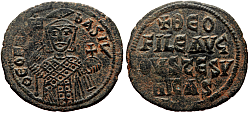 |
Theophilus (829-842 AD)
Denomination: 40 nummi (follis)
Mint: Constantinople
Time: 830-842 AD
Weight: 8.59 g
Diameter: approx. 29.0 mm
Reference: Sear 1667
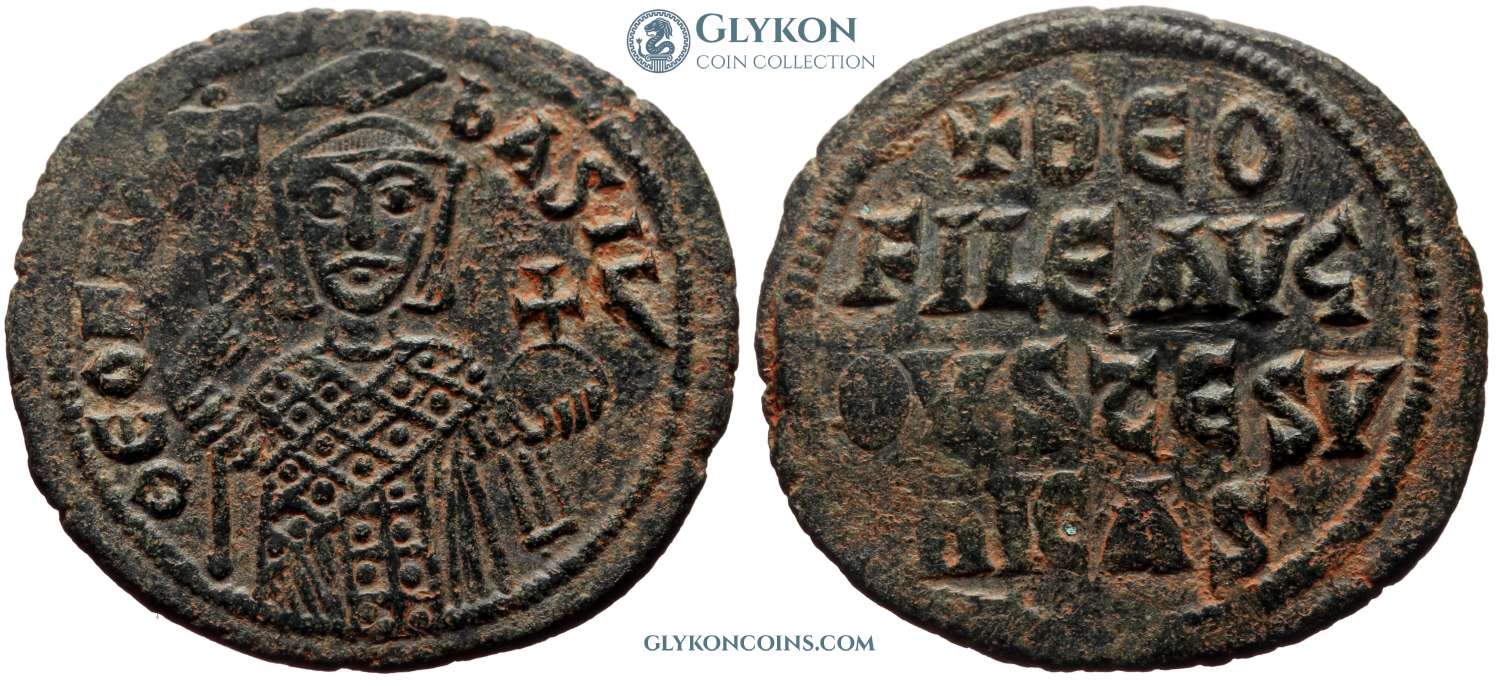
Obverse: Facing figure of Theophilus, wearing chlamys and peacock-plumed crown, holding crucigerous globe and labarum. Legend: ΘЄOFIL' bASIL'
Reverse: +ΘЄO / FILE AVζ / OVStE SV / nICAS (Theophilus Augustus, may you conquer) in four lines.
Comment: Much of Theophilus' reign was spent fighting endless wars with the Abbasid Caliphate, still at the height of its temporal power. These wars were fought with mixed results, but at the start of the 830s Theophilus scored some significant victories. This inspired him to issue a new style, "triumphal" follies. The design proved successful and served as a template for Byzantine bronze coins for the next 200+ years. In many aspects, Theophilus' reign was a time of transformation and change. Reportedly a popular monarch (sometimes called "Byzantine JFK"), he managed to pull the still struggling and battered empire onto the path of wholesale recovery. He was also known for refined personal taste, sponsoring automata and art pieces. It was under him that the famous mechanical Byzantine throne was designed and built. He was also known as a connoisseur of Arabic culture, despite spending most of his reign fighting Arabs. His death also marked the end of the Iconoclast controversy, as he was the very last emperor to accede to that doctrine. |
|
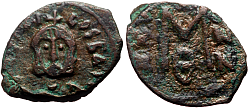 |
Theophilus (829-842 AD)
Denomination: 40 nummi (follis)
Mint: Syracuse
Time: 829-842 AD
Weight: 2.03 g
Diameter: approx. 17.6 mm
Reference: Sear 1681; DOC 30
Obverse: Facing crowned bust of Theophilus, wearing chlamys and holding globus cruciger. Legend: ΘЄOFILOS bAS'
Reverse: Large M indicating denomination between XXX and NNN. Cross above, Θ below.
Comment: Sicilian folles were unaffected by Theophilus' reform and continued to be minted with large M until the fall of Syracuse in 878. After that, although small Byzantine rump territories survived on the island for several more decades, coin production ceased and no further Byzantine issues were minted in Sicily. |
|
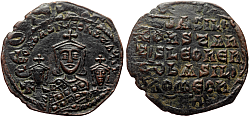 |
Basil I the Macedonian (867-886 AD)
Denomination: follis
Mint: Constantinople
Time: 870-879 AD
Weight: 7.44 g
Diameter: approx. 28.8 mm
Reference: Sear 1713
Obverse: Facing bearded bust of Basil wearing loros and crucigerous crown, flanked by beardless Leo (future Leo VI) and Basil’s eldest son Constantine both wearing chlamyses and crucigerous crowns. Legend: +LЄOn bASIL S COnST AVGG
Reverse: Legend in five lines: +bASIL'/ COnStAn /t S LЄOn Єn / ΘO bAzSILS / ROmЄOn (Basil, Constantine and Leo, in God, Emperors of the Romans). Star below.
Comment: Visibly overstruck over Theophilus' type Sear 1667. |
|
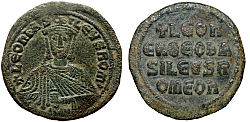 |
Leo VI the Wise (886-912 AD)
Denomination: follis
Mint: Constantinople
Time: 886-912 AD
Weight: 7.98 g
Diameter: approx. 28.0 mm
Reference: Sear 1729
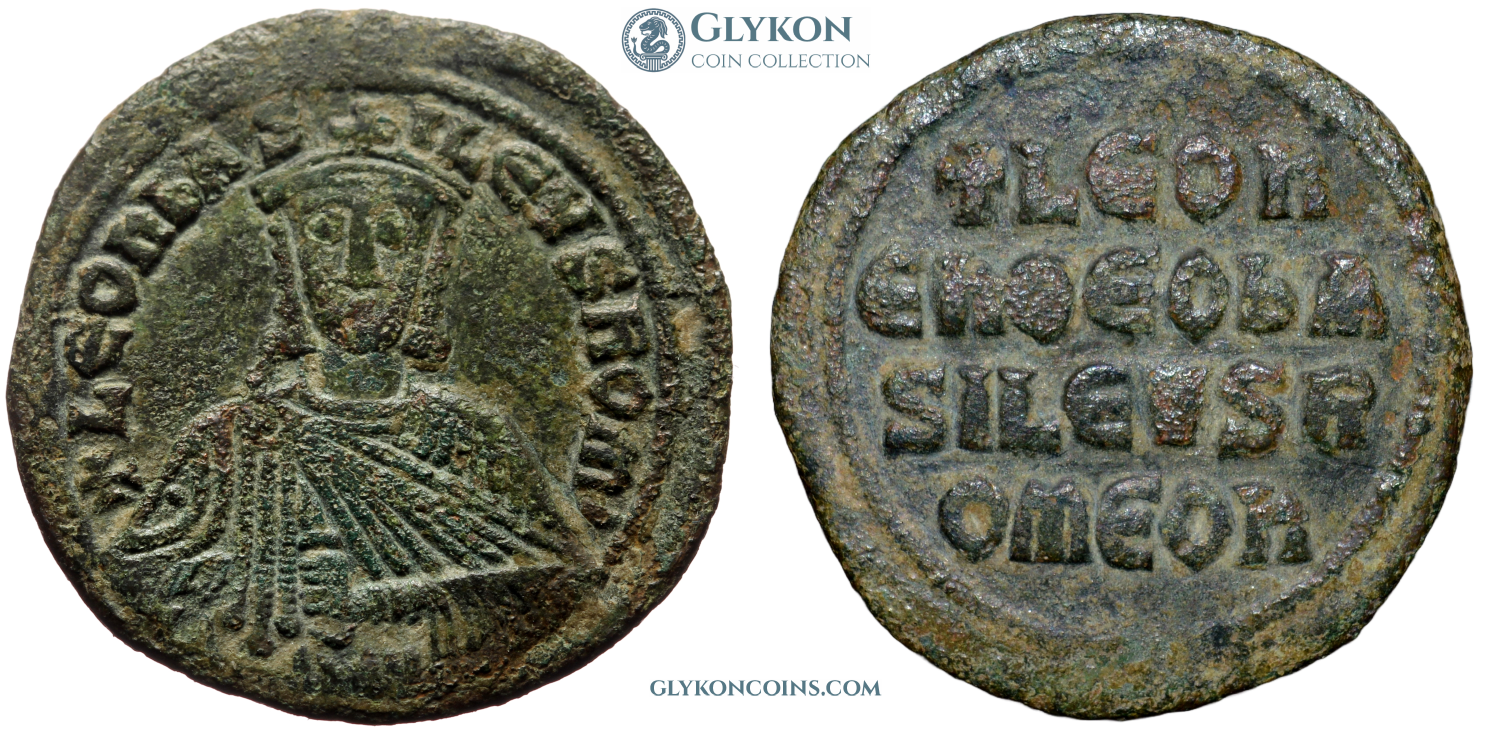
Obverse: Facing bust of Leo, wearing chlamys, holding akaka in left hand. Legend: +LЄOn bASILЄVS Rom
Reverse: Legend in four lines: +LЄOn / Єn ΘЄO bA / SILЄVS R / OmЄOn (Leo, in God, Emperor of the Romans). |
|
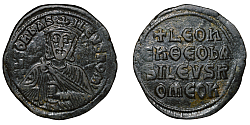 |
Leo VI the Wise (886-912 AD)
Denomination: follis
Mint: Constantinople
Time: 886-912 AD
Weight: 8.16 g
Diameter: approx. 27.6 mm
Reference: Sear 1729
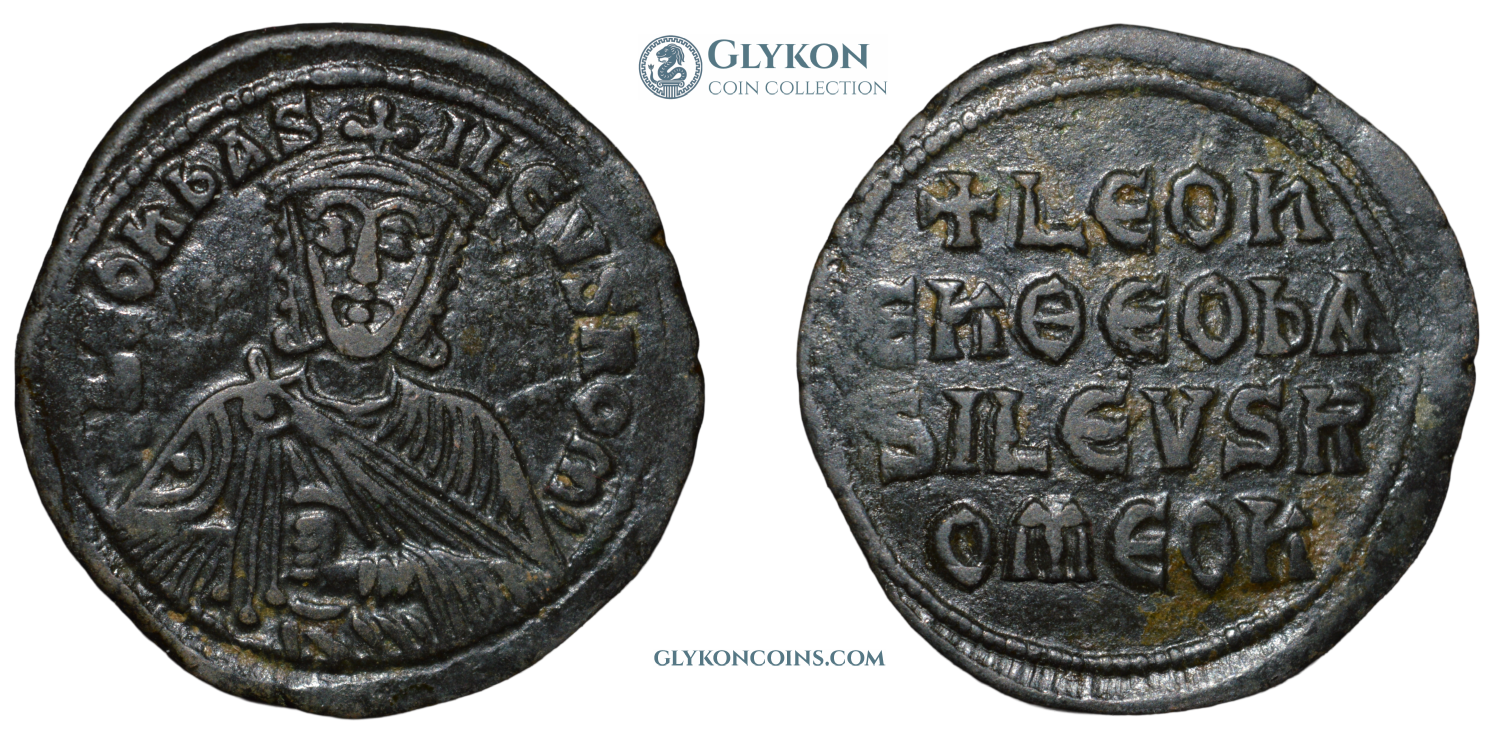
Obverse: Facing bust of Leo, wearing chlamys, holding akaka in left hand. Legend: +LЄOn bASILЄVS Rom
Reverse: Legend in four lines: +LЄOn / Єn ΘЄO bA / SILЄVS R / OmЄOn (Leo, in God, Emperor of the Romans).
Comment: Same type as above. |
|
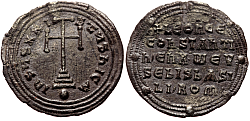 |
Leo VI the Wise (886-912 AD)
Denomination: Miliaresion
Mint: Constantinople
Time: 908-912 AD
Weight: 2.53 g
Diameter: approx. 24.3 mm
Reference: Sear 1727
Obverse: Cross potent on three steps, small globe below. Legend: IhSuS XRIStuS nICA
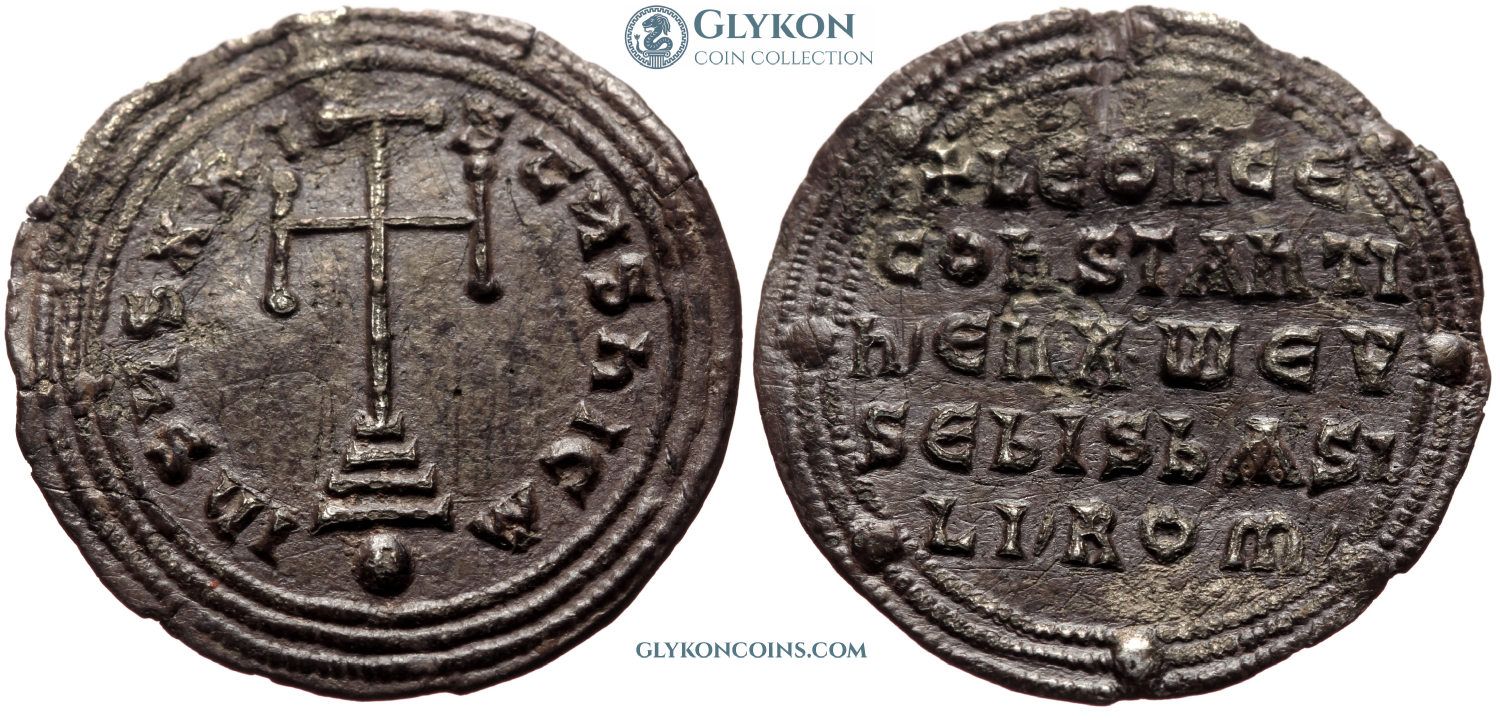
Reverse: Legend in five lines: +LЄOn CЄ / COnStAntI / n' Єn X•ω ЄV / SЄbIS bASI / LI' ROm' |
|
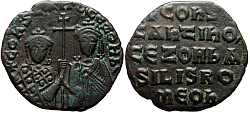 |
Constantine VII Porphyrogenitus (913-959 AD)
Denomination: follis
Mint: Constantinople
Time: 914-919 AD
Weight: 6.65 g
Diameter: approx. 24.6 mm
Reference: Sear 1758; DOC 22
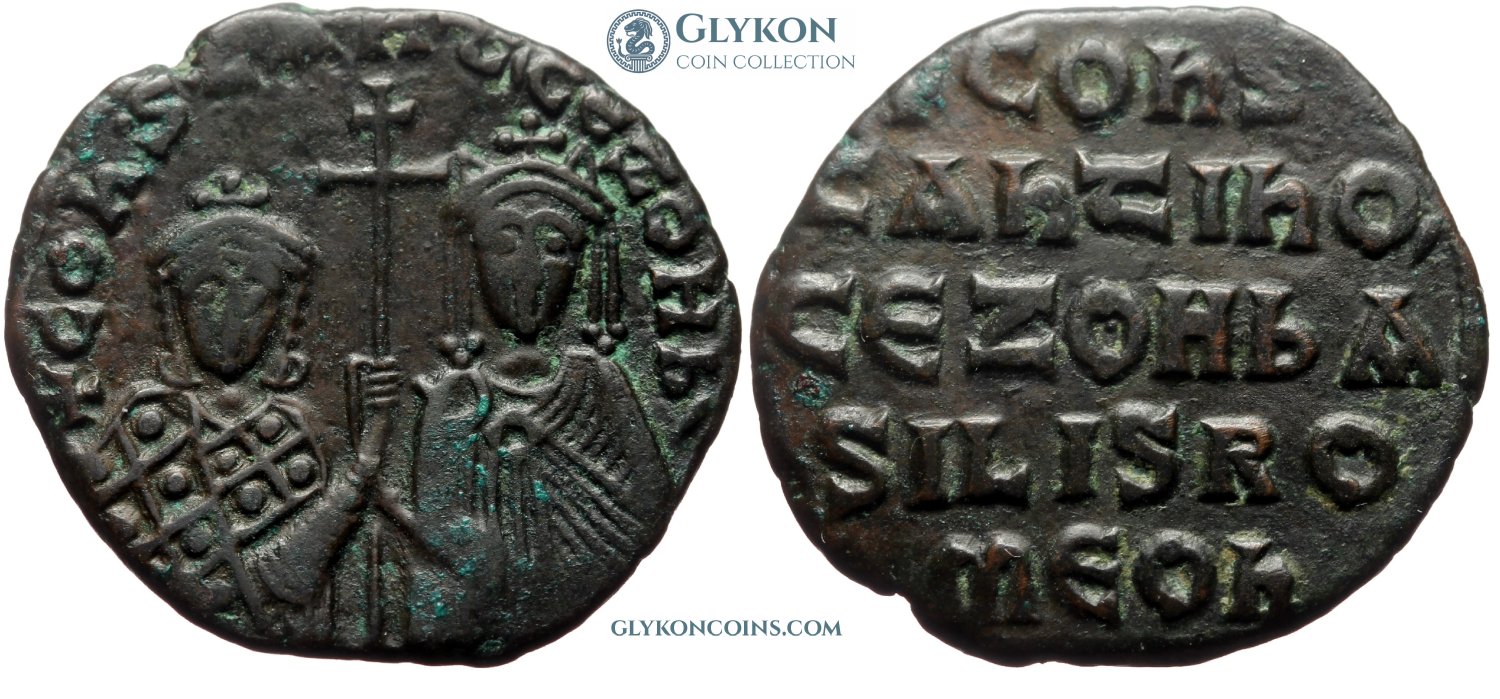
Obverse: Facing busts of young crowned Constantine wearing loros and crowned regent empress-mother Zoe wearing chlamys, both holding together a large patriarchal cross between them. Legend: +COnStAnt' CЄ ZOH b'
Reverse: Legend in five lines: +COnS / tAntInO' / CЄ ZOH bA /SILIS RO / mЄOn (Constantine and Zoe, in God, Emperors of the Romans). |
|
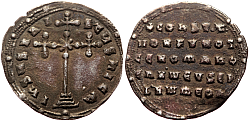 |
Constantine VII Porphyrogenitus (913-959 AD)
Denomination: Miliaresion
Mint: Constantinople
Time: 945-959 AD
Weight: 2.58 g
Diameter: approx. 23.4 mm
Reference: Sear 1757; DOC 21
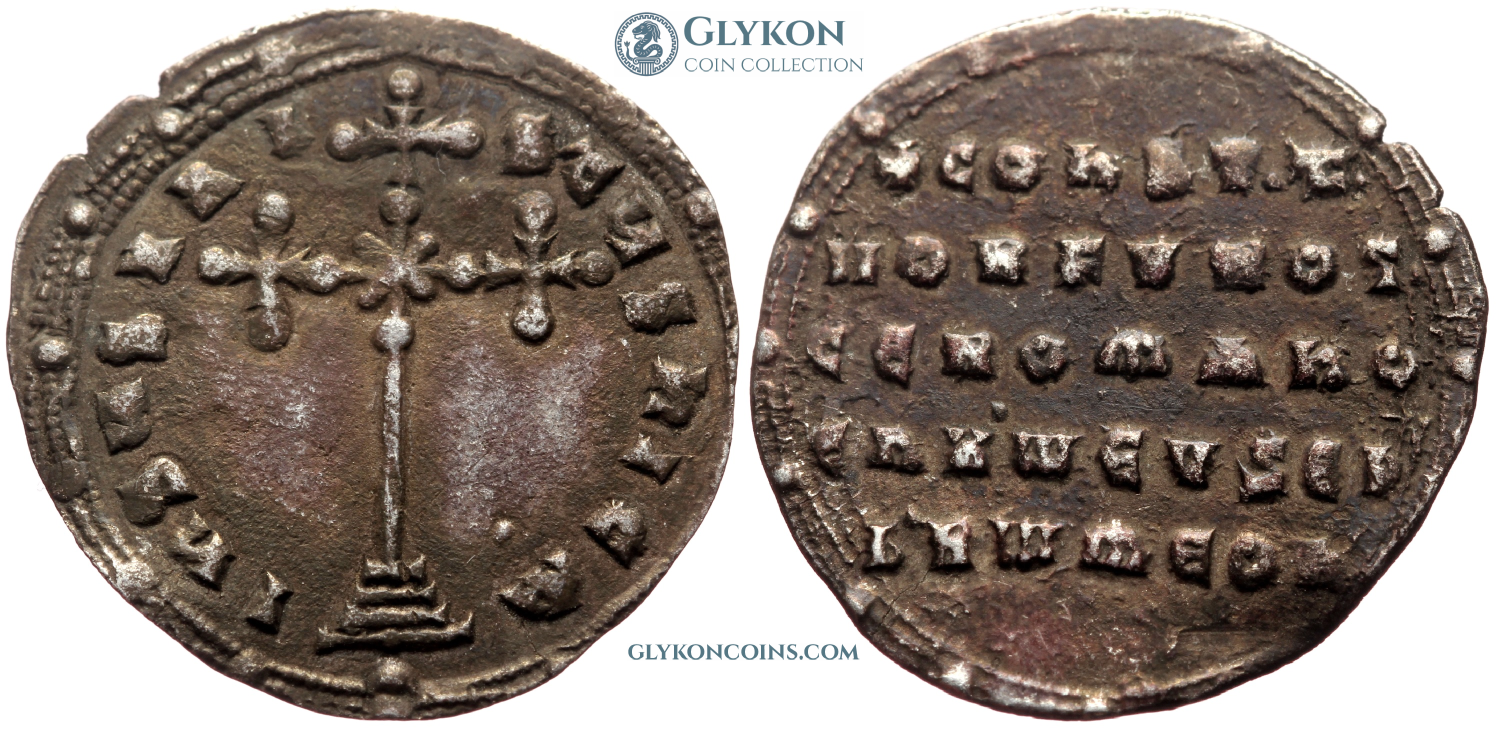
Obverse: Elaborate cross-crosslet on four steps with X at centre and a small globe at the end of each extremity, small globe below. Legend: IhSuS XRIStuS nICA
Reverse: Legend in five lines: +COnSt't' / ΠORFVROg / CЄ RωmAnO / Єn X•ω ЄVSЄb' / b' RωmЄOn |
|
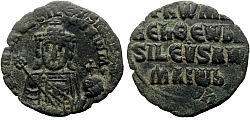 |
Romanos I Lekapenos (920-944 AD)
Denomination: follis
Mint: Constantinople
Time: 931-944 AD
Weight: 4.95 g
Diameter: approx. 25.2 mm
Reference: Sear 1760
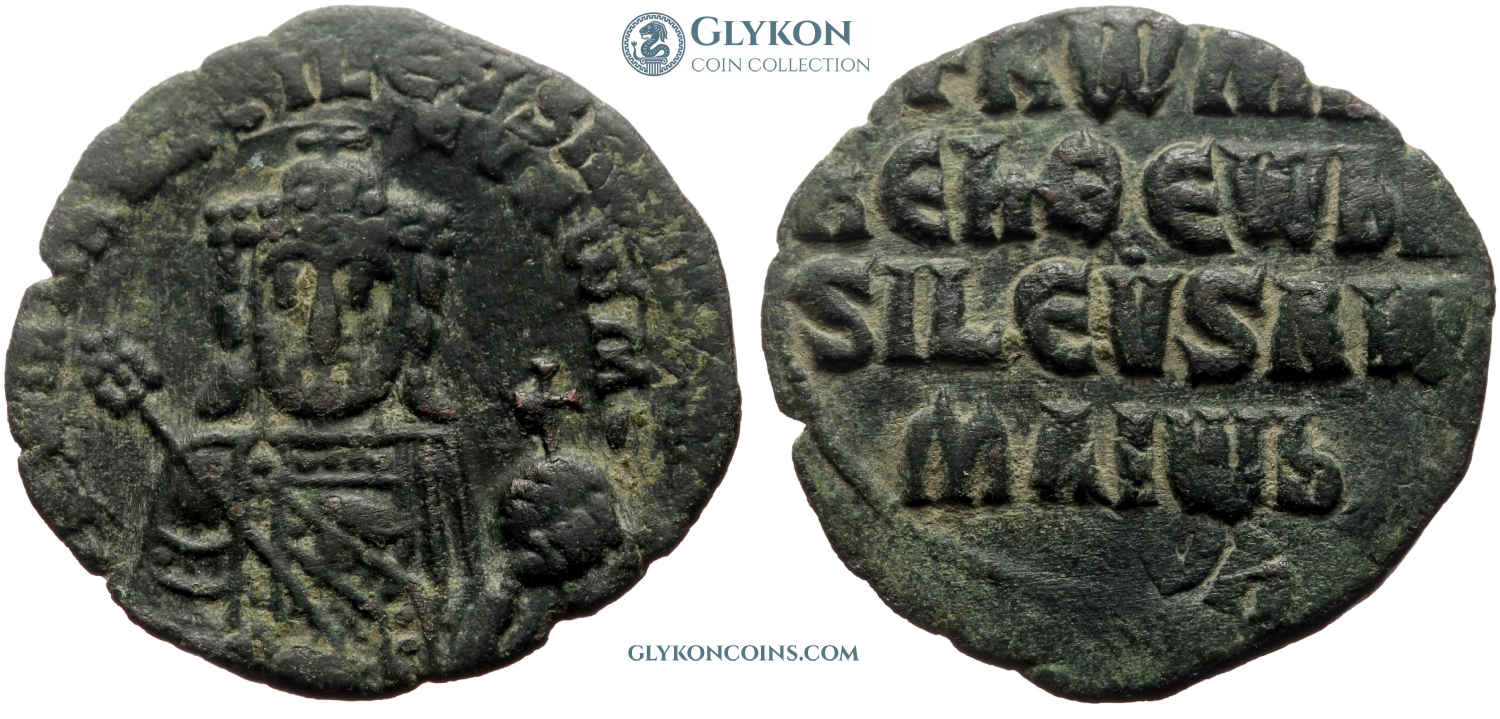
Obverse: Facing bust of Romanos, wearing chlamys, holding labarum and globus cruciger. Legend: +RωmAn' bASILЄVS Rωm'
Reverse: Legend in four lines: +RωmAn' / n' Єn Θ.Єω bA / SILЄVS Rω / mIωb (Romanos, in God, Emperor of the Romans).
Comment: Noticeably overstruck over the same type. |
|
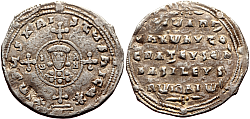 |
John I Tzimiskes (969-976 AD)
Denomination: Miliaresion
Mint: Constantinople
Time: 969-976 AD
Weight: 2.88 g
Diameter: approx. 23.3 mm
Reference: Sear 1792
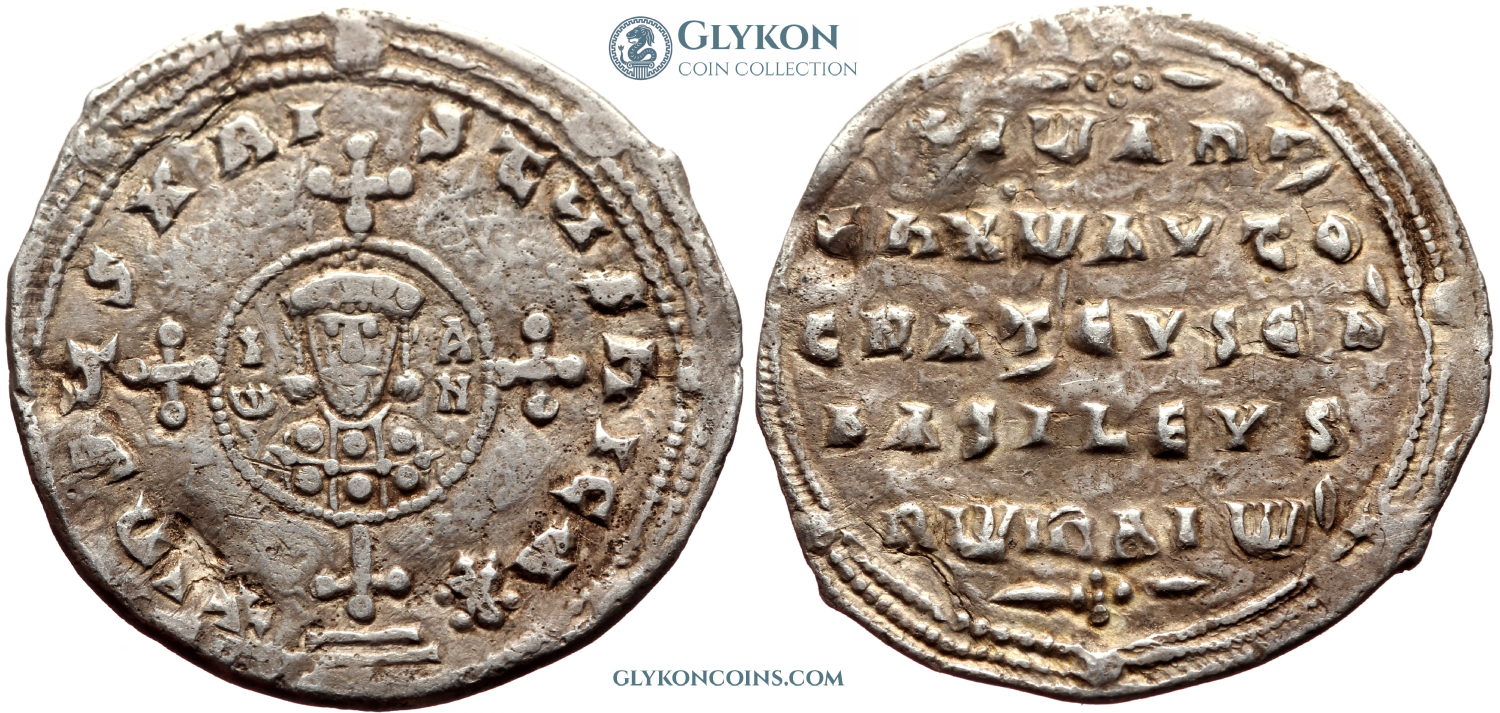
Obverse: Cross crosslet mounted on two steps. In the middle a medallion, within: facing busts of John wearing chlamys and crucigerous crown, surrounded by IwANN. Legend: +IhSYS XRISTYS nICA★
Reverse: Legend in seven lines: + / IωANN' / Єn Xω AVtO / CRAT' EVSEb' / bASILEVS / RωmAIω'/ + |
|
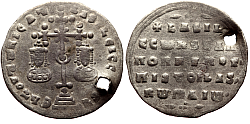 |
Basil II the Bulgar Slayer (963/976-1025 AD) with Constantine VIII (963/976-1028 AD)
Denomination: Miliaresion
Mint: Constantinople
Time: 976-1025 AD
Weight: 2.36 g
Diameter: approx. 24.1 mm
Reference: Sear 1810
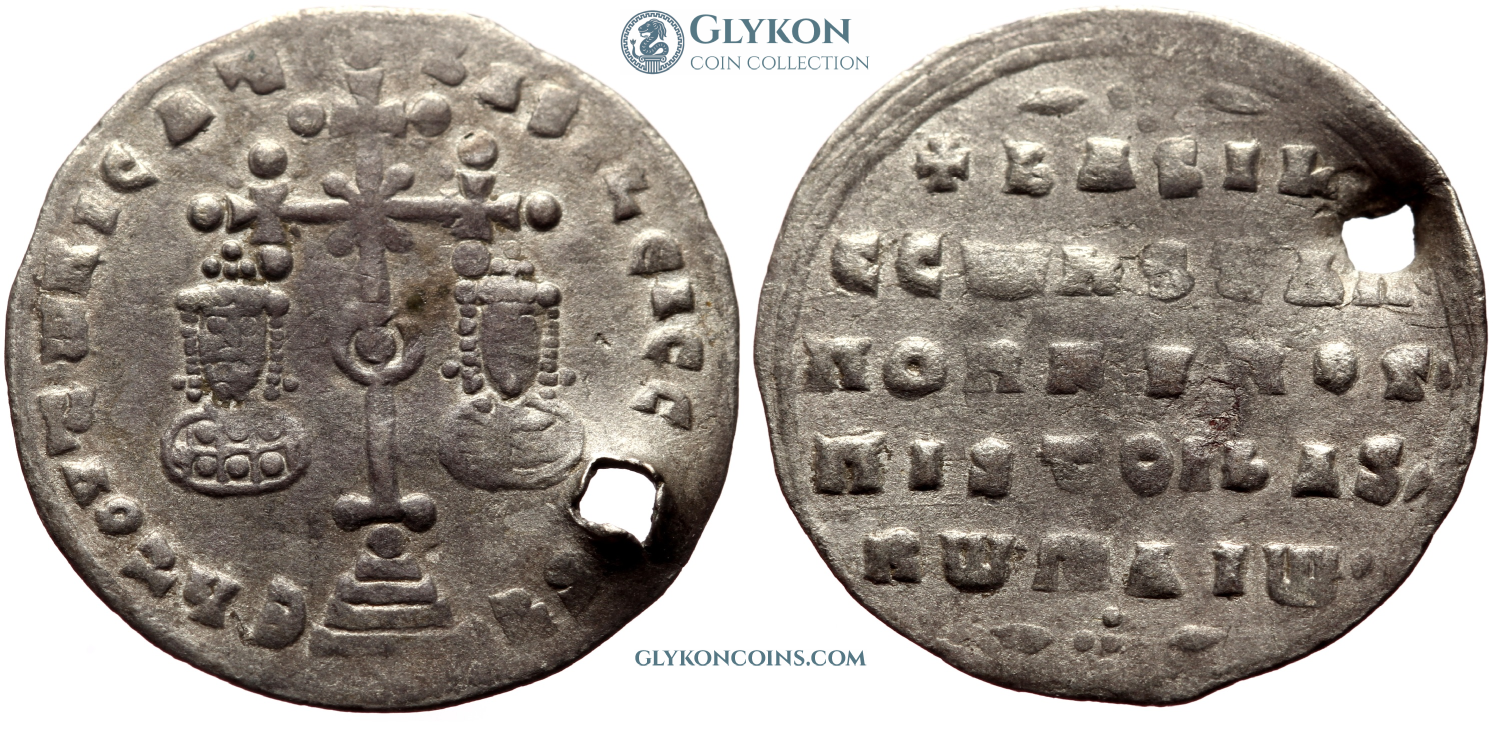
Obverse: Cross crosslet mounted on four steps. An X in the middle and a medallion mounted in the middle of the lower shaft. Flanked by two small facing busts of Basil II (left, bearded) and Constantine VIII (right, beardless), both crowned and wearing loros. Legend: Єn tOVtω nICAt bASILЄI C CωnSt' (Victorious Basil and Constantine).
Reverse: Legend in seven lines: -+- / +bASIL' / C CωnStAn' / ΠORFRVROS' / ΠIStOI bAS' / RωmAIω'/ -+- |
|
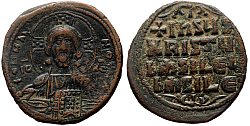 |
Basil II the Bulgar Slayer (963/976-1025 AD) with Constantine VIII (963/976-1028 AD)
Denomination: follis (class 2 anonymous follis)
Mint: Constantinople
Time: 976-1028 AD
Weight: 12.50 g
Diameter: approx. 30.1 mm
Reference: Sear 1813
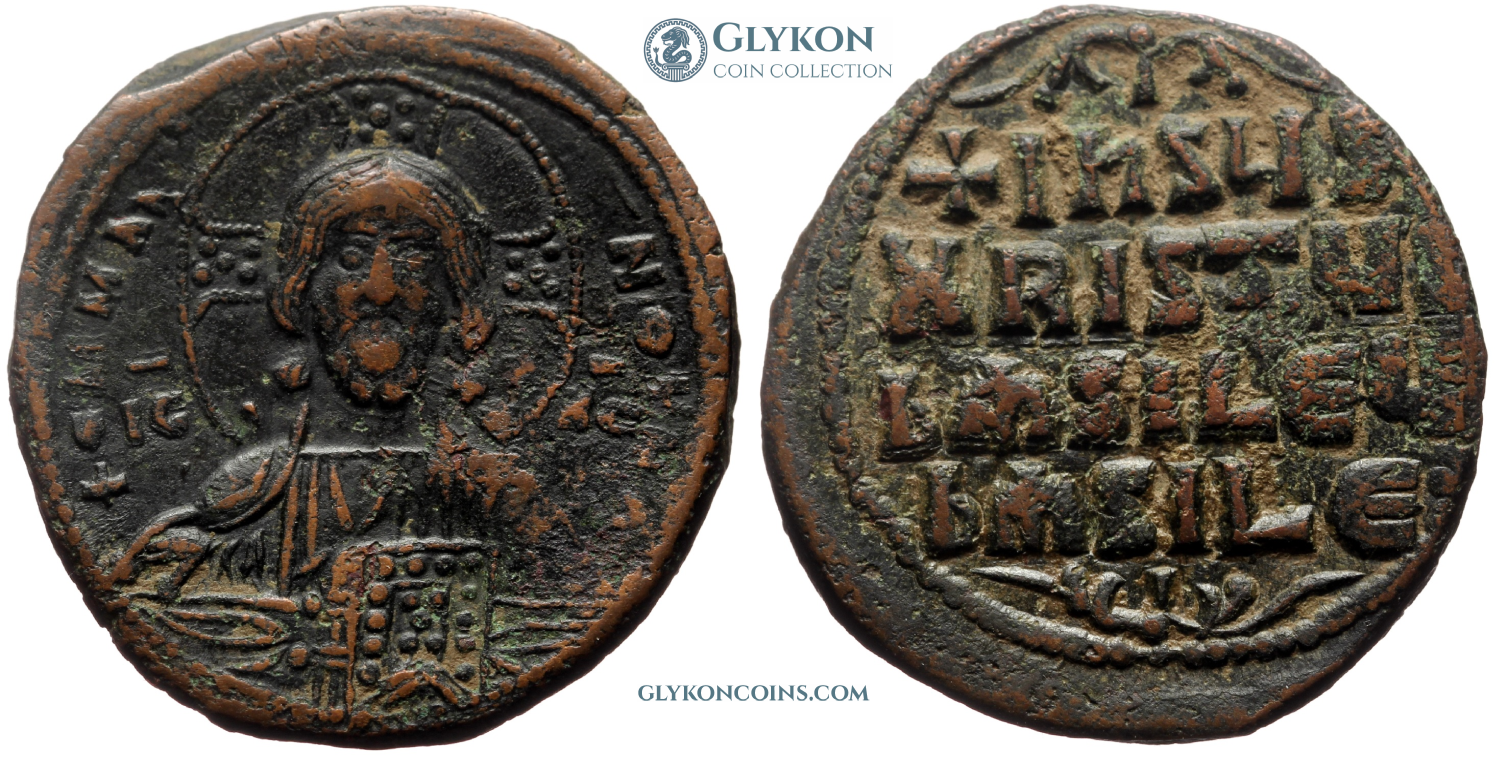
Obverse: Facing bust of Christ with nimbate (that is, haloed) cross behind head, holding a dotted book of gospels. Legend: IC-XC (monogram of Christ, flanking His bust) and +ЄMMANOVH (Emmanuel, at the edge)
Reverse: Between floral elements, legend in four lines: +IhSuS / XRISTuS / bASILEu / bASILE (Jesus Christ, King of Kings)
Comment: At the beginning of the reign of John Tzimiskes, Byzantine copper coinage underwent a sudden and rather unexpected change. Emperors stopped appearing on copper folles while still showing up on silver and gold coinage. Instead, their image was replaced by that of Christ. As historical sources do not explain this change, we are doomed to make educated guesses. The most likely explanation is that John, an extremely pious man, had a conscience problem after seizing the imperial throne by outright murder of his predecessor Nicephorus II Phocas and by adultery with his wife, Theophanu. It's likely that his guilt led him to the introduction of religiously inspired themes into his coinage. This change outlived the brief rule of John (thus the coins from his reign are actually rather scarce) and became the standard Byzantine copper coinage for about a century. These folles are called 'Anonymous' as they don't include the current emperor (or his family or any other then-living person).
|
|
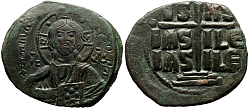 |
Romanos III Argyros (1028-1034 AD)
Denomination: follis (class B anonymous follis)
Mint: Constantinople
Time: 1028-1034 AD
Weight: 9.97 g
Diameter: approx. 30.3 mm
Reference: Sear 1823
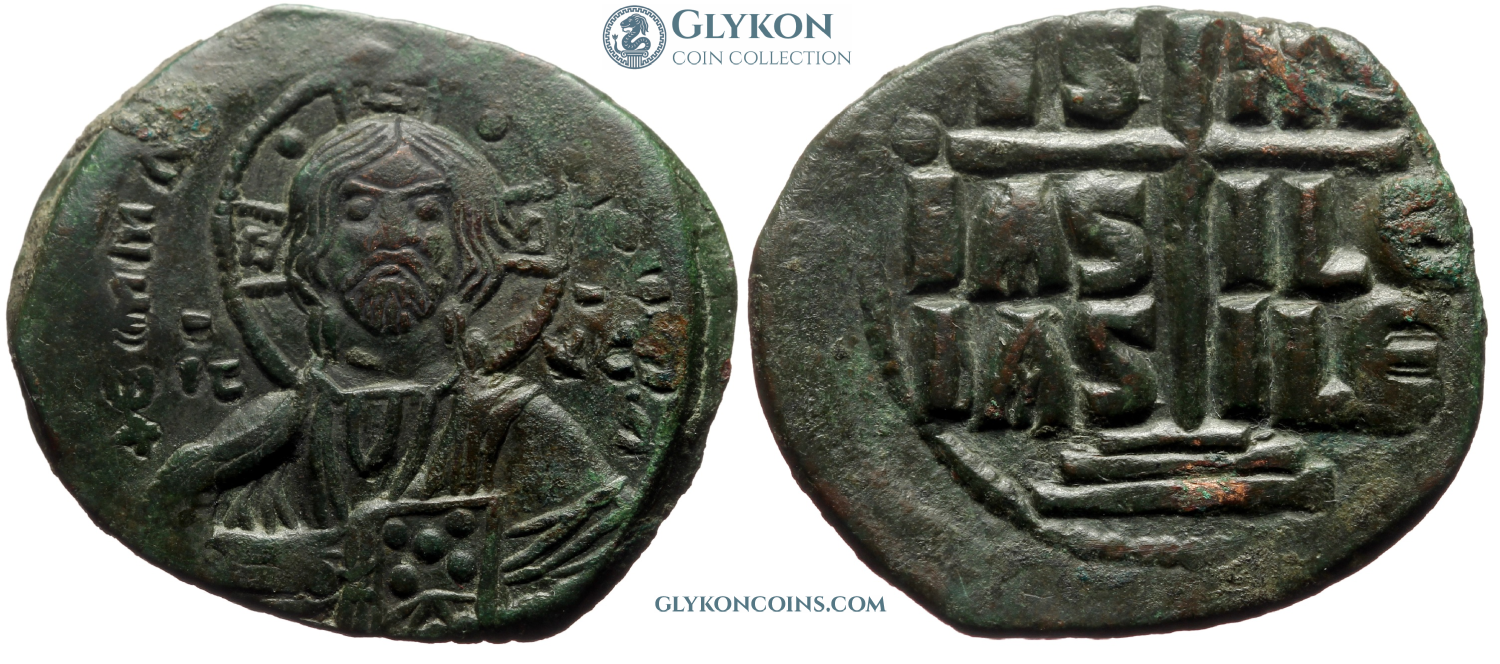
Obverse: Facing bust of Christ with nimbate (that is, haloed) cross behind head, holding a dotted book of gospels. Legend: IC-XC (monogram of Christ, flanking His bust) and +ЄMMANOVHN (Emmanuel, at the edge)
Reverse: Legend in the quarters of a calvary cross on three steps: IS-XS BAS-ILE BAS-ILE (Jesus Christ, King of Kings) |
|
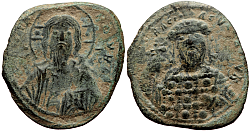 |
Constantine X Ducas (1059-1067 AD)
Denomination: follis
Mint: Constantinople
Time: 1059-1067 AD
Weight: 6.61 g
Diameter: approx. 26.7 mm
Reference: Sear 1854
Obverse: Facing bust of Christ with nimbate (that is, haloed) cross behind head, holding a dotted book of gospels and raising His right hand. Legend: IC-XC (monogram of Christ, flanking His bust) and +ЄMMANOVHA (Emmanuel)
Reverse: Facing bust of crowned Constantine, wearing loros and holding a small cross in his right hand. Legend: +KωnRACIΛЄVK O ΔOVK
Comment:Imperial portrait suddenly gradually returns to bronze coins.
Clearly some details peer through the dirt in this specimen. I might try to clean it if I have the time to spare (big "if").
|
|
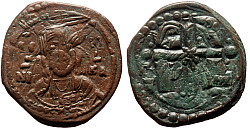 |
Romanos IV Diogenes (1068-1071 AD)
Denomination: follis
Mint: Constantinople
Time: 1068-1071 AD
Weight: 9.97 g
Diameter: approx. 30.3 mm
Reference: Sear 1823
Obverse: Facing bust of Christ with a dotted cross behind head, holding a dotted book of gospels. Legend: IC-XC NI-KA (Jesus Christ conquers)
Reverse: In the quarters of a large cross: C-R P-Δ. Small globus cruciger and two pellets at the end of each arms of the cross.
Comment: Weakly overstruck over Sear 1866, that being Class G anonymous follis displaying Christ and the Virgin.
Yes, each side of this particular coin has distinctive colors.
|
Spotted an error, misattribution, or a forgery? Please contact me!
|