| No. |
Photo |
Description |
|
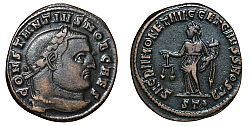 |
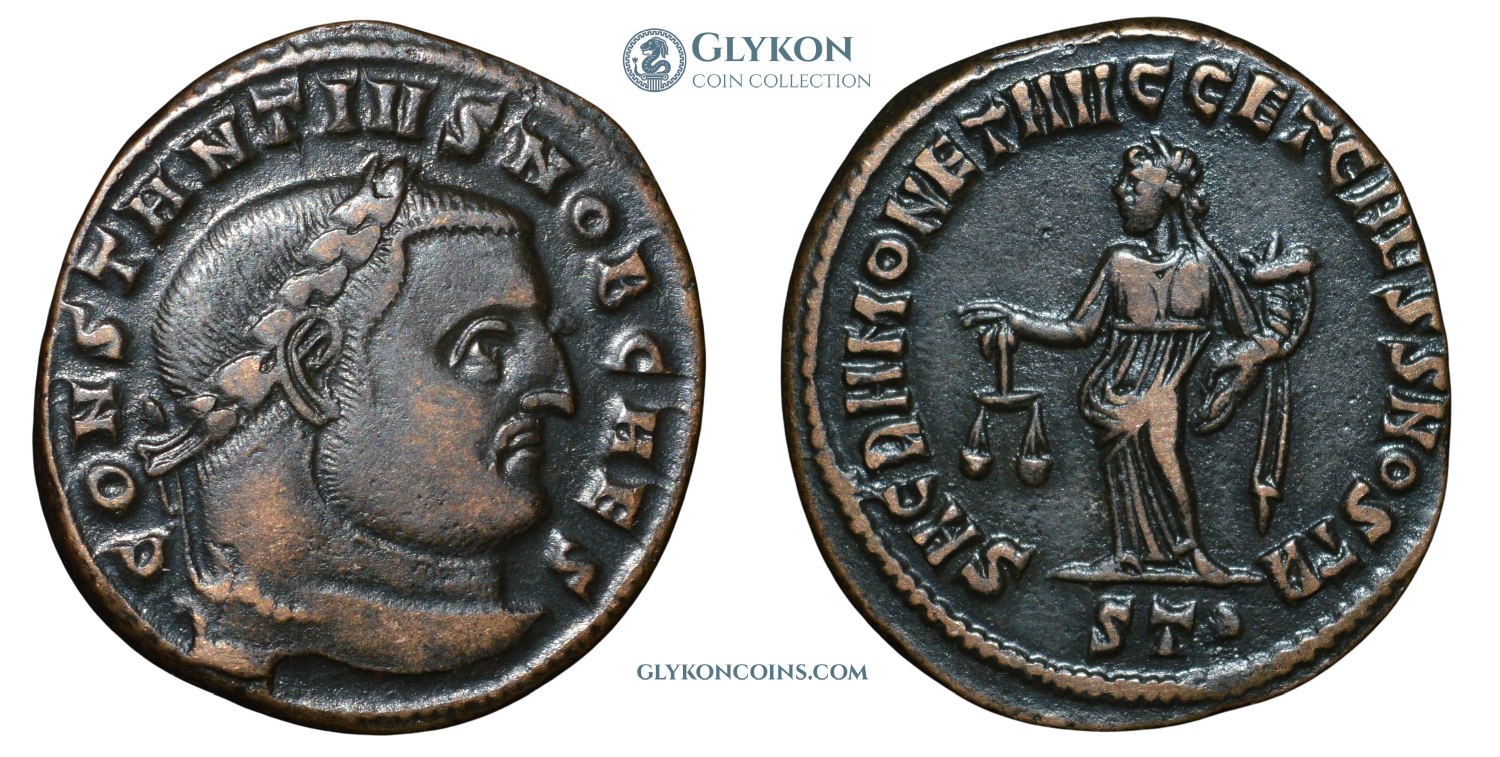
Constantius I Chlorus (293-306 AD)
Denomination: Follis (AE1)
Mint: Ticinum (Pavia)
Time: 300-303 AD
Weight: 9.71 g
Diameter: approx. 27.4 mm
Reference: RIC 46a
Obverse: Laureate head of Constantius facing right. Legend: CONSTANTIVS NOB CAES.
Reverse: Moneta standing facing left, holding scales in right hand and cornucopia in left hand. Legend: SACRA MONET AVGG ET CAESS NOSTR. Mintmark: ST•. |
|
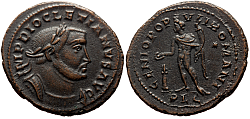 |
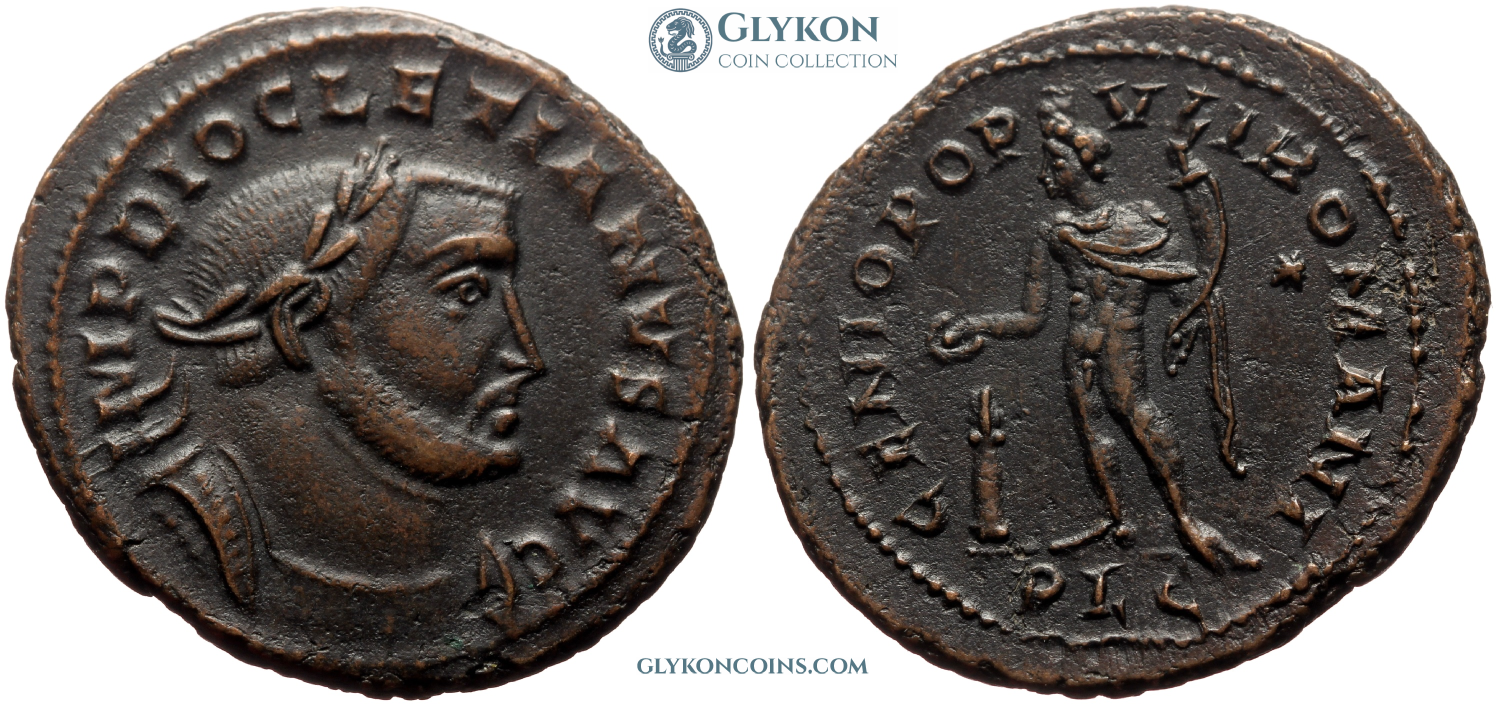
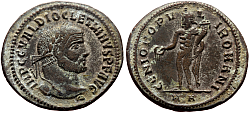
Diocletian (284-305 AD)
Denomination: Follis (AE1)
Mint: Lugdunum (Lyon)
Time: 303-305 AD
Weight: 11.16 g
Diameter: approx. 29.6 mm
Reference: RIC VI Lugdunum 175a
Obverse: Laureate and cuirassed bust of Diocletian facing right. Legend: IMP DIOCLETIANVS AVG.
Reverse: Genius standing facing left, wearing chlamys and modius but otherwise nude, holding patera and cornucopia. Hercules' club lower left, star right. Legend: GENIO POPVLI ROMANI. Mintmark: PLC. |
|
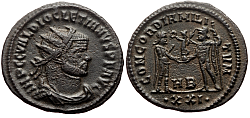 |
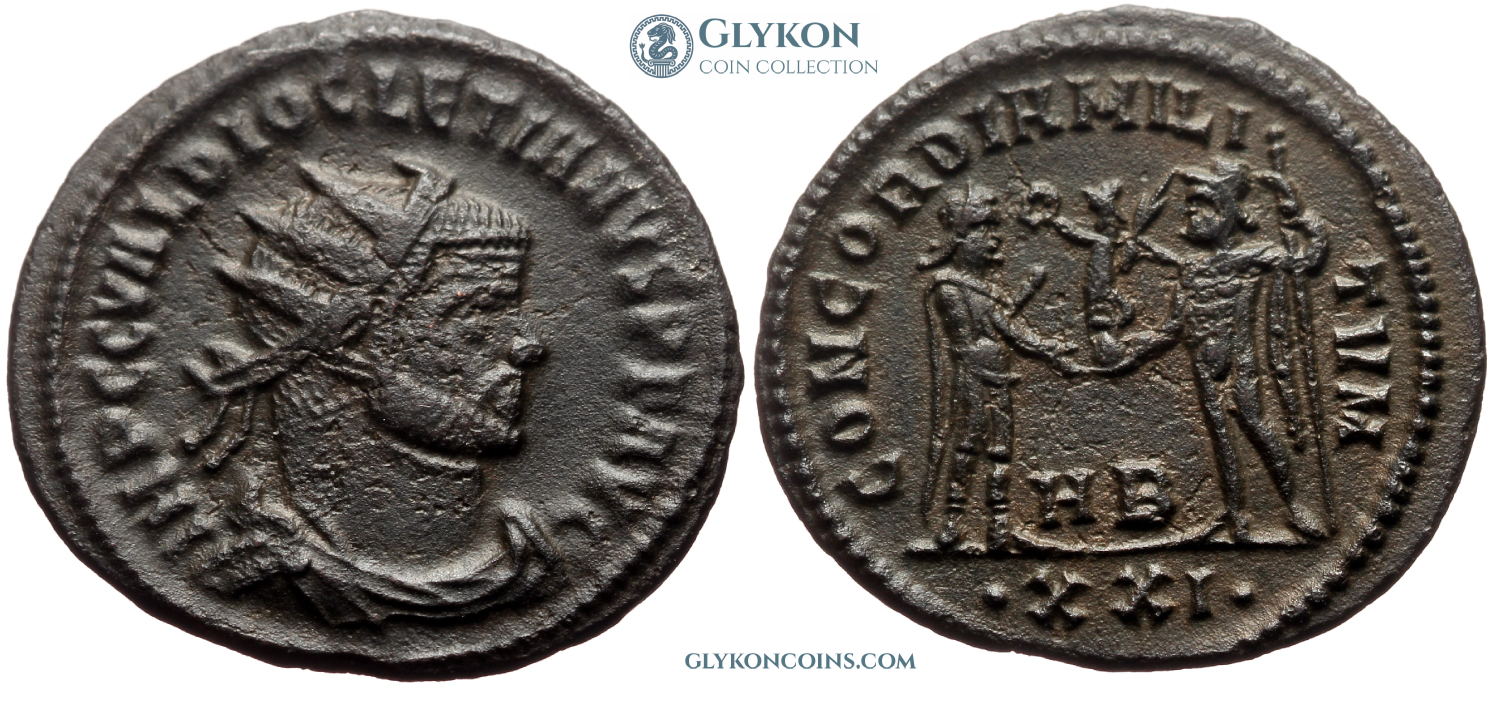
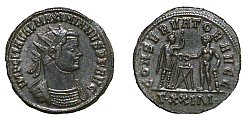
Diocletian (284-305 AD)
Denomination: Antoninianus
Mint: Heraclea
Time: 293 AD
Weight: 3.88 g
Diameter: approx. 22.3 mm
Reference: RIC V 284c, HB
Obverse: Radiate, draped, cuirassed bust of Diocletian facing right. Legend: IMP CC VAL DIOCLETIANVS PF AVG.
Reverse: Naked Jupiter on the right grants Victory holding wreath on a globe to Diocletian on the left. HB under Victory. Mintmark •XXI•. Legend: CONCORDIA MILITVM |
|
 |
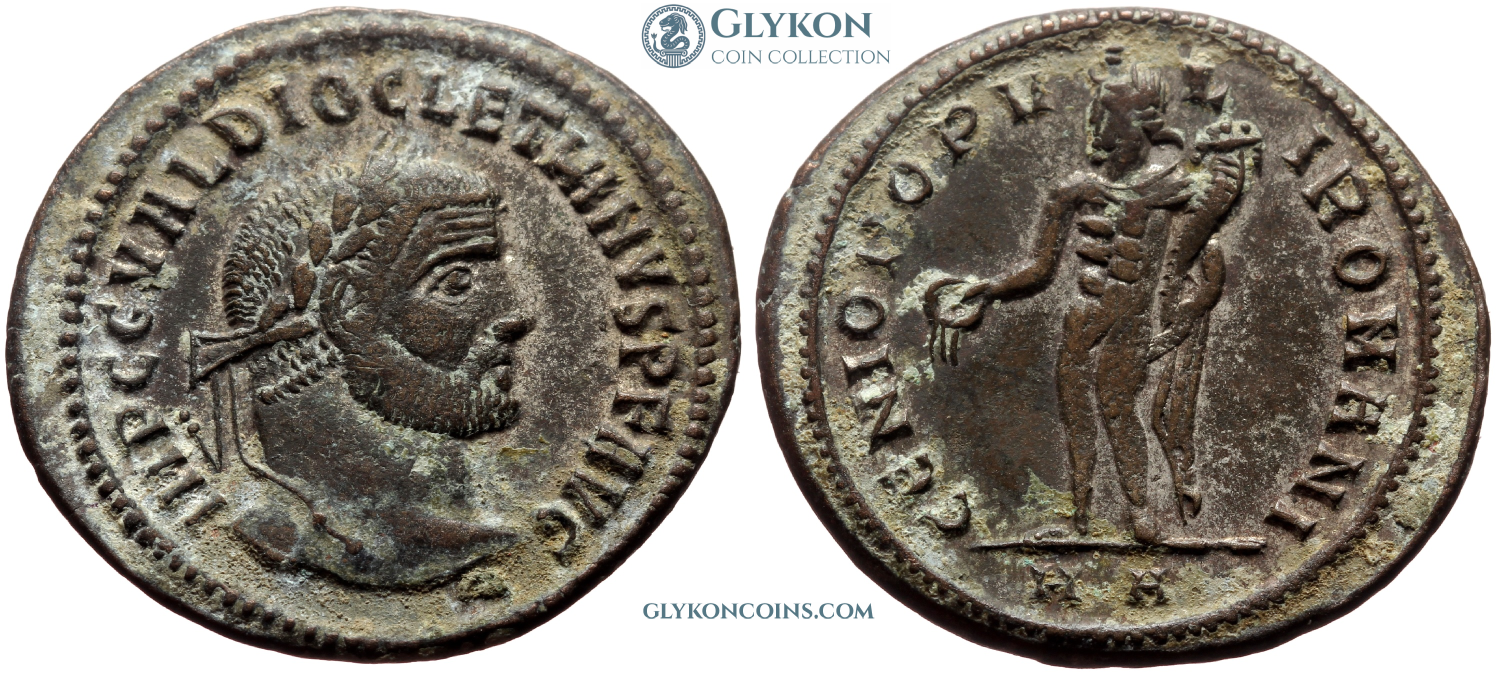
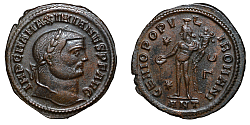
Diocletian (284-305 AD)
Denomination: Follis (AE1)
Mint: Heraclea
Time: 294 AD
Weight: 8.22 g
Diameter: approx. 28.5 mm
Reference: RIC VI Heraclea 12a
Obverse: Laureate head of Diocletian facing right. Legend: IMP CC VAL DIOCLETIANVS PF AVG.
Reverse: Genius standing facing left, wearing chlamys and modius but otherwise nude, pouring sacrificial liquid from patera in his right hand and holding cornucopia in his left hand. Legend: GENIO POPVLI ROMANI. Mintmark: HA. |
|
 |
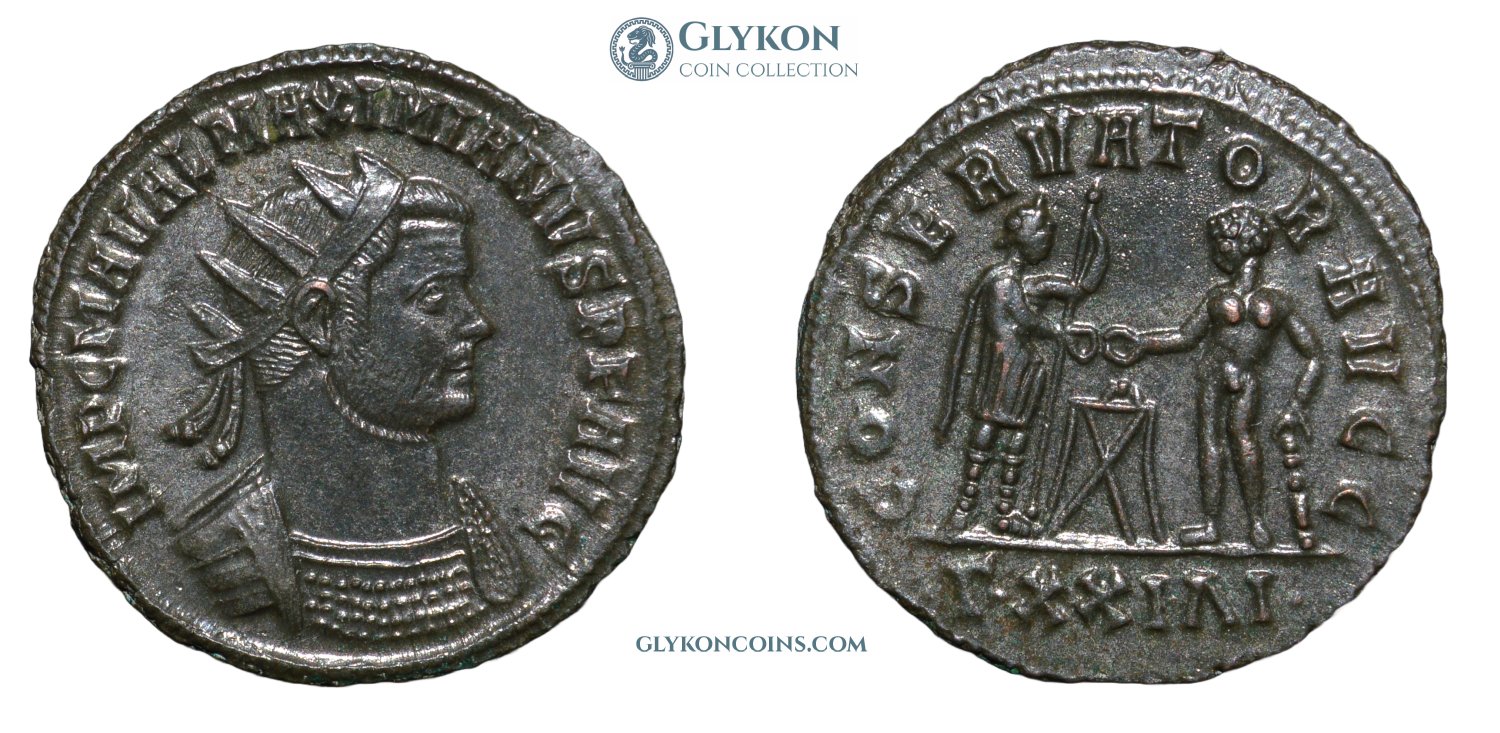
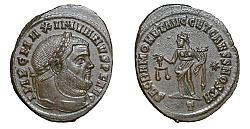
Maximian Herculius (286-305 AD)
Denomination: Antoninianus
Mint: Siscia (Sisak)
Time: 289-290 AD
Weight: 3.94 g
Diameter: approx. 22.7 mm
Reference: RIC V 580
Obverse: Radiate, cuirassed bust of Maximian facing right. Legend: IMP C MA VAL MAXIMIANVS PF AVG.
Reverse: On left the emperor holding sceptre and on the right nude Hercules leaning on his club make jointly sacrifice above an altar. Legend: CONSERVATOR AVGG. Mintmark: Γ•XXIΛI•.
Provenance: MULLER AG, Solingen, Germany, AUKTION NR. 71. 26.7.1992. lot no 723.
|
|
 |
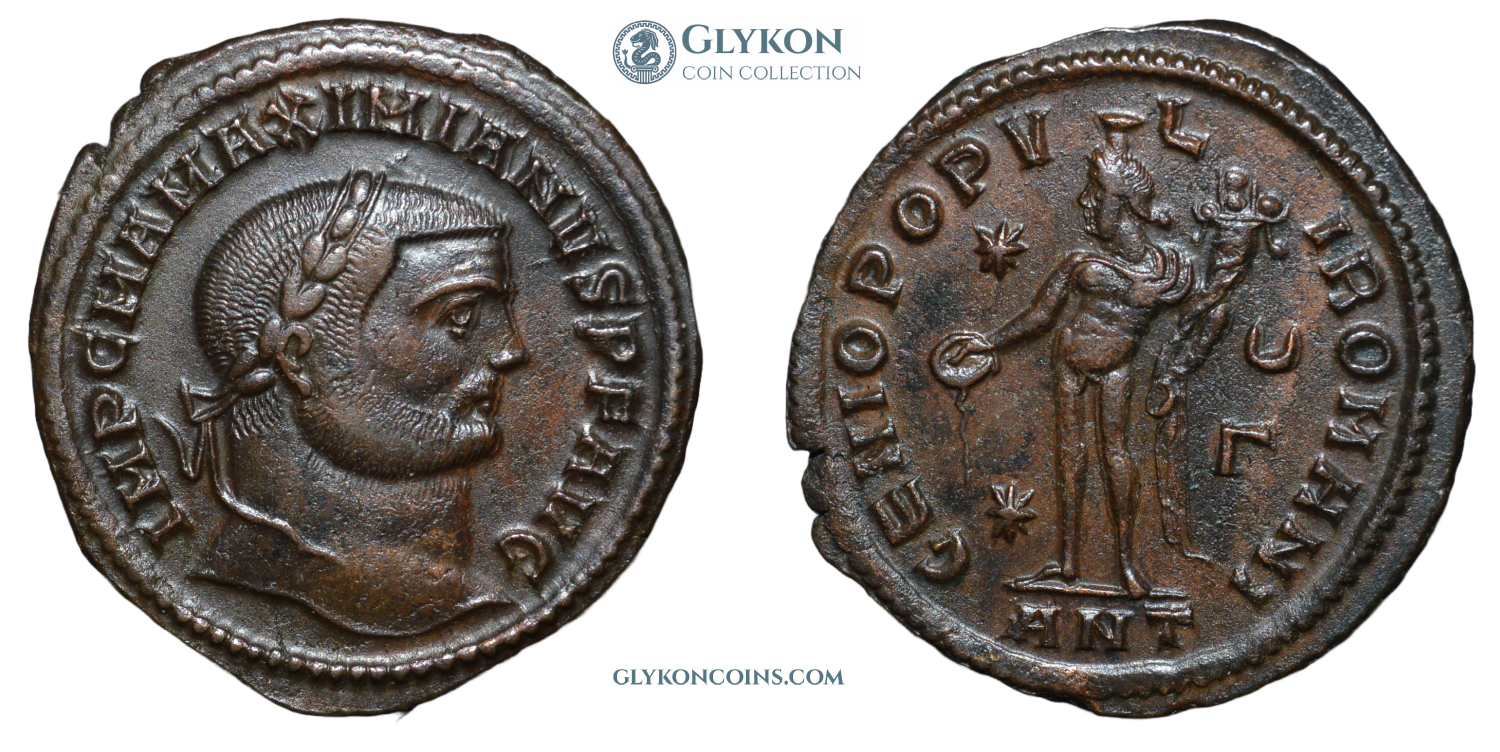
Maximian Herculius (286-305 AD)
Denomination: Follis (AE1)
Mint: Antioch
Time: 304-305 AD
Weight: 8.63 g
Diameter: approx. 28.4 mm
Reference: RIC VI 50b
Obverse: Laureate head of Maximian facing right. Legend: IMP C MA MAXIMIANVS PF AVG.
Reverse: Between two stars and crescent: standing nude Genius wearing modius, with chlamys draped over his left shoulder, head facing left, pouring sacrificial liquid from patera in his right hand and holding cornucopia in his left hand. Legend: GENIO POPVLI ROMANI. Mintmark: A and ANT.
Provenance: Albrecht + Hoffmann Gmbh, 7.11.1989, 776, C 472.
|
|
 |
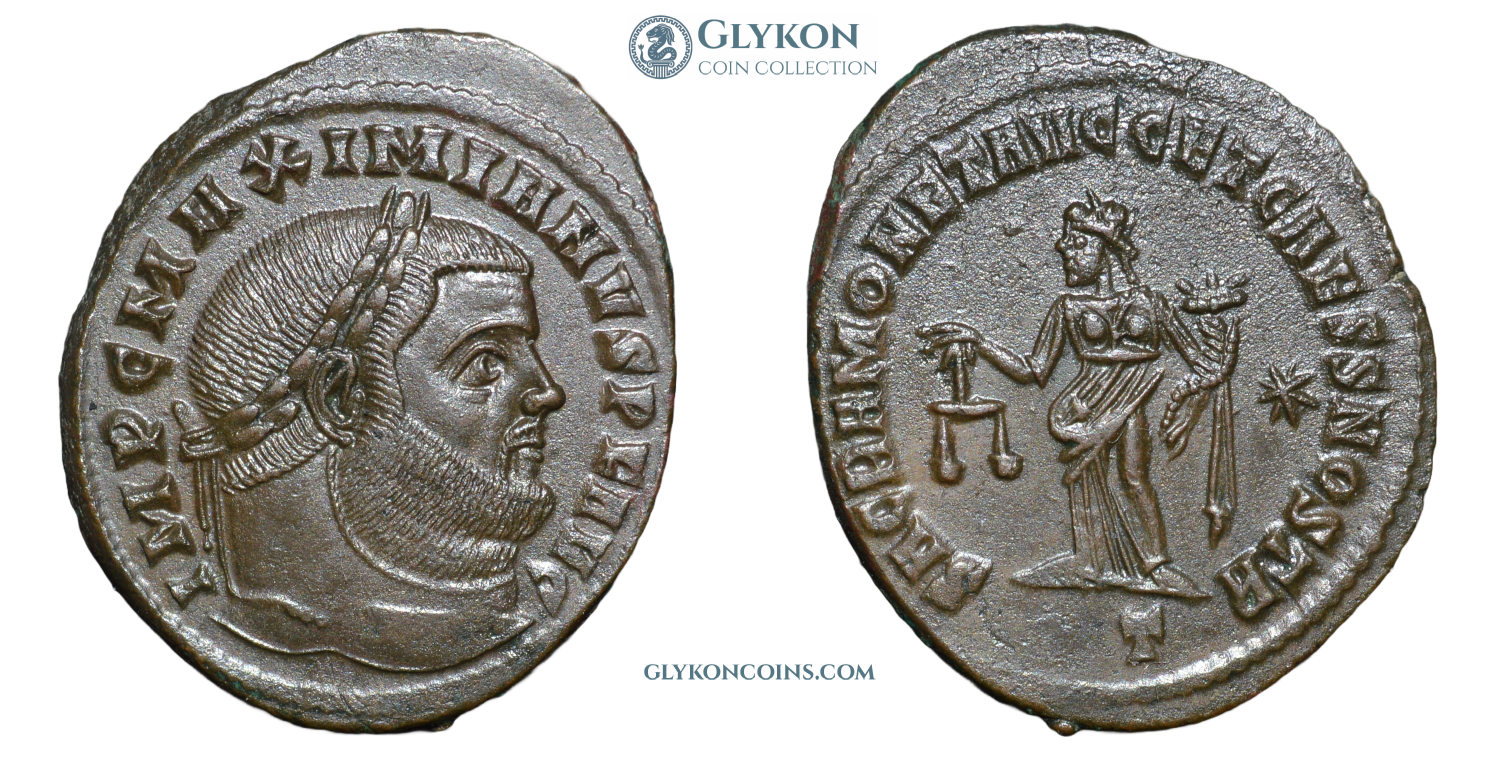
Maximian Herculius (286-305 AD)
Denomination: Follis (AE1)
Mint: Ticinum (Pavia)
Time: 304-305 AD
Weight: 9.16 g
Diameter: approx. 29.1 mm
Reference: RIC VI 47b
Obverse: Laureate head of Maximian facing right. Legend: IMP C MAXIMIANVS PF AVG.
Reverse: Moneta standing facing left, holding scales in right hand and cornucopia in left hand. Legend: SACRA MONETA AVGG ET CAESS NOSTR. Mintmark: (?)T.
Provenance: HANK.: PEGAN Num. AUKTION, 10.5.1990 No 802
The incomplete strike of this otherwise almost perfectly preserved coin makes it impossible to determine which officina it came from. |
|
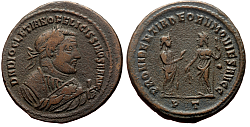 |
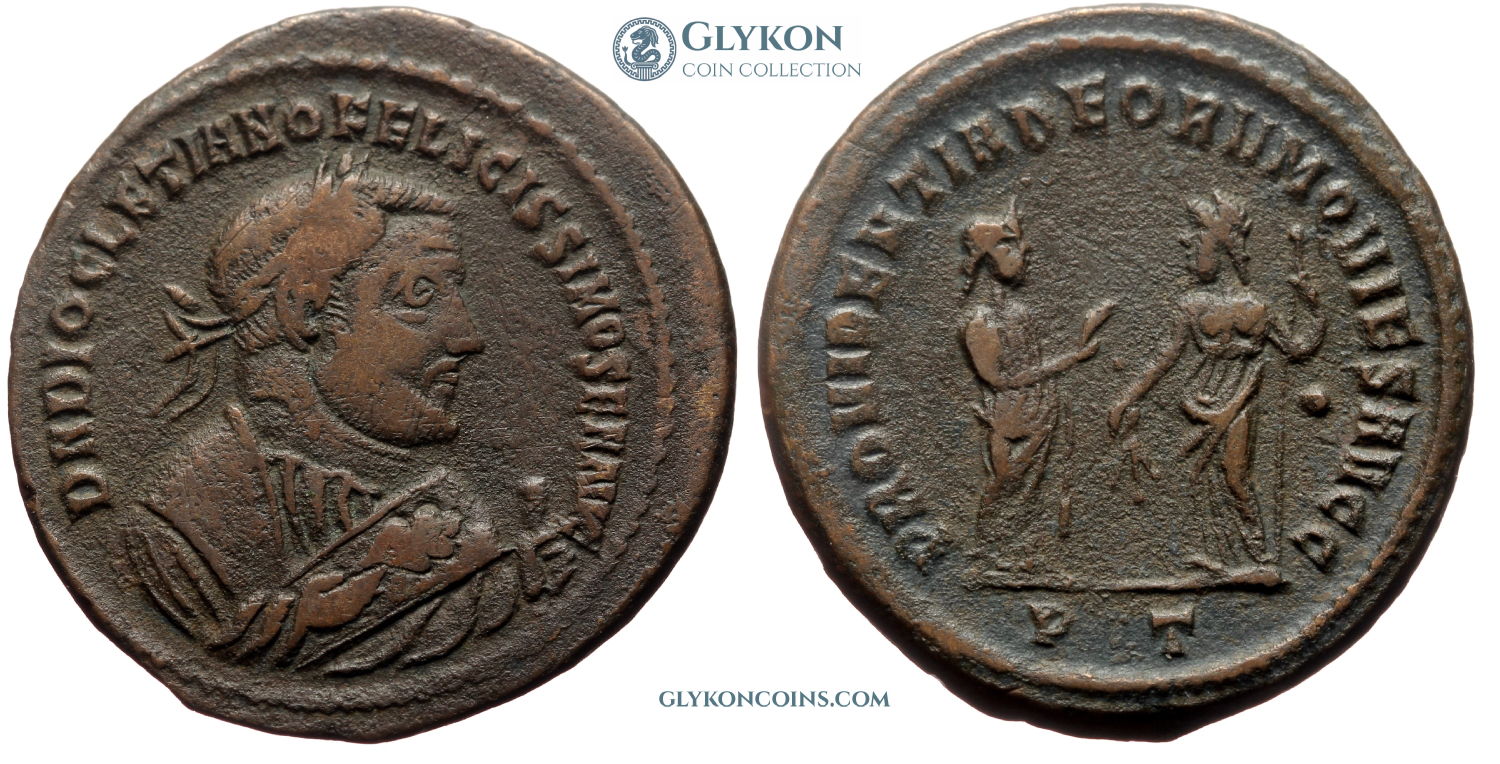
Diocletian (284-305 AD)
Denomination: Follis (AE1)
Mint: Ticinum (Ticino)
Time: 305 AD
Weight: 10.63 g
Diameter: approx. 28.5 mm
Reference: RIC VI Ticinum 57aa
Obverse: Laureate bust of Diocletian facing right, holding an olive branch in right hand and a mappa in left hand. Legend: DN DIOCLETIANO FELICISSIMO SEN AVG.
Reverse: On left, draped Providentia standing facing right, extending her right hand to Quies. On the right, draped Quies (personification of rest) standing facing left, holding a branch downwards in right hand and leaning on a sceptre held in left hand. Dot on the far right. Mintmark: PT.
The famous abdication series, minted after Diocletian voluntarily abdicated and forced his collegue Maximian do to the same. Maximian of course didn't accept his forced retimement and tried to seize power again twice. |
|
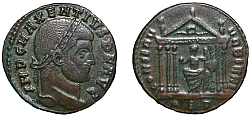 |
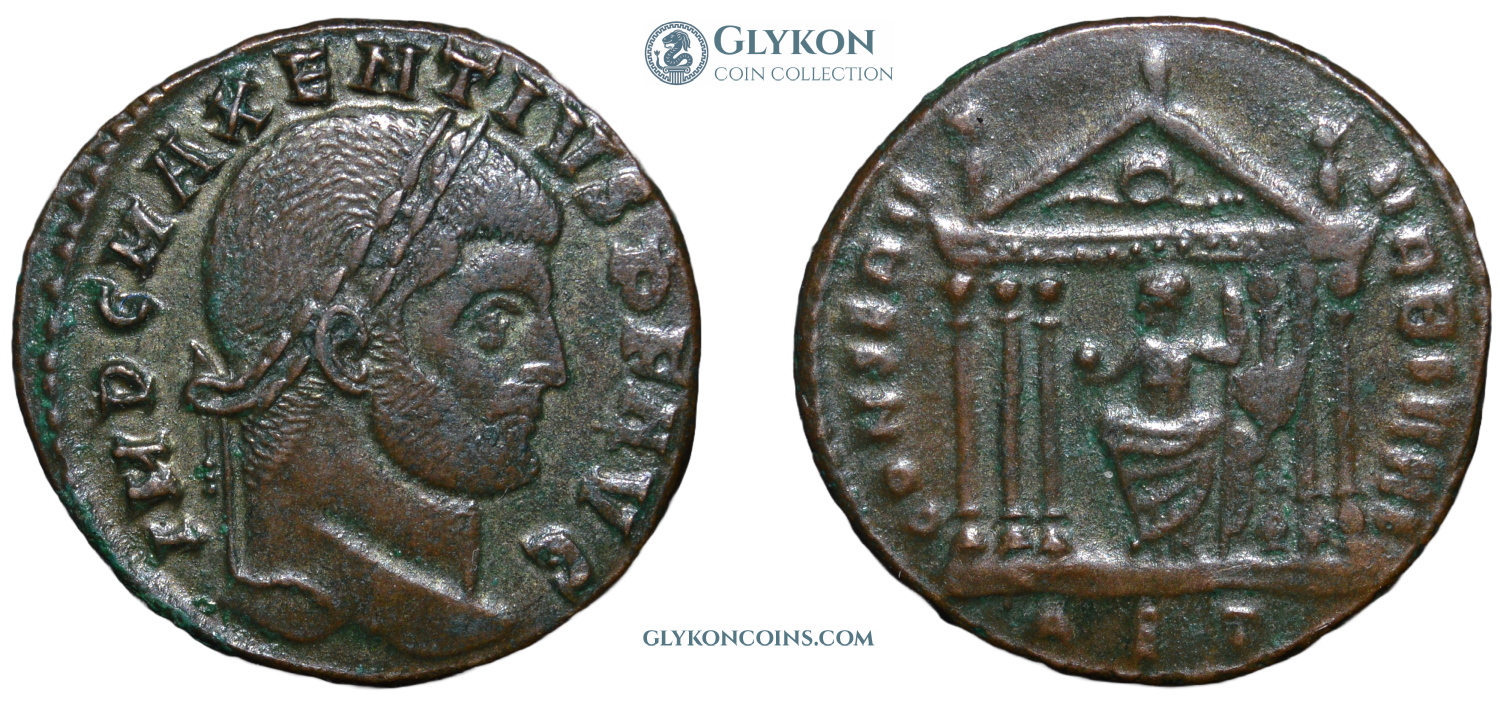
Maxentius (306-312 AD)
Denomination: Follis (AE1)
Mint: Rome
Time: 306-312 AD
Weight: 5.96 g
Diameter: approx. 24.2 mm
Reference: RIC 258, T
Obverse: Laureate head of Maxentius facing right. Legend: IMP C MAXENTIVS PF AVG.
Reverse: Within six-columned temple Roma seated with head facing left, holding globe and sceptre. Shield at her feet. Wreath on the temple's crowning. Legend: CONSERV VRB SVAE. Mintmark: RET. |
|
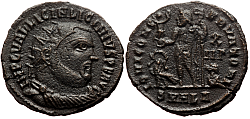 |
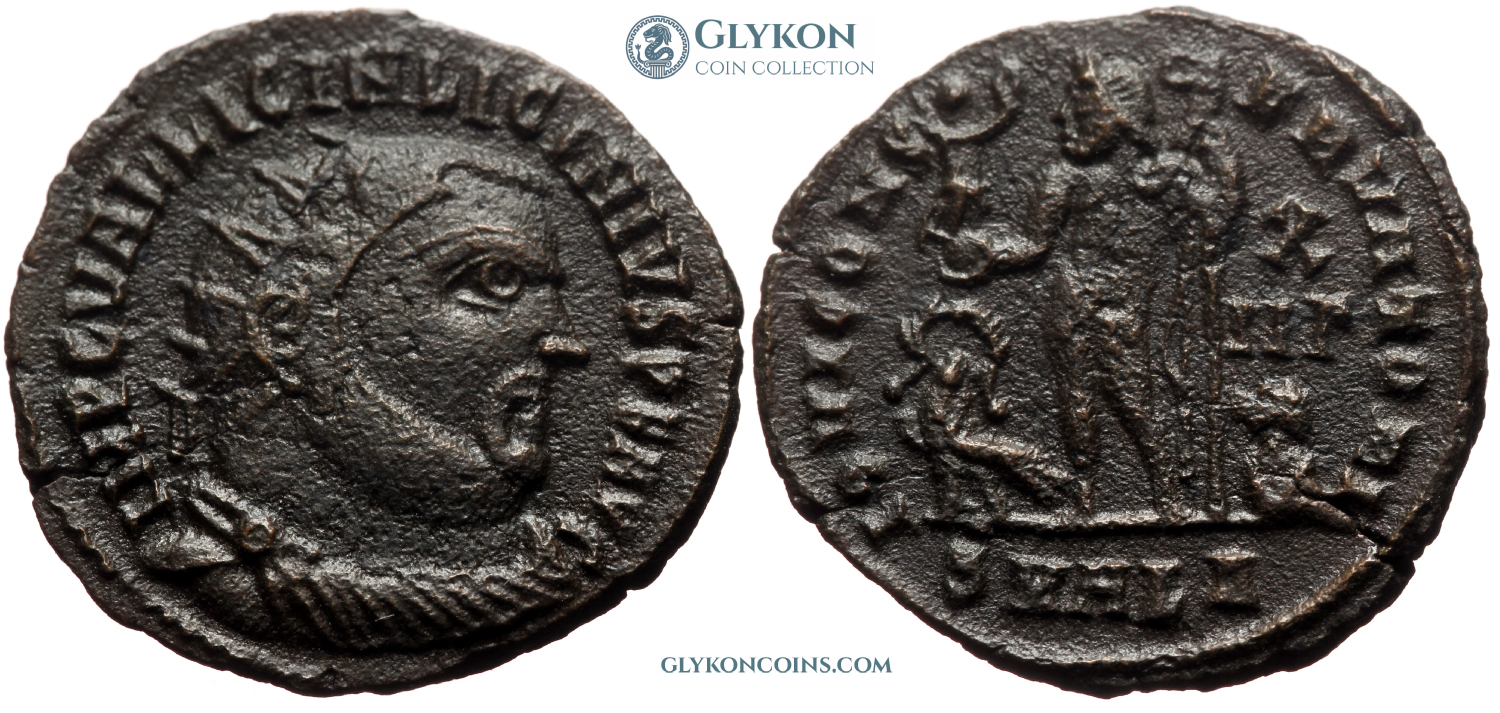
Licinius I (308-324 AD)
Denomination: AE3
Mint: Alexandria
Time: 308-324 AD
Weight: 2.90 g
Diameter: approx. 19.2 mm
Reference: RIC VII Alexandria 28
Obverse: Radiate, draped and cuirassed bust of Licinius facing right. Legend: IMP C VAL LICIN LICINIVS P F AVG
Reverse: Jupiter nude standing facing left, wearing chlamys across left shoulder, holding Nike standing on a globe and a long scepter. On lower left an standing with wreath in its beak. On lower right a bounded captive sitting facing right. X and III amove the captive. Legend: IOVI CONSERVATORI. Mintmark: SMALHB |
|
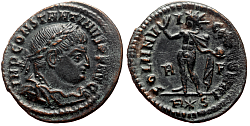 |
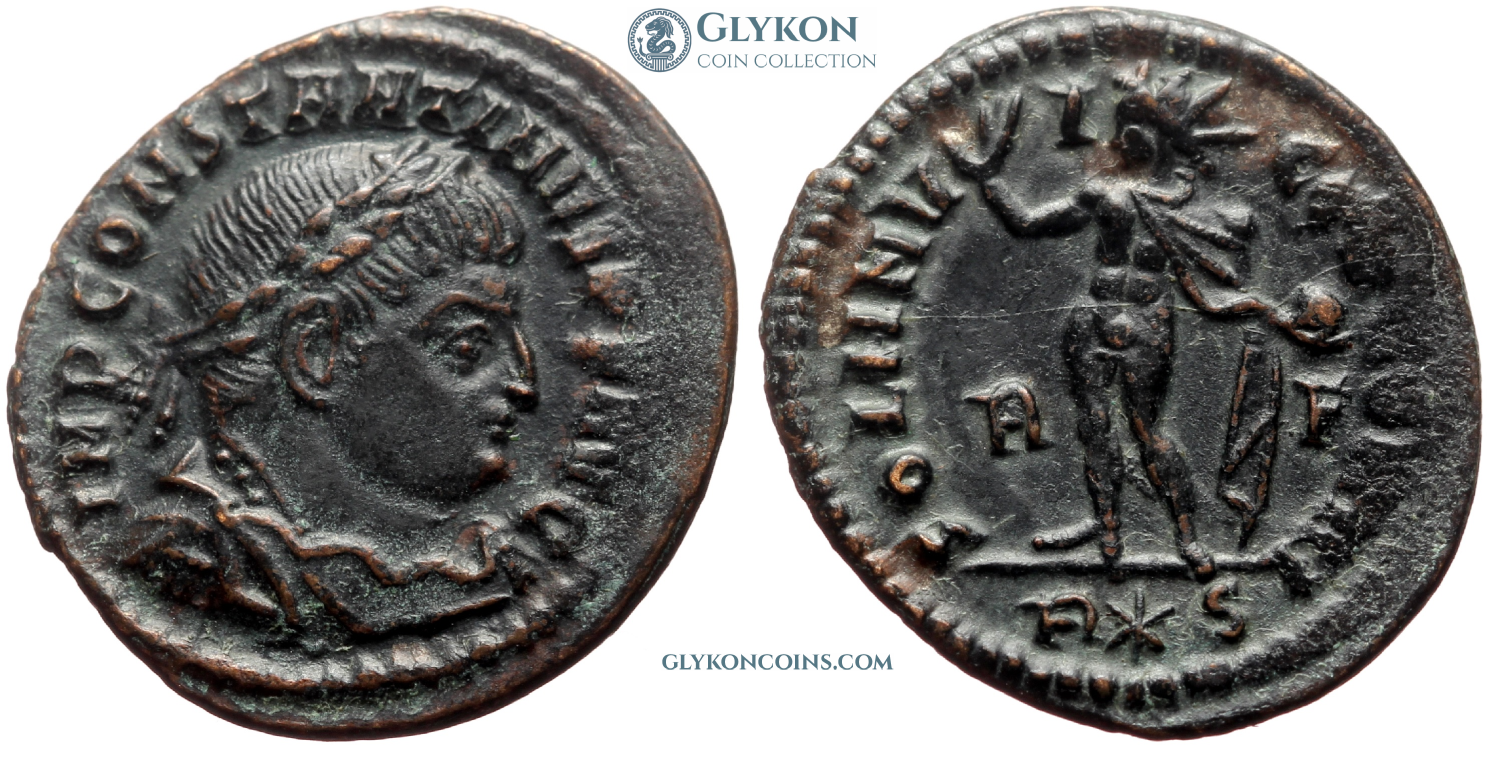
Constantine I the Great (306-337 AD)
Denomination: AE3
Mint: Rome
Time: 314 AD
Weight: 3.09 g
Diameter: approx. 21.1 mm
Reference: RIC VII Rome 19; Sear 16096
Obverse: Laureate and cuirassed bust of Constantine facing right. Legend: IMP CONSTANTINVS PF AVG
Reverse: Sol, flanked by R and F, standing facing left, wearing chlamys (cloak) but otherwise naked, raising right hand and holding a globe in left hand. Mintmark R★T. Legend: SOLI INVICTO COMITI.
And this is where the spider enters the mix. Constantine is without doubt one of the most consequential persons in the world’s history. His religious policy, military exploits, foundation of Constantinople and administrative achievements, while obviously incredibly important, are beyond our interest here. But he did kill his eldest son and his wife. But what’s interesting with this coin is that despite Constantine definitely favoring Christianity since 312, his mints were still issuing coins with clearly Pagan iconography. And they would continue to do so until the early 320s. |
|
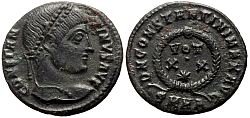 |
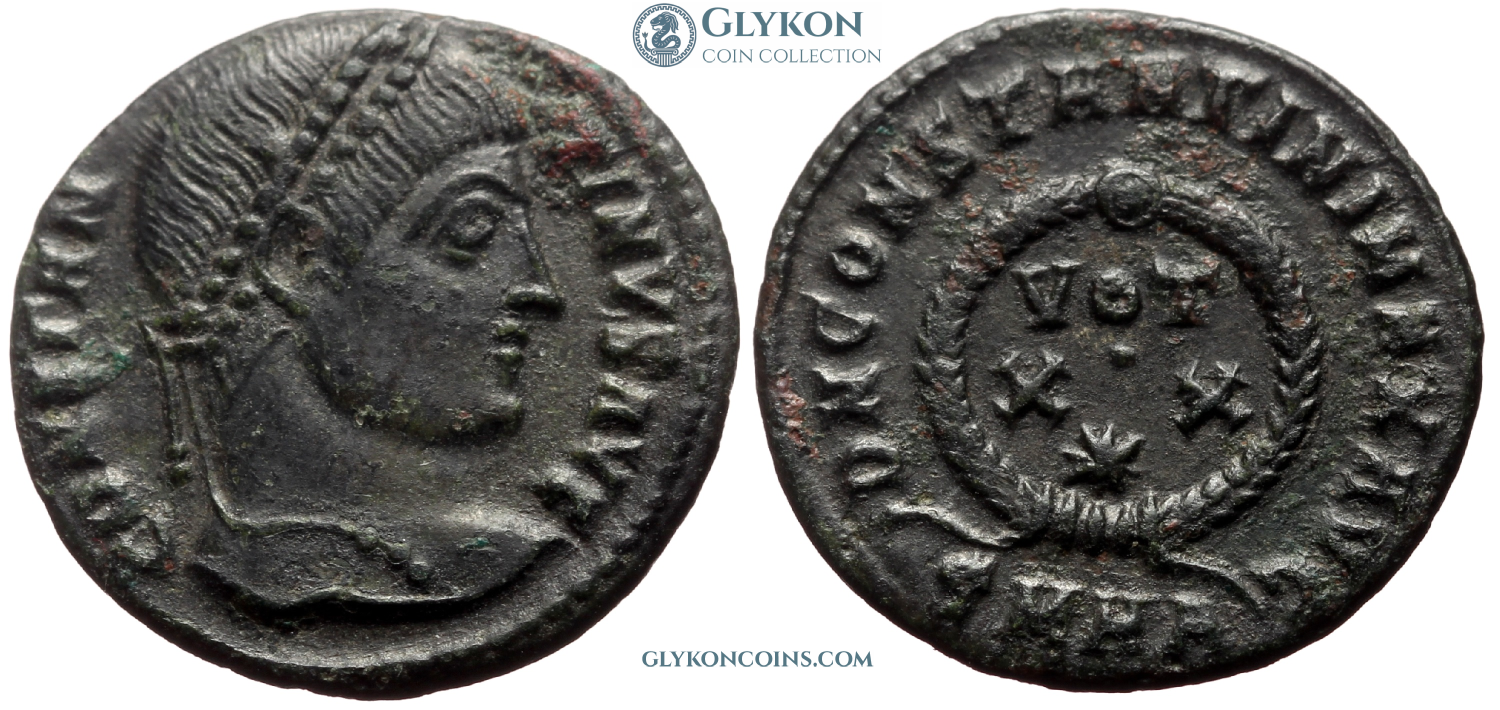
Constantine I the Great (306-337 AD)
Denomination: AE3
Mint: Heraclea
Time: 324 AD
Weight: 2.72 g
Diameter: approx. 18.6 mm
Reference:RIC VII Heraclea 60
Obverse: Pearl-diademed head of Constantine facing right. Legend: CONSTANTINVS AVG
Reverse: Within wreath in three lines: VOT XX *, dot in the middle. Legend: DN CONSTANTINI MAX AVG. Mintmark: SMHB.
Comment: The gradual phasing out of pagan imagery from the Constantinian-era coinage led to the introduction of the "votive" type of reverses, with inscriptions such as VOT and MVLT accompanied by Roman numerals. These coins celebrated the length of rule (VOT) and expressed hopes for many more years to come (MVLT). It seems that the horror at the brevity and violent end of emperors during the Crisis years must have been deeply ingrained into the psyche of every person wearing purple so much that logevity became a virtue. In fact, this celebration of longevity and wishing for many more years of rule was a pervasive theme in Roman imperial ideology from then on. Even as late as the mid 10th century, the emperor, as attested by Constantine VII Porphyrogenitus, was ceremonially wished "many years" (multos annos) by his courtiers at almost every step. |
|
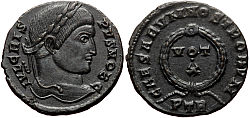 |
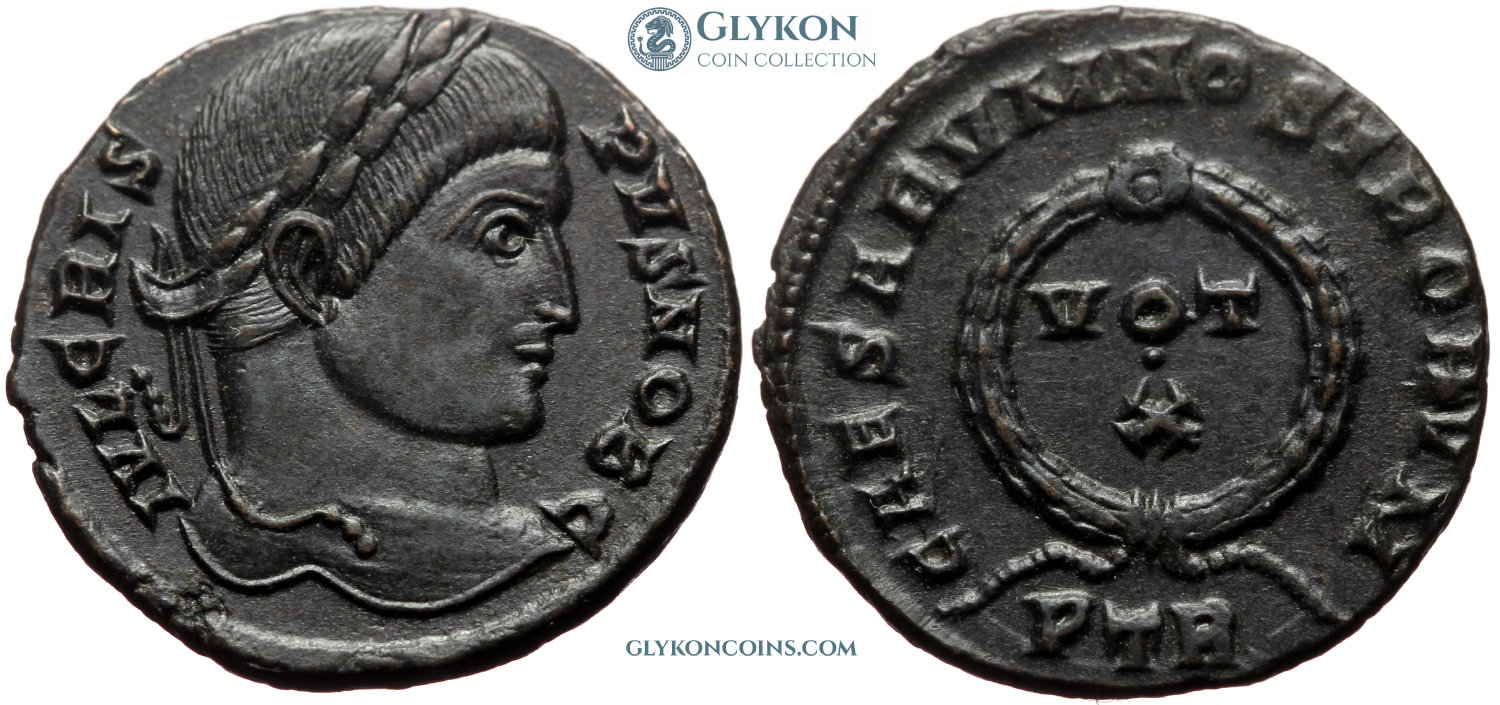
Crispus (Caesar in 317-326 AD)
Denomination: AE3
Mint: Trier
Time: 317-326 AD
Weight: 2.75 g
Diameter: approx. 17.5 mm
Reference:RIC VII Trier 431; Sear 16760
Obverse: Laureate head of Crispus facing right. Legend: IVL CRISPVS NOB C
Reverse: Within a wreath: VOT X *, dot in the middle. Legend: CAESARVM NOSTRORVM. Mintmark: PTR. |
|
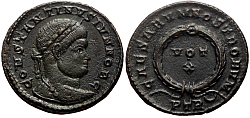 |
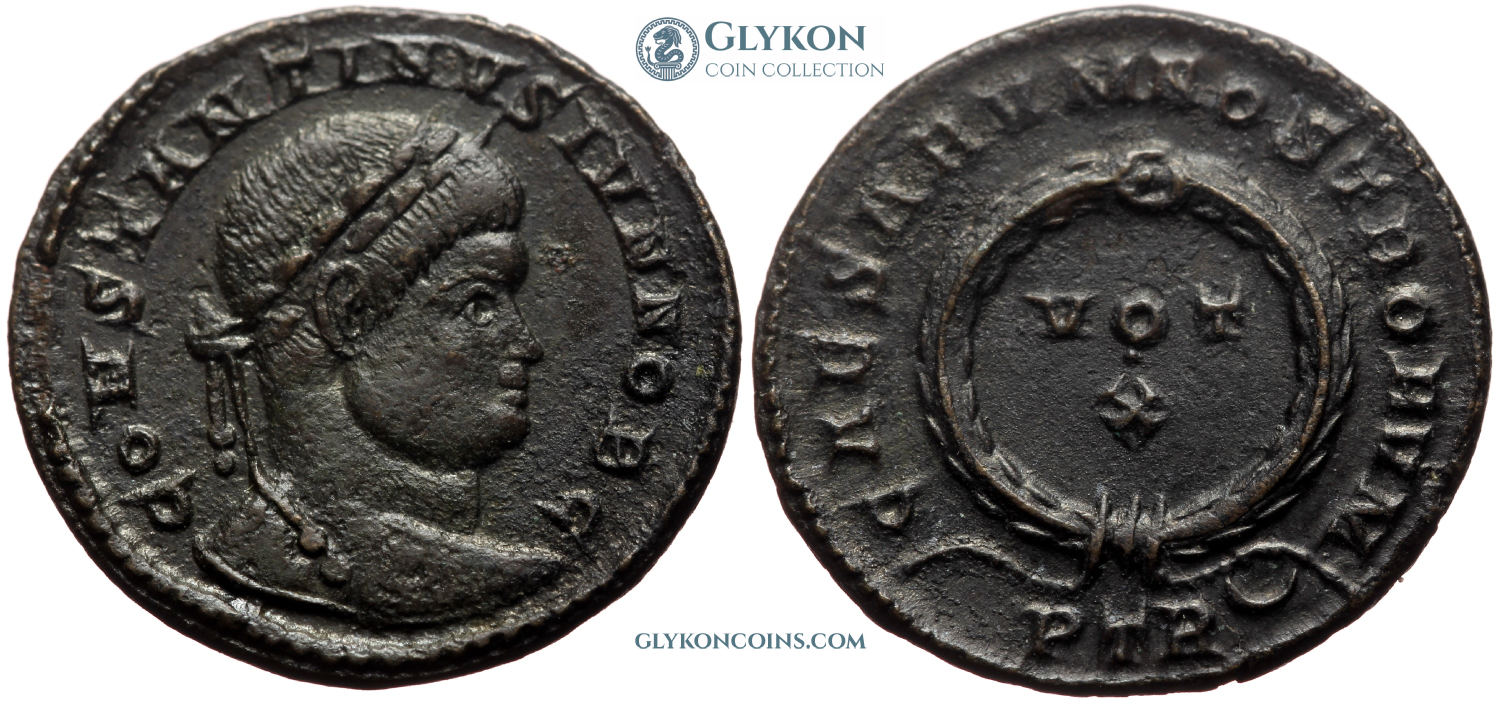
Constantine II (337-340 AD)
Denomination: AE3
Mint: Trier
Time: 323-324 AD (as Caesar)
Weight: 2.76 g
Diameter: approx. 18.9 mm
Reference:RIC VII Trier 433
Obverse: Laureate head of Constantine II facing right. Legend: CONSTANTINVS IVN NOB C
Reverse: Within a wreath: VOT X *, dot in the middle. Legend: CAESARVM NOSTRORVM. Mintmark: PTR. |
|
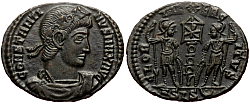 |
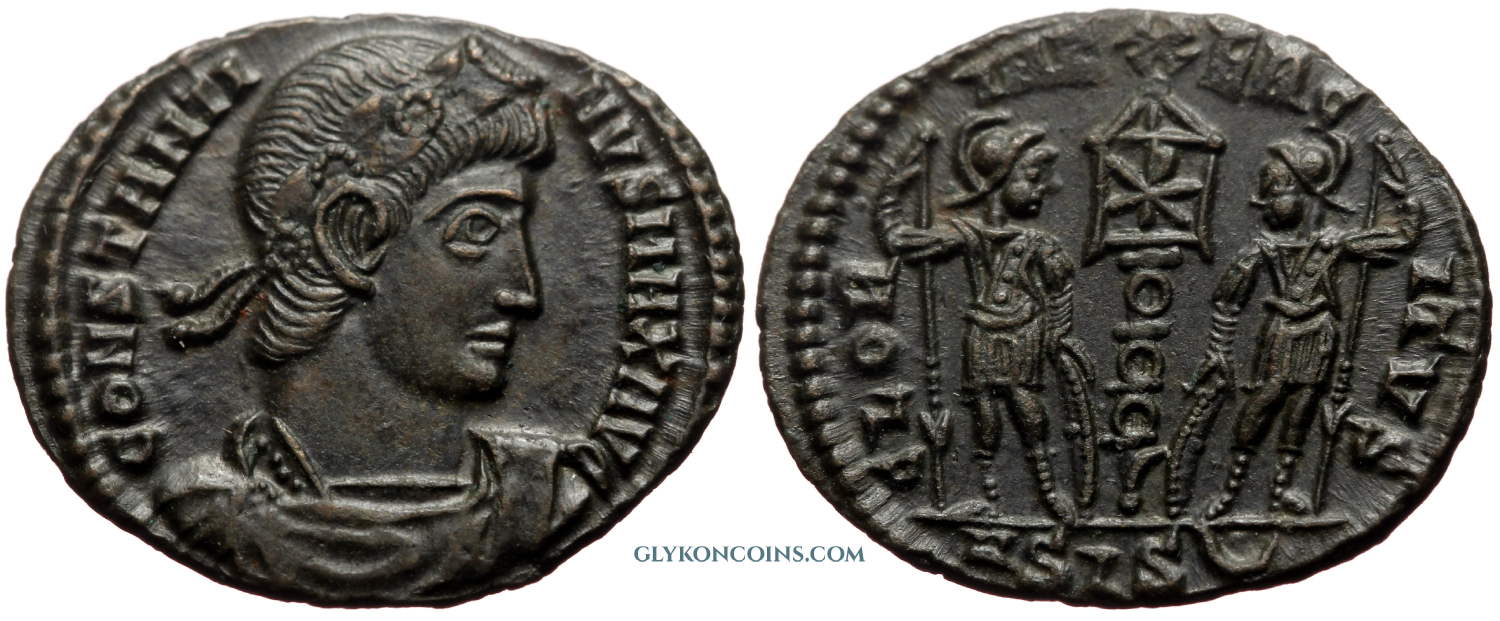
Constantine II (337-340 AD)
Denomination: AE3
Mint: Siscia
Time: 323-324 AD (as Caesar)
Weight: 1.64 g
Diameter: approx. 17.0 mm
Reference:RIC VIII Siscia 96
Obverse: Diademed, deaped and cuirassed bust of Constantine II facing right. Legend: CONSTANTINVS MAX AVG
Reverse: : A military standard with cross and labarum in the middle, looked upon by two flanking Roman soldiers holding spears and shields. Legend: GLORIA EXERCITVS. Mintmark: ASIS•︶ |
|
 |
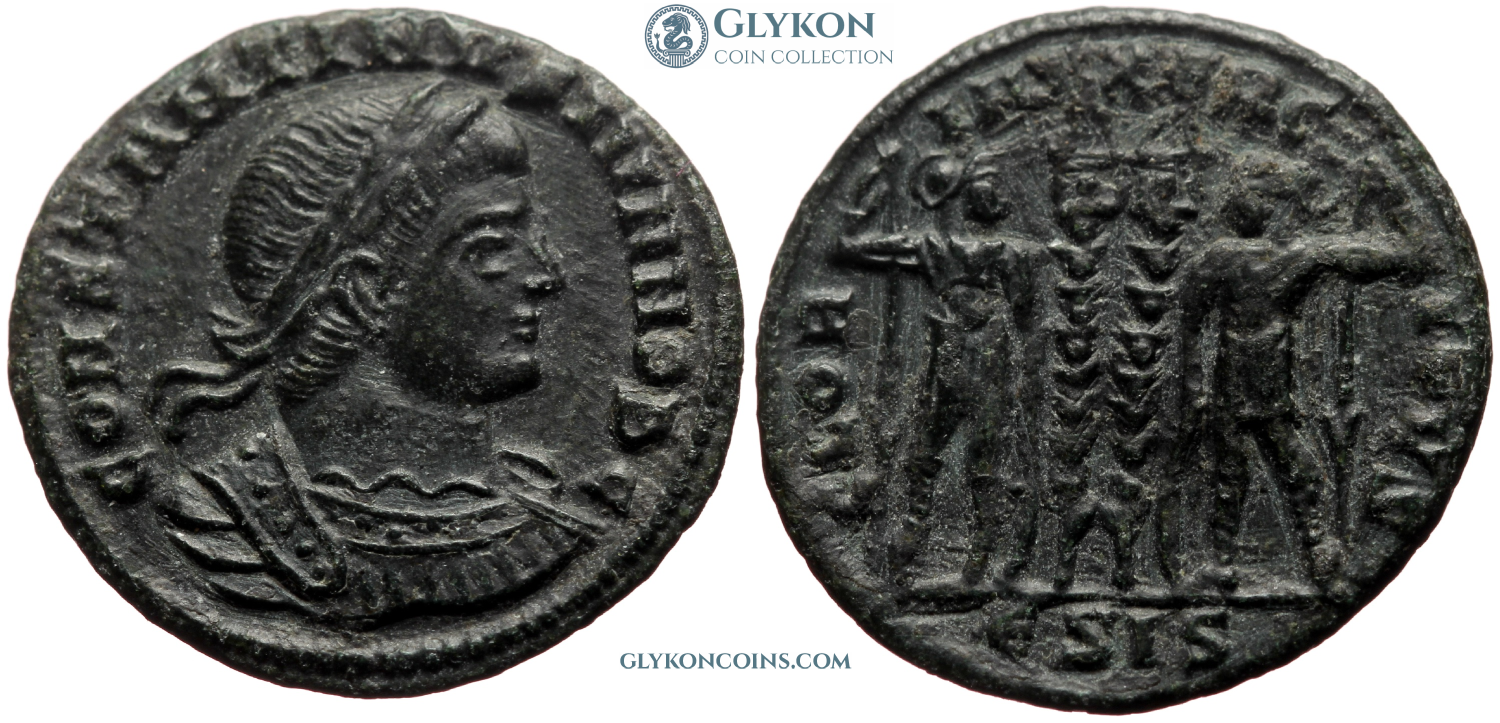
Constantine II (337-340 AD)
Denomination: AE3
Mint: Siscia
Time: 334-335 AD (as Caesar)
Weight: 2.24 g
Diameter: approx. 18.2 mm
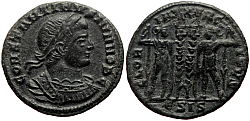
Reference:RIC VII Siscia 236; Sear 17334
Obverse: Laureate and cuirassed bust of Constantine II facing right. Legend: CONSTANTINVS IVN NOB C
Reverse: : Two military standards in the middle, looked upon by two flanking Roman soldiers holding spears and shields. Legend: GLORIA EXERCITVS. Mintmark: ЄSIS |
|
 |
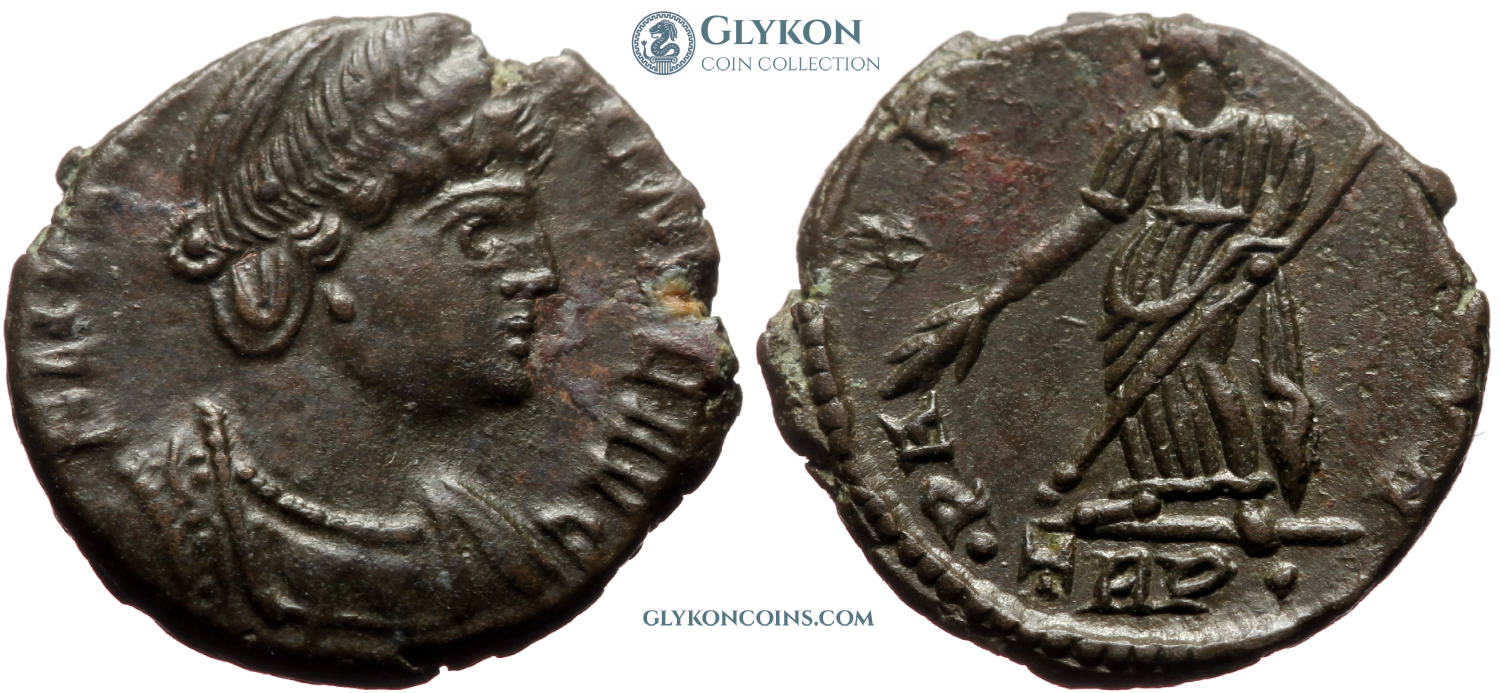
Helena, Augusta (d. 330 AD)
Denomination: AE4
Mint: Trier
Time: 337-340 AD (posthumous)
Weight: 1.60 g
Diameter: approx. 13.8 mm
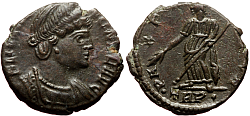
Reference:RIC VII Trier 78
Obverse: Diademed bust of Helena in elaborate mantle facing right. Legend: FL IVL HELENAE AVG
Reverse: Pax standing facing left, holding a branch and a scepter. Mintmark TRP• in exergue. Legend: •PAX PVBLICA
|
|
 |
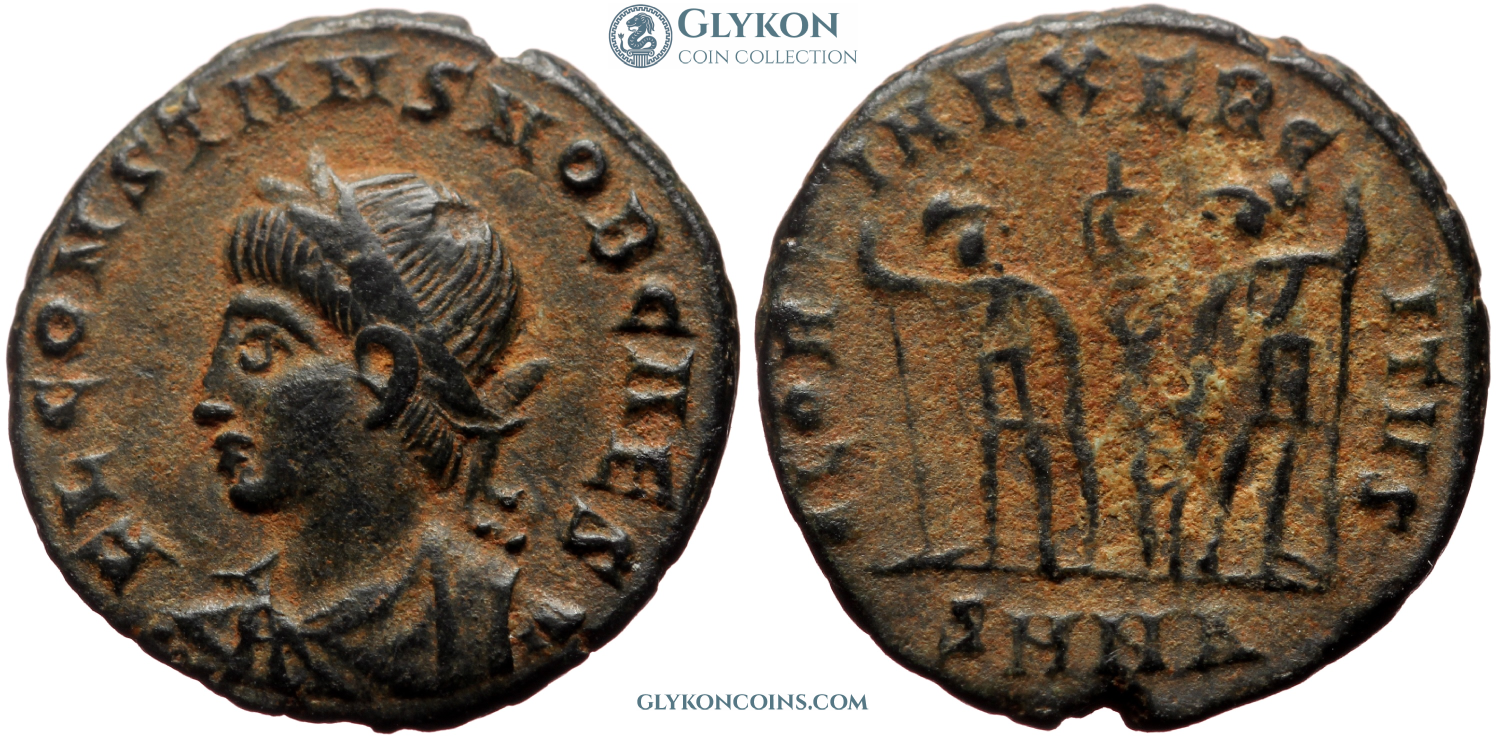
Constans I (337-350 AD)
Denomination: AE4
Mint: Nicomedia
Time: 336-337 AD (as Caesar)
Weight: 1.85 g
Diameter: approx. 15.5 mm
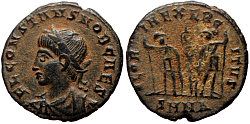
Reference: RIC VII Nicomedia 202
Obverse: Laureate, draped and cuirassed bust of Constans facing left. Legend: F L CONSTANS NOB CAES
Reverse: A military standard in the middle, looked upon by two flanking Roman soldiers holding spears and shields. Legend: GLORIA EXERCITVS. Mintmark SMNΔ(?) in exergue. |
|
 |
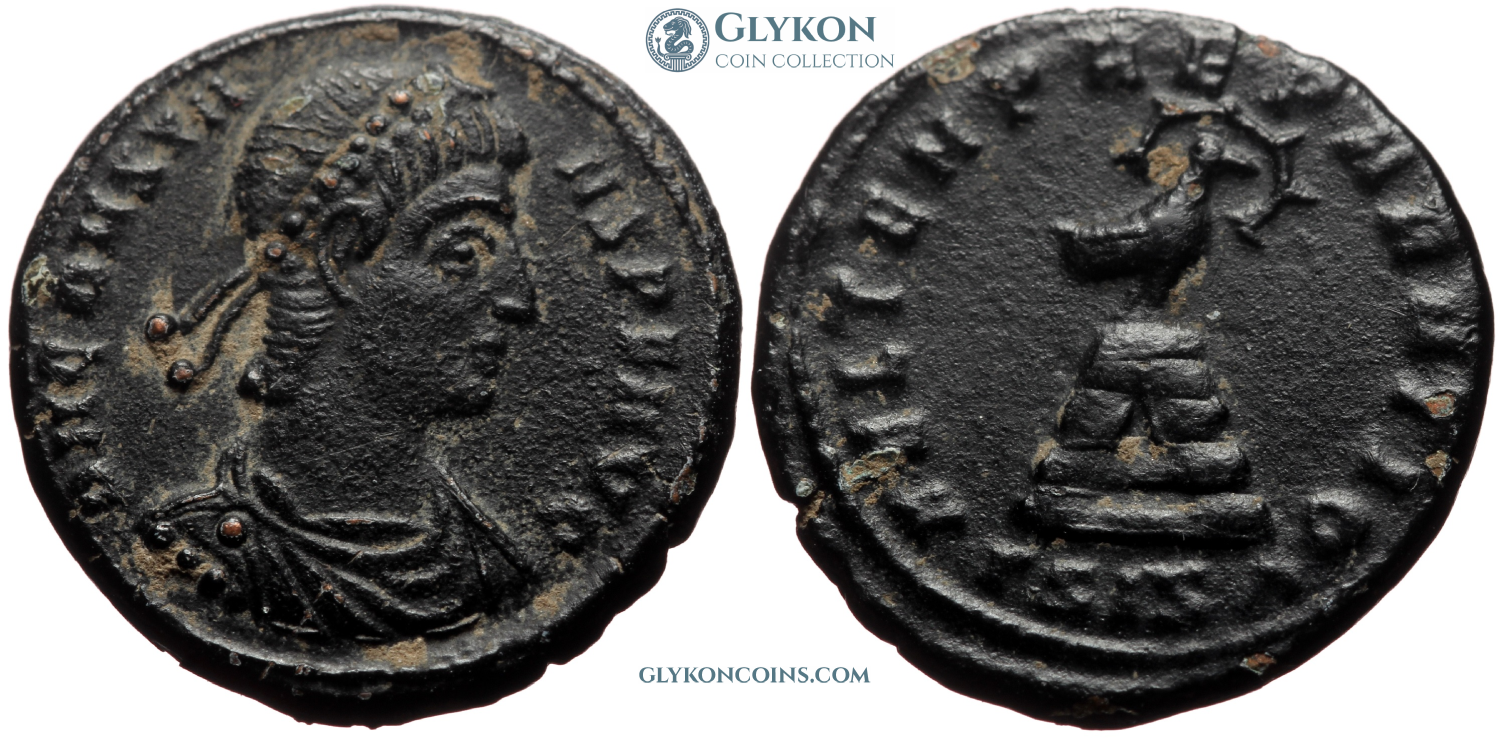
Constans I (337-350 AD)
Denomination: AE3
Mint: Siscia
Time: 337-350 AD
Weight: 3.68 g
Diameter: approx. 19.2 mm
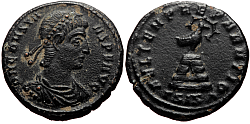
Reference: RIC VIII 241
Obverse: Pearl-diademed, draped and cuirassed bust of Constans facing right. Legend: DN CONSTANS PF AVG
Reverse: A phoenix with a wreath around its head standing on top of a layered mound. Legend: FEL TEMP REPARATIO. Mintmark ΓSISΛ(?). |
|
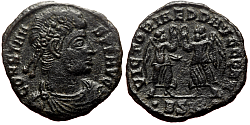 |
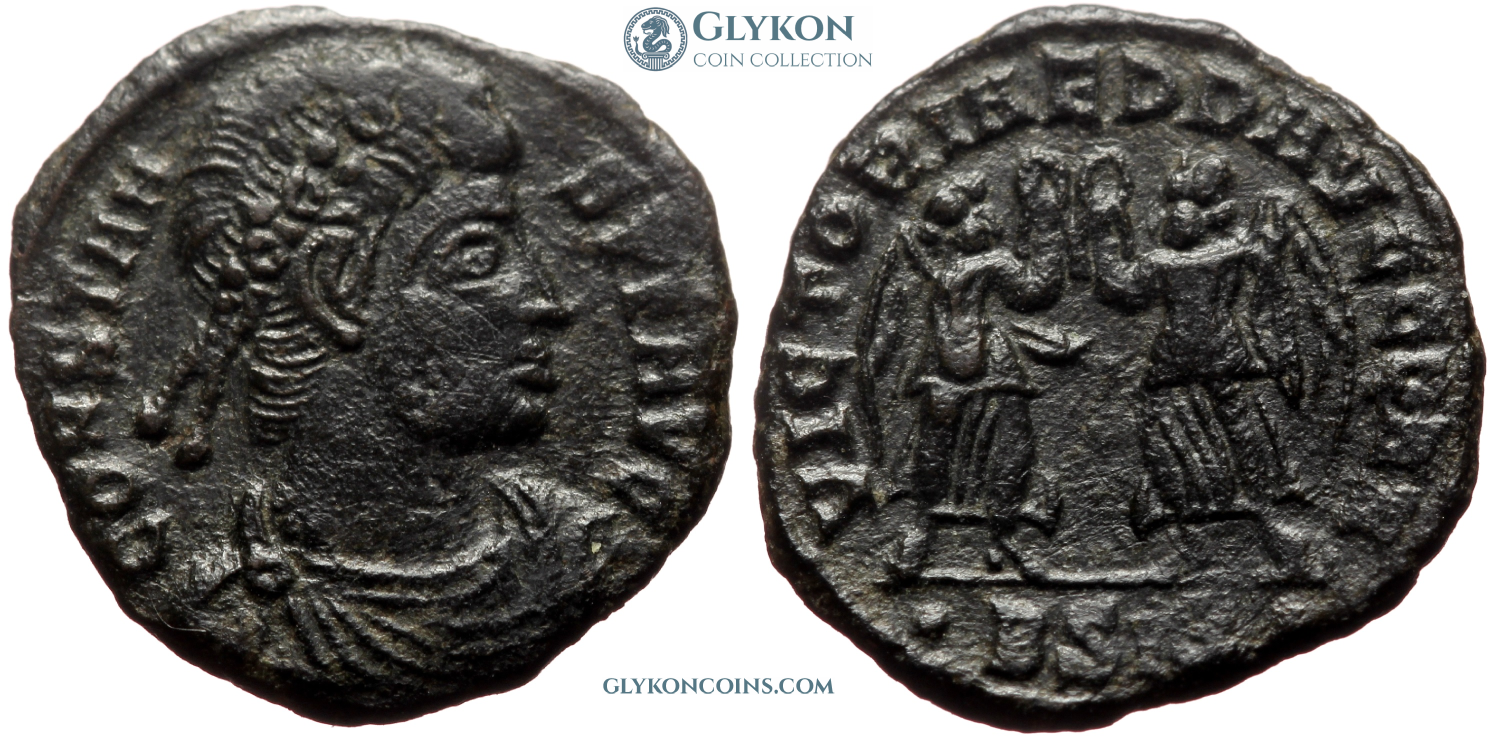
Constans I (337-350 AD)
Denomination: AE4
Mint: Siscia
Time: 337-350 AD
Weight: 1.69 g
Diameter: approx. 15.4 mm
Reference: RIC VIII Siscia 184
Obverse: Pearl-diademed, draped and cuirassed bust of Constans facing right. Legend: CONSTANS PF AVG
Reverse: Two Victories facing each other, each holding a wreath and palm branch. Legend: VICTORIAE DD AVGG Q NN. Mintmark: •BSIS |
|
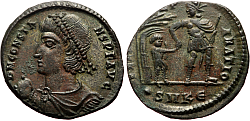 |
Constans I (337-350 AD)
Denomination: AE3
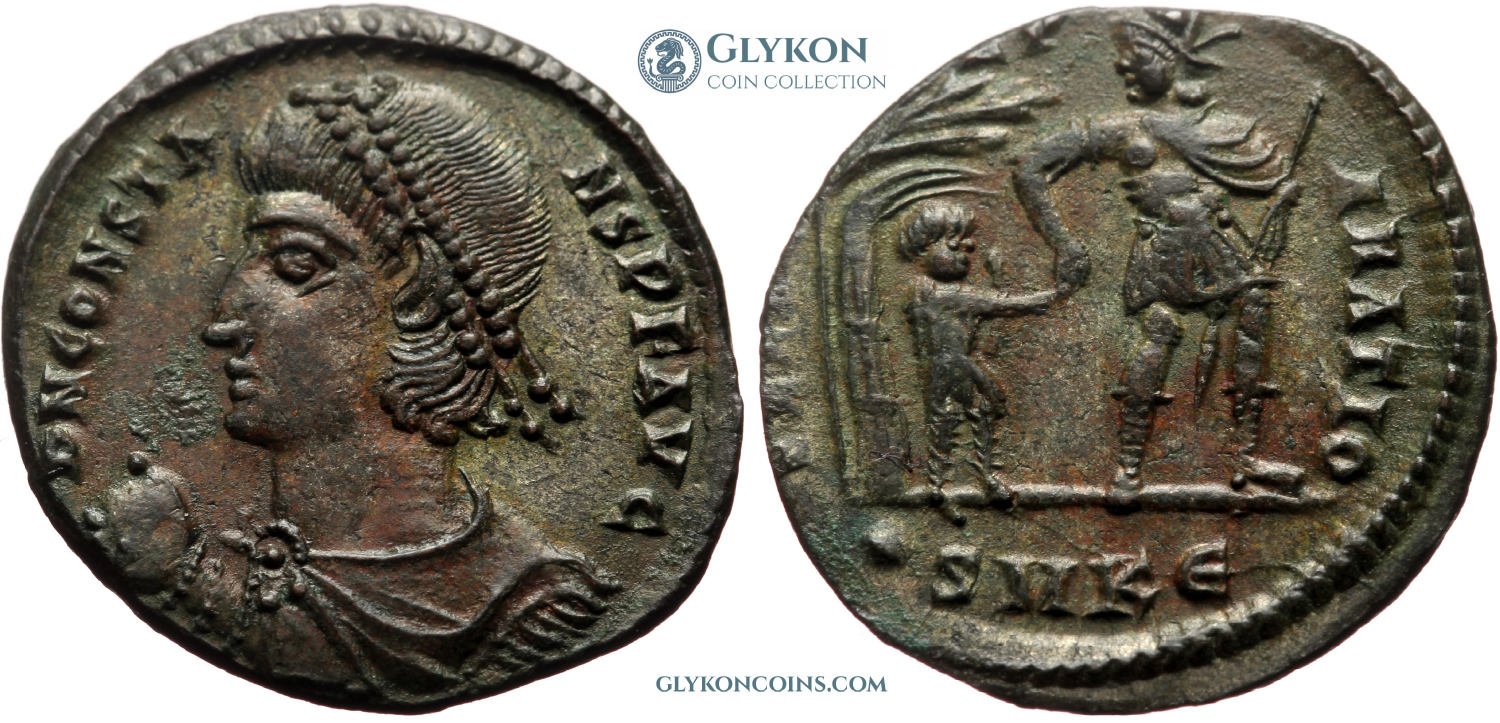
Mint: Cyzicus
Time: 348-351 AD
Weight: 3.76 g
Diameter: approx. 20.4 mm
Reference: RIC VIII 82
Obverse: Pearl-diademed, draped and cuirassed bust of Constans facing left, holding a globe in his hand. Legend: DN CONSTANS PF AVG
Reverse: Roman soldier walking right, leading a small figure from hut, or a forest. Legend: FEL TEMP REPARATIO. Mintmark •SMKЄ in exergue.
Comment: Part of the "Restoration of Happy Times", about which more below. This type however is interesting particularly because it has been interpreted in so many different ways. Who's the small figure led by the Roman soldier? Is this a barbarian captive, led out of his woody hut, or perhaps out of the imperial territory? Or maybe it's a Roman child that is rescued and led to safety? |
|
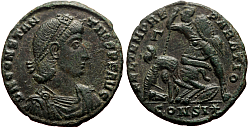 |
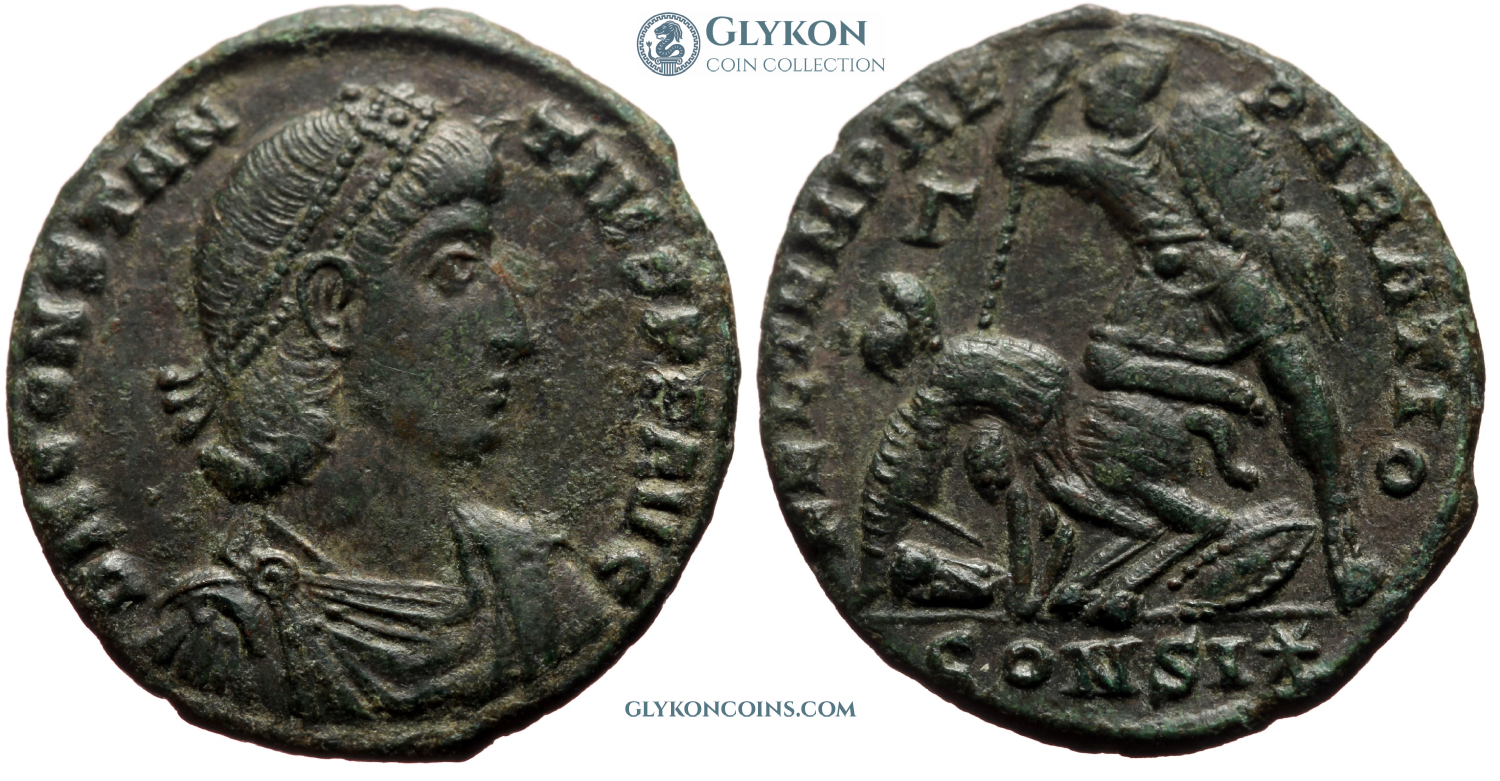
Constantius II (337-361 AD)
Denomination: AE3
Mint: Constantinople
Time: 348-351 AD
Weight: 4.79 g
Diameter: approx. 22.8 mm
Reference:RIC VIII Constantinople 81.1
Obverse: Pearl-diademed, draped and cuirassed bust of Constantius facing right. Legend: DN CONSTANTIVS PF AVG
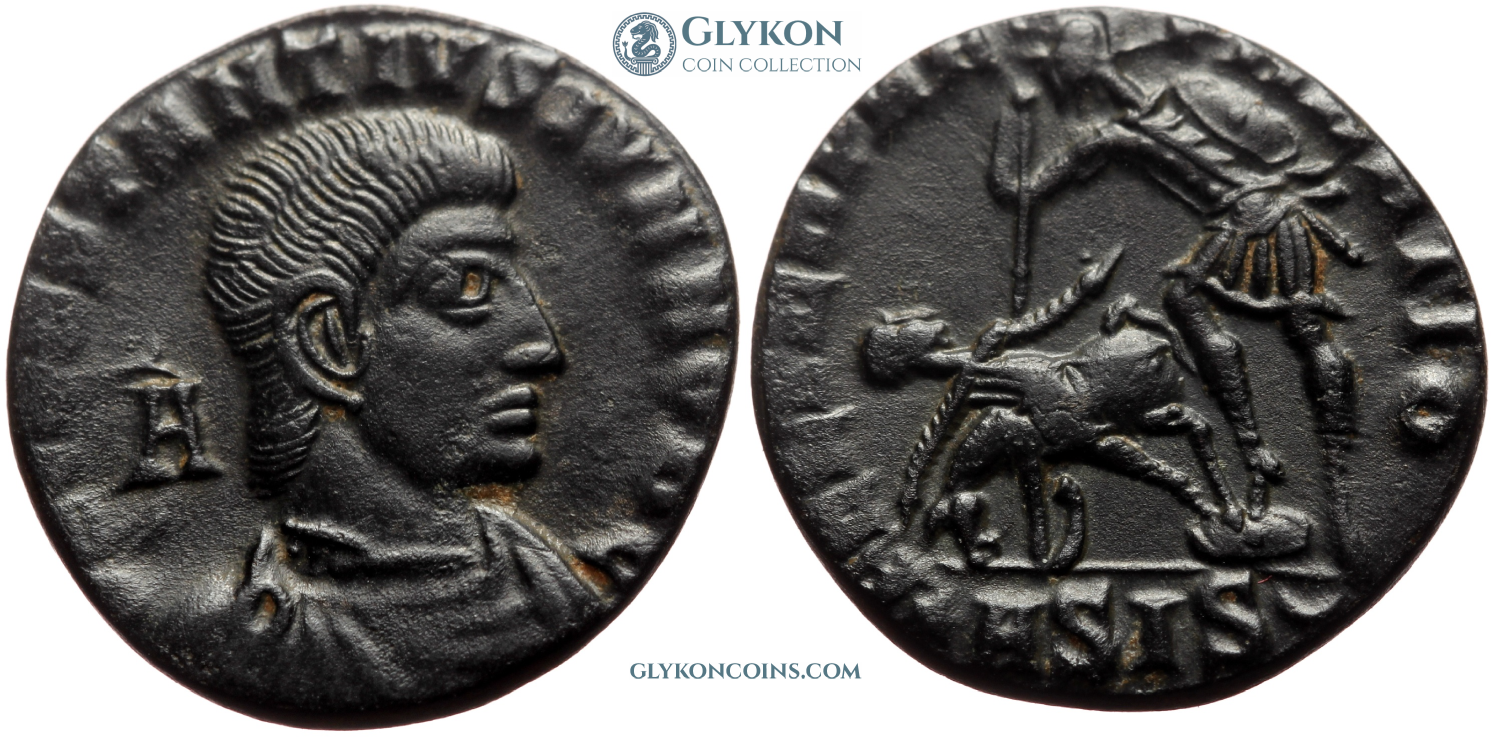
Reverse: Roman soldier jumping and spearing a falling enemy horseman. Γ (gamma) on the left. Legend: FEL TEMP REPARATIO. Mintmark: CONSI*.
Comment: Much of post-Constantine coinage celebrated the "Restoration of Happy Times". Indeed, the rule of the Constantinian dynasty brought much needed stabilization of the empire after the horror of internecine wars. The temporary strengthening of the state also allowed it to regain supremacy over neighboring empires and states. For a brief time it indeed seemed like the good old times of prosperity and peace were returning. This type is notorious as one of the most violent depictions in Roman coinage. The rider is clearly speared and dying. A sign of times, when we compared this to coinage from previous centuries, celebrating mostly peace and prosperity. It's almost as if hard men who defended the battered empire wanted the civilian population to witness the border warfare in all of it's gory details. |
|
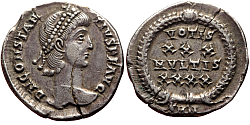 |
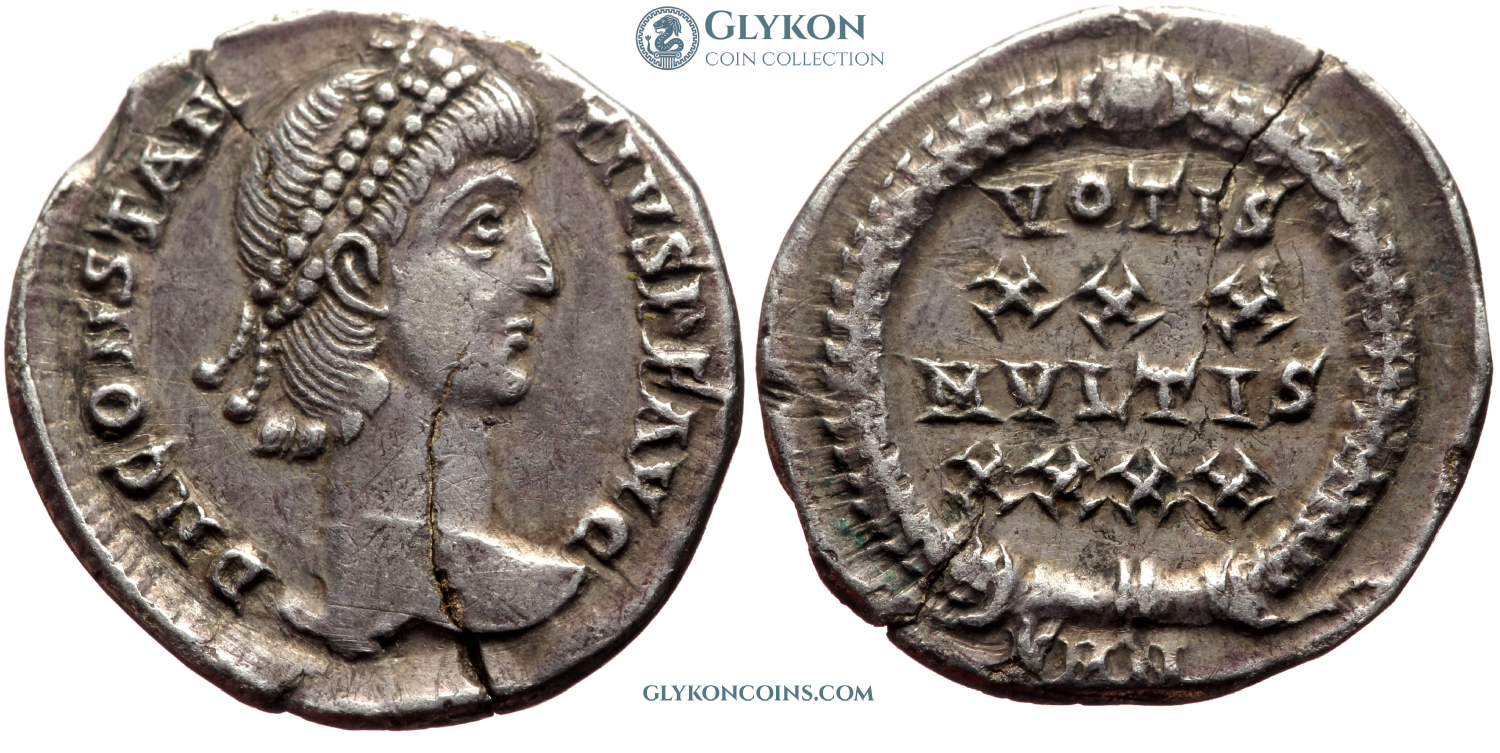
Constantius II (337-361 AD)
Denomination: Siliqua
Mint: Nicomedia
Time: 351-355 AD
Weight: 3.05 g
Diameter: approx. 19.8 mm
Reference: RIC VIII Nicomedia 80
Obverse: Pearl-diademed head of Constantius II facing right. Legend: DN CONSTANTIVS PF AVG
Reverse: Within a decorated wreath: VOTIS XXX MVLTIS XXXX in four lines. Mintmark SMN. |
|
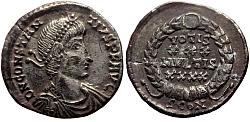 |
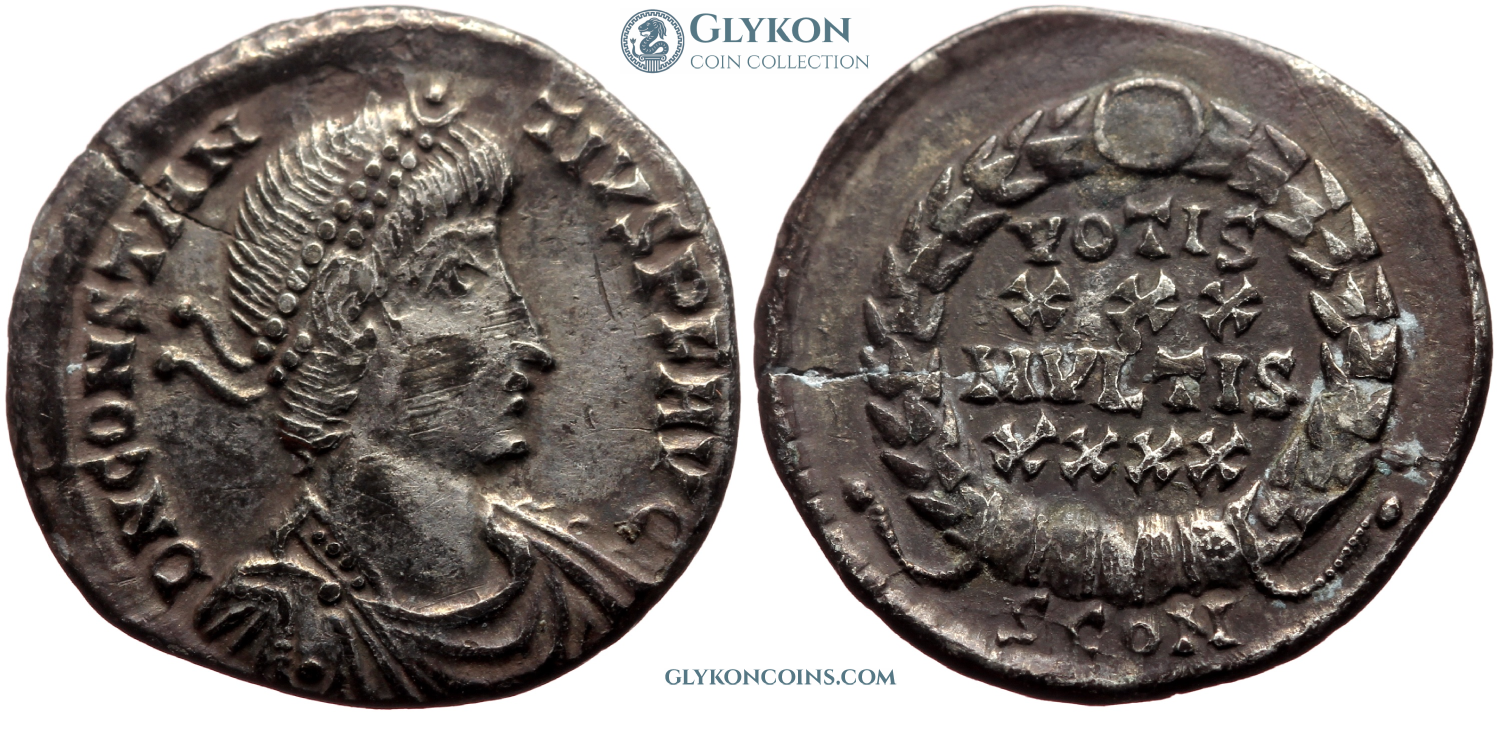
Constantius II (337-361 AD)
Denomination: Siliqua
Mint: Arelate (modern Arles)
Time: 353-360 AD
Weight: 2.10 g
Diameter: approx. 17.6 mm
Reference: RIC VIII Arles 207,S
Obverse: Pearl-diademed head of Constantius II facing right. Legend: DN CONSTANTIVS PF AVG
Reverse: Within a decorated wreath: VOTIS XXX MVLTIS XXXX in four lines. Mintmark SCON. |
|
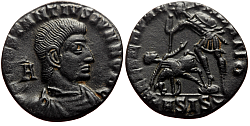 |
Constantius Gallus (351-354 AD)
Denomination: AE3
Mint: Siscia
Time: 351-354 AD
Weight: 4.33 g
Diameter: approx. 19.9 mm
Reference:RIC VIII Siscia 337
Obverse: Bare-headed, draped and cuirassed bust of Gallus facing right. A behind. Legend: DN CONSTANTIVS IVN NOB C
Reverse: Roman soldier jumping and spearing a falling enemy horseman. Legend: FEL TEMP REPARATIO. Mintmark: ΔSIS︶
Comment: Interestingly, the dies were cut by a far less skilled engraver. Some coins of similar types are so detailed that a sharp observer may discern which particular Barbarian group the fallen rider belongs to. On this one both the Roman soldier and the barbarian rider look like stick figures. A sign of times to come, as we are nearing the decline of aesthetics in Roman coinage. |
|
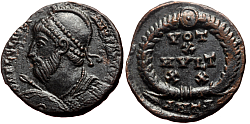 |
Julian the Apostate (361-363 AD)
Denomination: AE3
Mint: Antioch
Time: 361-363 AD
Weight: 2.85 g
Diameter: approx. 17.1 mm
Reference:RIC VIII 219
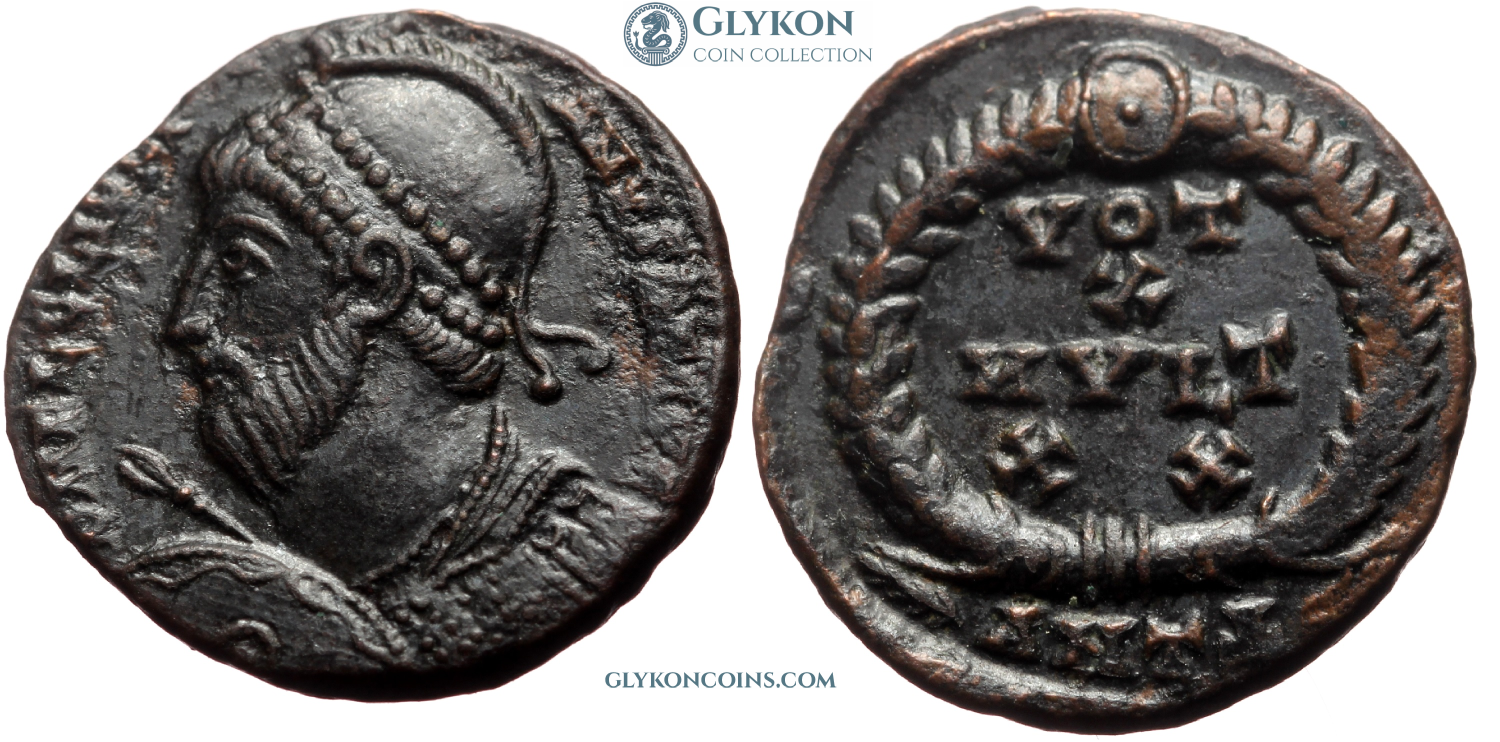
Obverse: Pearl-diademed, helmeted, cuirassed and bearded bust Julian facing left, holding spear and shield. Legend: DN FL CL IVLIANVS PF AVG
Reverse: Within a wreath: VOT X MVLT XX. Mintmark withing palm branches: ANTA? |
|
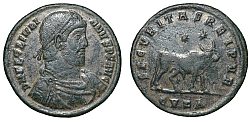 |
Julian the Apostate (361-363 AD)
Denomination: AE1 or double maiorina
Mint: Cyzicus
Time: 361-363 AD
Weight: 8.32 g
Diameter: approx. 28.7 mm
Reference:RIC 127
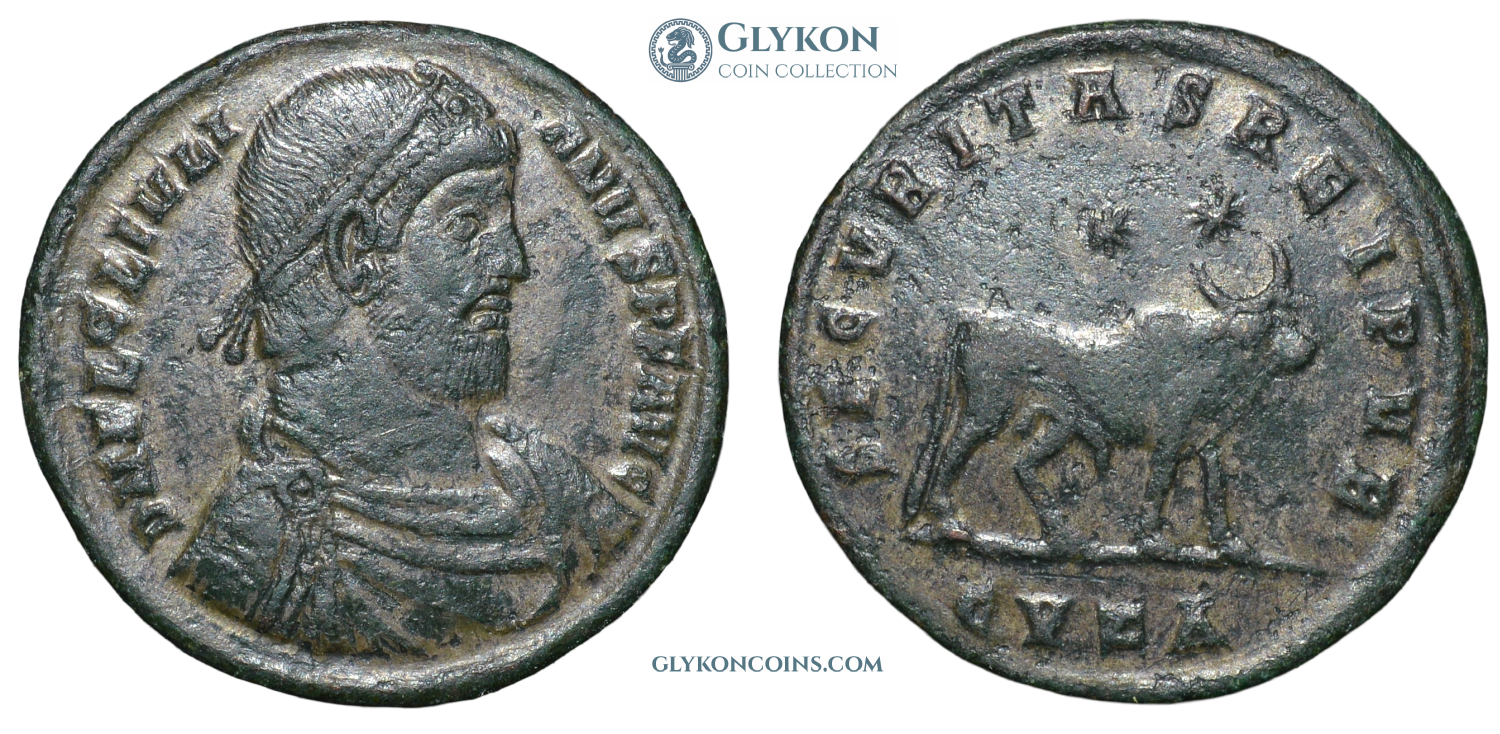
Obverse: Pearl-diademed, helmeted, cuirassed and bearded bust of Julian facing right. Legend: DN FL CL IVLIANVS PF AVG
Reverse: Standing bull facing right. Two stars above. Legend: SECVRITAS REI PVB. CVZA in exergue.
Comment: Julian, the last (if we disregard the usurper Eugenius whose religious convictions are murky) Pagan emperor of Rome, is well known for his doomed attempt to stem the fast Christianization of the empire. Among his efforts was his reintroduction of coinage with unambiguously Pagan iconography, which includes especially his famous "bull" large bronze coins like this one. Curiously, surviving texts mention that the Christian public of Antioch derided Julian's Pagan coinage. While this doesn't refer to a specific coin, it's most likely this type. |
|
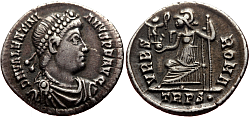 |
Valentinian I (364-375 AD)
Denomination: Siliqua
Mint: Augusta Treverorum (Trier)
Time: 367-375 AD
Weight: 2.33 g
Diameter: approx. 17.9 mm
Reference: RIC Trier IX 27
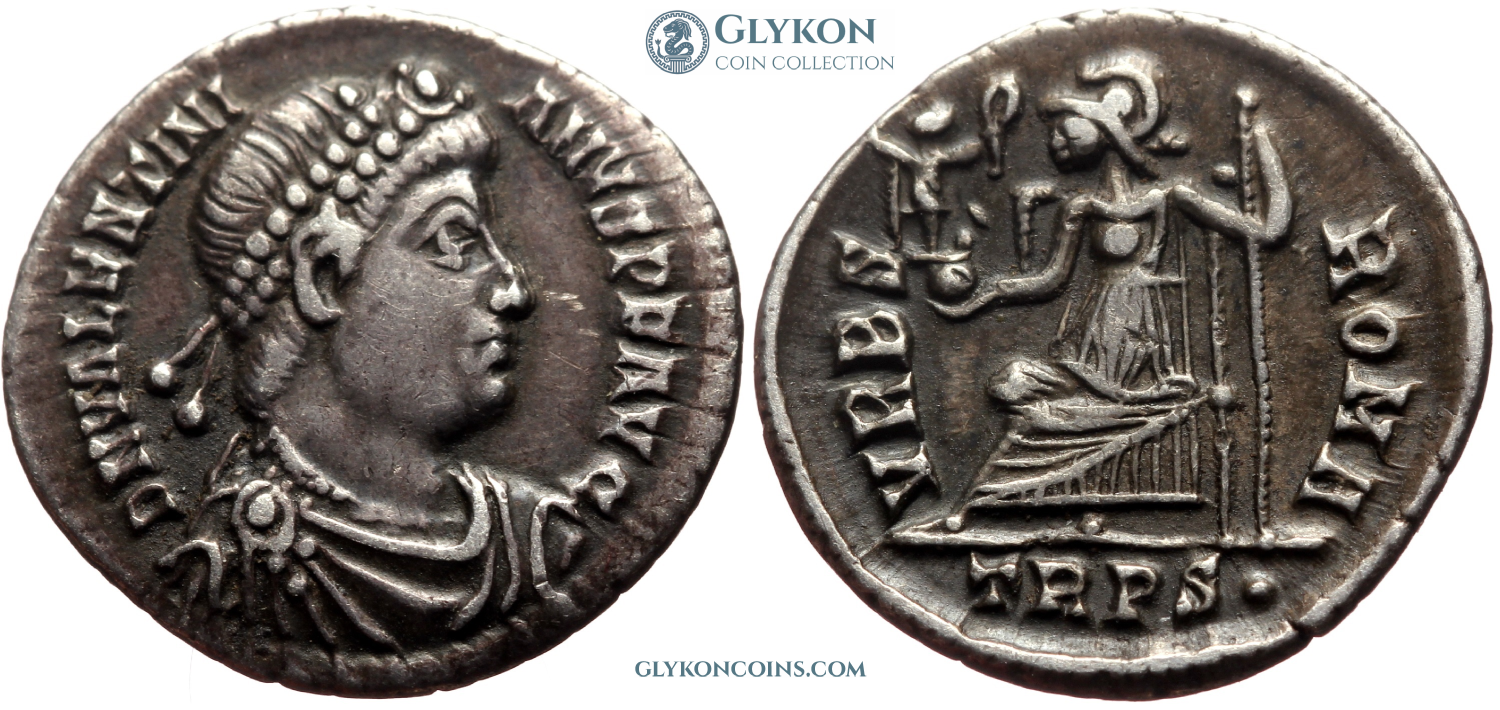
Obverse: Pearl-diademed and draped bust of Valentinian facing right. Legend: DN VALENTINIANVS PF AVG.
Reverse: Helmeted Roma seated on a throne facing left, holding Victory on globe and a sceptre. Legend: VRBS ROMA. Mintmark TRPS and a dot. |
|
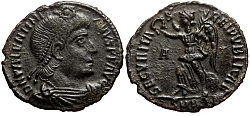 |
Valentinian I (364-375 AD)
Denomination: AE3
Mint: Aquileia
Time: 367-375 AD
Weight: 1.80 g
Diameter: approx. 18.5 mm
Reference:RIC IX Aquileia 9a (type I)
Obverse: Pearl-diademed, draped and cuirassed bust of Valentinian facing right. Legend: DN VALENTINIANVS PF AVG
Reverse: Draped Victory advancing left, holding a wreath and a palm branch. A on the left. Mintmark: SMAQ(?) in exergue. Legend: SECVRITAS REI PVBLICAE |
|
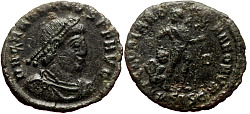 |
Valentinian I (364-375 AD)
Denomination: AE3
Mint: Siscia
Time: 367-375 AD
Weight: 2.22 g
Diameter: approx. 18.3 mm
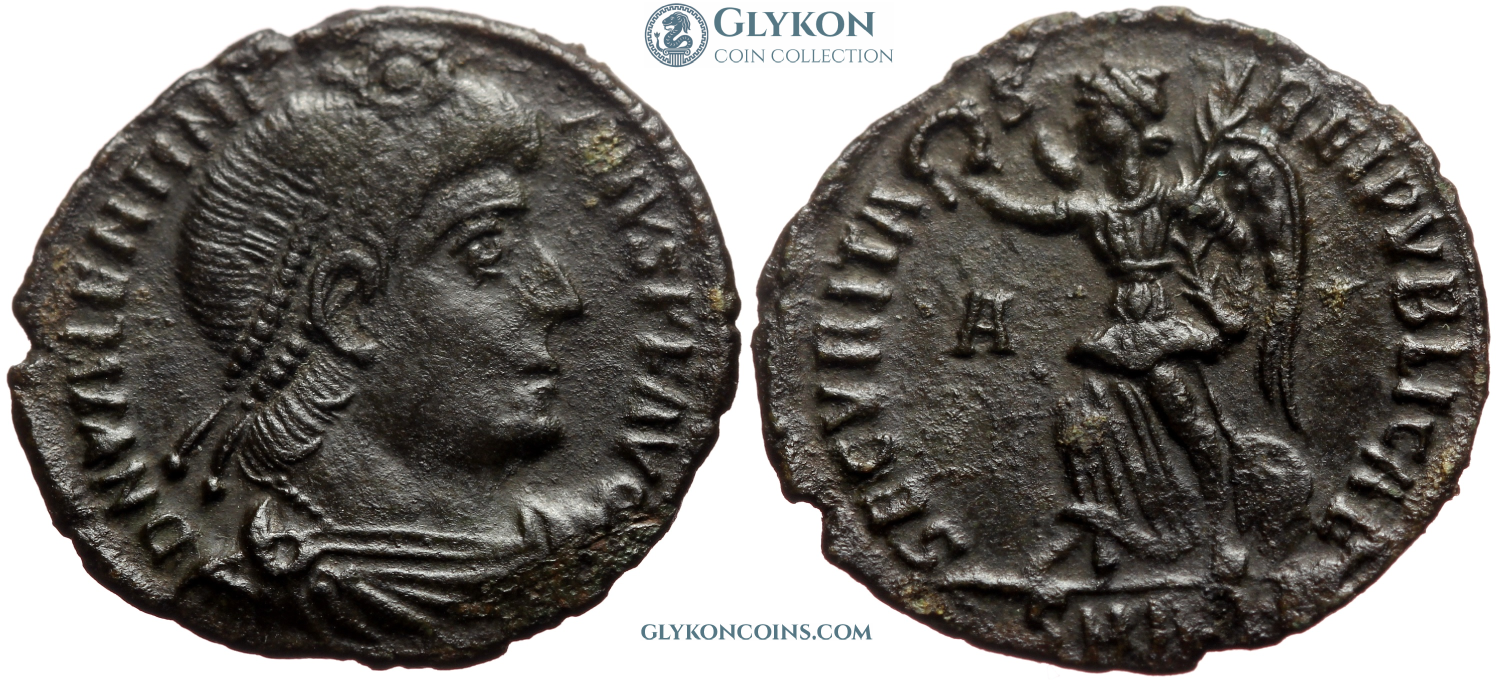
Reference:RIC IX Siscia 14a
Obverse: Pearl-diademed, draped and cuirassed bust of Valentinian facing right. Legend: DN VALENTINIANVS PF AVG
Reverse: Emperor walking right while holding a labarum and dragging a kneeling captive. D on the right. Mintmark ASISC(?). Legend: GLORIA ROMANORVM |
|
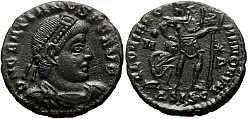 |
Gratian (367-383 AD)
Denomination: AE3
Mint: Siscia
Time: 367-375 AD
Weight: 2.39 g
Diameter: approx. 17.1 mm
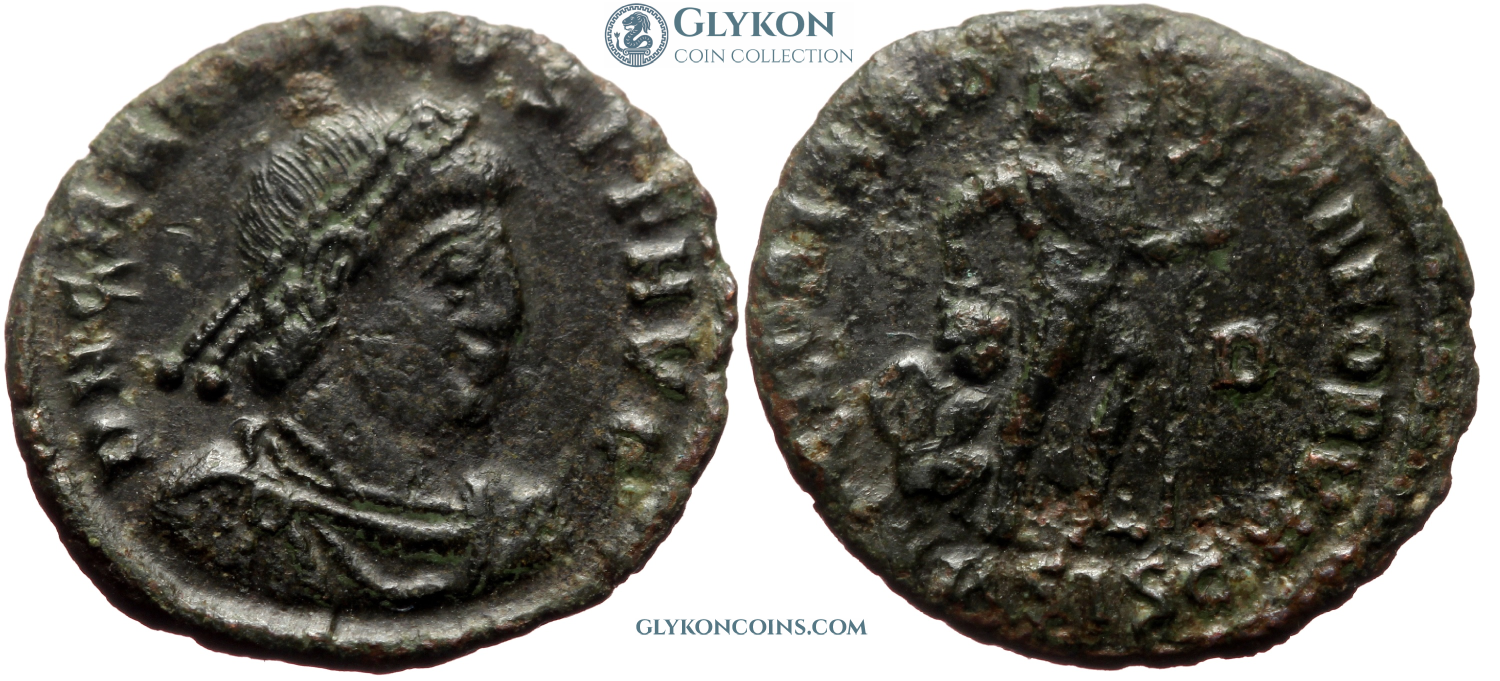
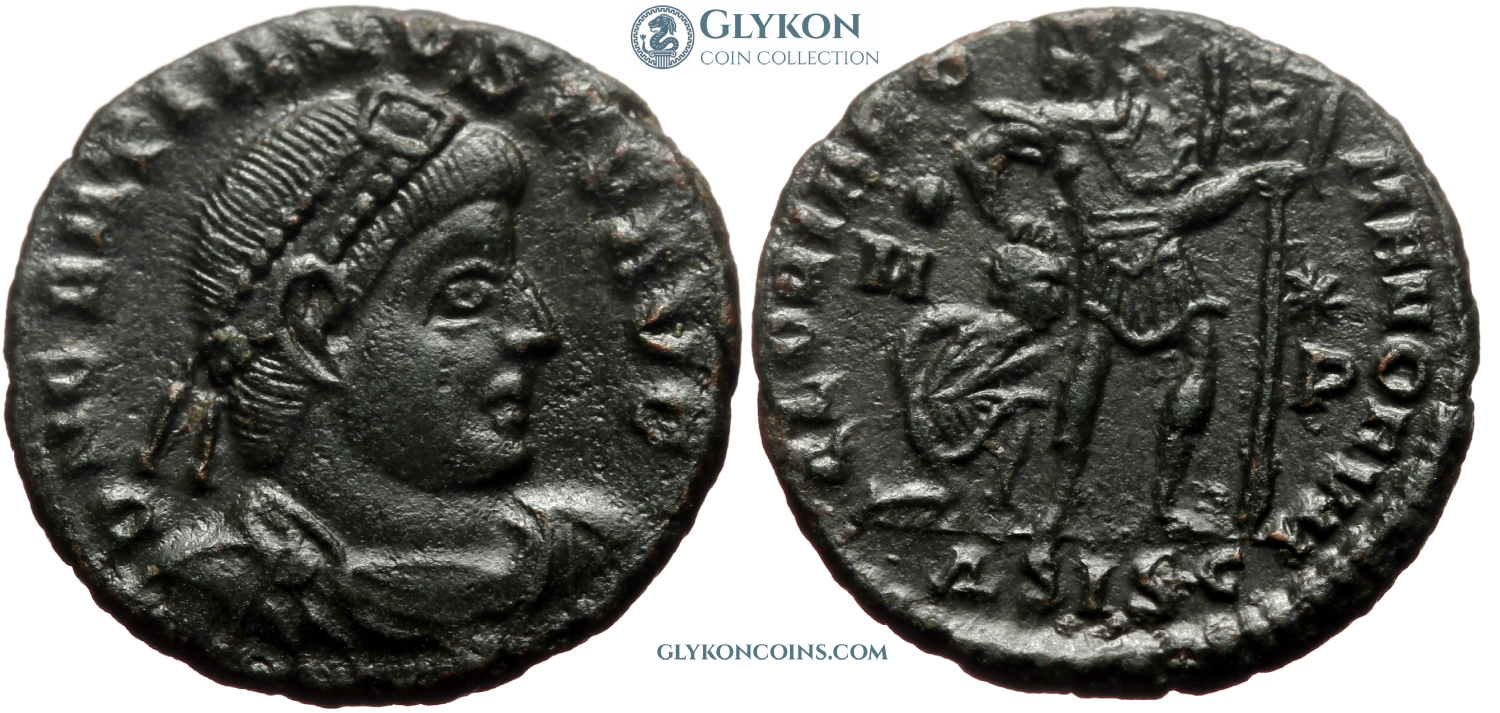
Reference:RIC IX Siscia 14c
Obverse: Pearl-diademed, draped and cuirassed bust of Gratian facing right. Legend: DN GRATIANVS PF AVG,
Reverse: Emperor walking right while holding a labarum and dragging a kneeling captive. •H on the left, *P on the right. Mintmark ΔSISC. Legend: GLORIA ROMANORVM |
|
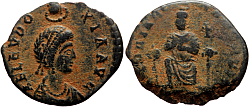 |
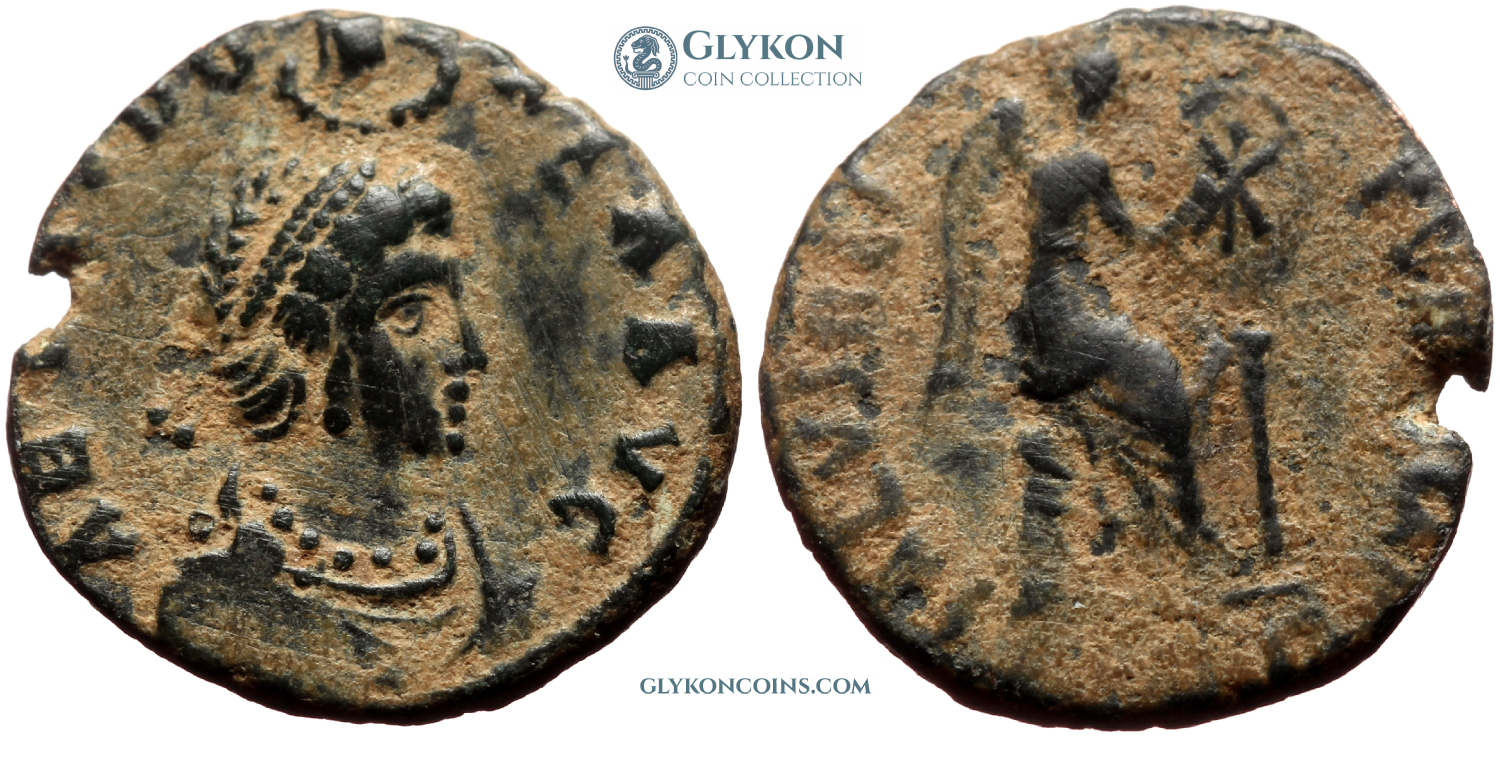
Aelia Eudoxia (Empress 395-404 AD, officially Augusta from 400 AD)
Denomination: AE3
Mint: Cyzicus
Time: 400-401 AD
Weight: 2.21 g
Diameter: approx. 18.7 mm
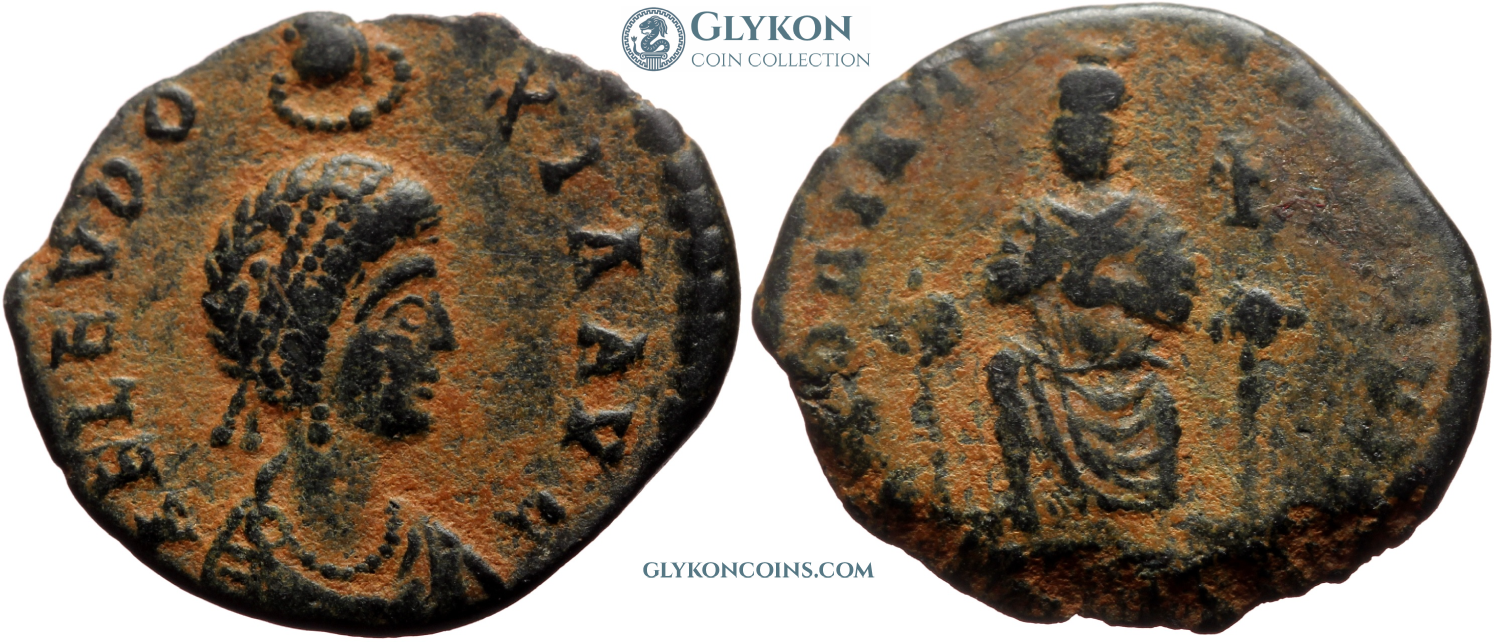
Reference: RIC X 81
Obverse: Pearl-diademed and draped bust of Aelia Eudoxia facing right, crowned by the Hand of God (Manus Dei). Legend: AEL EVDOXIA AVG
Reverse: Enthroned Empress facing with hands crossed, crowned by the Hand of God. Cross in the upper right. Legend: GLORIA ROMANORVM. Mintmark outside the uneven surface of the flan, typically SMK followed by an officina letter.
Comment: One of the earliest depictions of Manus Dei in Roman coinage. It will later occasionally appear on Byzantine coins well into the 15th century, and will become a staple of European coins in the Early Modern period. |
|
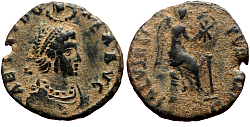 |
Aelia Eudoxia (Empress 395-404 AD, officially Augusta from 400 AD)
Denomination: AE4
Mint: Constantinople
Time: 401-403 AD
Weight: 2.00 g
Diameter: approx. 15.9 mm
Reference: RIC X 102
Obverse: Pearl-diademed and draped bust of Aelia Eudoxia facing right, crowned by the Hand of God (Manus Dei). Legend: AEL EVDOXIA AVG
Reverse: Victory or and angel seated facing right, touching shield mounted on a column inscribed with chi-rho. Legend: SALVS REIPVBLICAE. Mintmark: SMNA. |
|
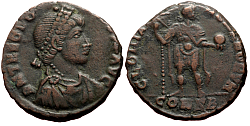 |
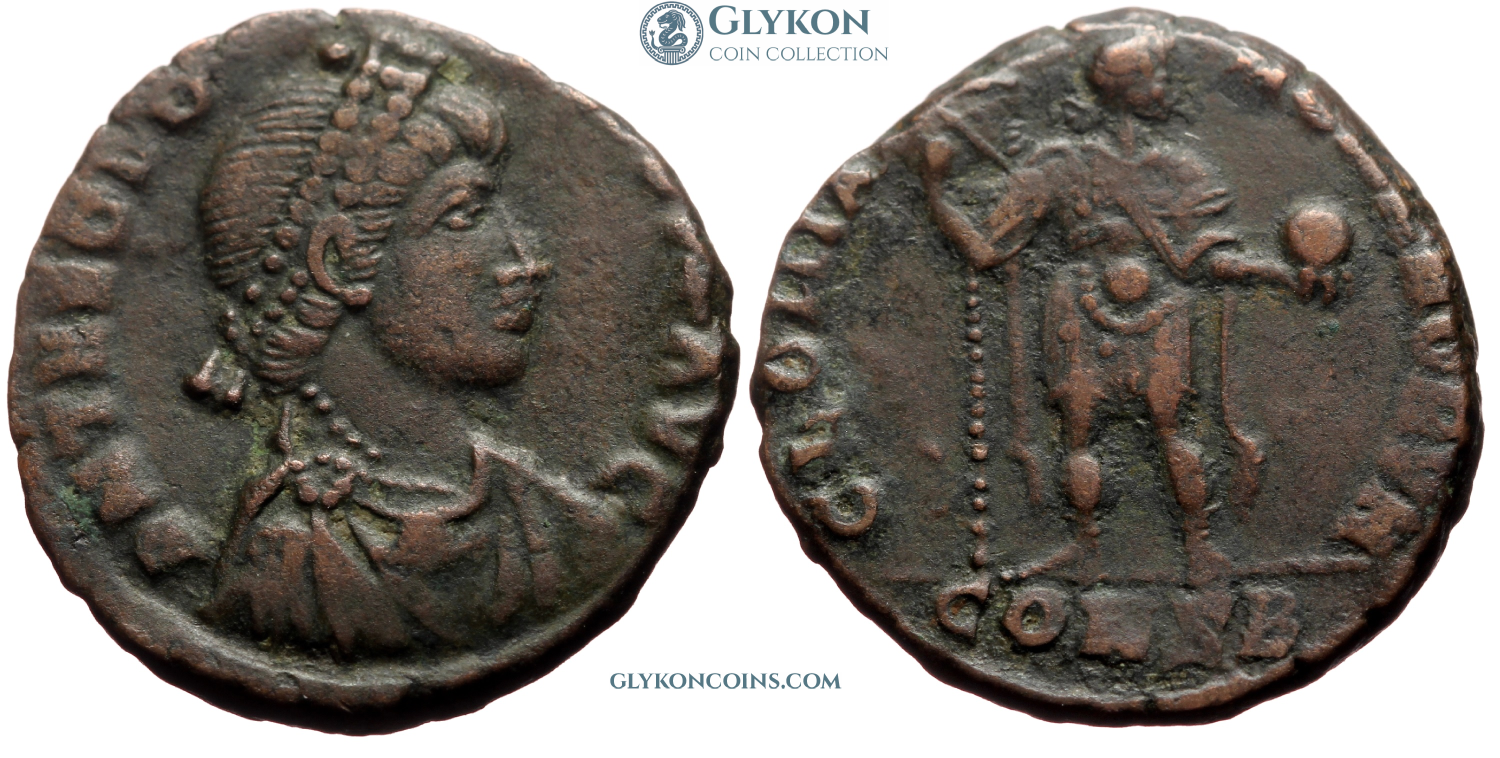
Theodosius I the Great (379-395 AD)
Denomination: AE2
Mint: Constantinople
Time: 392-395 AD
Weight: 3.89 g
Diameter: approx. 20.0 mm
Reference:RIC IX 88
Obverse: Pearl-diademed, draped and cuirassed bust of Theodosius facing right. Legend: DN THEODOSIVS PF AVG
Reverse: Emperor standing facing, head turned right, holding a labarum and a globe. Mintmark CONSB. Legend: GLORIA ROMANORVM |
|
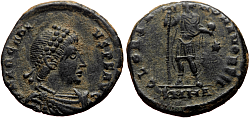 |
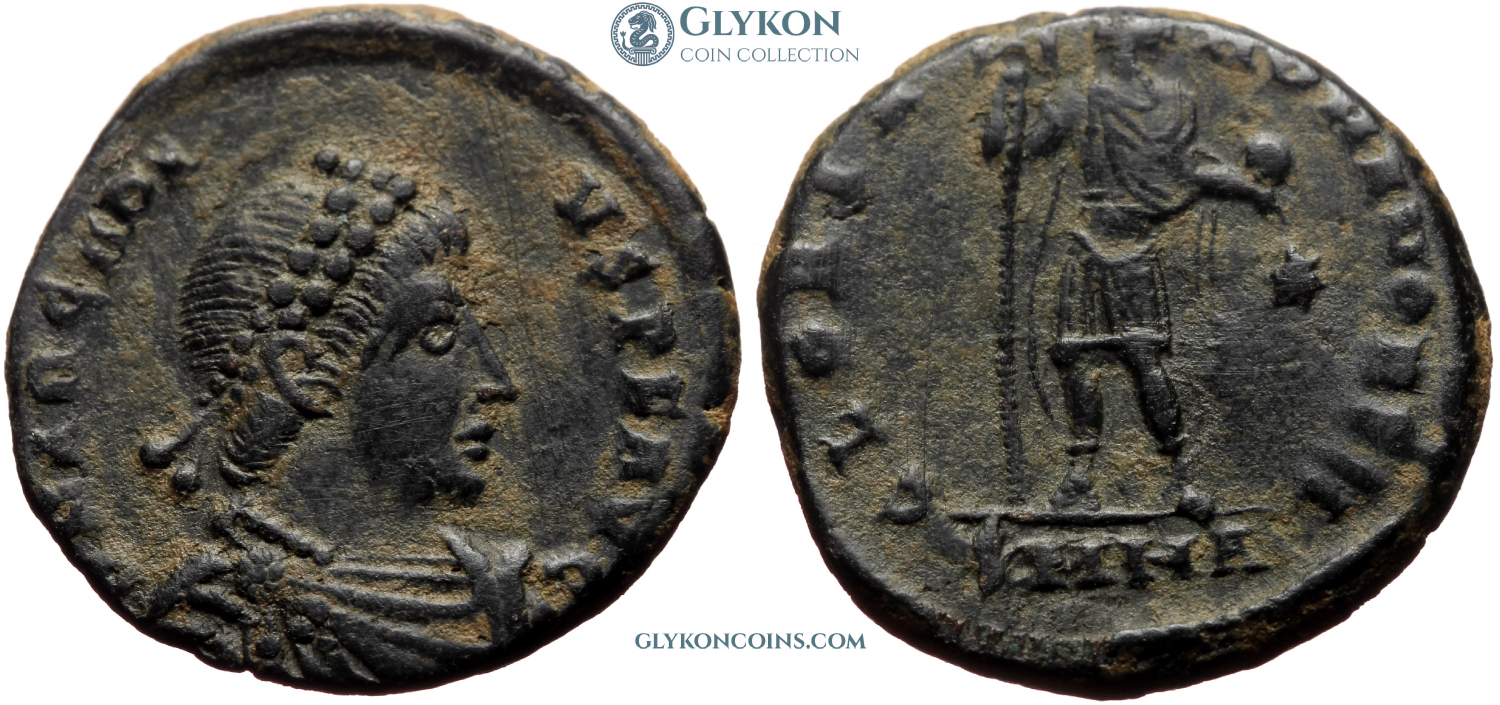
Arcadius (395-408 AD)
Denomination: AE2
Mint: Heraclea
Time: 392-395 AD (as junior emperor)
Weight: 4.93 g
Diameter: approx. 20.5 mm
Reference:RIC IX Heraclea 27b
Obverse: Pearl-diademed, draped and cuirassed bust of Arcadius facing right. Legend: DN ARCADIVS PF AVG
Reverse: Emperor standing facing, head turned right, holding a labarum and a globe. Star to the right. Mintmark SMHB. Legend: GLORIA ROMANORVM |
|
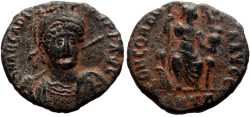 |
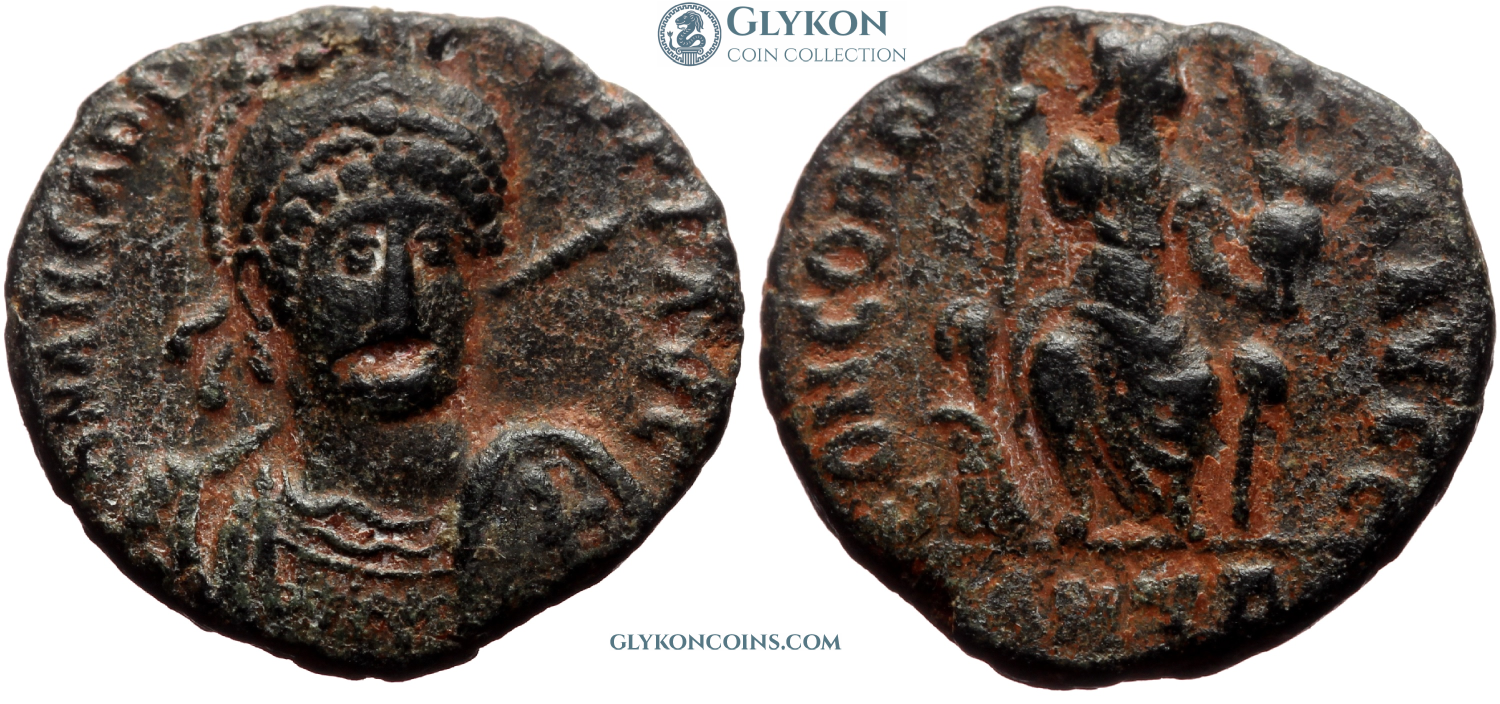
Arcadius (395-408 AD)
Denomination: AE3
Mint: Antioch
Time: 395-408 AD
Weight: 2.54 g
Diameter: approx. 15.9 mm
Reference:RIC IX 97
Obverse: 3/4-facing bust of Arcadius, helmeted and cuirassed, wearing shield with equestrian motif on left shoulder and holding in right hand a spear behind his head. Legend: DN ARCADIVS PF AVG
Reverse: Enthroned personified Constantinople (or Empress) facing, head turned right, holding a sceptre and small winged Victory holding wreath on a globe, foot on a ship's prow. Mintmark: ANTΓ. Legend: CONCORDIA AVGG
Comment: This particular specimen was once a sort of joke among collectors. Just looke at the damage, it makes the emperor look like a megamouth shark. |
|
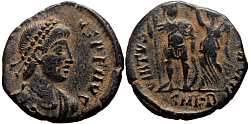 |
Honorius (395-423 AD)
Denomination: AE3
Mint: Cyzicus
Time: 395-401 AD
Weight: 2.46 g
Diameter: approx. 16.4 mm
Reference:RIC X Cyzicus 68; Sear 21030
Obverse: Pearl-diademed, draped and cuirassed bust of Honorius facing right. Legend: DN HONORIVS PF AVG
Reverse: Victory on the right standing facing left crowns Honorius on the left standing looking right and holding a shield and a spear. Mintmark SMKB (?). Legend: VIRTVS EXERCITI
Comment: Despite the eventual definitive division of the empire in 395, the contemporaries saw it still as one and the same state with just several co-ruling emperors. Therefore it's no wonder that coins depicting Western and Eastern emperor(s) were still minted in Eastern and Western mints respectively. The mental, cultural and political separation between the Latin West and Greek East took several centuries to take place and several world-shattering events to facilitate it. |