Byzantine coinage of the early or East Roman period (to 610 AD)
| No. |
Photo |
Description |
|
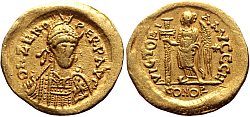 |
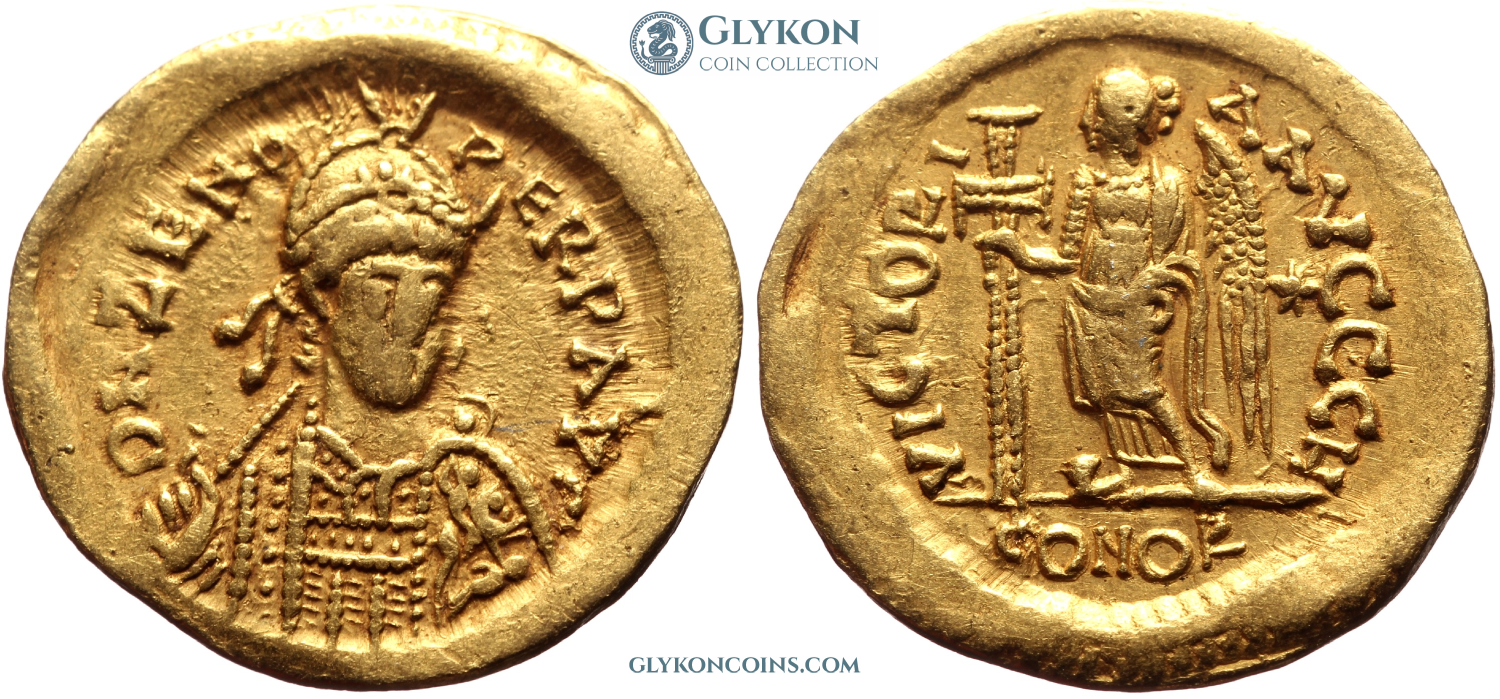
Zeno (474/5 and again 476-491 AD)
Denomination: Solidus
Mint: Constantinople
Time: 476-491 AD (second reign)
Weight: 4.44 g
Diameter: approx. 21.0 mm
Reference: RIC 910
Obverse: 3/4-facing bust, helmeted and cuirassed, wearing shield with equestrian motif on left shoulder and holding in right hand a spear behind head. Legend: DN ZENO PERP AVG.
Reverse: Winged Victory standing to left, holding long cross in right hand, star on right. Legend: VICTORIA AVGGG. Officina mark H. CONOB below in exergue. |
|
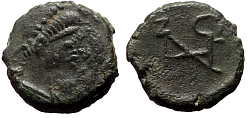 |
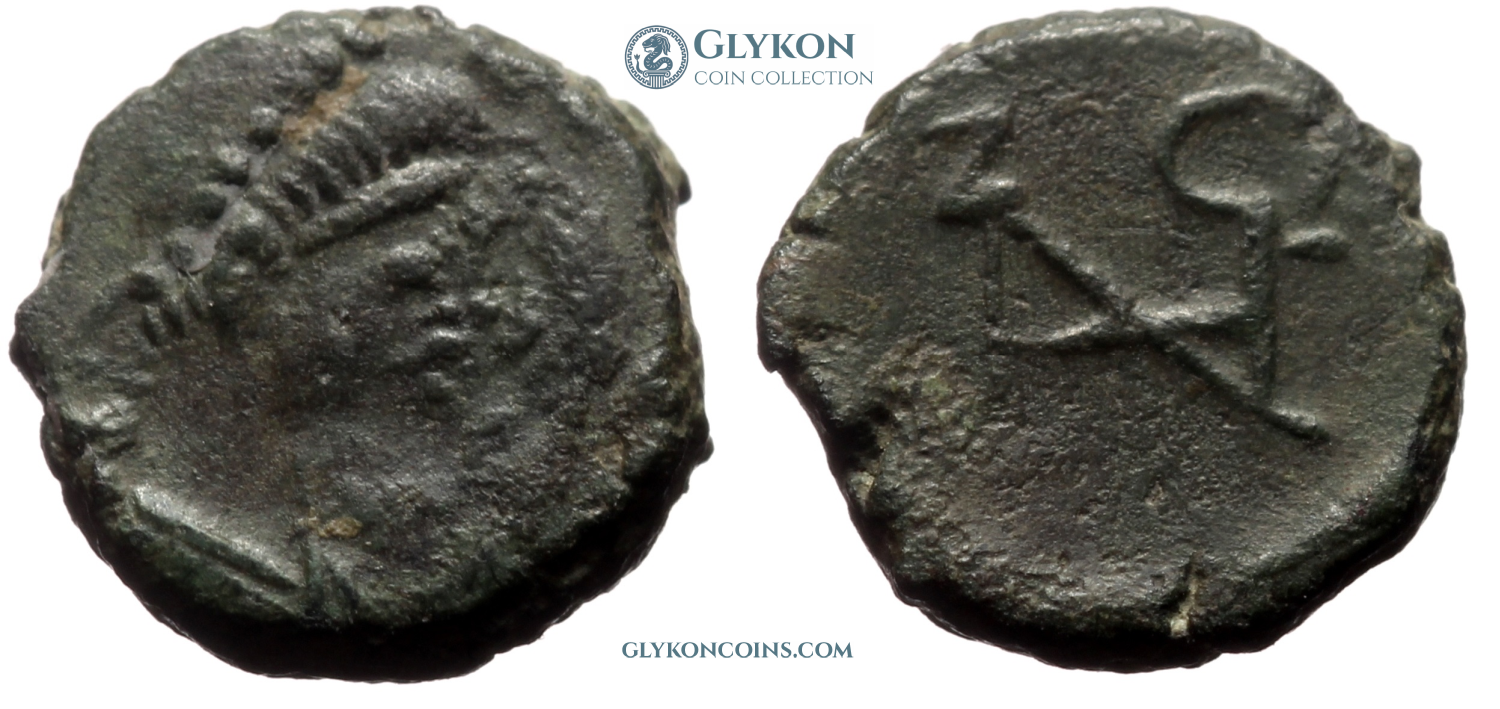
Zeno (474/5 and again 476-491 AD)
Denomination: nummus (AE4)
Mint: Constantinople or Cyzicus
Time: 476-491 AD (second reign)
Weight: 0.70 g
Diameter: approx. 8.5 mm
Reference: RIC 961/3 or 965
Obverse: Pearl-diademed head facing right. No legend.
Reverse: Monogram.
Comment: This tiny coin evidences the remarkable deterioration of Roman coinage that happened through the 5th century. It's almost as if at some point the Roman state stopped caring how coins looked and that they could be an effective vehicle to deliver imperial propaganda or message. Sadly, the necessary engraving skills were no longer transmitted between generations of craftsmen, causing an irreversible decline in quality. Even when later emperors started to mint larger and more legible coins again, they could no longer reproduce the realistic look of preceding coinage. |
|
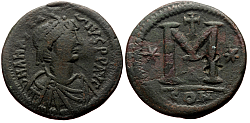 |
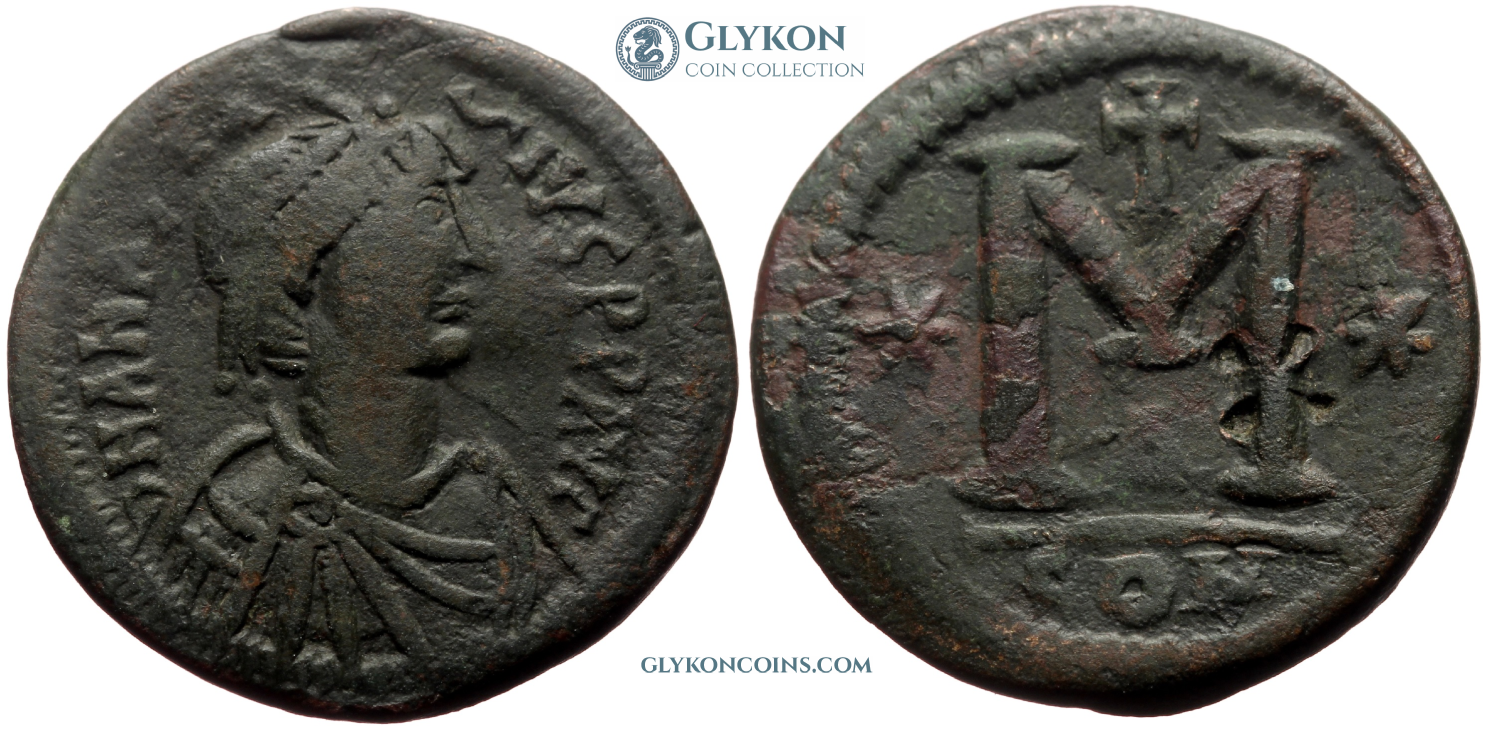
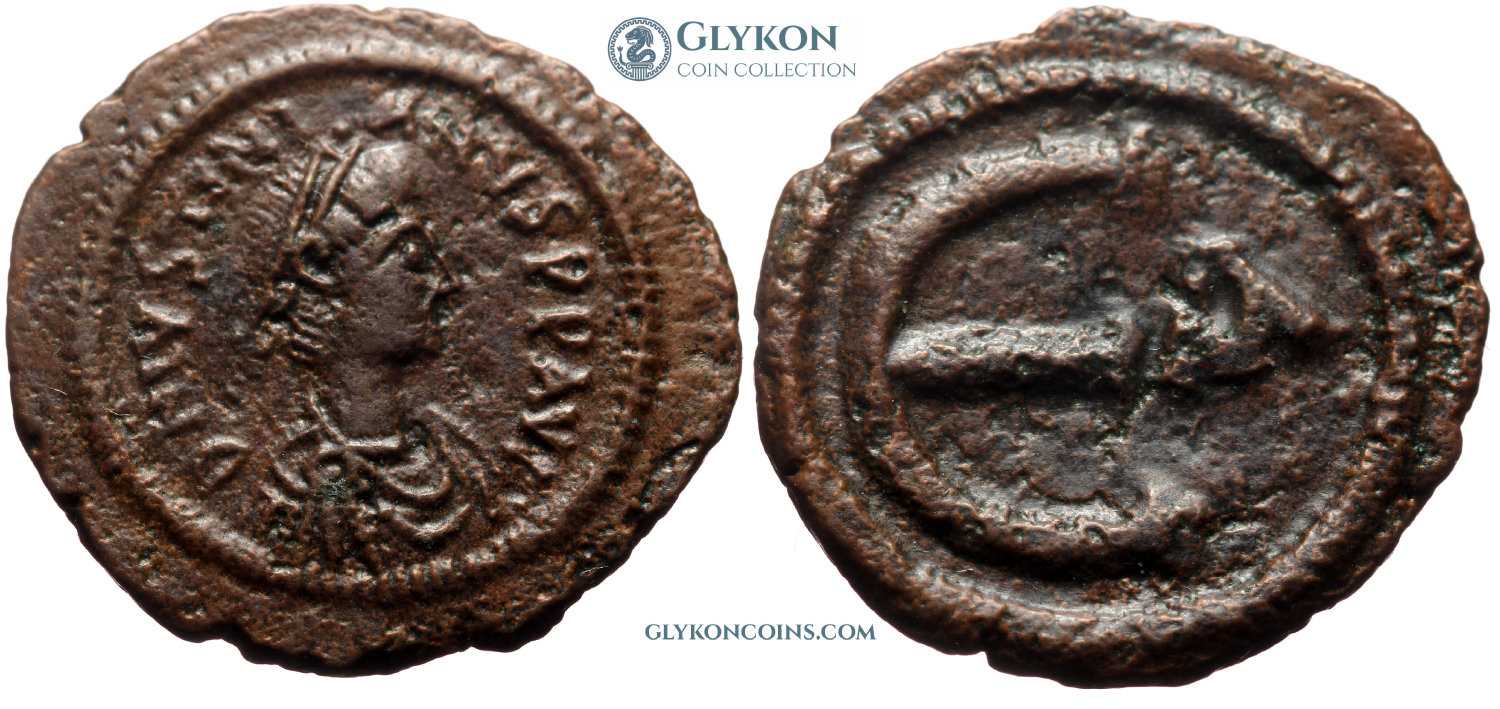
Anastasius I Dicorus (491-518 AD)
Denomination: 40 nummi (follis)
Mint: Constantinople
Time: 498 AD or shortly afterAD
Weight: 8.35 g
Diameter: approx. 24.2 mm
Reference: Sear 16; DOC I 20a
Obverse: Bust of Anastasius facing right, draped, cuirassed, and wearing a pearl diadem. Legend: DN ANASTASIVS P P AVG
Reverse: Between two stars large M indicating denomination of 40 nummi. Cross above, faint traces of officina symbol Δ (fourth officina) below. CON below in exergue. Interesting banker's mark (?).
Comment: Anastasius, despite ascending the throne at the ripe age of 60, proved to be an energetic, effectual and reform-minded emperor. One of his most long-lasting reforms was the one relating to monetary policy. Anastasius took it upon himself to stabilize the finances, especially the copper coins used in daily transactions. In the course of previous decades the system of their issue had essentially disintegrated. The bronze coins were minted in small quantities, in a tiny and truly unpleasant form, and people often found themselves in a deep shortage of small change, resorting to barter. Anastasius remedied this by issuing new, larger copper coins denominated in multiples of the old copper coin such as 5, 10 and especially 40. Some other fractions also exist. By far the most important of these was the 40 nummi coin, commonly known by numismatists as the follis (plural folles), despite its original name not being exactly known. The reform proved to be successful, and the new system, despite many changes and constant debasement, survived in broad strokes well into the 1070s. Despite its success, the reform was not without bumps in the road. Initially, the follis was issued in a small size and weight standard, which led to the public distrusting it as an undervalued coin. Therefore, soon Anastasius started minting folles in much larger formats. This particular coin belongs to the first batch, before the coin sizes were increased. |
|
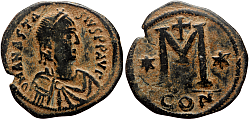 |
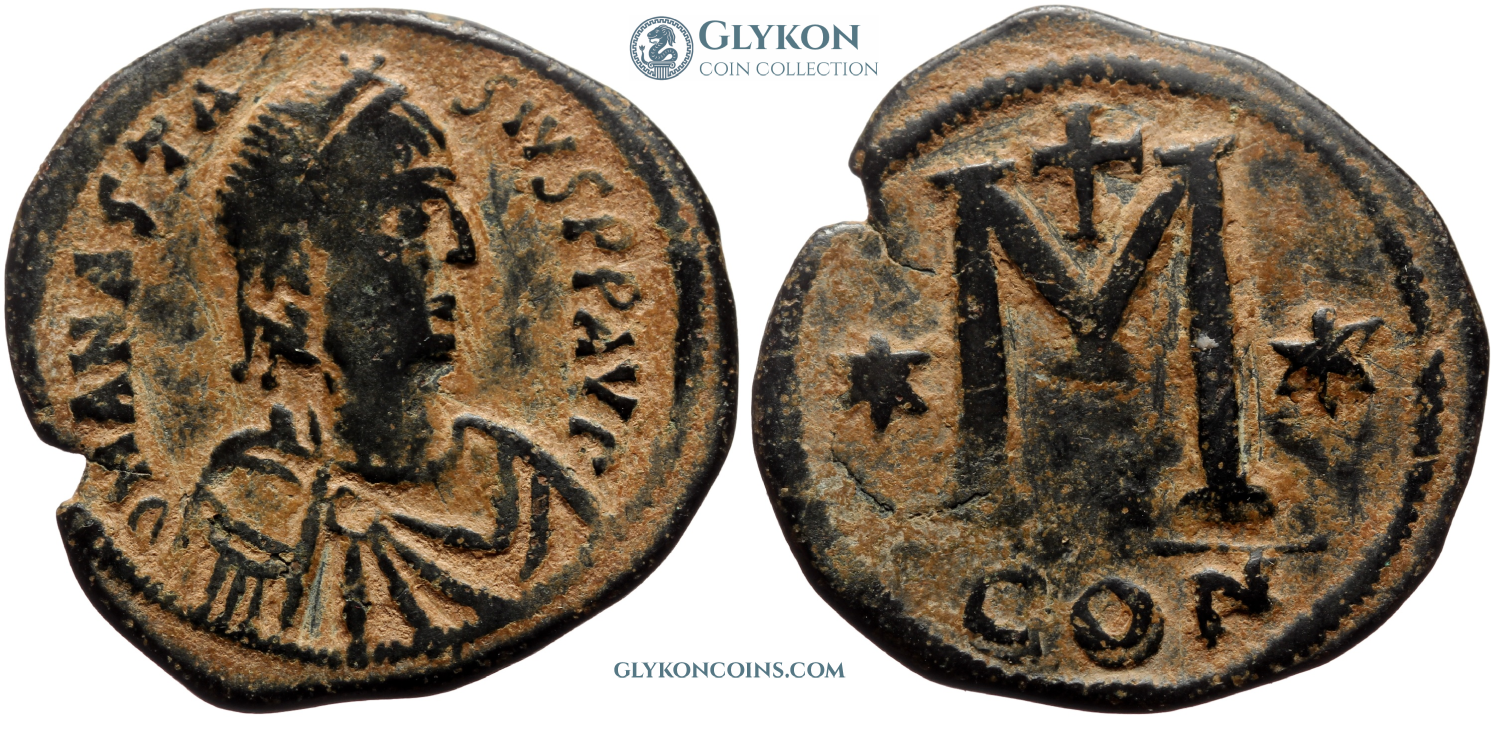
Anastasius I Dicorus (491-518 AD)
Denomination: 40 nummi (follis)
Mint: Constantinople
Time: 512-517 AD
Weight: 17.19 g
Diameter: approx. 36.2 mm
Reference: Sear 19; DOC I 23
Obverse: Bust of Anastasius facing right, draped, cuirassed, and wearing a pearl diadem. Legend: DN ANASTASIVS P P AVG
Reverse: Between two stars large M indicating denomination of 40 nummi. Cross above, faint traces of officina symbol ϵ (fifth officina) below. CON below in exergue.
Comment: Very first of the large folles. |
|
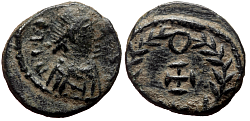 |
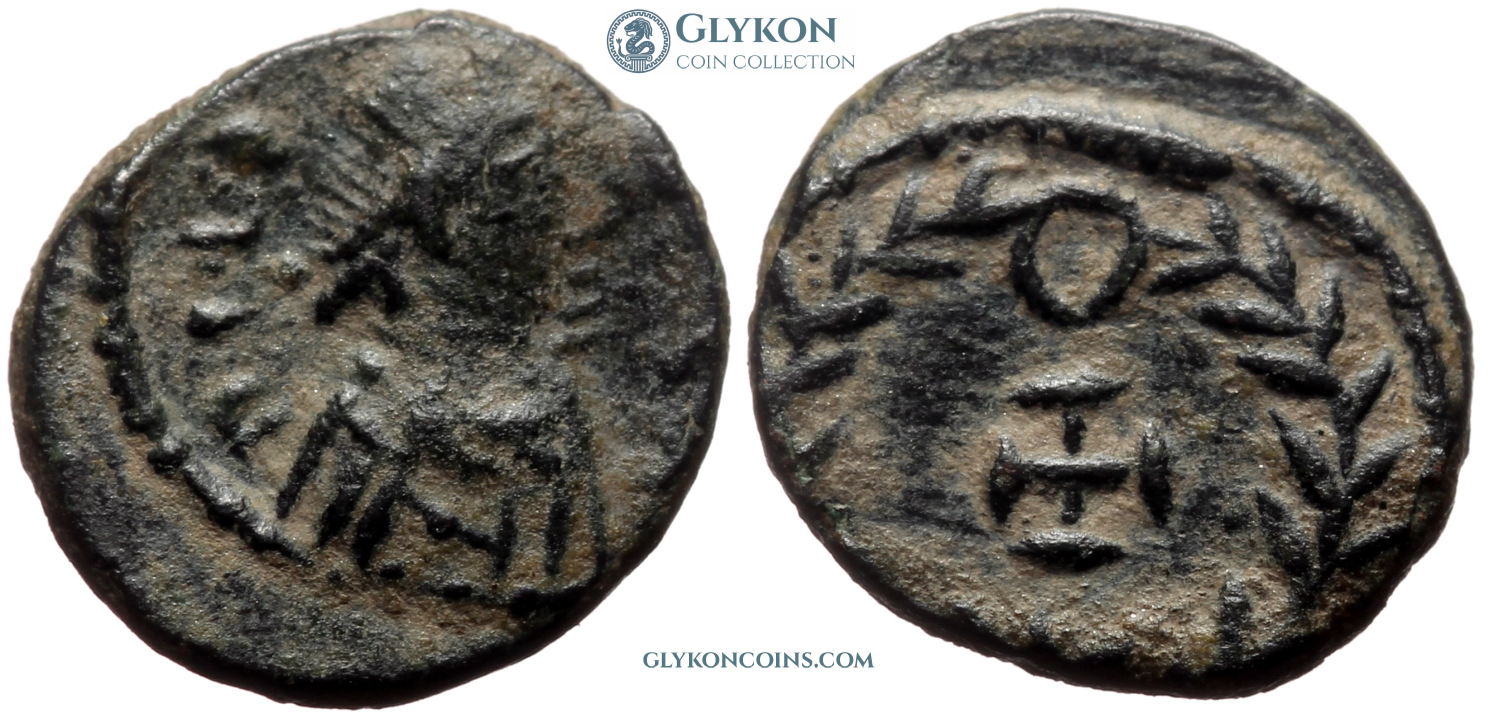
Hilderic, king of the Vandals (523-530 AD)
Denomination: nummus (AE4)
Mint: Carthage
Time: 523-530 AD
Weight: 0.62 g
Diameter: approx. 9.5 mm
Reference: BMC Vandals 9; MEC 1,24-25
Obverse: Draped, cuirassed, and pearl-diademed bust of Hilderic facing right. Legend: HILD REX
Reverse: Cross potent within a wreath with one circular ornament.
Comment: Out of many Barbarian kingdoms founded during the death throes of the Western Roman Empire, the Vandal kingdom was unique in its initial fierce independence, as it for a time did not recognize even symbolic sovereignty of the emperor from Constantinople. Nevertheless, as it conquered one of the heartlands of the Empire and was cut off from regular contact with other Germanic peoples, it became gradually Romanized and fell swiftly to the Byzantine reconquest in the 530s. It also minted coinage maintaining the old Roman, admittedly very disorganized, standards. This is because the economic and cultural unity of the Mediterranean world wasn't shattered until the advent of Islam. |
|
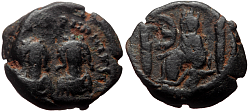 |
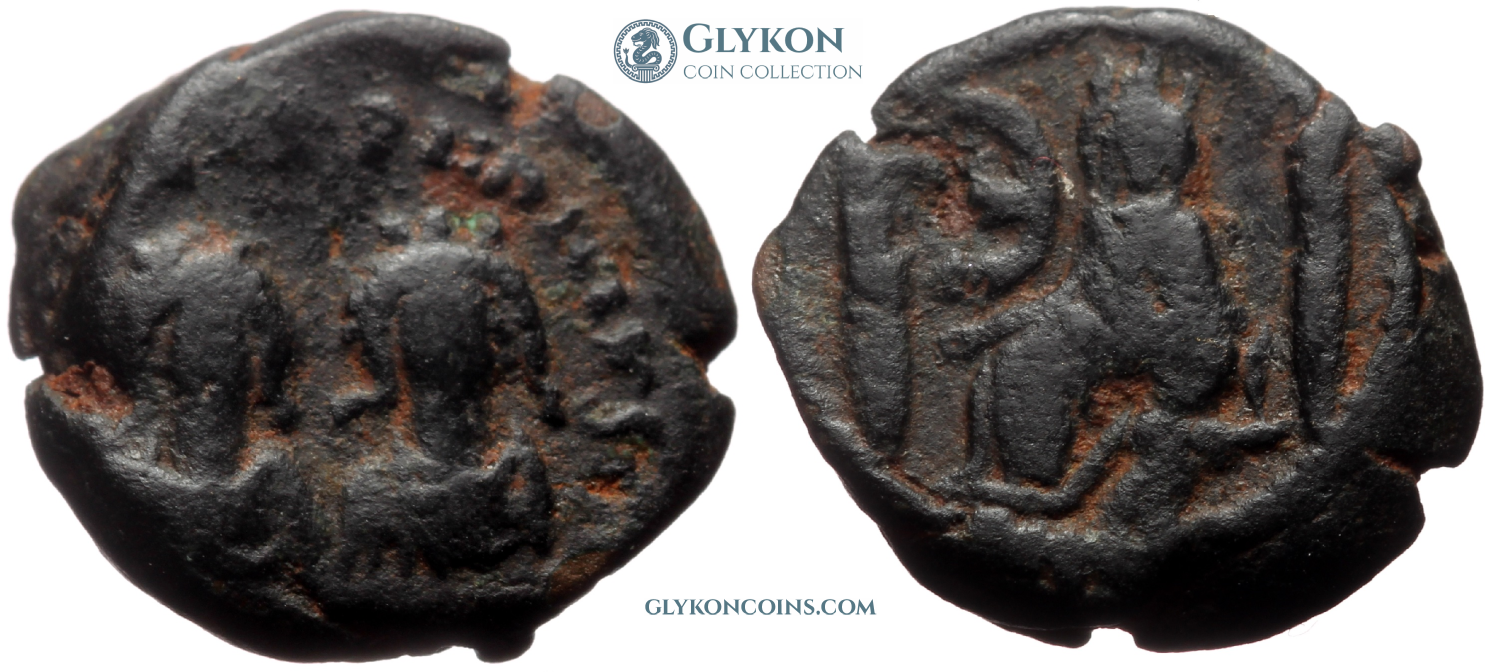
Justin I (518-527 AD)
Denomination: 5 nummi (pentanummium)
Mint: Antioch
Time: 518-527 AD
Weight: 1.86 g
Diameter: approx. 12.8 mm
Reference: Sear 133
Obverse: Facing pearl-diademed, draped and cuirassed busts of Justin and Justinian. Legend: DN IVSTINVS ET IVSTINIANVS PP AVG
Reverse: Crowned Tyche of Antioch seated facing left. River deity swimming towards right at her feet. On the left large ϵ indicating denomination of 5 nummi. All within a columned shrine.
Comment: Pretty remarkable that such pagan imagery was still appearing on coins so late into the Christian era. My only explanation is that it became so symbolic of the city of Antioch that it lost any religious meaning.
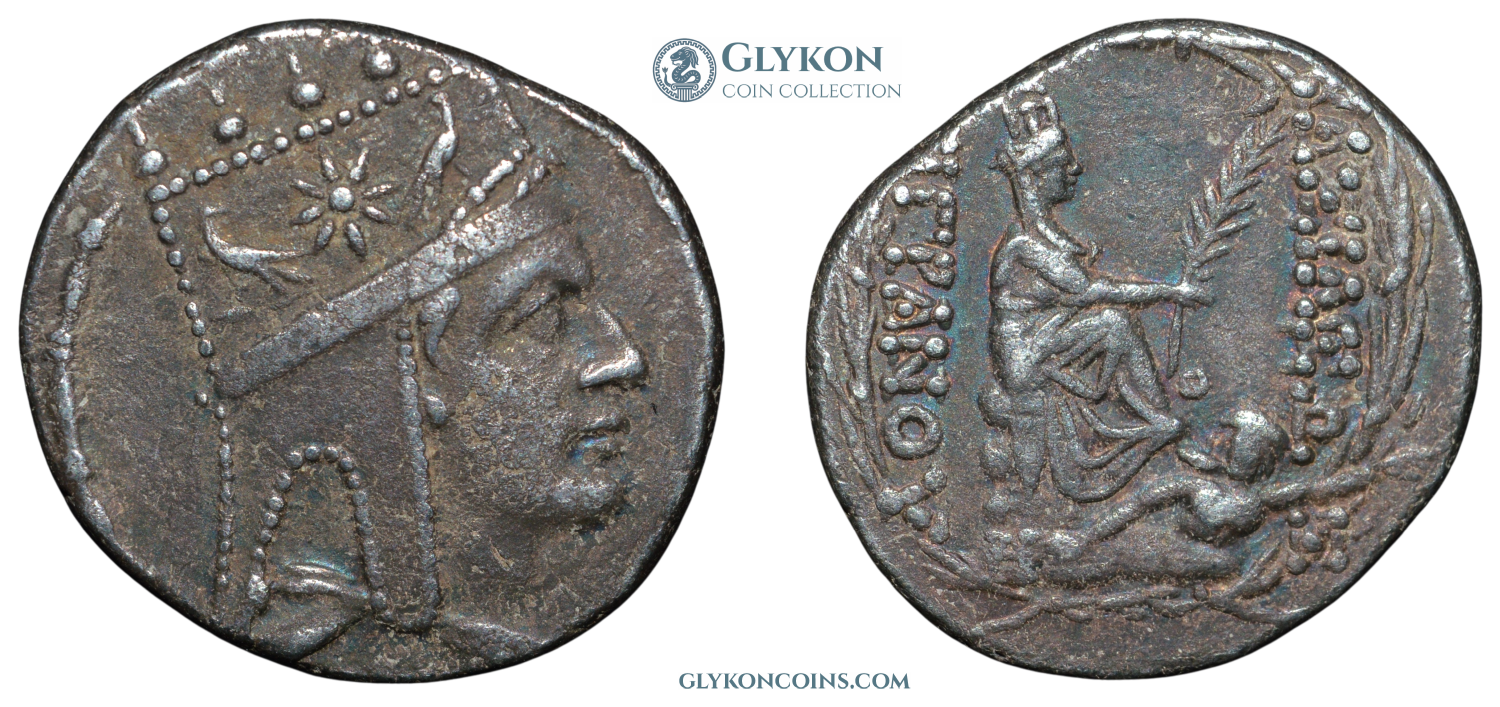
I don't see the river deity (Orontes?) being mentioned in any standard reference. However, the "object" below Tyche shows remarkable similarity to the Tyche+river god duo seen on so many coins from the Hellenistic and early Roman periods, including tetradrachms from the early Roman era or those minted by Tigranes the Great. |
|
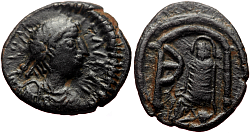 |
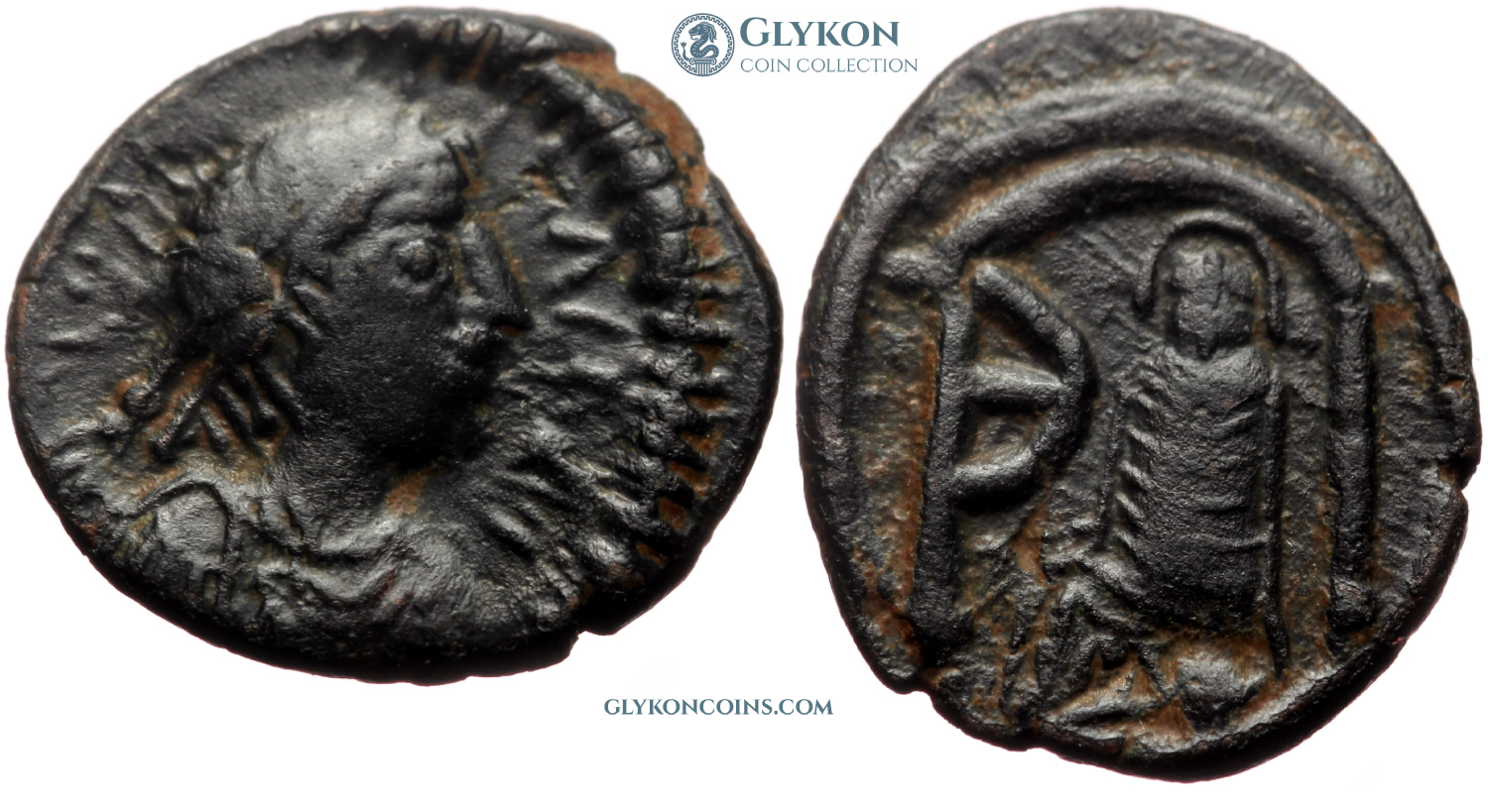
Justinian I the Great (527-565 AD)
Denomination: 5 nummi (pentanummium)
Mint: Antioch
Time: 527-565 AD
Weight: 1.60 g
Diameter: approx. 13.8 mm
Reference: Sear 240
Obverse: Draped, cuirassed, and pearl-diademed bust of Justinian facing right. Legend: DN IVSTINIANVS PP AVG
Reverse: Crowned Tyche of Antioch seated facing left. River deity swimming towards right at her feet. On the left large ϵ indicating denomination of 5 nummi. All within a columned shrine.
Comment: Perhaps the last Roman coin with pagan motifs. |
|
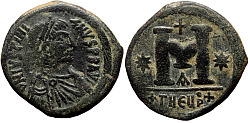 |
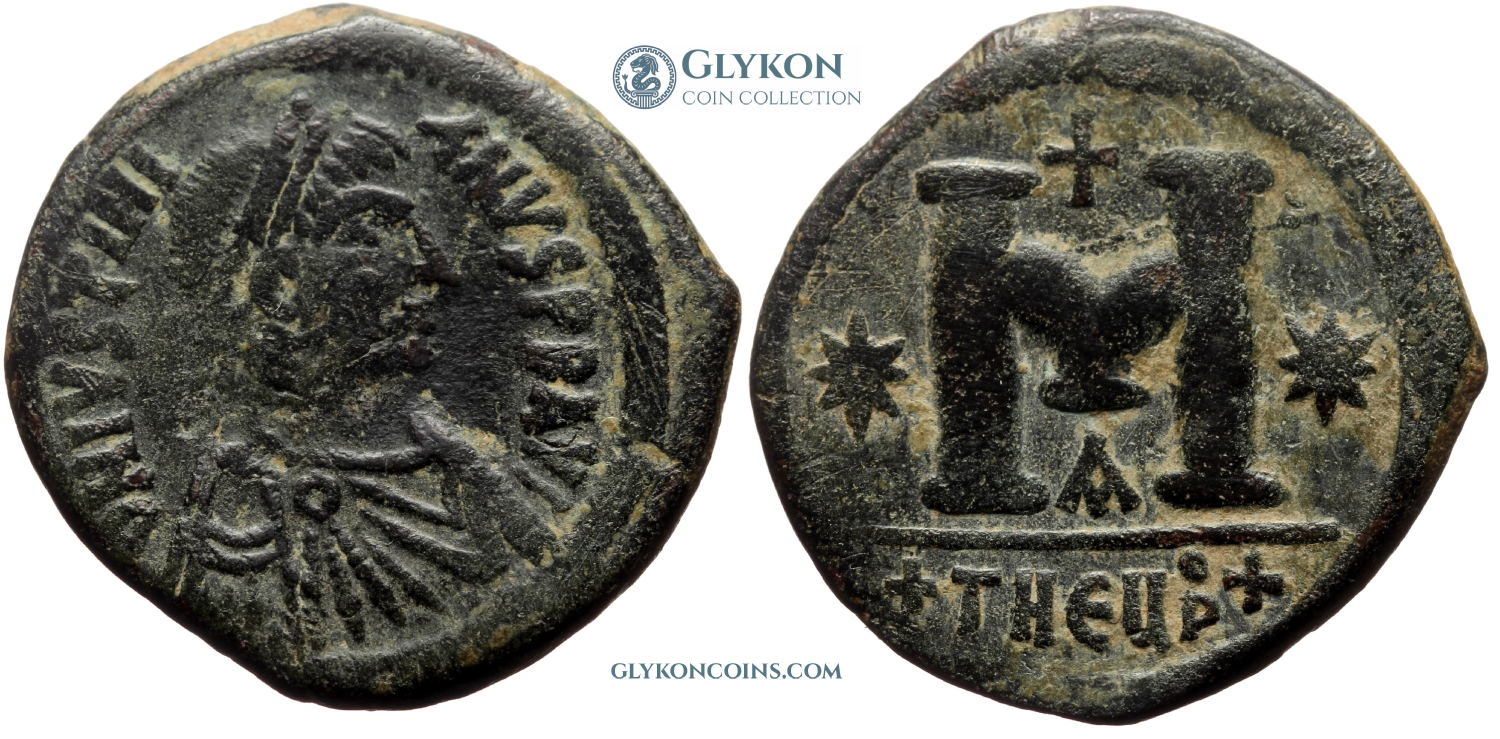
Justinian I the Great (527-565 AD)
Denomination: 40 nummi (follis)
Mint: Antioch
Time: 527-538 AD (before the regnal year reform of 538)
Weight: 14.94 g
Diameter: approx. 30.5 mm
Reference: Sear 216; DOC 210
Obverse: Draped, cuirassed, and pearl-diademed bust of Justinian facing right. Legend: DN IVSTINIANVS PP AVG
Reverse: Large M indicating denomination of 40 nummi flanked by two stars. Cross above, officina symbol A (first officina) below. +THЄuoP+ in exergue.
Comment: After a series of disasters, including earthquakes, the ancient metropolis of Antioch was rebuilt by Justinian at great expense and renamed Theopolis, literally the City of God. It didn't help much, as in 540 the city was struck by a devastating Persian raid, which resulted in the abduction of the bulk of the population. The name therefore didn't stick in common parlance and quickly fell out of use. Nevertheless, it continued to appear on coins as the official name until the Byzantine Empire lost the city during Heraclius' reign in the early 7th century. When the Empire reestablished direct control in the 10th century, the name Theopolis was not remembered anymore.
Also of note is that this coin is from before the reform of 538, which added the current emperor's regnal year to the coinage. |
|
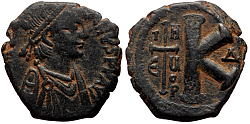 |
Justinian I the Great (527-565 AD)
Denomination: 20 nummi (half-follis)
Mint: Antioch
Time: 532-538 AD (before the regnal year reform of 538)
Weight: 10.13 g
Diameter: approx. 25.4 mm
Reference: Sear 226; DOC 211
Obverse: Draped, cuirassed, and pearl-diademed bust of Justinian facing right. Legend: DN IVSTINIANVS PP AVG
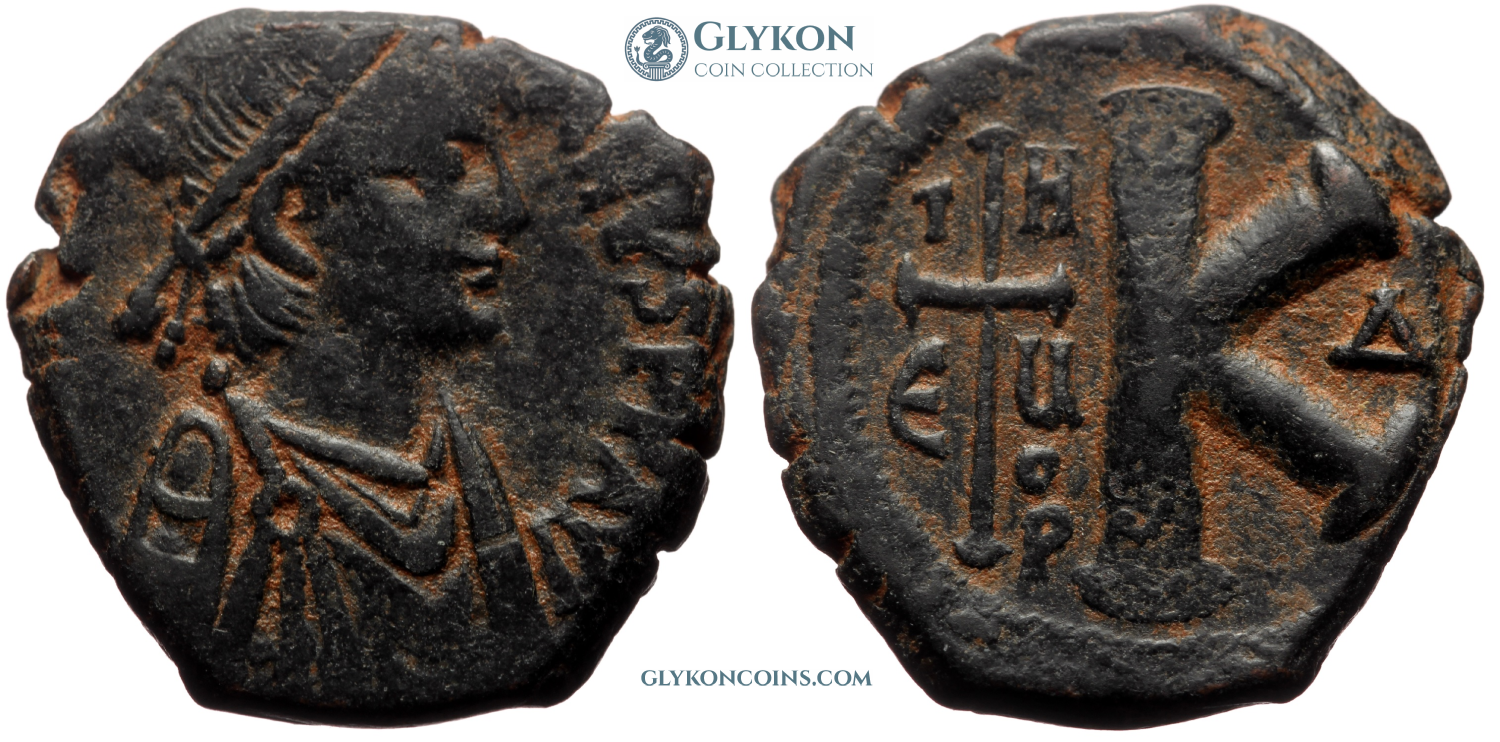
Reverse: On the left a large cross with T-H-Є-uOP in its four quarters. On the right a large K indicating denomination of 20 nummi. Officina symbol Δ. |
|
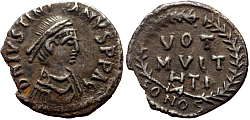 |
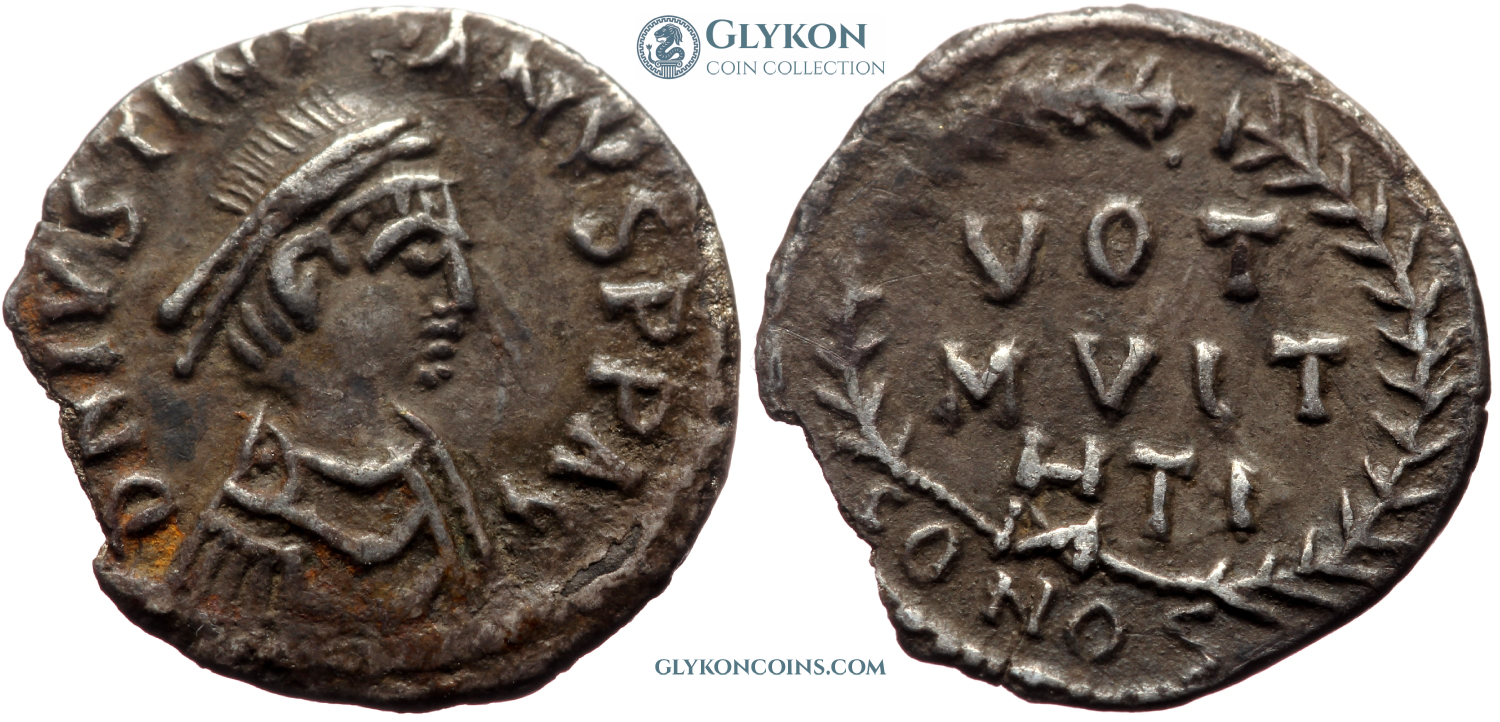
Justinian I the Great (527-565 AD)
Denomination: half-siliqua
Mint: Carthage
Time: 533-565 AD
Weight: 1.18 g
Diameter: approx. 14.7 mm
Reference: Sear 253; ex Platt 1972, Collection Murat, no. 94
Obverse: Draped, cuirassed, and pearl-diademed bust of Justinian facing right. Legend: DN IVSTINIANVS PP AG
Reverse: Within wreath: VOT MVLT HTC. Below mintmark CONOS
Comment: Although the Roman monetary system was no longer based on silver at the time, some silver coins traditionally referred to as siliquas and (for smaller types) half siliquas continued to be minted in relatively small quantities. It is suspected that these silver coins were produced for ceremonial, donative, or in response to some specific regional needs. This makes them relatively rare treats for collectors. |
|
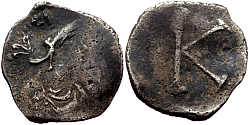 |
Justinian I the Great (527-565 AD)
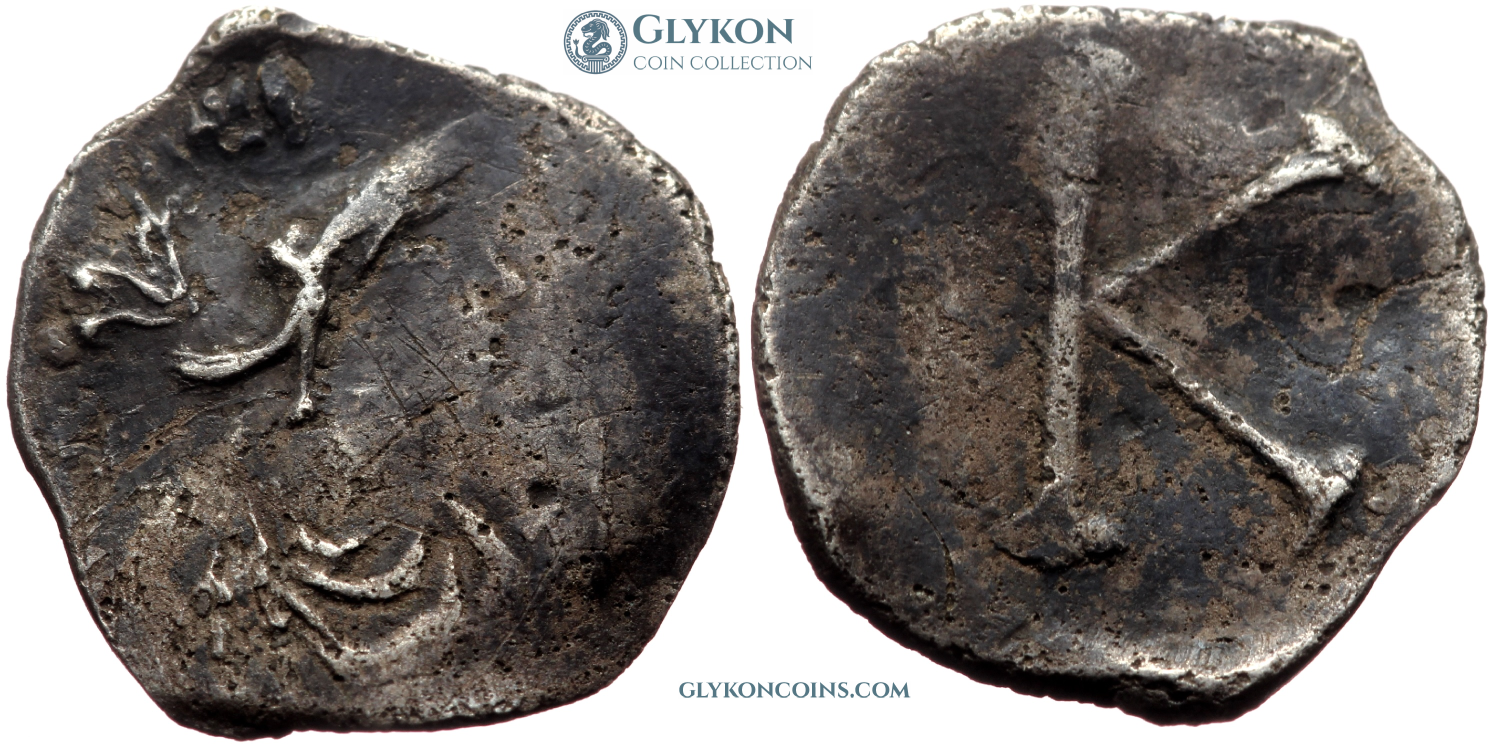
Denomination: so-called "Anonymous half-siliqua"
Mint: Constantinople
Time: about 530 AD
Weight: 0.98 g
Diameter: approx. 14.3 mm
Reference: Bendall Anonymous 8
Obverse: Draped, cuirassed, and helmeted bust of female figure, most likely personification of Constantinople. No legend.
Reverse: Letter K indicating value (?)
Comment: A coin from a very enigmatic series of tiny silvers from the reign of Justinian. Their exact purpose is debated, I personally lean to the theory that they were tokens or prizes given away to hoi polloi (Constantinopolitan pleb) during Hippodrome races and other celebrations. Letter K very likely indicates that the coin had a face value of a bronze half-follis. Or perhaps it could be redeemed for wares of such value. |
|
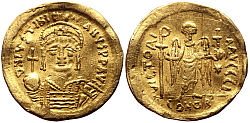 |
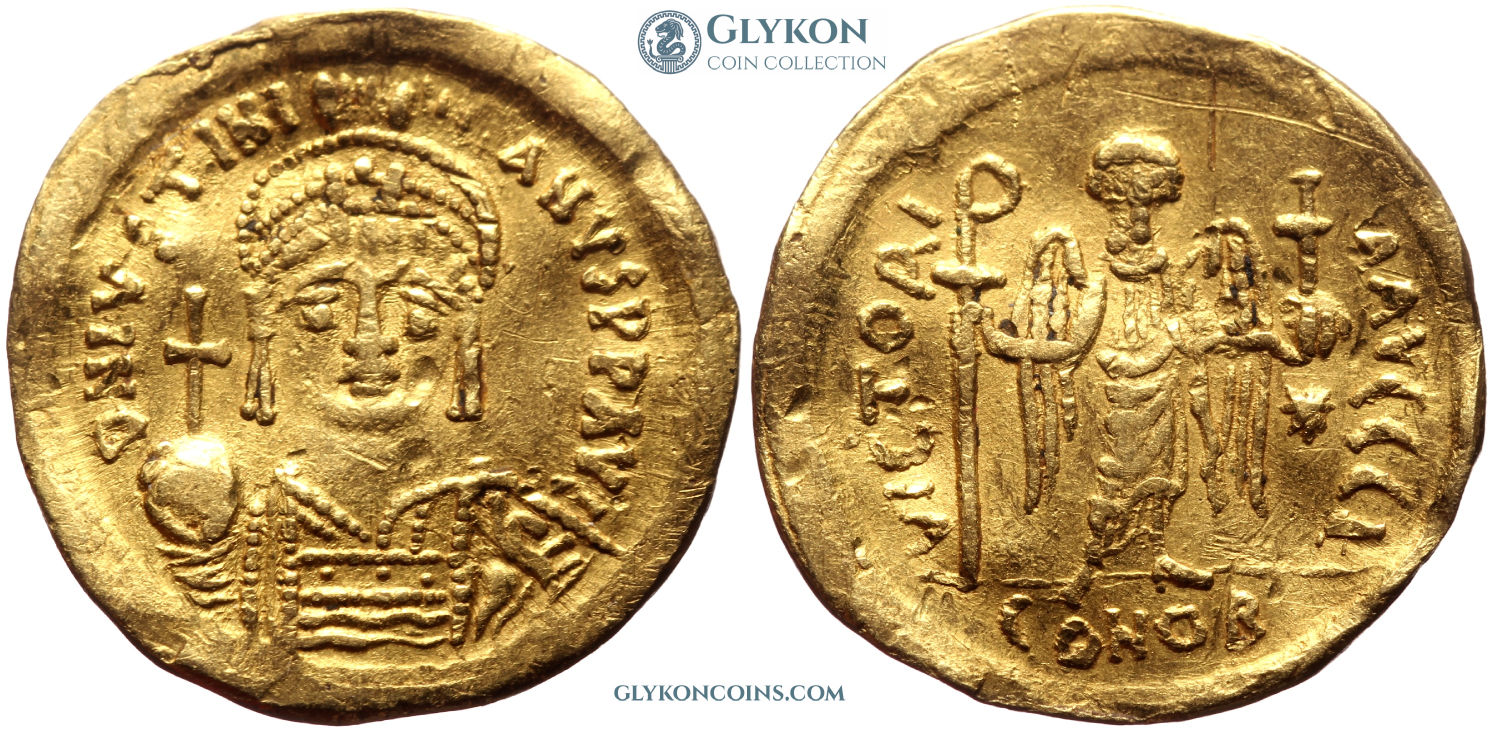
Justinian I the Great (527-565 AD)
Denomination: Solidus
Mint: Constantinople
Time: 528-538 AD
Weight: 4.43 g
Diameter: approx. 20.1 mm
Reference: Sear 139
Obverse: Facing bust, helmeted and cuirassed, wearing shield with equestrian motif on left shoulder, holding globus cruciger in right hand. Legend in bungled letters: DN IVSTINIANVS PP AVG
Reverse: Winged Victory standing facing, holding long Staurogram in right hand and globus cruciger in left hand, star on lower right below globus. Legend in bungled letters: VICTORIA AVGGG. Officina mark I. CONOB below in exergue. |
|
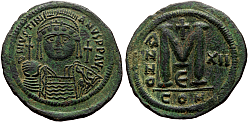 |
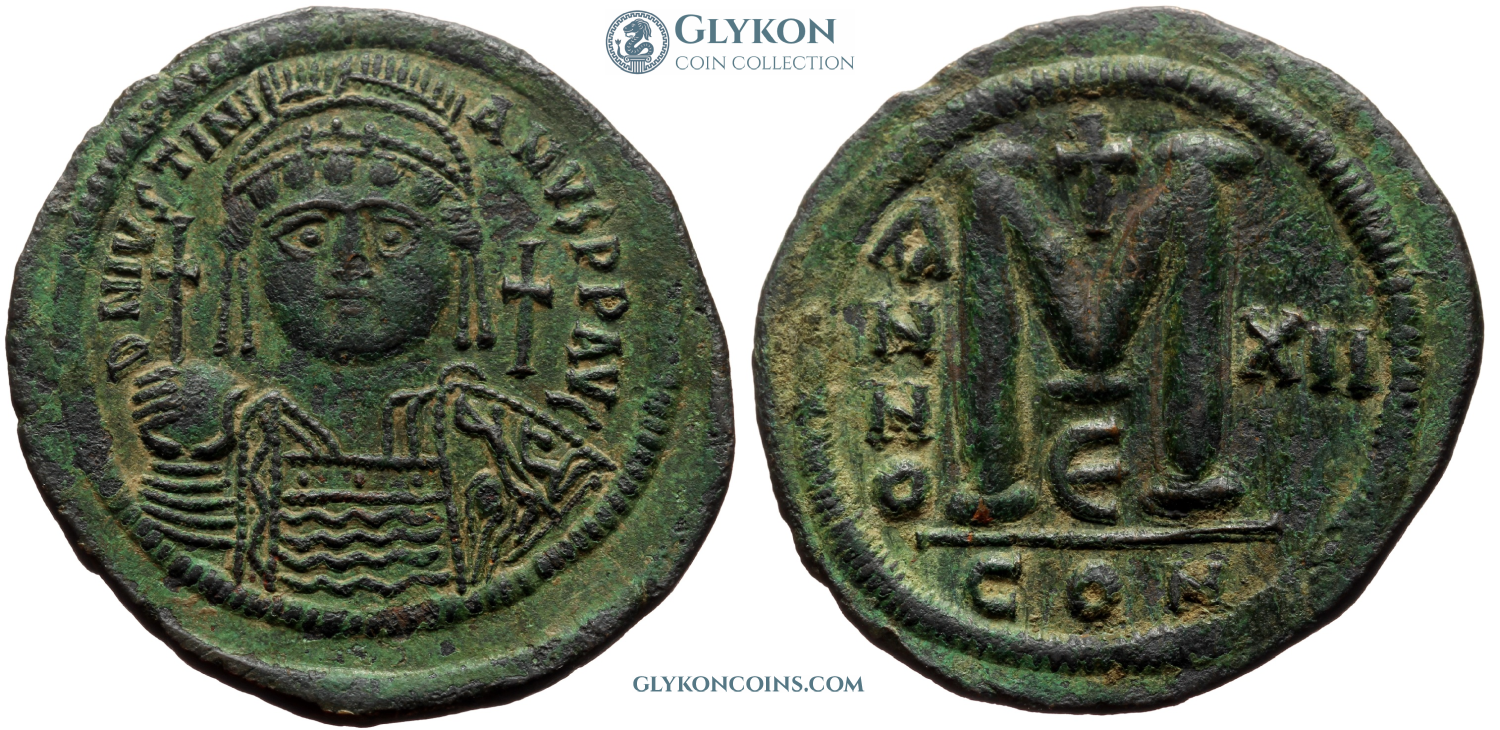
Justinian I the Great (527-565 AD)
Denomination: 40 nummi (follis)
Mint: Constantinople
Time: 538/9 AD (regnal year 12)
Weight: 22.96 g
Diameter: approx. 42.8 mm
Reference: Sear 163; DOC 37e; MIB 95a
Obverse: Facing bust of Justinian, helmeted and cuirassed, wearing shield with equestrian motif on left shoulder, holding globus cruciger in right hand. Cross to right. Legend: DN IVSTINIANVS PP AVG.
Reverse: Large M indicating denomination of 40 nummi. Cross above, officina symbol ϵ (fifth officina) below. Left and right ANNO and regnal year XII (12). CON below in exergue.
Comment: One of the most spectacular coins of late antiquity, if not of the entirety of ancient coinage. |
|
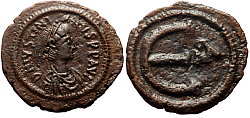 |
Justinian I the Great (527-565 AD)
Denomination: 5 nummi (pentanummium)
Mint: Constantinople
Time: 527-565 AD
Weight: 3.24 g
Diameter: approx. 20.5 mm
Reference: Sear 170; MIB 103
Obverse: Draped and diademed bust of Justinian facing right. Legend: DN IVSTINIANVS PP AVG.
Reverse: Large Є indicating denomination of 5 nummi. Officina symbol A to the right middle. |
|
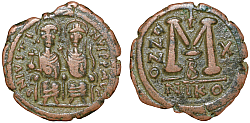 |
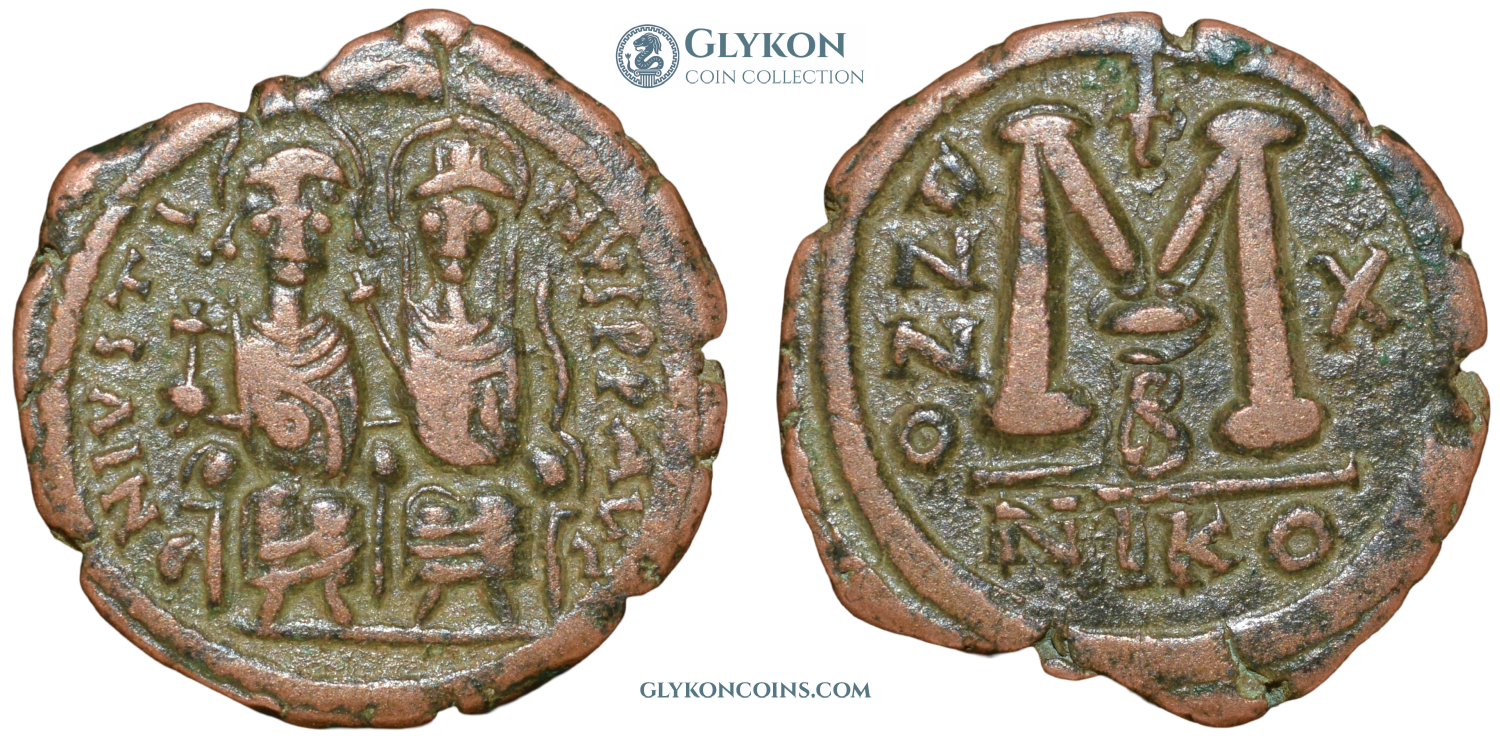
Justin II (565-578 AD) and Sophia
Denomination: 40 nummi (follis)
Mint: Nicomedia
Time: 574-575 AD
Weight: 12.63 g
Diameter: approx. 29.1 mm
Reference: Sear 369
Obverse: Justin (left) and Sophia (right) sitting enthroned, crowned and nimbated. Justin holding globus cruciger, Sophia holding a cross-tipped scepter. Legend: DN IVSTINVS PP AVG
Reverse: Large M indicating denomination of 40 nummi. Cross above, officina symbol B (second officina) below. ANNO on the left and regnal year X on the right. NIKO in exergue. |
|
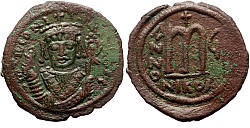 |
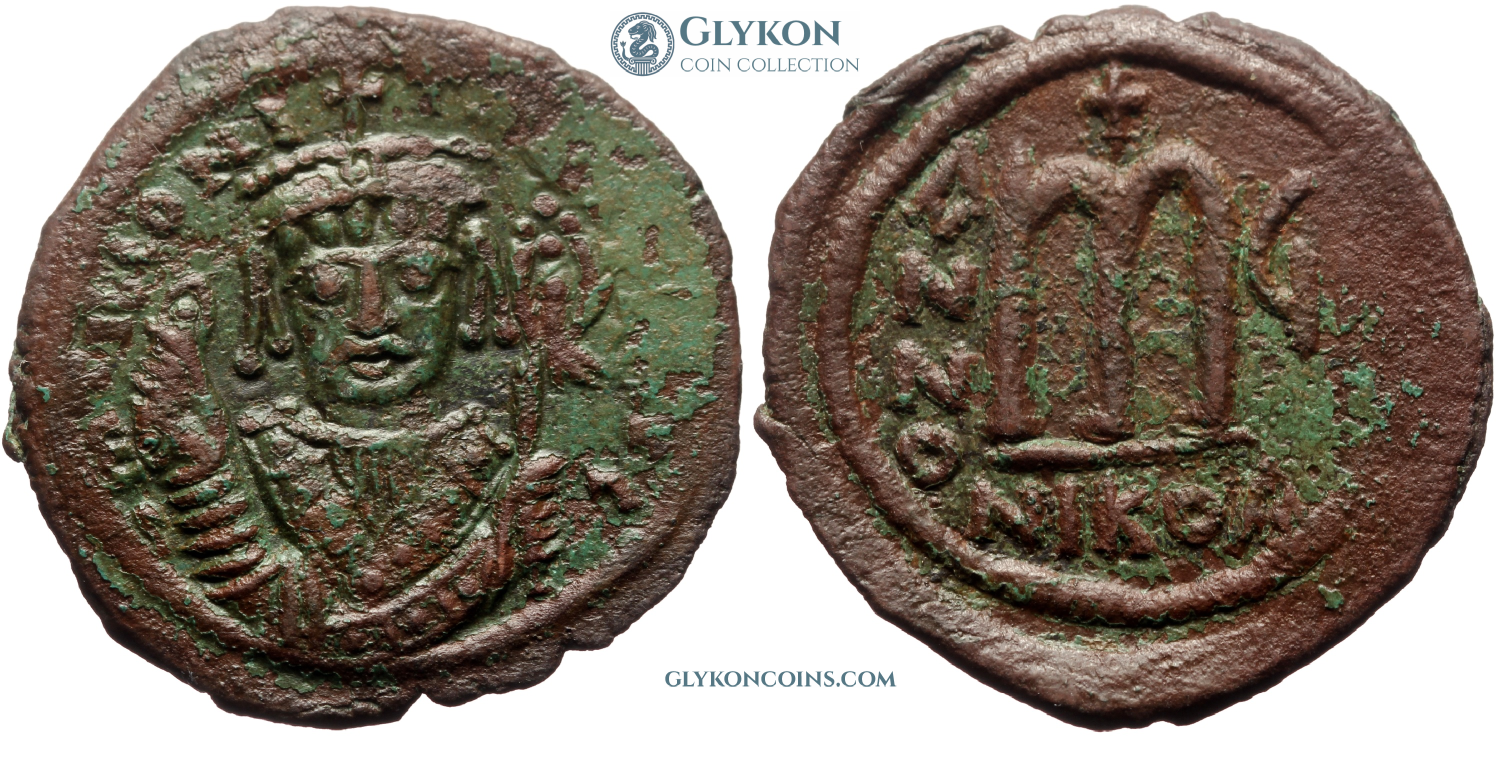
Tiberius II Constantine (578-582 AD)
Denomination: 40 nummi (follis)
Mint: Nicomedia
Time: 584-585 AD (7th year)
Weight: 11.72 g
Diameter: approx. 32.7 mm
Reference: Sear 441
Obverse: Facing, crowned bust of Tiberius in consular robes, holding mappa and eagle-tipped sceptre. A cross above the eagle. Legend in bungled letters: dN TIb CONSTANT PP AVG
Reverse: Large m (note the small letter) indicating denomination of 40 nummi. Cross above. Left and right ANNO and regnal year ζI (7th; not an error, the "I" is barely visible). Below in exergue NIKO and officina symbol A. |
|
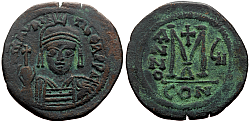 |
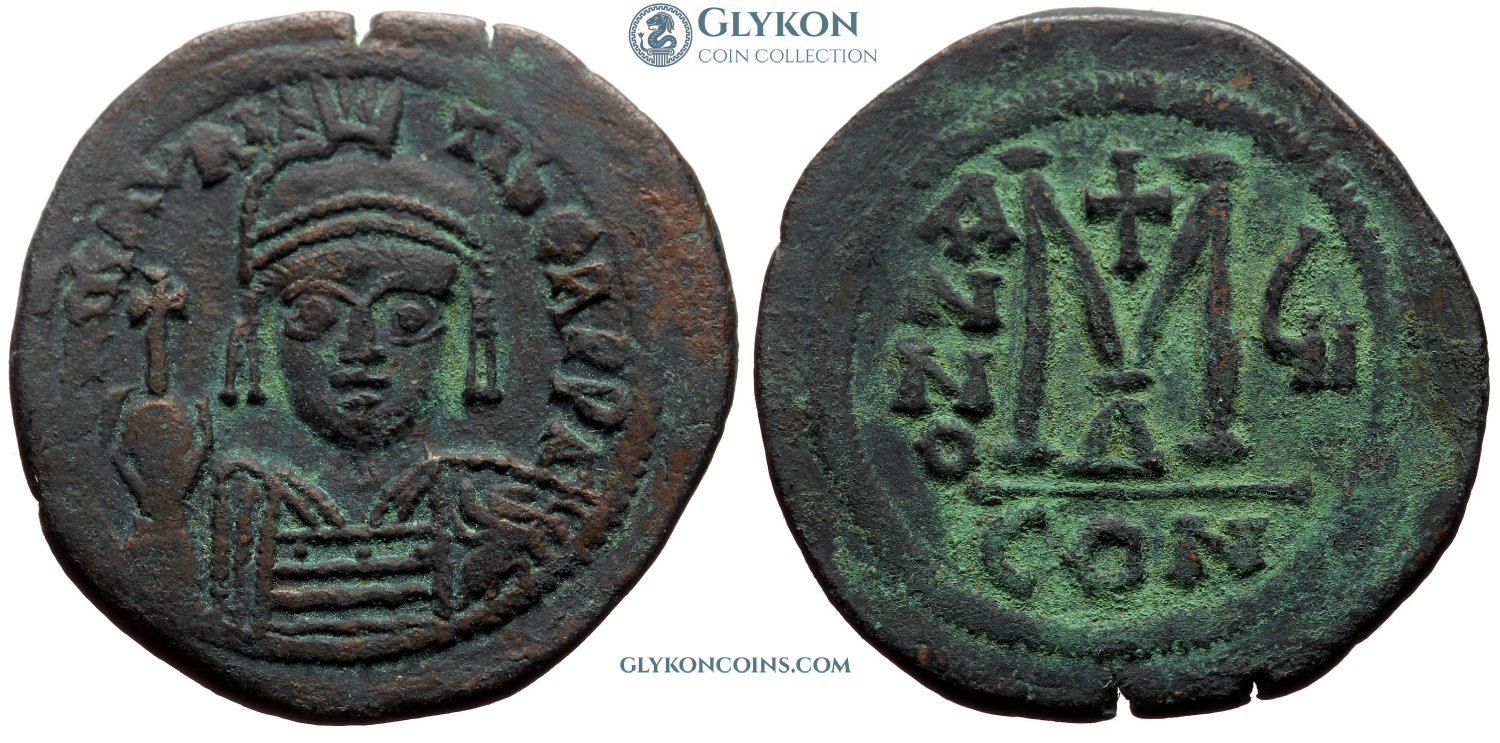
Maurice Tiberius (582-602 AD)
Denomination: 40 nummi (follis)
Mint: Constantinople
Time: 588/9 AD (regnal year 7)
Weight: 12.53 g
Diameter: approx. 32.7 mm
Reference: Sear 494
Obverse: Facing bust of Maurice Tiberius, helmeted and cuirassed, wearing shield with equestrian motif on left shoulder, holding globus cruciger in right hand. Legend in bungled letters: DN MAVRC TIBER PP A(VG).
Reverse: Large M indicating denomination of 40 nummi. Cross above, officina symbol Δ (fourth officina) below. Left and right ANNO and regnal year ζI (7). CON below in exergue. |
|
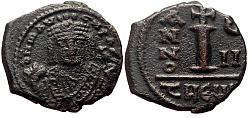 |
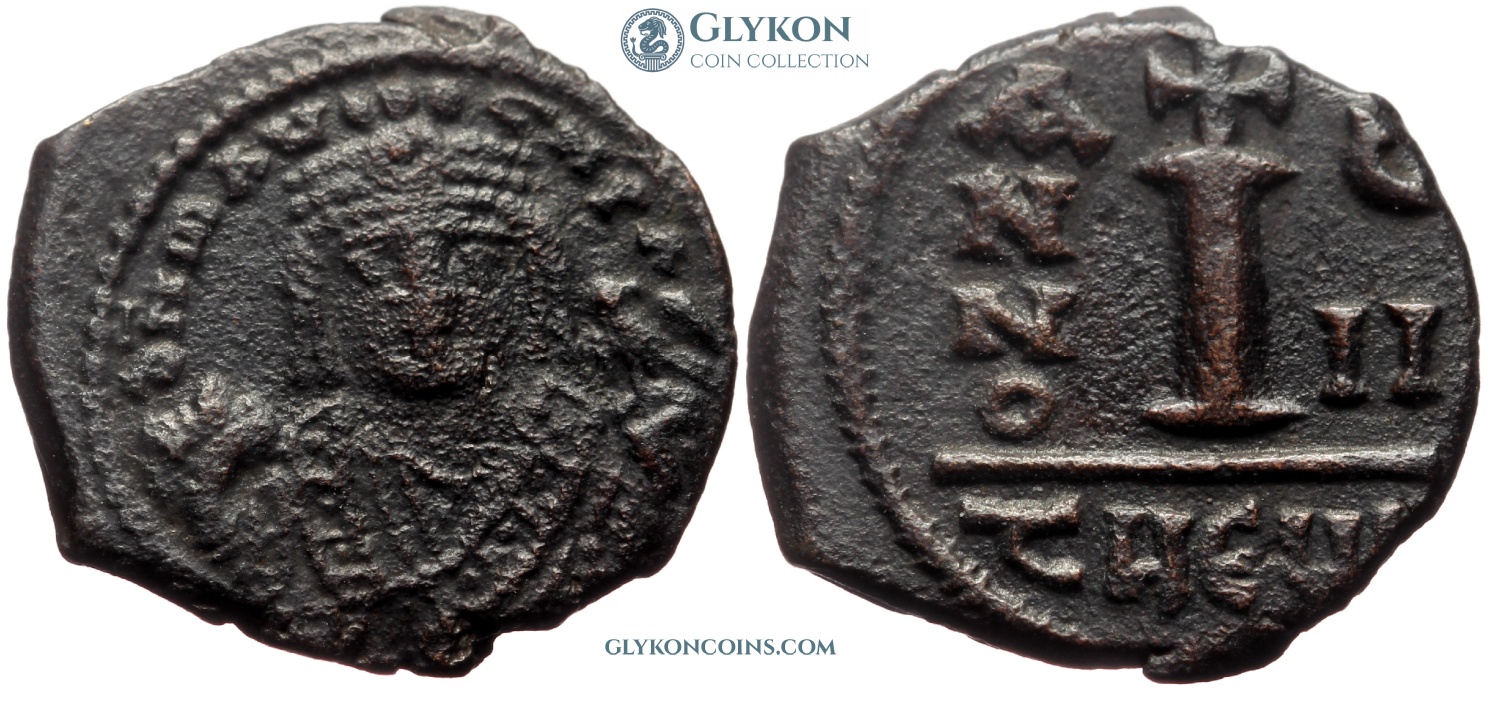
Maurice Tiberius (582-602 AD)
Denomination: 10 nummi (Decanummium)
Mint: Antioch
Time: 590/591 AD (regnal year 9)
Weight: 2.48 g
Diameter: approx. 16.3 mm
Reference: Sear 537
Obverse: Facing bust of Maurice Tiberius crowned and in consular robes, holding mappa and eagle-tipped scepter. Legend in bungled letters: dN MAV CN P AV
Reverse: Large I indicating denomination of 10 nummi, topped by a cross. Left and right ANNO and regnal year ζIII (9). tHЄVP below in exergue.
Comment: Sear lists no regnal years earlier than 9 for this type, so one "I" must have simple fell outside of the flan while striking.
Gorgeous tiny coin, the photo does not give it justice. |
|
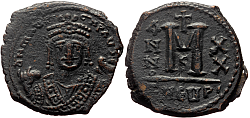 |
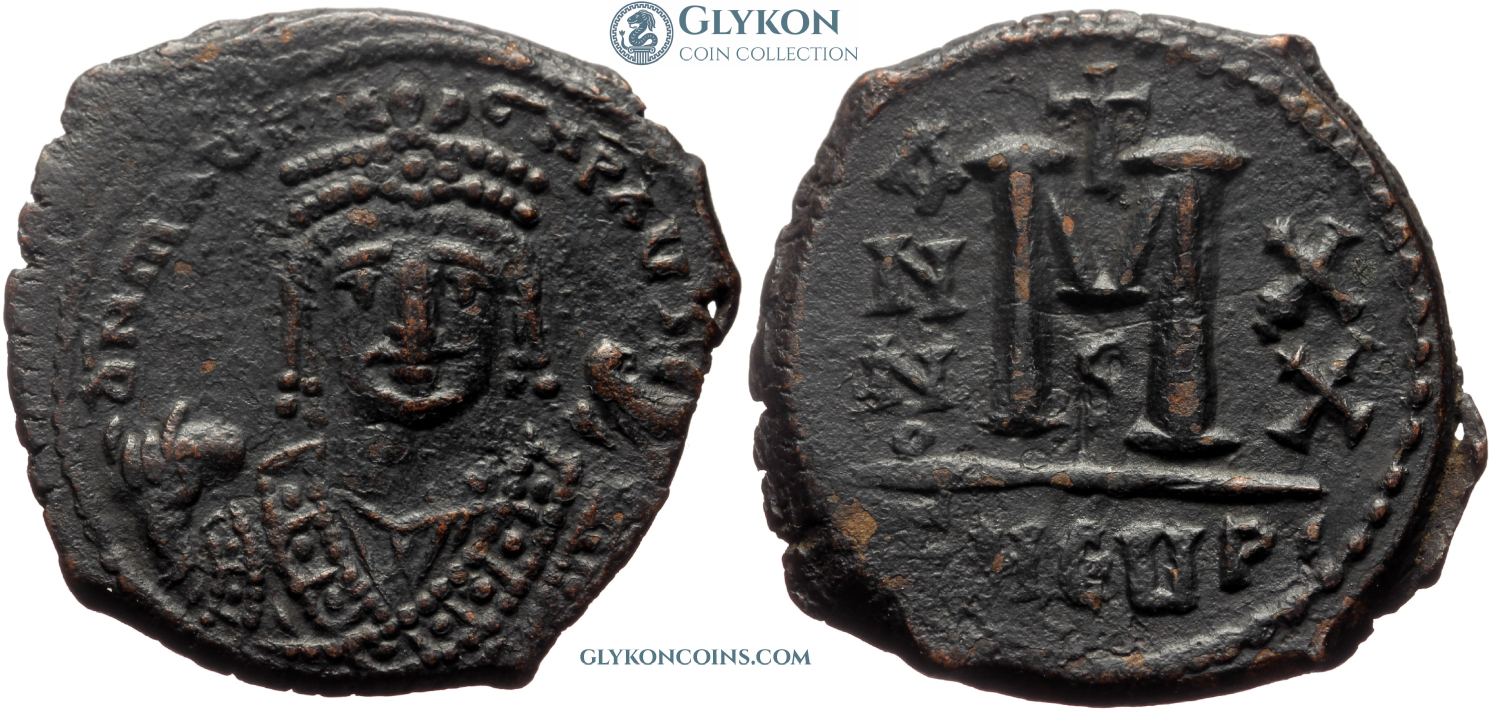
Maurice Tiberius (582-602 AD)
Denomination: 40 nummi (follis)
Mint: Antioch
Time: 601/602 AD (regnal year 20)
Weight: 11.16 g
Diameter: approx. 28.7 mm
Reference: Sear 533
Obverse: Facing bust of Maurice Tiberius crowned and in consular robes, holding mappa and eagle-tipped scepter. Legend in bungled letters: dN MAVΓI CN P AVG
Reverse: Large M indicating denomination of 40 nummi. Cross above, officina symbol S below. Left and right ANNO and regnal year XX. tHЄVP below in exergue. |
|
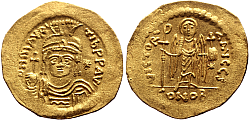 |
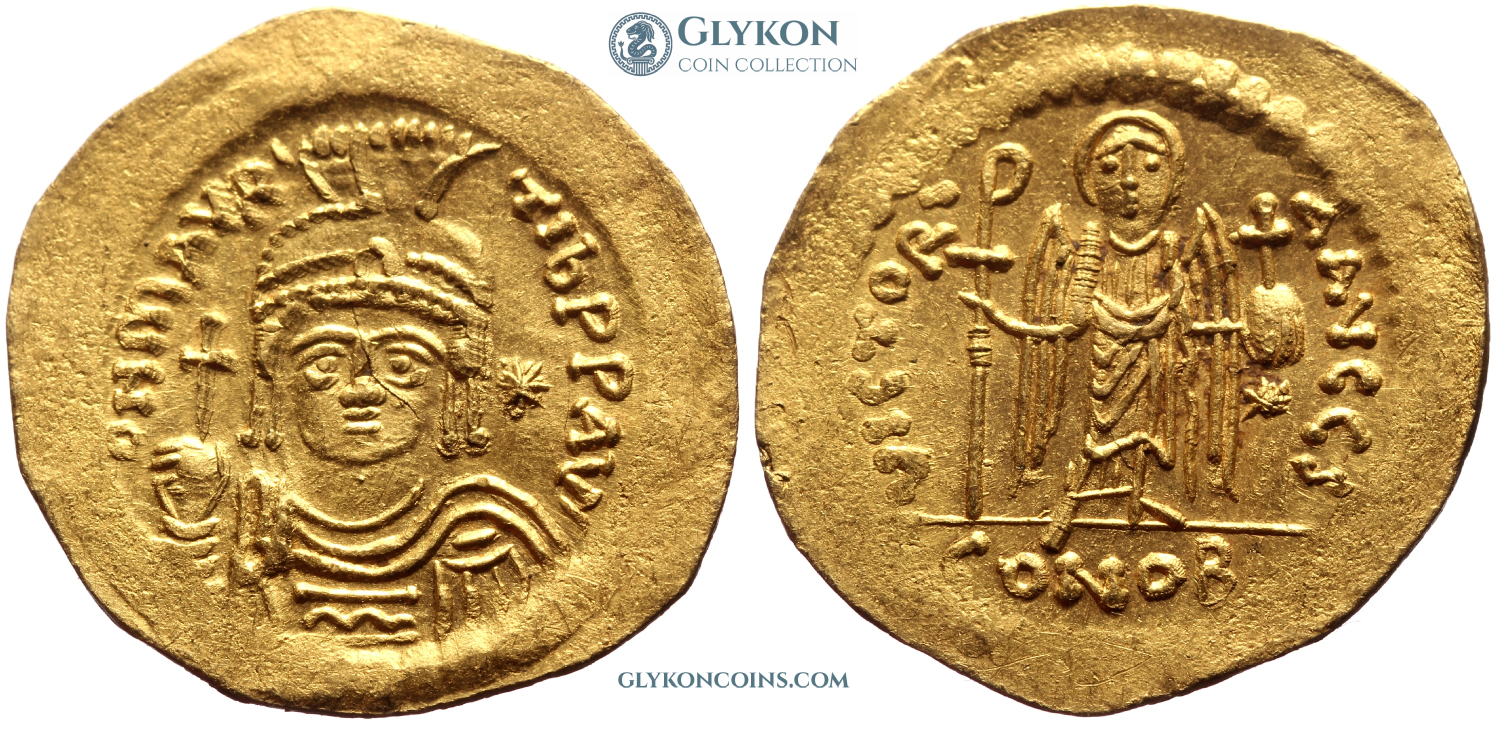
Maurice Tiberius (582-602 AD)
Denomination: Solidus (lightweight)
Mint: Constantinople
Time: 582-602 AD
Weight: 4.27 g
Diameter: approx. 22.9 mm
Reference: Sear 481
Obverse: Facing bust, helmeted and cuirassed with high plume, holding globus cruciger in right hand. Star over left shoulder. Legend in bungled letters: dN MAVRC TIb PP AVG.
Reverse: Winged Victory standing facing, holding long Staurogram in right hand and globus cruciger in left hand, star on lower right below globus. Legend in bungled letters: VICTORIA AVGG. Officina mark C. CONOB below in exergue. |
|
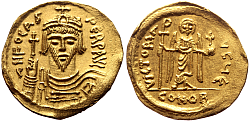 |
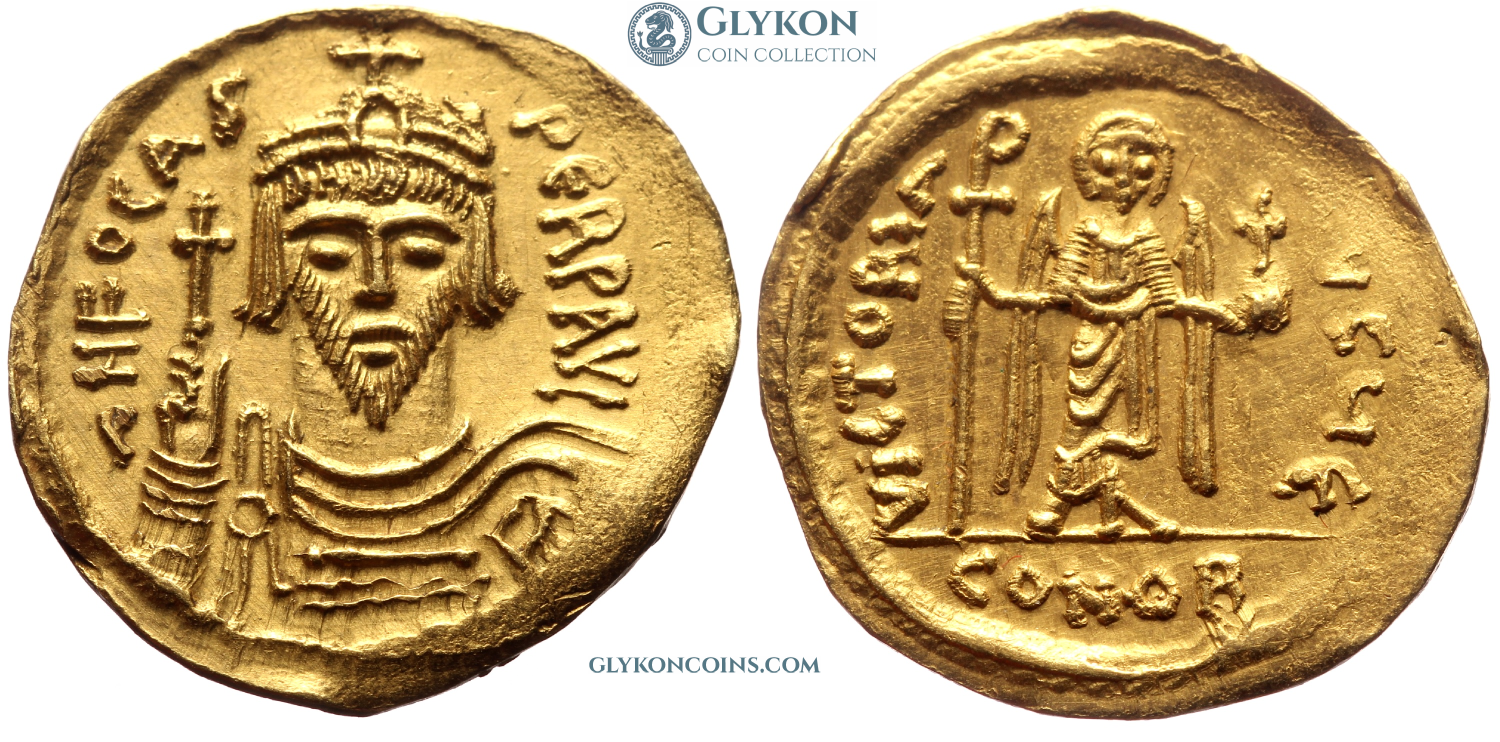
Phocas (602-610 AD)
Denomination: Solidus
Mint: Constantinople
Time: 602-610 AD
Weight: 4.11 g
Diameter: approx. 20.2 mm
Reference: Sear 620
Obverse: Facing bearded bust, cuirassed and wearing crucigerous crown, holding cross in right hand. Legend in bungled letters: dN FOCAS PERP AVG.
Reverse: Winged Victory standing facing, holding long Staurogram in right hand and globus cruciger in left hand. Legend in bungled letters: VICTORIA AVGU. Officina mark ε. CONOB below in exergue. |
|
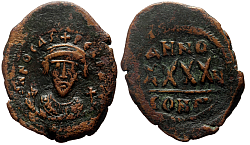 |
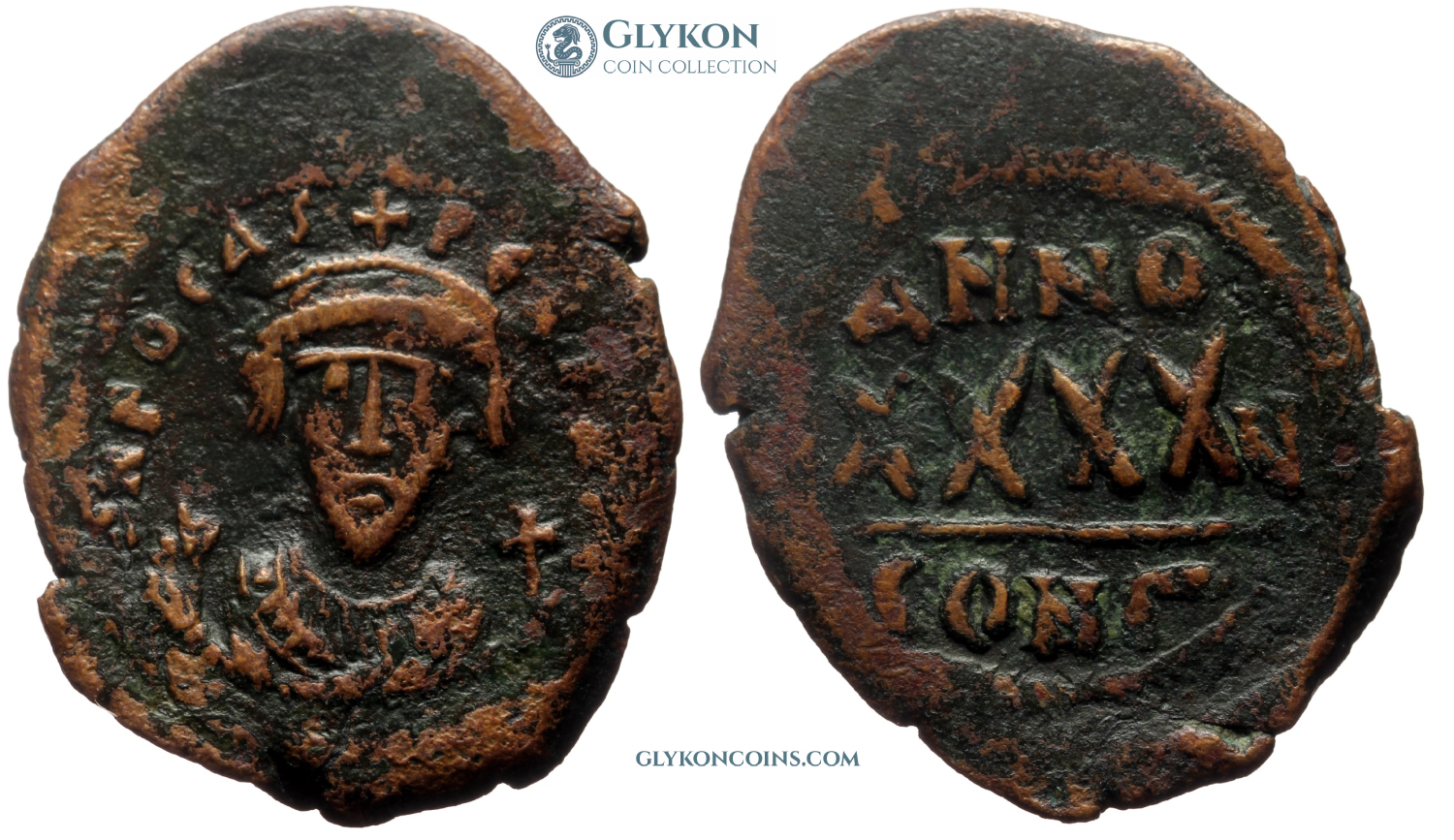
Phocas (602-610 AD)
Denomination: 40 nummi (follis)
Mint: Constantinople
Time: 608/609 AD
Weight: 9.95 g
Diameter: approx. 34.3 mm
Reference: Sear 640
Obverse: Facing bearded bust in consular robes, wearing crucigerous crown, holding mappa and cross. Additional cross on the right. Legend in bungled letters: dn FOCAS PF AVG.
Reverse: ANNO, below: XXXX (value) and ϛ (regnal year 6). Below in exergue CON (Constantinople mint) and Γ (officina mark).
Comment: Phocas is an interesting character. In many ways he was the closing figure of Late Antiquity, presiding over the very last years in which the Empire still resembled something that ancient Greeks and Romans would find familiar. The chaotic years that followed thoroughly changed the social, religious, and economic fabric of the Mediterranean world, with the collapse of long-distance trade, depopulation of cities, and the rise of Islam.
Phocas rather unexpectedly seized the throne, as he was a mid-ranking officer in the East Roman army, most likely a centurion. He rose among his fellow soldiers as spokesman to voice their grievances. Despite those grievances being justified - a fact attested even by sources hostile to Phocas - he and other soldiers were treated abusively by the shrewd but extremely parsimonious Emperor Maurice. For example, despite pleas and protests, Maurice refused to ransom a large group of soldiers taken prisoner by the Avars, which resulted in all of the prisoners being executed. When the army finally rebelled, Phocas emerged as the natural leader of the mutineers, marched on Constantinople, and seized the throne after brutally executing Maurice and his sons.
What happened next is a matter of dispute. Phocas is described by later sources as a ravenous tyrant, almost a beast in human skin. The Empire supposedly nearly collapsed under his terror and under foreign invasions, to which Phocas allegedly opened all gates. Then the savior emerged in the person of Heraclius, who finally deposed and executed the tyrant, capturing the throne for himself. Whether that narrative is true is debatable, but we must remember that all surviving sources on Phocas were written after his death, and Heraclius and his heirs had a strong interest in justifying the usurpation, especially in light of their less-than-stellar performance in wars against the Persians and later the Arabs.
What’s certain now is that, despite wars on all fronts, the borders held firm until after Phocas’ deposition and death. Also interesting is the fact that in the city of Rome, where the Heraclian grip was tenuous, the Column of Phocas survived. It’s not at all surprising that the column was erected - after all, every ruler loves monuments to their glory. What’s interesting is that it wasn’t torn down, coincidentally in the very place where Heraclius’ authority and reach were the weakest. |
|
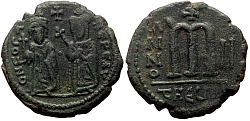 |
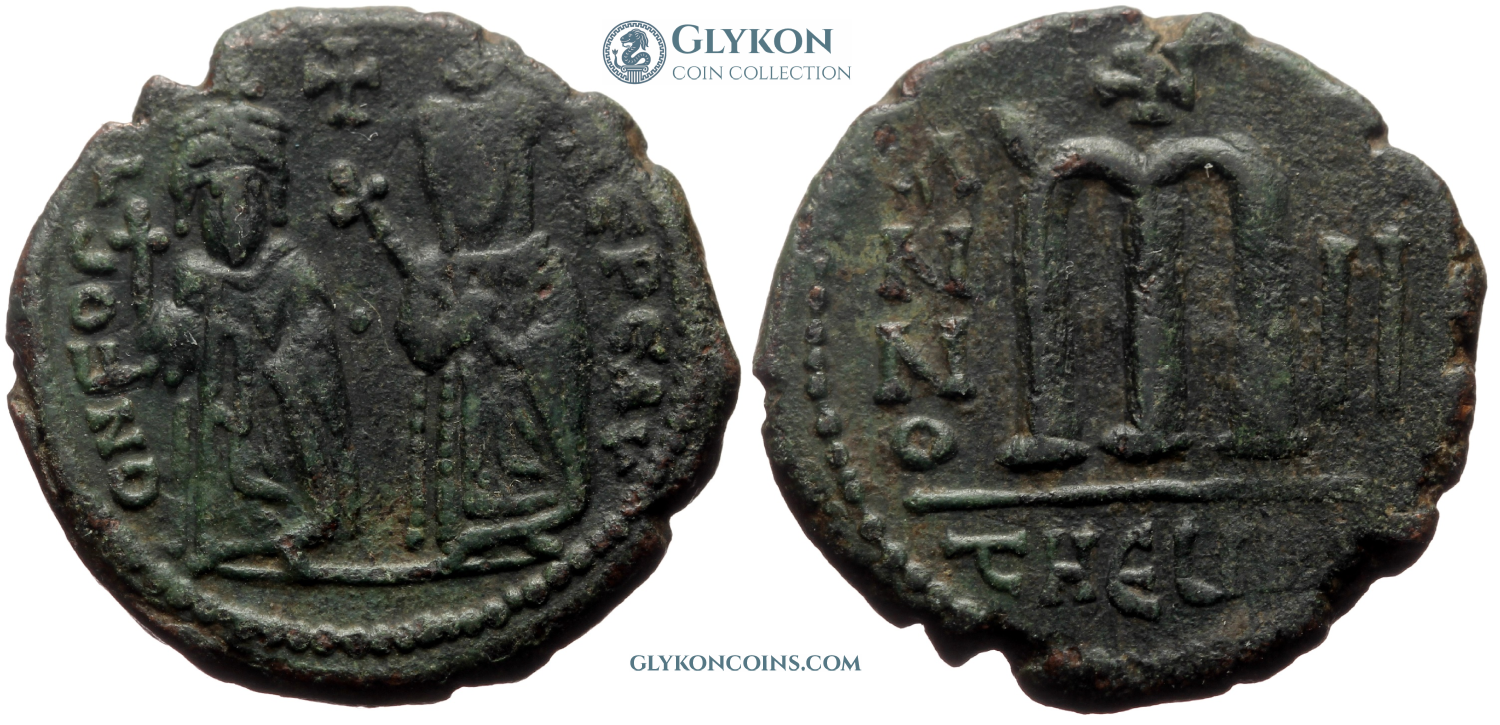
Phocas (602-610 AD)
Denomination: 40 nummi (follis)
Mint: Antioch
Time: 603/604 AD
Weight: 10.05 g
Diameter: approx. 26.5 mm
Reference: Sear 671
Obverse: Facing standing figures of Phocas, crowned, wearing chlamys and holding globus cruciger and his wife Leontia, crowned, robed and holding a cros-topped scepter. Cross above. Pellet between the figures. Legend in bungled letters: dN FOCA NЄ PЄ AV.
Reverse: Large m indicating denomination of 40 nummi. Cross above. Left and right ANNO and regnal year II. tHЄuP' below in exergue. |
Spotted an error, misattribution, or a forgery? Please contact me!
|